
Every cryptocurrency other than Bitcoin falls under the altcoin umbrella, yet stablecoins behave so differently from the rest that the market treats them as their own category. Understanding the stablecoin vs altcoin distinction matters whether you’re making payments, staking tokens, or holding digital assets long term. The split comes down to price behavior, backing mechanisms, and what each type is built to do.
What is a stablecoin and what is an altcoin?
An altcoin, a blend of “alternative” and “coin,” is any cryptocurrency other than Bitcoin. Bitcoin is excluded from the label by convention because it’s the original blockchain asset, the baseline everything else is measured against. With a capped supply of 21 million coins and no central issuer, Bitcoin operates as a decentralized store of value. As of 2026, Bitcoin’s market capitalization sits near $2 trillion.
Altcoins make up a broad and varied group. They include layer-1 blockchain tokens, governance tokens, utility tokens, and meme coins. As of 2025, altcoins accounted for roughly 44% of the global crypto market.
Stablecoins are digital assets engineered to minimize price volatility by pegging their market value to an external reference, usually a fiat currency like the U.S. dollar but sometimes a commodity like gold. Their collective market value crossed $300 billion as of 2026.
Here’s where the taxonomy gets interesting: stablecoins are technically a subset of altcoins, since they aren’t Bitcoin. But their purpose is so different, keeping a steady price rather than chasing growth, that exchanges, data aggregators, and regulators all separate them out. When someone says “altcoin,” they almost never mean a stablecoin. When you see a stablecoin vs altcoin comparison, you’re really looking at stability-focused digital dollars versus everything else in the non-Bitcoin crypto world.
How stablecoin prices stay pegged
Stablecoins don’t hold their peg by accident. Each type uses a specific mechanism to keep its market price close to the target value.
Fiat-pegged stablecoins are the most straightforward. The issuer holds cash or cash equivalents for every token in circulation. USDC, for example, is collateralized by cash and short-term U.S. government securities. When the market price drifts above or below the peg, traders can redeem tokens for the underlying reserves (or mint new tokens by depositing fiat). That redemption mechanism creates an arbitrage loop: if USDC trades at $0.99, arbitrageurs buy it cheap and redeem it for $1.00 worth of reserves, pocketing the difference and pushing the price back up. The same loop works in reverse when the price rises above $1.00.
Crypto-collateralized stablecoins take a different approach. DAI is minted by locking ETH (or other accepted crypto assets) in a smart contract with an overcollateralization ratio. Because the collateral itself is volatile, borrowers must deposit more value than the stablecoins they receive. If the collateral’s value drops too far, the smart contract liquidates it automatically to protect the peg. This model is more decentralized than fiat-backed coins, but it ties up more capital.
Algorithmic stablecoins attempt to maintain stability through automated supply adjustments instead of real collateral. When the price falls below the peg, the protocol contracts the supply; when it rises, the protocol expands it. The problem is that this model depends entirely on market confidence. Under stress, confidence can evaporate faster than the algorithm can respond. The Terra/UST collapse in 2022 showed exactly how this plays out: UST lost its dollar peg, triggered a death spiral in the linked LUNA token, and wiped out tens of billions in value within days. That failure stands as the clearest warning that algorithmic designs without redeemable backing are fragile when they’re needed most.
How altcoin prices are determined
Altcoin prices are set by open-market supply and demand. There’s no peg, no reserve vault, and no redemption mechanism pulling the price back to a fixed number. What buyers are willing to pay, and what sellers are willing to accept, is the price.
Several forces move that price. Network adoption is one of the strongest: when more people use a layer-1 blockchain, demand for its native token rises because every transaction, smart contract call, and dApp interaction requires that token for fees. Regulatory news can push prices sharply in either direction, and technological upgrades (or failures) change how the market values a project’s future.
Large-cap altcoins tend to be less volatile than small-cap ones simply because deeper liquidity absorbs buying and selling pressure more smoothly. A token with billions in daily trading volume won’t swing as hard on a single large order as one with a few million.
Meme coins sit at the far end of the volatility spectrum. Tokens like Dogecoin and Shiba Inu aren’t built around a technical breakthrough or a specific utility. They’re driven by community hype and public sentiment. A viral social media moment can send a meme coin surging; a shift in attention can collapse it just as fast. Without underlying business fundamentals, the value of any altcoin ultimately rests on what the next buyer will pay.
Key differences between stablecoins and altcoins
| Feature | Stablecoins | Altcoins |
|---|---|---|
| Price behavior | Move fractions of a cent around the peg (typically $1.00 for USD-pegged coins) | Can swing 5 to 10% or more in a single week |
| Primary purpose | Medium of exchange and store of value during market volatility | Governance, utility, network access, or speculative growth |
| Revenue potential | Not designed for capital appreciation | Can deliver large gains or large losses |
| Collateral structure | Backed by fiat reserves, crypto collateral, or algorithmic mechanisms | Backed only by project value and market demand |
| Regulatory treatment | Increasingly covered by specific frameworks (MiCA in the EU, GENIUS Act in the U.S.) | Often face ambiguity; some may be classified as securities |
| Transaction role | Settlement layer and bridge between fiat and crypto | Pay gas fees, stake, govern protocols, or access services |
The transaction volume gap is striking. Stablecoin gross transaction flows reached $46 trillion globally in 2025, and stablecoins account for over 90% of all on-chain transactions per industry estimates. That dominance reflects their role as the default settlement currency across DeFi and centralized exchanges alike.
Types of altcoins
Altcoins break into several functional categories, each serving a different role as distinct cryptocurrency types in the broader crypto market.
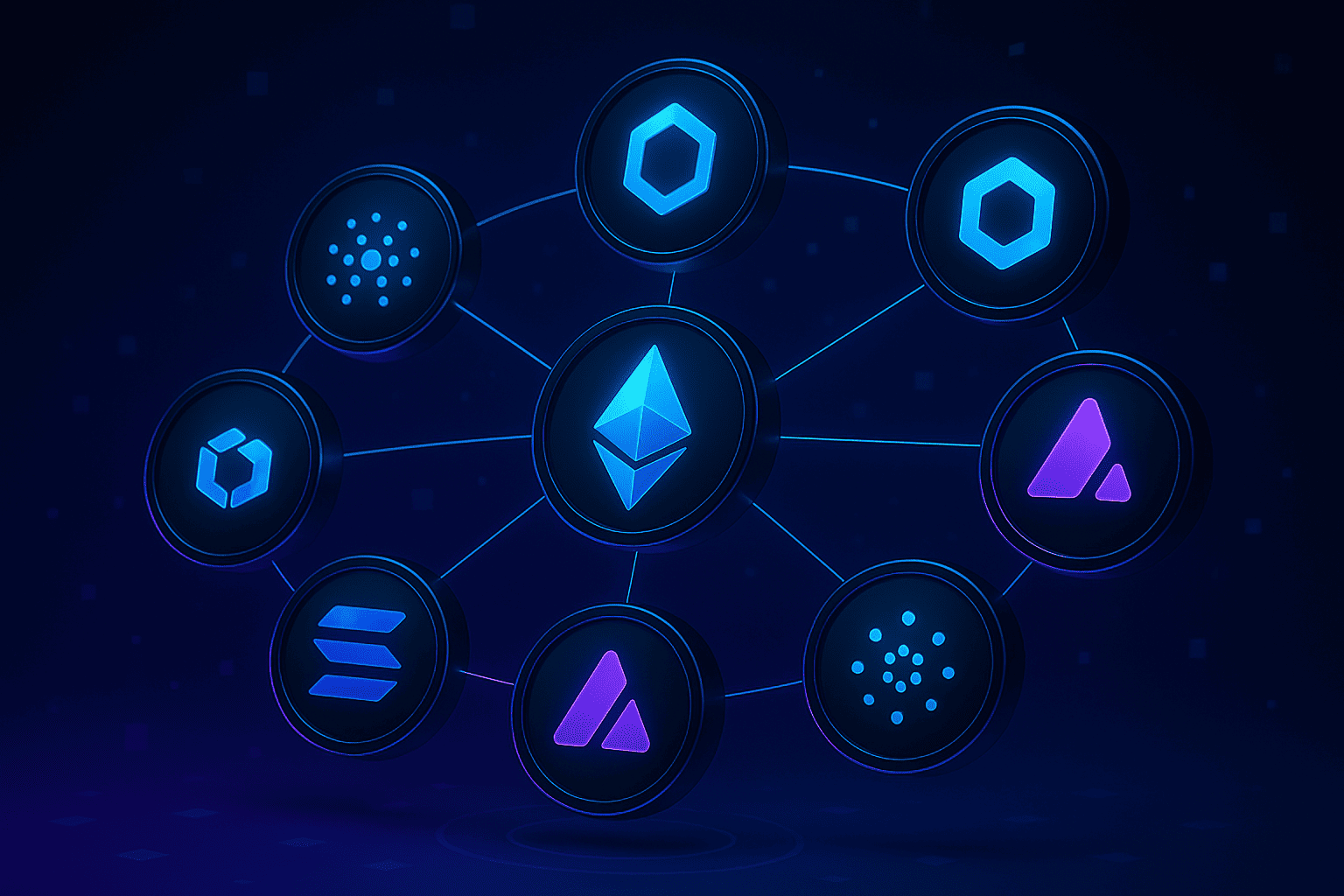
- Native tokens are required to pay transaction fees on their respective blockchains. ETH powers every operation on Ethereum, from deploying smart contracts to interacting with dApps. SOL does the same on Solana, which focuses on high throughput and low fees. Without the native token, you can’t use the network.
- Governance tokens grant holders voting rights on protocol upgrades and treasury allocations within a DAO. Holding these tokens gives you a direct say in how a project evolves, from fee structures to which new features get funded.
- Utility tokens provide access to a specific service or application within a blockchain network. Think of them as keys: you need the token to unlock what the platform offers, whether that’s storage, computing, or content.
- Meme coins are created around internet memes or pop culture references. Dogecoin (DOGE) and Shiba Inu (SHIB) are the most prominent examples. They’re driven by community speculation rather than technical innovation, and their prices can be wildly unpredictable.
Some altcoins don’t fit neatly into one box. Several were built specifically to improve on Bitcoin’s limitations by focusing on scalability, transaction speed, or energy efficiency. These projects often compete directly with each other for developer adoption and user growth.
Types of stablecoins
The three most widely used stablecoins illustrate the range of designs in this category.
- USDT (Tether) is fiat-collateralized and the largest stablecoin by circulation. It operates across multiple blockchains and is the default trading pair on most exchanges.
- USDC (USD Coin) is also fiat-collateralized, backed by cash and short-term U.S. treasuries. It’s known for its regular reserve attestations.
- DAI is crypto-collateralized and decentralized, minted on Ethereum through smart contracts rather than managed by a single company.
Collateralized stablecoin models
- Fiat-collateralized stablecoins are backed 1:1 by fiat currency reserves held in custodian bank accounts. This is the most widely adopted model because the backing is simple to understand and, when properly audited, straightforward to verify.
- Crypto-collateralized stablecoins are backed by on-chain cryptocurrency assets managed through smart contracts with overcollateralization. The extra collateral cushion absorbs price swings in the underlying crypto, but it also means users must lock up more value than they receive.
- Commodity-backed stablecoins are pegged to real-world assets such as gold or oil. Each token represents ownership of the physical underlying, offering a way to hold commodity exposure on a blockchain without dealing with physical storage or delivery.
Algorithmic stablecoins
- Algorithmic stablecoins rely on code-driven supply adjustments to maintain their peg, expanding or contracting the circulating supply based on market price signals.
- This model has largely fallen out of favor after multiple high-profile failures, most notably the Terra/UST collapse. Without redeemable reserves, the peg depends on sustained market confidence, which has proven unreliable under pressure.
Centralized versus decentralized issuance
- Centralized stablecoins like USDT and USDC are managed by a central organization that holds fiat reserves, conducts attestations, and can freeze or blacklist tokens when required by regulators or law enforcement.
- Decentralized stablecoins like DAI use smart contracts and crypto collateral instead of a central authority. No single entity controls minting or redemption. The trade-off is that governance falls to token holders, and the system’s safety depends entirely on the smart contract code and its oracle feeds.
How smart contracts power both asset classes
Smart contracts define the issuance, transfer, and utility rules for both altcoins and stablecoins. They’re the programmable backbone that makes these assets work without a traditional intermediary.
Smart contracts in altcoin tokenomics
Altcoin smart contracts govern tokenomics: maximum supply, inflation rates, and distribution schedules are all written into the code at launch. The ERC-20 standard on Ethereum is a good example. By following a common interface, any ERC-20 token can integrate into decentralized exchanges and lending protocols without custom development. That composability is what lets thousands of altcoins plug into the same DeFi infrastructure.
Smart contracts in stablecoin collateral management
For stablecoins, smart contracts manage the collateral locking, minting, and redemption process. Crypto-backed stablecoins rely on smart-contract-enforced overcollateralization ratios to buffer against drops in collateral value. When the ratio falls below a set threshold, the contract triggers automatic liquidation, selling enough collateral to bring the ratio back into a safe range. This all happens on-chain, transparently and without a human decision.
Oracles and transparency
Smart contracts on their own can’t see what’s happening off-chain. Oracle services bridge that gap by feeding external data, such as asset prices and reserve balances, into on-chain contracts. A stablecoin that relies on the price of ETH for its collateral ratio needs an oracle to report that price accurately and frequently.
How transparent the backing mechanism is matters here. If the smart contract logic has a flaw, or if the oracle delivers a bad price feed, the system can misprice collateral or fail to trigger liquidations in time. For fiat-backed stablecoins, a reserve shortfall that the market discovers late can shake confidence and break the peg. The quality of both the code and the data flowing into it determines how trustworthy the system actually is.
Use cases for stablecoins
Stablecoins have moved well past simple trading pairs. Their fixed value makes them practical for real financial operations where unpredictable price swings aren’t acceptable.
- Cross-border payments. Because the value holds steady during transfer, stablecoins remove foreign-exchange risk from international settlements. A payment sent as USDC arrives worth the same dollar amount it was sent at, and most transactions settle within a few minutes rather than the days a traditional wire can take.
- Treasury movement. Companies shift funds between entities or platforms faster than traditional banking rails allow. Moving stablecoins between wallets on Ethereum, Solana, Tron, or Polygon takes minutes, not business days.
- Customer payments. Merchants accept stablecoins at checkout and settle into bank accounts in their preferred fiat currency. The customer pays in crypto, and the merchant receives dollars (or euros, or whatever they choose) without holding volatile assets.
- Inflation hedge. In markets with unstable local currencies, holding a dollar-pegged token preserves purchasing power. Someone in a country with 50% annual inflation can park savings in USDC and maintain dollar-equivalent value.
- Lending and borrowing in DeFi. Stablecoins serve as base collateral and loan denomination because their value doesn’t fluctuate. Borrowers know what they owe, and lenders know what they’ll get back.
- Bridge between traditional finance and blockchain. Stablecoins let institutions settle on-chain without taking on crypto price exposure. A bank or fund can move value through a blockchain network and never touch a volatile asset.
Use cases for altcoins
Altcoins aren’t just speculative bets. Many of them serve as the fuel that keeps blockchain networks running.
- Access to blockchain platforms. Native tokens are required to run smart contracts, pay gas fees, and interact with dApps. You can’t use Ethereum without ETH or Solana without SOL.
- Securing proof-of-stake networks. Validators stake the native altcoin to process transactions and earn rewards. The more value staked, the more economically costly it becomes for an attacker to compromise the network.
- Governance participation. Holding governance tokens grants voting rights on protocol parameters and treasury spending. This gives token holders direct influence over a project’s direction.
- Liquidity bootstrapping. Altcoins incentivize yield farming and liquidity provision in DeFi protocols. New projects distribute tokens to liquidity providers as a way to build the trading depth they need to function.
- Environment-specific currencies. Altcoins power gaming economies, creator platforms, and decentralized storage networks. In these environments, the token is the native currency for every in-platform transaction.
- Speculative investment. Traders buy altcoins anticipating price appreciation as network adoption grows. This is the highest-risk, highest-potential-reward use case, and it drives a large share of daily trading volume.
Risks of investing in stablecoins
Stablecoins are lower-volatility assets, but that doesn’t mean they’re without risk. Two notable events illustrate how things can go wrong: USDT briefly dropped below its $1 peg in May 2022, and USDC de-pegged temporarily during the Silicon Valley Bank collapse in March 2023. Both restored their peg relatively quickly, but the episodes shook confidence and caught holders off guard.
De-pegging and counterparty risk
De-pegging happens when a stablecoin loses parity with its tracked asset, usually because the market loses confidence in the reserves backing it. Even a rumor about insufficient reserves can push the price below $1.00 as holders rush to sell.
Counterparty risk compounds this. Fiat-backed stablecoins depend on the solvency and governance of the issuing organization. If the issuer mismanages reserves, faces legal trouble, or can’t process redemptions fast enough, the peg can slip. The USDC de-peg during the SVB collapse was a direct example: part of USDC’s reserves sat in a bank that was failing, and until the situation resolved, the market repriced the token downward.
For major fiat-backed coins, de-peg events have historically been short-lived. Arbitrage mechanisms kicked in, confidence was restored, and the peg returned. But “historically short-lived” isn’t a guarantee, and smaller or less transparent stablecoins don’t have the same track record.
Centralization and smart-contract exposure
Centralized issuers have the power to freeze funds. If a regulator or law enforcement agency demands it, the issuing organization can blacklist specific wallet addresses and render the tokens in them unusable. That’s a feature for compliance and a risk for holders who value censorship resistance.
Decentralized stablecoins avoid that centralization risk but face their own set of problems. Smart-contract flaws can be exploited, and oracle failures can feed bad price data into the collateral management system. A bug in the liquidation logic or a delayed price update could leave the protocol undercollateralized before anyone notices.
Regulatory and security challenges
Regulatory pressure is increasing. Evolving rules in both the EU and the U.S. now dictate what assets must back stablecoins, what disclosures issuers must make, and who’s allowed to issue them at all. These frameworks add legitimacy but also create compliance costs and legal uncertainty during transition periods.
Security challenges apply to any crypto holding. Private keys can be lost, wallets can be compromised, and blockchain transactions can’t be reversed. A stolen stablecoin is gone the same way a stolen altcoin is gone.
Risks of investing in altcoins
Altcoins carry a wider and less predictable range of risks than stablecoins. The potential for high returns comes packaged with the potential for total loss.
Volatility and project uncertainty
High volatility is the defining characteristic. Altcoin prices can swing dramatically based on sentiment, regulatory news, or technological shifts. A single tweet, a regulatory filing, or a failed network upgrade can move a token’s price by double digits in hours.
Project uncertainty runs deeper than price. If a network loses its users, gets hacked, or simply fades into irrelevance as competitors improve, the token loses value alongside it. Unlike a stock tied to a company with revenue and assets, many altcoins have no cash flow or hard assets backing them. When the community moves on, there’s nothing to prop the price up.
Market saturation and insider risks
Thousands of altcoins exist, and many of them offer little beyond a whitepaper and a website. Experts advise searching for reviews, scam reports, and complaints before investing in any crypto project. That advice exists because scams and abandoned projects are common, especially among smaller tokens.
Insider concentration is another concern. Insiders frequently control a significant portion of a token’s supply and can change protocol rules through governance votes they dominate. When a small group holds enough tokens to move the market, retail buyers are at a structural disadvantage.
Liquidity and technical vulnerabilities
Many altcoins trade thinly. Low liquidity means large transactions can move the market price significantly, and you might not be able to sell at a fair price when you want to exit. This is especially true for tokens listed on only one or two smaller exchanges.
Technical vulnerabilities pose real threats to smaller networks. The Monero 51% attack in 2025 demonstrated that proof-of-work networks with limited hash power can be overtaken by a single miner or mining pool. Smart-contract code flaws are another vector: a bug in a DeFi protocol’s contract can drain funds before anyone can respond.
Regulatory ambiguity
Some altcoins may be treated as securities under existing law, which would subject them to registration requirements and trading restrictions. The challenge is that classification often isn’t settled until a regulator or court weighs in. A token that’s compliant today might not be compliant tomorrow if the regulatory interpretation shifts. That ambiguity creates risk not just for holders but for exchanges and developers building around these tokens.
Stablecoins vs altcoins for business payments
Businesses choosing between stablecoins and altcoins for payments face a practical decision that goes beyond personal investment preferences. The right choice depends on what the business actually needs the asset to do.
Core payment characteristics
Stablecoins align with operational payment needs. Their predictable value, fast settlement, and availability across multiple blockchains make them straightforward to integrate into existing financial workflows. A company paying a supplier overseas can send USDC and know the recipient gets the expected dollar amount.
Altcoins suit businesses that build on a specific blockchain or need native-token access for smart-contract interaction. A gaming company running on Solana needs SOL, stored in a Solana wallet, to pay transaction fees and interact with its own contracts. In that context, the altcoin isn’t a payment choice; it’s an operational requirement.
Price stability and regulatory treatment
How much price swing a business can tolerate is a deciding factor. Stablecoins keep financial operations free of unexpected gains or losses. A $50,000 payment in USDC is worth $50,000 when it arrives. The same payment in an altcoin could be worth $47,000 or $53,000 by the time it settles, creating accounting headaches and balance-sheet risk.
Regulatory and accounting treatment differs between the two. The EU’s MiCA framework requires reserve transparency and licensing for stablecoin issuers, giving businesses clearer rules to follow. The U.S. GENIUS Act mandates reserve disclosure and authorization for stablecoin issuers, pushing in the same direction. Altcoin classification varies by jurisdiction, and a token’s legal status can change. For a business that needs regulatory certainty, stablecoins are on firmer ground right now.
Compatibility and long-term strategy
Before picking an asset, check what your partners, customers, and technical stack already support. If your payment processor handles USDC and your customers hold USDC, adding an altcoin option adds complexity without clear benefit. If your product lives on a specific blockchain and your users already hold its native token, supporting that token removes friction.
Long-term, stablecoins modernize payment operations and can open new regions where traditional banking is slow or expensive. Altcoins connect a business to emerging networks or user communities, which can matter if your growth strategy depends on being early in a specific market.
Is Bitcoin a stablecoin or an altcoin?
Bitcoin is neither. The altcoin category is defined as any cryptocurrency other than Bitcoin, so Bitcoin is the baseline the term was coined against. It can’t be an altcoin by definition.
Bitcoin isn’t a stablecoin either. Its price is set by open-market supply and demand with no peg to any external asset. There’s no reserve vault, no redemption mechanism, and no algorithm targeting a specific dollar value. Bitcoin’s price moves with market sentiment, macroeconomic conditions, and its own supply dynamics.
What Bitcoin does function as is a decentralized store of value, often called digital gold. Its fixed supply of 21 million coins, with approximately 19.4 million already mined, makes Bitcoin deflationary relative to fiat currencies that can be printed without limit. That scarcity is central to its value proposition, but it doesn’t make it stable. Bitcoin’s price can move sharply in either direction, which is the opposite of what a stablecoin is designed to do.
Frequently asked questions
What are the top altcoins by market presence?
ETH, SOL, and XRP consistently rank among the largest altcoins by market capitalization and adoption. These tokens anchor major blockchain networks with active developer communities and high transaction volumes, which keeps them at the top of the altcoin market.
Can stablecoins generate investment returns?
Stablecoins aren’t designed for capital appreciation. Their value stays pegged to the reference asset, so you won’t see price-driven gains. However, you can earn yield by lending stablecoins or providing liquidity in DeFi protocols. The returns come from interest and fees, not from the token going up in price.
What happens when a stablecoin loses its peg?
Market confidence drops, and selling pressure pushes the price further from the target. For fiat-backed stablecoins, arbitrage mechanisms typically activate: traders buy the discounted token and redeem it for $1.00 in reserves, gradually restoring the peg. Algorithmic stablecoins face a harder path because they lack redeemable reserves. If confidence can’t be restored, the de-peg can spiral, as it did with Terra/UST.
How do stablecoins handle cross-chain transfers?
Leading stablecoins like USDT and USDC circulate on multiple blockchains, including Ethereum, Solana, Tron, and Polygon. Interoperability protocols and bridge services enable transfers between these networks. You send stablecoins on one chain and receive them on another, though each bridge carries its own trust assumptions and fee structure.
Choosing the right crypto category for your goals
Stablecoins and altcoins fill complementary roles. One gives you stability for transactions, payments, and capital preservation. The other gives you growth potential, utility, and access to blockchain networks.
Because each category serves a different financial purpose, matching the asset type to your goal is the practical starting point. Payments and treasury operations favor stablecoins, since predictable value matters when real money is on the line, while protocol access, governance participation, and speculative exposure favor altcoins because those activities require holding tokens whose value moves with the network’s success.
The risk profiles differ at a fundamental level. Stablecoin risk centers on peg integrity and issuer solvency: will the backing hold, and will the issuer remain operational and honest? Altcoin risk centers on volatility and project viability: will the network grow, and will demand for the token hold up over time?
Regulations are shifting quickly for both categories. Stablecoins are gaining clearer rules first, with frameworks like MiCA and the GENIUS Act setting specific requirements for reserves and issuance. Altcoin regulation remains more uncertain, with ongoing debates about which tokens qualify as securities. For a closer look at how specific wallets and exchanges handle both stablecoins and altcoins, AXL Research Hub covers those comparisons in our exchange and wallet reviews. Whatever you choose, understanding what each asset type does, and what it doesn’t do, keeps your expectations grounded and your decisions sharper.