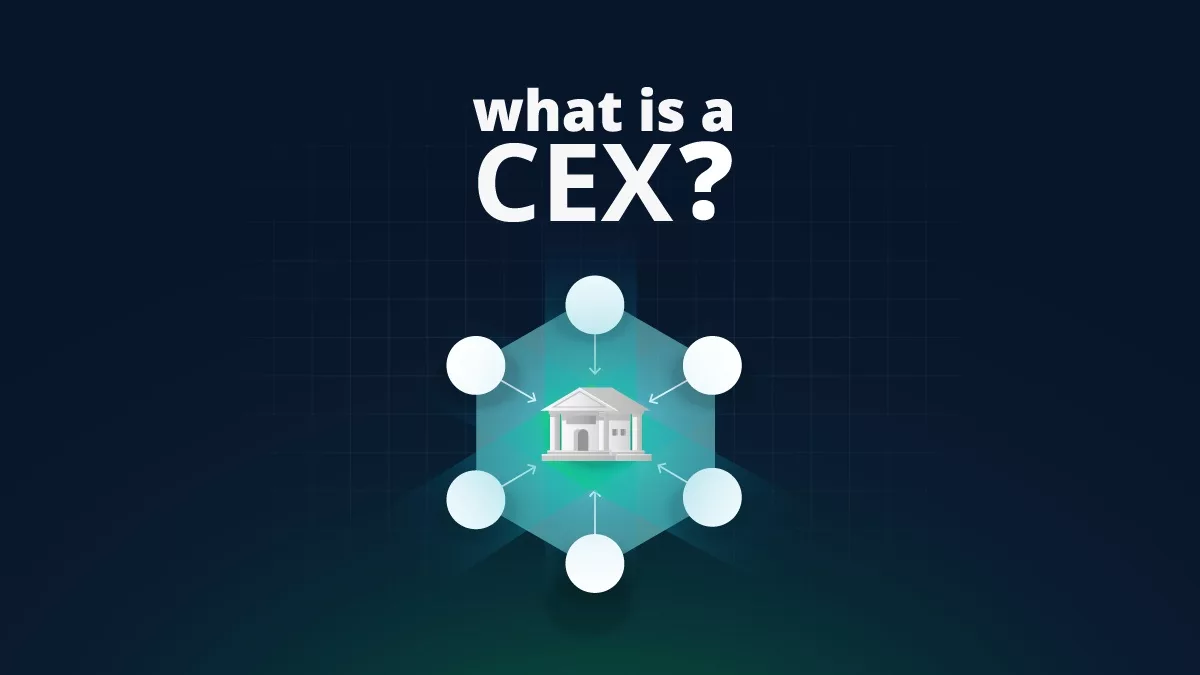

CEX is short for centralized exchange. These company-run platforms let you buy, sell, and hold crypto through an account, and they’re the usual way to turn dollars into Bitcoin and cash back out again. The catch is that the exchange holds the keys to your coins, not you, so picking a sound one matters.
What is CEX?
A centralized exchange (CEX) is a cryptocurrency trading platform run by a company that stands between buyers and sellers. You don’t trade directly with another person. You trade through the exchange, and it handles everything in the middle.
That middle role covers four jobs. The exchange holds custody of your funds. It keeps an internal order book of everyone’s buy and sell orders, and it matches those orders into trades. It also runs the systems that convert regular money into crypto, or one coin into another. On the fiat side, that usually means dollars, euros, and pounds (USD, EUR, GBP). On the crypto side, you’ll see assets like Bitcoin (BTC), Ethereum (ETH), and Tether (USDT).
If you’ve used a stock brokerage app, a CEX will feel familiar. You open an account, log in with a password, and watch your balances on a dashboard. What you give up is direct control of your private keys. The exchange holds them for you, much like a bank holds your deposits. That means you’re taking on counterparty risk: if the company fails, your coins can go down with it.
Centralized exchanges are also the main regulated doorway into and out of crypto. Regulators classify them as Virtual Asset Service Providers (VASPs), and that label brings identity checks and anti-money-laundering rules with it. It’s the reason a CEX asks for your ID before you can trade.
How does a centralized exchange work?
A centralized exchange works in four steps: you verify your identity, fund your account, place trades the exchange matches on its order book, and withdraw to your bank or your own wallet. While your assets sit on the platform, the exchange holds them. Every major centralized platform follows this same basic sequence.
- Register and verify your identity. You sign up with an email and password, then pass Know Your Customer (KYC) checks. Expect to upload a government-issued ID and a proof of address. You’ll usually also take a selfie or short video so the exchange can match your face to the ID. Anonymous accounts aren’t an option on a regulated exchange.
- Fund your account. You can deposit dollars by bank transfer, wire, debit card, or credit card through networks like Visa and Mastercard. In Europe, SEPA handles euro transfers, and international wires run over SWIFT. The exchange converts your fiat at its own current rate. You can also send crypto in from another wallet. Either way, the funds land in a custodial account, and the exchange holds the private keys.
- Place a trade. Each trading pair has its own order book that updates continuously. Typical pairs look like ADA/USDT, XRP/BTC, XRP/EUR, SOL/GBP, or SHIB/USD. A market order fills right away at the best price available. A limit order waits on the book and fills only if the market reaches the price you set.
- Withdraw. You can send fiat back to a linked bank account or move crypto out to a self-hosted wallet. Before the money leaves, the exchange runs automated sanctions screening. It also checks the transaction against your account’s risk profile. Once the crypto lands in your own wallet, custody passes back to you and your private keys.
Step three hides a detail that shows up on your fee statement. Traders who post limit orders are called makers, because their orders sit on the book and give everyone else something to trade against. That’s where an exchange’s liquidity comes from. Traders who fill those orders with a market order are takers, and they pay a taker fee on each fill. Exchanges usually list maker and taker rates separately, so check both before you settle on an order type.
The screening in step four explains another common surprise. If a withdrawal sits in review longer than you expected, the exchange’s compliance checks are often the reason.
Core features of centralized crypto exchanges
Big centralized exchanges pack a lot under one login. The same account that lets a beginner buy a small amount of Bitcoin can also give a professional trader institutional-grade charting and API access.
Trading products
Spot trading is the basic product. You buy a coin, and it settles into your balance right away.
Margin trading lets you borrow funds to take a bigger position than your balance alone would allow. CEX.IO, for example, offers leverage of up to 20x. Leverage multiplies losses just as fast as gains. If the market moves against a leveraged position far enough, the exchange can close it out and you lose the money you put up.
Derivatives go a step further. Many exchanges list futures contracts and options tied to an underlying digital asset. Traders use them to bet on price moves or to hedge coins they already hold, without buying or selling the coins themselves.
Then there’s the passive side. Many platforms run crypto staking programs, where your coins help validate a proof-of-stake network and you earn a share of the rewards. Others offer crypto savings accounts, and some host NFT marketplaces. Availability varies by country, so a product you see advertised may not be open to you.
For active traders, the toolkit includes:
- Charting interfaces for reading price action without leaving the exchange.
- Real-time market data feeds that show the order book and recent trades as they happen.
- Instant-convert calculators that quote what you’ll get before you swap one asset for another.
- Trading API access so you can run algorithmic strategies through your own software.
Fees are where you’ll want to slow down. Trading fees on a CEX typically run 0.1% to 0.5% per transaction. Where you land in that range depends on your volume tier and the type of order you place. On a $1,000 trade, that works out to $1 to $5.
The trading fee is only one way an exchange earns money from you. Exchanges also charge withdrawal fees and build spreads into fiat conversions. They earn on staking, lending interest, and margin fees, and many charge projects to list their tokens. The conversion spread is the easiest to miss, because it’s baked into the price you see on an instant buy rather than shown as a line item.
Fiat on-ramps
An on-ramp is the part of the exchange that connects your bank to the crypto market. You send dollars by bank transfer or card, and the exchange turns them into crypto in your account. For most people, this is the simplest way to buy a first coin.
The off-ramp runs the same road in reverse. You sell your crypto for dollars and withdraw them to your bank account. Centralized exchanges are the main bridge where crypto value reaches the traditional financial system. If you ever want to spend your gains as regular money, you’ll almost certainly cash out through an off-ramp like this.
Custody architecture
When you hold coins on an exchange, they sit in the exchange’s built-in wallet by default. The exchange controls the private keys to that wallet, not you.
Behind the scenes, exchanges split those funds into two pools. Hot wallets stay connected to the internet, because the exchange needs ready coins to process trades and withdrawals. Cold storage is offline and hardware-secured, which makes it far harder to reach remotely. Leading centralized exchanges keep 90% to 95% of user funds in cold storage. The thinking is simple: if hackers break into a hot wallet, they only reach the smaller slice of funds kept online.
On your own account, you control a few settings that matter a lot:
- Two-factor authentication (2FA) means a stolen password alone won’t get someone into your account.
- Withdrawal address whitelisting limits withdrawals to addresses you’ve approved ahead of time, so a hijacked account can’t send your coins to a stranger’s wallet.
- Device management shows which phones and computers are logged in, so you can kick off one you don’t recognize.
The exchange handles the rest. Reputable platforms run security audits and pay outside researchers through bug bounty programs to report flaws. Some carry insurance on the funds held in hot wallets, so read what the policy actually covers before you count on it. On the card payment side, look for certifications such as PCI DSS Level 1.
Account support tools
Account dashboards bring your holdings together in one view. Most include portfolio tracking, and many let you export transaction reports for your taxes. Educational libraries are common too, aimed at people still learning the basics.
Support is the bigger difference from a self-custody wallet. Exchanges offer live help through chat, email, or phone. If you forget your login, you can go through account recovery and get back in. You never have to guard a seed phrase or figure out blockchain gas fees. With a self-custody wallet, losing your seed phrase usually means losing your coins for good.
Advantages of using a centralized exchange
For first-time buyers and for anyone trading in size, a CEX is usually the easier place to start. Four advantages stand out:
- Deep liquidity. Retail traders and institutional market makers all feed the same order book. That depth lets large orders fill fast with little slippage, so the price barely moves between the moment you click buy and the moment your order fills.
- Easy onboarding. One-click buying and password-based account recovery lower the technical bar. You don’t need to understand wallets or network fees to make your first purchase.
- Built-in fiat gateways. You pay straight from a bank account or card. You never have to route money through a separate bridging protocol before you can trade.
- Everything under one login. Spot markets, leveraged derivatives, and yield products live in the same account. Moving from one to another is a transfer between balances, not a trip to a new platform.
Each of those conveniences depends on the exchange holding your money. That same fact is the source of every major risk.
Risks of centralized exchanges
The risks of a CEX all trace back to one design choice. A third party holds your assets, and a central team runs the platform.
Counterparty insolvency risk
On a CEX, you don’t hold the private keys to your coins. You depend on the exchange operator staying solvent, keeping honest internal controls, and treating your deposits as yours.
When that trust breaks, it breaks badly. If an exchange misuses customer funds or goes bankrupt, withdrawals can freeze overnight. Some of that money may never come back. FTX is the clearest case. When it collapsed in November 2022, roughly $8 billion in customer funds had been misappropriated. Before FTX, the BitConnect collapse had already shown how quickly a platform’s failure becomes its users’ loss.
The practical takeaway: keep only what you’re actively trading on an exchange. Coins you plan to hold for a long time are safer in a wallet where you control the keys.
Cybersecurity breaches
Centralized exchanges pool billions of dollars in one custodial system. That concentration makes them a standing target for hacking groups. Hot wallets are the weak point, since they have to stay online to handle daily trading and withdrawals.
The history here is long. Mt. Gox lost about $450 million in its 2014 hack. Bitfinex lost $72 million at the time of its 2016 breach. Cold storage shrinks the amount a hacker can reach, but it doesn’t take the risk to zero. No exchange can promise that.
Keep in mind that a platform hack and an account takeover are different problems. You can’t stop the first one. You can make the second far less likely with 2FA and address whitelisting.
Regulatory restrictions
Crypto laws change from country to country, and they keep changing. Licensing disputes and enforcement actions can force an exchange to switch off features in some regions. In places where an exchange isn’t licensed, customer accounts can even get frozen. Regional limits show up even at established platforms. CEX.IO’s Staking and Savings products, for example, aren’t available in the U.S. or the EEA.
Costs are a quieter drag, especially if you trade often. Trading fees, conversion spreads, and withdrawal charges look small on any single trade. Spread across hundreds of trades, they add up to real money.
CEX vs. DEX: key differences
A decentralized exchange (DEX) like Uniswap, PancakeSwap, or SushiSwap does the same basic job without a company in the middle. Trades run through smart contracts on a blockchain. Your coins stay in your own wallet the whole time.
| Factor | CEX | DEX |
|---|---|---|
| Operator | A company | No central operator |
| Custody | Exchange holds user funds and private keys | Users keep non-custodial control throughout |
| Identity verification | KYC required at onboarding | Permissionless access, no identity verification |
| Trade execution | Internal order book | Automatic on-chain execution via smart contracts |
| Liquidity | Institutional and retail market makers | Automated market maker (AMM) liquidity pools |
| Fiat access | Direct on/off ramps via bank transfer and card | Crypto-to-crypto only, no native fiat |
| Fee model | Volume-based trading fees plus withdrawal fees | Blockchain network gas fees that are hard to predict |
| Regulatory status | Regulated VASP with AML/KYC obligations | Contested, with no central operator |
| Main risk | Exchange insolvency or hack | Smart contract bugs and your own key-management mistakes, with no operator to turn to |
| Records | Primary records source for law enforcement | Tracing pseudonymous activity takes blockchain analytics |
| Best fit | Beginners, fiat on-ramps, high-volume trading | DeFi access, smaller unvetted tokens, self-custody trading |
For most people, picking between centralized and decentralized exchanges is a trade-off between convenience and custody. A CEX gives you dollar deposits, a support team, and a way back into a locked account. A DEX gives you full control of your keys, along with full responsibility for them.
The line between the two is starting to blur. Hybrid exchanges try to pair centralized liquidity and ease of use with wallets where you keep control of the keys. They’re still a newer category, so vet any hybrid platform as carefully as you would a regular exchange.
Regulation of centralized exchanges
Centralized exchanges answer to the same kind of anti-money-laundering (AML) rules that banks do. Under FATF Recommendation 15, the international AML standard, they’re classified as Virtual Asset Service Providers. That classification requires them to run AML programs on par with those of traditional financial institutions.
Licensing frameworks in the US and EU
In the United States, an exchange has to register with FinCEN as a Money Services Business (MSB). It also has to comply with the Bank Secrecy Act. In the European Union, exchanges fall under Markets in Crypto-Assets (MiCA), which regulates crypto-asset service providers.
For you, this is the first thing to check. An exchange’s licensing tells you which rules it has agreed to follow where you live.
Day-to-day compliance duties
Once licensed, an exchange carries a standing list of obligations:
- KYC onboarding, which is why you upload your ID before you can trade.
- Ongoing transaction monitoring that watches account activity after you’re approved.
- Sanctions screening on deposits and withdrawals.
- Travel Rule data sharing, where the sending exchange passes originator and beneficiary details to the receiving exchange when you move crypto between them.
- Suspicious Activity Report (SAR) filing with authorities when a transaction looks off.
Much of that monitoring happens on the blockchain itself. Exchanges use analytics tools such as Chainalysis to screen the wallets your funds come from and go to. They look for links to darknet markets, mixing services, ransomware, and sanctioned entities. If crypto you deposit has passed through one of those, the exchange can flag it or freeze it.
Skipping these duties carries a steep price. In 2023, Binance reached a $4.3 billion settlement with the DOJ, FinCEN, and OFAC over failures in its AML and sanctions compliance.
Examples of centralized exchanges
The best-known centralized exchanges differ mostly in where they’re licensed, where they operate, and what kind of trader they serve. Our crypto exchange comparisons at AXL Research Hub go deeper on fees and features for each one.
Coinbase
Coinbase is a U.S.-regulated exchange that holds FinCEN registration as a Money Services Business. It’s also publicly listed on NASDAQ, so it publishes financial reports the way other public companies do. The interface is built with beginners in mind and comes with retail educational resources. On the other end of the market, Coinbase runs custody infrastructure for institutions.
Kraken
Kraken is a U.S.-based exchange that operates across multiple regulated jurisdictions. Its pitch leans on security practices and a wide spread of trading options. That mix tends to appeal to experienced traders more than first-time buyers.
Binance
Binance is the largest centralized crypto exchange in the world by trading volume. It lists a wide range of trading pairs and derivative products. In 2023, it was the subject of a landmark U.S. regulatory resolution that included guilty pleas and an overhaul of its compliance program.
Gemini
Gemini holds a charter from the New York State Department of Financial Services (NYDFS), one of the stricter state regulators. It positions itself around compliance, and it holds SOC 2 Type 2 security certification to back that up. That posture makes it a common pick for institutions.
Frequently asked questions
Can I trade anonymously on a centralized exchange?
No. Regulated centralized exchanges enforce KYC identity verification under FATF standards and national AML laws. You’ll need a government-issued ID to open an account. The exchange also keeps your transaction history, and that history can be subpoenaed.
Are centralized exchanges safe to use?
Reputable exchanges cut down risk in several ways. They keep 90% to 95% of funds in cold storage, hold regulatory licenses, offer 2FA, and carry insurance. Still, any custodial platform carries the risk of insolvency or a hack. A non-custodial wallet avoids that particular risk, though you take on the job of protecting your own keys.
Is it cheaper to buy crypto on a CEX or a DEX?
It depends on how much you’re trading and how busy the network is. CEXs charge a percentage trading fee, typically 0.1% to 0.5%, with discounts as your volume grows. DEXs often skip platform fees but charge blockchain gas fees, and those spike when network traffic is heavy. Gas doesn’t shrink with trade size, so it takes a bigger bite out of small trades.
Choosing the right exchange model for your crypto trades
A centralized exchange fits you if you want to buy with dollars, trade with deep liquidity, and have a regulator watching over the platform. It also fits if you’d rather have a support team help you back into a locked account than guard a seed phrase yourself.
If owning your private keys outright matters more to you, self-custody wallets and decentralized protocols are the better match. You can trade on-chain without asking anyone’s permission. Plenty of people use both: they buy on a CEX, then move long-term holdings to a wallet they control.
Before you deposit anything, do three checks. Confirm the exchange is licensed where you live. Look up how it stores customer funds, including how much it keeps in cold storage. Then read the full fee schedule, withdrawal and conversion costs included, so the price you pay matches the price you expected.