
What is a DEX? A decentralized exchange is a crypto marketplace run by smart contracts, where you swap tokens straight from your own wallet with no company holding your funds. Owning that control also means owning the fees, the scam risk, and any mistake you can’t undo.
What is a DEX?
A DEX, or decentralized exchange, is a peer-to-peer cryptocurrency marketplace where you swap digital assets directly from your own self-custody wallet, with no central company, bank, or broker involved. Self-executing smart contracts on a public blockchain run the trading. They take the place of a company’s staff and its internal database.
The biggest practical difference is custody. A DEX is non-custodial, so your private keys and your funds stay with you for the entire trade. Your tokens leave your wallet only at the moment the swap settles. The new tokens land back in that same wallet, and nobody at an exchange ever holds a balance for you.
At the smart contract level, access works differently too: there’s no account to register, no email sign-up, and no identity check, so anyone with a compatible DeFi wallet can trade. Some of the websites built on top of those contracts do add their own screening, though.
No sign-up doesn’t mean anonymous. Every swap gets recorded on a public blockchain under your wallet address. Anyone can look it up and trace it.
DEXs are a core part of decentralized finance, or DeFi. They sit alongside on-chain lending, borrowing, and derivatives protocols.
They’ve also grown from a niche into a real slice of the market. DEX transaction volume reached $217 billion in the first quarter of 2021. By April 2021, DeFi had more than 2 million traders. That was a 10-fold jump from May 2020. In early 2024, DEXs handled under 7% of total crypto spot trading volume. By 2026, their share had passed 13%. DefiLlama puts 30-day DEX trading volume to late September 2026 at roughly $311 billion.
How does a decentralized exchange work?
A decentralized exchange works by handing your trade to a smart contract. The contract checks your wallet balance, calculates the exchange rate, and swaps the tokens automatically. It acts as escrow and executor at the same time, and both sides of the swap settle together on the blockchain or not at all.
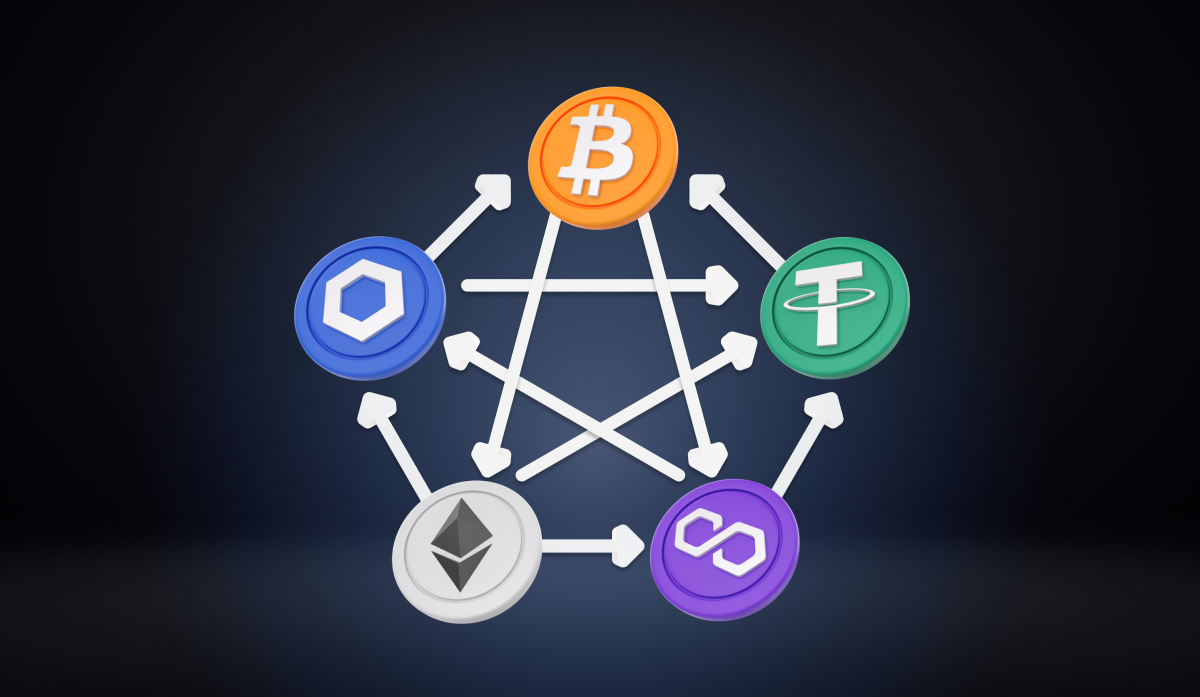
That all-or-nothing property is called atomic settlement. Your whole swap runs as a single blockchain transaction, so if any step fails, whether the price moved past the limit you set or the pool couldn’t cover your amount, the entire transaction reverts. That way, you never end up having sent your tokens without getting the other side back.
One catch: on EVM chains like Ethereum, a reverted swap still costs the gas the network used trying to process it. Failed trades aren’t free.
A DEX only swaps one crypto asset for another. You can’t deposit dollars into one, and you can’t cash out to a bank account from one. Your first crypto has to come from a fiat on-ramp or a centralized exchange. From there, you move it to your own wallet.
Every DEX swap carries two separate costs, and they behave very differently:
| Cost layer | Who gets paid | How it’s charged | Example |
|---|---|---|---|
| Pool or protocol fee | Liquidity providers | A percentage of the trade | 0.3% on a standard Uniswap pool |
| Network gas fee | The blockchain network | Per transaction, regardless of trade size | Paid in ETH on Ethereum, BNB on BNB Smart Chain, SOL on Solana |
The pool fee grows with your trade. The gas fee doesn’t. During heavy congestion on Ethereum, gas can run past $20 to $50 per transaction, whether your swap is huge or tiny.
Run the numbers on a small swap and gas wins. A 500 USDC swap in a 0.3% pool pays $1.50 to liquidity providers. A $20 gas fee on that same trade eats another 4%.
You also need the chain’s native token on hand to pay gas. If you hold only USDC on Ethereum, you can’t swap it until you add some ETH.
That flat gas cost is why people making smaller swaps use Layer 2 networks such as Base, Arbitrum, Optimism, and Polygon. These networks cut Ethereum gas costs and speed up settlement. The pool fee stays a percentage either way, but a much smaller gas bill changes the math on a small trade.
Most DEX smart contracts are open source. Anyone can read the code and check the trading rules for themselves. Developers can also fork an existing protocol, meaning they copy its code and launch a new exchange with it. That’s why so many DEXs look and work almost the same. Keep in mind that a fork copies the code, not the track record.
Types of DEXs: AMMs, order books, and aggregators
DEXs split into a few designs based on two questions: how the price gets set, and how orders get matched on-chain. Automated market makers and order books answer those questions in opposite ways. Aggregators sit on top of both and don’t hold liquidity of their own.
Automated market makers (AMMs)
An automated market maker doesn’t match one buyer with one seller the usual way. You trade against a shared pool of tokens instead. Users called liquidity providers (LPs) fund that pool.
A formula sets the price. Uniswap pioneered the constant-product formula, x * y = k, in 2018. Here x and y are the amounts of the two tokens in the pool, and k has to stay the same after every trade. When you buy token y, you add x to the pool and take y out. With less y left, its price goes up for the next buyer.
Prices keep adjusting this way based on what’s left in the pool. Bigger trades shift the ratio more. That’s where price impact comes from, and it’s why a large order in a small pool can move the price a lot.
LPs earn a share of the pool’s trading fees in proportion to what they deposited. That’s where the 0.3% fee on a standard Uniswap pool goes.
AMM design has moved well past simple two-token pools:
- Concentrated liquidity: Uniswap V3 (2021) lets LPs put their funds to work within a custom price range instead of spreading them across every possible price.
- Weighted multi-asset pools: Balancer pools can hold 3 to 8 different tokens in one pool.
- Stable-asset curves: Curve Finance uses bonding curves tuned for stablecoins and liquid staking tokens that trade near parity, so swaps between them see less slippage.
- Hooks: Uniswap V4, launched in January 2025, added customizable smart contract modules called hooks for dynamic fees, limit orders, and on-chain oracles.
As a trader, you mostly notice these designs as better prices on certain pairs. As an LP, you feel them more, because each design changes how your deposit gets used.
Order book DEXs and perpetual protocols
An order book DEX works like a traditional exchange. It keeps an open list of buy bids and sell asks. A trade fills when a bid and an ask meet at a specific price.
That model is hard to run on a busy blockchain. Every order you place or cancel counts as activity the network has to process. On an expensive base layer, constantly adjusting orders would cost a fortune and move too slowly.
So order book DEXs have moved off the base layer. Some use hybrid setups with off-chain matching engines. Others run on purpose-built high-speed blockchains of their own.
dYdX V4 runs on dYdX Chain, a purpose-built application blockchain based on Cosmos. Order matching there stays non-custodial. Hyperliquid built its own Layer 1 blockchain for perpetual futures. It held about $7.4 billion in total value locked as of late September 2026.
Order books dominate on-chain derivatives and perpetual futures. Traders in those markets want precise limit orders at exact prices. A pool formula doesn’t give them that naturally.
DEX aggregators and intent-based routers
An aggregator works as a routing layer without liquidity reserves of its own. It scans dozens of separate DEXs and pools, then sends your trade wherever the net price is best. Major names include 1inch, Matcha, Jupiter, and UniswapX.
Because liquidity is scattered across many pools, one pool alone might move its price sharply against a big order, which is why the gain shows up on medium and large swaps. By splitting that order across several venues at once, an aggregator leaves you with lower slippage and a better net price.
Intent-based routing goes a step further. You state the outcome you want, like a minimum amount of ETH for your USDC. Outside parties called solvers then compete to fill it the most efficient way.
Many routers also send trades through private transaction relays. That keeps your pending swap out of the public mempool, where front-running bots look for targets.
DEX vs. CEX: key differences
The core split is who holds your money. On a centralized exchange (CEX), the company holds your funds, and you hold only an internal claim on them. On a DEX, you hold your own keys.
| Feature | DEX | CEX |
|---|---|---|
| Custody of funds | You hold your private keys in a non-custodial wallet | The exchange holds your funds as custodian |
| Trade execution and settlement | On-chain via smart contracts | Off-chain via the exchange’s internal order book database |
| KYC and identity verification | None at the protocol level (some front-ends apply IP or sanctions screening) | Mandatory Know Your Customer (KYC) and anti-money laundering (AML) checks |
| Supported assets and fiat access | Crypto-to-crypto only, with permissionless token listing | Curated, vetted listings with deeper liquidity on flagship pairs, plus fiat access |
| Primary failure risk | Smart contract bugs, malicious approvals, and user error | Corporate insolvency, withdrawal freezes, or custodial hacks |
| Account recovery and support | None (transactions are irreversible) | Customer support desk and account recovery |
| Share of crypto spot volume (January 2026) | Over 13% | About 86% |
CEX failures can be enormous. FTX collapsed in November 2022. Back in 2018, Coincheck lost $530 million in NEM to theft. A DEX user sidesteps that kind of loss by never handing over custody. In exchange, you take on everything in the DEX column yourself.
After major exchanges went insolvent, more traders shifted their activity toward self-custody. Even so, CEXs still handle the large majority of spot volume.
One distinction trips people up. The smart contracts themselves are permissionless, so anyone can call them. The website you use to reach them is a separate thing, usually run by a company or team. That site may block certain IP addresses or screen wallets against sanctions lists. A block like that is a compliance decision by whoever runs the site. It doesn’t change the protocol underneath.
Benefits of using a decentralized exchange
The main reason to use a DEX is control, and most of the other benefits grow out of it.
With full self-custody, no exchange can go insolvent with your money inside. Nobody can freeze your withdrawals on short notice. Nobody caps how much you can trade in a day, either. Your funds stay in your wallet until you decide to move them.
You also get immediate access to newly minted and long-tail tokens. As soon as someone creates a liquidity pool for a token, you can trade it, on whichever blockchain it lives on. A centralized exchange lists tokens on its own schedule, if it lists them at all. The same openness is how scam tokens reach traders, so this benefit cuts both ways.
DEXs resist censorship and stay up because their smart contracts run directly on decentralized blockchain networks. There’s no single server to crash or switch off. A front-end website can go down, but the contracts keep running as long as the chain does.
Access matters too. If you have a smartphone and an internet connection, you can trade on a DEX without a bank account. That’s a real benefit for people in developing economies who don’t have access to traditional banks.
Finally, DEX liquidity is open for other software to build on. Lending markets, yield aggregators, and other DeFi protocols can plug straight into it without asking anyone’s permission. Developers call this composability.
Risks and challenges of trading on a DEX
On a DEX, all the operational and security responsibility moves to you. No central institution absorbs a loss or reverses an error.
Smart contract bugs and operational exploits
Funds in a DEX pool are only as safe as the whole software stack behind them. That stack includes the smart contracts and the compilers that turn the code into something the blockchain runs. It also includes off-chain dependencies. A coding flaw at any of those layers can expose pooled funds.
The Curve Finance exploit in July 2023 shows how deep this goes. Attackers drained factory pools through a reentrancy flaw in the compiler of the underlying programming language. A contract can read as correct and still compile into something vulnerable.

Audits lower the risk but don’t remove it. Specialized blockchain security firms such as CertiK, Consensys, ChainSecurity, and Trail of Bits review protocol code. Exploits still happen after audits, so treat an audit as one good sign rather than a guarantee.
Some of the biggest losses don’t involve breaking any code. Attackers go after the people who run a protocol instead. In April 2026, about $286 million was drained from Drift Protocol on Solana. A North Korea-linked social engineering campaign had run for 6 months before it compromised the protocol’s governance signers. When you size up a protocol, look at who can change it or move its funds, not just whether the code passed an audit.
Impermanent loss for liquidity providers
Impermanent loss only hits you if you deposit tokens into a pool as a liquidity provider. Plain swaps don’t carry it.
Impermanent loss is the drop in value an LP sees when the price ratio of the two deposited tokens moves far from where it stood at deposit. You measure it against what you’d have if you’d simply held both tokens in your wallet.
It comes from the way constant-product pools rebalance. When one token rises, traders buy it out of the pool and pay with the other token. The formula keeps doing its job, so you end up holding more of the token that fell and less of the one that rose. If prices drift back to where they started, the loss disappears. That’s why it’s called impermanent. If you withdraw while prices are still apart, the loss becomes real.
Trading fees are supposed to make up the difference, and in volatile pairs they often fall short. Across 17 Uniswap V3 pools in 2021, impermanent loss totaled about $260 million. Fees earned in those pools came to about $199 million. Losses wiped out fee gains in over 80% of the pools analyzed. Before you add liquidity to a volatile pair, weigh how much you can realistically earn in fees against how far the two prices could drift.
Front-running, MEV, and slippage
Before your swap confirms, it sits in the public mempool, where anyone can see it. Automated bots watch that queue. They reorder trades or insert their own around yours to capture what’s called Maximal Extractable Value (MEV).
The most common version is a sandwich attack. A bot spots your pending buy and buys the same token right before you, which pushes the price up. Your trade then fills at the worse price. The bot sells right after you and keeps the difference. On Ethereum in 2023, a single sandwich bot pulled tens of millions of dollars out of routine retail trades.
Slippage is the gap between the price you saw when you submitted a trade and the price you got once it confirmed. Low pool liquidity makes it worse. So do fast-moving markets and large order sizes.
Your slippage tolerance setting ties these two problems together. It caps how far the price can move before your swap reverts. It also caps how much a sandwich bot can squeeze out of you. Set it too loose and you give bots room to work. Set it too tight on a volatile pool and your swap keeps failing, with gas charged each time.
Routing through an aggregator that uses private relays keeps your trade out of the public mempool altogether.
Scam tokens, malicious approvals, and user error
Anyone can list a token on a DEX, and scammers take advantage of that. Some create fake tokens that copy the name and ticker of a real project. Others run rug pulls, where the creator mints a huge batch of extra tokens and dumps them into the pool to drain the real assets out. Check a token’s contract address against the project’s official channels before you buy.
Token approvals on EVM blockchains are a quieter risk. Before a DEX contract can move your tokens, you sign an approval that lets it spend them. Many apps ask for an unlimited amount by default so you won’t need to approve again. That permission stays active after your trade is done. If the contract gets compromised later, or was malicious from the start, it can pull every approved token out of your wallet without you signing anything new.
Non-EVM architectures such as Solana work differently. They handle transaction permissions without persistent unlimited token approvals. On EVM chains, protect yourself by approving only the amount you’re swapping and revoking approvals you no longer use.
Then there’s plain user error, which scammers work hard to cause. A phishing site that copies a real DEX front-end can trick you into signing a transaction that empties your wallet. Address poisoning plants a lookalike address in your transaction history. That address matches the first and last characters of one you actually use. In May 2024, about $68 million in Wrapped Bitcoin went to a scammer’s lookalike address this way. Check the full address every time, not just the ends.
Popular DEX platforms
A handful of platforms handle much of the DEX market, and each one is built for a different kind of trade.
Uniswap is the largest spot AMM decentralized exchange by volume. It started on Ethereum and now runs on V4 smart contracts with customizable pool hooks. Its all-time swap volume tops $4 trillion. In the 30 days to late September 2026, Uniswap handled about $92 billion, nearly 30% of the total DEX market.
PancakeSwap is the leading AMM on BNB Smart Chain. It also runs on Ethereum Layer 2 networks, including Base and Arbitrum. As of late September 2026, PancakeSwap did about $29 billion in 30-day trading volume. It held roughly $2.3 billion in total value locked.
Curve Finance is a specialized AMM built for low-slippage swaps between stablecoins and closely pegged assets. If you’re moving between two dollar stablecoins, Curve’s design targets exactly that trade.
Hyperliquid and dYdX are order-book DEXs running on dedicated high-throughput chains. Both focus on perpetual futures and derivatives.
1inch, Matcha, and Jupiter are trade aggregators. They split and route your swap across multiple liquidity pools to get a better execution price. You don’t have to compare DEXs by hand.
How to use a DEX step by step
A first swap only takes a few minutes. The expensive mistakes tend to happen at two points: the website you connect to and the approval you sign.
- Set up a self-custody wallet. Use a compatible non-custodial wallet such as MetaMask, Trust Wallet, Rabby, Coinbase Wallet, or Uniswap Wallet, or a Trezor hardware wallet. AXL Research Hub‘s wallet reviews compare these options if you’re not sure which one fits. Write your recovery seed phrase down and store it offline. Anyone who gets that phrase gets your funds.
- Fund the wallet with two things. You need the token you plan to swap. You also need some of the chain’s native token for gas, such as ETH on Ethereum. Without the gas token, the swap won’t go through.
- Go to the official DEX site and connect. Type or bookmark the exact official URL instead of clicking ads or links in messages. Then connect your wallet to the web app or mobile interface. A real DEX never asks for your private key or seed phrase. Any site that does is a scam.
- Pick your tokens and set slippage. Choose the input and output tokens, then enter your amount. For liquid pairs, a slippage tolerance of 0.5% to 1% is typical. Smaller or volatile pools usually need 1% to 3%.
- Approve the token with a limit. On EVM chains, your first swap of a token asks you to sign a one-time approval. Set the spending cap to the amount you’re swapping instead of accepting unlimited. Once you’re done trading, revoke any approvals you don’t need.
- Review, confirm, and check your wallet. Your wallet prompt shows the quoted price impact and the gas fee. If the price impact looks high, lower the amount or try an aggregator. Confirm the swap, then make sure the output tokens show up in your wallet.
Here’s how that plays out on a typical USDC-to-ETH swap. You swap 500 USDC with a 0.5% slippage tolerance. You sign twice: once for the token approval and once for the swap itself. The trade settles in roughly 30 seconds.
Since you approved only 500 USDC, your next USDC swap will ask for a fresh approval. That extra signature is the price of not leaving an open-ended permission sitting in your wallet.
Frequently asked questions about DEXs
Are DEXs legal, and how are they regulated?
Using open-source DEX code is legal in most jurisdictions. The rules around DeFi are still taking shape, and regulators are watching more closely how illicit funds move through DEXs. Tax reporting stays your job no matter which interface you use.
Money laundering is the main concern. After the Bybit hack in February 2025, $1.46 billion in stolen crypto moved rapidly through multiple DEXs and cross-chain bridges. In the US, guidance the SEC issued in April 2026 gives non-custodial front-ends temporary regulatory clarity through 2031. Separately, some DEX web interfaces restrict access by IP address.
Can I recover funds sent by mistake on a DEX?
No. Once a blockchain transaction confirms, it’s final and irreversible. No customer support team can cancel a swap, pull back funds sent to the wrong address, or refund a scam token you bought.
Your protection comes before you sign. Check the URL, the token’s contract address, the full recipient address, and the approval amount every time.
Choosing between a DEX and a centralized exchange
The CEX vs DEX choice comes down to what you value more. A DEX gives you self-custody and access to any token that has a pool. A CEX lets you use dollars easily and gives you deep liquidity on major pairs. It also gives you account safeguards like support and recovery.
If you’re buying crypto with dollars for the first time, you’ll start on a CEX or another fiat on-ramp anyway. A DEX can’t take dollars. A common setup is to buy on a centralized exchange and withdraw to your own wallet. From there, you swap on a DEX when you want a token the exchange doesn’t list or want your funds off a company’s books.
Once you trade on-chain, your habits decide how much risk you carry. Keep your seed phrase offline, and match your slippage setting to the pool you’re trading in. Verify contract addresses before you buy anything new. For smaller trades, use a Layer 2 network so gas doesn’t eat the swap.
If you’re weighing specific platforms, our exchange and wallet reviews and comparisons go through them one at a time.