
Cryptocurrencies aren’t all built for the same purpose. Some work like digital cash, others power applications on a blockchain, and a few exist purely because of internet jokes. Sorting them by function rather than by the catch-all label “altcoin” is what makes the market readable. Bitcoin alone accounts for roughly 59.5% of a crypto market worth about $2.67 trillion, and the thousands of tokens behind it do very different jobs.
What are the different types of cryptocurrency?
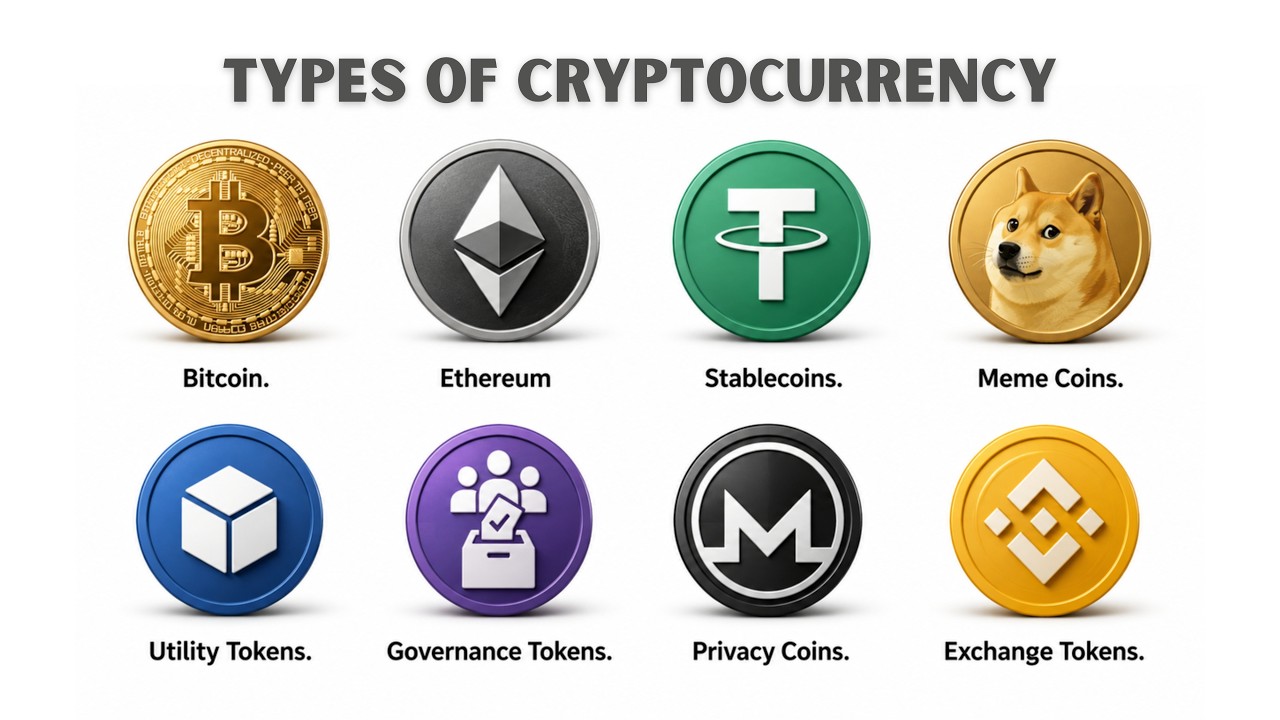
Cryptocurrencies split into several functional categories, each reflecting a distinct purpose. The broadest groupings include payment currencies, smart-contract platform tokens, stablecoins, utility tokens, memecoins, privacy coins, governance tokens, and security tokens. Some store value, some power a network, some maintain price stability, some grant voting rights, and some represent ownership of a real-world asset.
Any cryptocurrency other than Bitcoin is commonly called an altcoin. That label covers everything from Ethereum to the smallest memecoin, which is why it’s more useful to sort by function than by that single umbrella term, once you have the cryptocurrency basics down.
The total count of tracked cryptocurrencies varies wildly depending on which aggregator you check. The UK Financial Conduct Authority estimated over 20,000 different crypto tokens by the start of 2023, while other listing services track tens of millions of entries once you include inactive and micro-cap tokens. Most of those will never matter to an average investor, but understanding the main categories helps you evaluate what role a given coin or token plays in a portfolio or a decentralized application.
Coin vs. token: what separates them
A coin operates on its own independent blockchain. Bitcoin runs on the Bitcoin network, Ether runs on Ethereum, and SOL runs on Solana; for the first two side by side, see Bitcoin and Ethereum compared. Each of these is a Layer-1 blockchain, meaning it functions independently, processes its own transactions, and defines its own consensus mechanism.
A token, by contrast, is built on top of an existing blockchain using a token standard. ERC-20 is the most common standard on Ethereum, and it’s used by tokens like LINK, UNI, COMP, AAVE, and MKR. BNB Chain has its own equivalent called BEP-20. In either case, the token relies on the host chain for transaction processing and security. It inherits that chain’s consensus mechanism rather than defining its own.
This distinction matters more than it might seem at first. When you send an ERC-20 token, you’re paying gas fees on Ethereum in ETH, not in the token itself. The token’s security depends entirely on Ethereum’s validator network. A coin like Bitcoin, on the other hand, secures itself through its own proof-of-work miners.
Layer-2 protocols add another layer to this picture. They run on top of a Layer-1 blockchain to extend its capabilities, usually by processing transactions faster or more cheaply and then settling the results back on the main chain. Tokens associated with Layer-2 networks still depend on the underlying Layer 1 for their ultimate security guarantees. Keeping this framework in mind, that coins define their own chain while tokens borrow someone else’s, makes it easier to understand the gas fees, security trade-offs, and interoperability considerations you’ll encounter across every category below.
Payment currencies
Payment currencies are designed to work as digital cash: borderless, peer-to-peer transfers of value without intermediaries like banks or payment processors. Their value comes from a combination of consensus mechanism, supply schedule, and demand rather than backing by a physical asset.
Bitcoin introduced this concept in 2009 as the first decentralized ledger currency. Its supply is capped at 21 million coins, with a halving event that cuts the block reward roughly every four years. New blocks are created on average every 10 minutes, and the last coin is expected to be mined around 2140.
Litecoin forked from Bitcoin in 2011 to offer faster block confirmations. It swapped Bitcoin’s SHA-256 hashing algorithm for Scrypt and reduced average block confirmation time to roughly 2.5 minutes. Its supply cap is 84 million LTC, four times Bitcoin’s, and it follows the same halving schedule concept, cutting its block reward approximately every four years.
Bitcoin Cash forked from Bitcoin in 2017 with a different goal: handling more transactions per block. At launch it increased the maximum block size from 1 MB to 8 MB, and later raised that limit to 32 MB. The idea was that larger blocks would allow the network to process more payments without the fee spikes Bitcoin experiences during busy periods.
Bitcoin as a store of value and medium of exchange
Bitcoin was launched in 2009 by the pseudonymous creator Satoshi Nakamoto, who published a whitepaper describing a peer-to-peer electronic cash system. It uses a proof-of-work consensus mechanism built on SHA-256 hashing, where miners solve computational puzzles to add blocks to the chain.
The hard cap of 21 million coins, combined with a fixed halving schedule, creates a deflationary supply trajectory. Unlike fiat currencies, which central banks can print without a preset limit, you can’t increase Bitcoin’s supply. This scarcity is a large part of why supporters view it as a store of value, sometimes compared to digital gold.
Decentralization is another argument in Bitcoin’s favor. It lacks a central development team in the way that newer blockchains have one, and its energy-intensive mining raises the cost of attempting to control the network. Critics counter that 10-minute block times and proof-of-work energy consumption make it less practical as everyday currency for buying coffee or paying rent.
Institutional interest has grown substantially, especially after spot Bitcoin ETFs began trading in the U.S. in January 2024. One major ETF product now manages over 800,000 BTC, exceeding $100 billion in assets under management and representing nearly 4% of total supply, which gives a sense of how much institutional capital has flowed in. Corporate treasuries are also involved: one prominent holder carries over 714,000 BTC on its balance sheet. Together, these positions reinforce Bitcoin’s evolving role as a reserve asset rather than purely a medium of exchange.
Proof-of-work energy use continues to draw environmental criticism. Proponents point to a growing share of renewable energy in mining operations, but the debate isn’t settled, and it’s worth factoring into your own evaluation of Bitcoin’s long-term positioning.
Smart-contract platform tokens
Smart-contract platform tokens are the native currencies required to pay gas fees on programmable blockchains. Gas fees are the cost of executing transactions and running applications on the network, functioning like a toll: users pay validators (or miners, depending on the chain) for maintaining the network and processing operations.
These tokens overlap with payment currencies since you can send and receive them like money, but they serve a broader purpose. Any interaction with the chain, whether it’s swapping tokens on a decentralized exchange, minting an NFT, or deploying a smart contract, requires spending the platform’s native token. Interoperability-focused chains designed to link multiple blockchains together also fall under this infrastructure category.
Ethereum (ETH)
Ethereum is the second-largest cryptocurrency by market cap. Founded by Vitalik Buterin, it was conceived in 2013 and launched in 2015 as an open-source blockchain supporting Turing-complete smart contracts, meaning developers can build virtually any application logic on it.
On September 15, 2022, Ethereum transitioned from proof of work to proof of stake in an event called the Merge. The goal was to improve scalability and dramatically reduce energy consumption. Under proof of stake, validators lock up ETH as collateral instead of running energy-hungry mining rigs.
Ethereum doesn’t have a hard supply cap like Bitcoin’s 21 million. Instead, a portion of ETH is burned after each transaction, creating a potential deflationary dynamic when network activity is high enough that the burn rate exceeds new issuance. Whether ETH is inflationary or deflationary in any given period depends on how busy the network is.
Block time on Ethereum averages roughly 12 seconds, far faster than Bitcoin’s 10 minutes. The Pectra upgrade in late 2025 improved account abstraction for simpler wallet usage and lowered costs for Layer-2 scaling solutions, making the network more accessible to everyday users.
Ethereum hosts a wide range of DeFi protocols (including Maker, Uniswap, and Synthetix), NFT marketplaces, play-to-earn games, and thousands of other decentralized applications. Supporters highlight its developer community and adaptability. Critics point to centralization risk from a core development team and concerns about the proof-of-stake validator structure concentrating influence among large stakers.
Solana (SOL)
Solana launched in 2020 and combines proof of stake with a proof-of-history timestamp mechanism. Proof of history pre-records a digital timestamp of incoming transactions, removing one variable from the confirmation process and reducing computational requirements for validators. The result is speed: Solana processes roughly 60,000 transactions per minute on average, with fees that can be fractions of a cent.
The Firedancer validator client, launched in 2026, pushed theoretical capacity toward 1 million transactions per second. This was a direct response to earlier reliability concerns, including a notable 17-hour outage that shook confidence in the network’s uptime.
Solana has become a preferred chain for high-frequency trading, consumer-facing dApps, decentralized social media, stablecoin transfers, and memecoin projects. It reported approximately 23,500 monthly active developers, reflecting a growing builder community.
The trade-off is decentralization. Solana has thousands of validators, but that’s far fewer than Ethereum’s over 1 million. The expensive hardware needed to run a Solana validator raises the barrier to entry, which critics argue concentrates network control among fewer, better-funded operators.
Cardano (ADA)
Cardano was founded in 2017 by Ethereum co-founder Charles Hoskinson. Named after mathematician Gerolamo Cardano, it’s an open-source proof-of-stake blockchain that uses the Ouroboros consensus algorithm, written in Haskell. Its native token ADA is named after Ada Lovelace.
What sets Cardano apart is its development philosophy. Upgrades follow a first-principles, peer-reviewed research approach with university partnerships. Changes undergo strict mathematical review before deployment, which means the network moves more slowly than competitors but aims for fewer surprises once updates go live.
Smart contract functionality arrived and decentralized applications began emerging in 2021 and 2022. The conservative upgrade cycle has drawn criticism for slower feature rollout, and the network has experienced outages, including one in 2023. For investors, Cardano represents a bet on methodical, research-driven development over the “move fast and iterate” approach of chains like Solana.
BNB
BNB launched in 2017 as a utility token that blends currency and utility functions. Holders receive trading-fee discounts on the associated exchange platform and get access to exclusive token sales. It sits at the intersection of payment currency and utility token, deriving much of its value from the exchange platform it’s tied to rather than from independent blockchain innovation alone.
Stablecoins
Stablecoins are pegged to a stable asset, most commonly the U.S. dollar, which keeps them from swinging in price the way other cryptocurrencies do. Because they trade at high volumes and behave like cash within crypto markets, investors rely on them to take profit, park funds between trades, or move money on and off exchanges without converting back to traditional bank accounts.
Three main backing models exist. Fiat-reserved stablecoins hold cash and Treasury bonds at roughly a 1:1 ratio for every token in circulation. Crypto-collateralized stablecoins use smart-contract-managed crypto reserves to maintain their peg. Algorithmic stablecoins use no hard collateral at all, relying instead on supply-and-demand algorithms to expand or contract the token supply, a model that carries the highest risk of losing its peg.
Tether (USDT), launched in 2014, is the largest stablecoin by market cap and is pegged to the U.S. dollar. USDC launched in September 2018, backed 1:1 by U.S. dollars held as cash and Treasury bonds, and it publishes monthly public reserve attestations, a point that comes up whenever you see USDC and USDT compared. Dai takes a different approach: it’s issued by the Maker protocol on Ethereum and maintained at a dollar peg through smart-contract-managed collateralized debt positions, making it decentralized rather than controlled by a single company.
Beyond trading, stablecoins serve a real-world purpose for people in economically unstable countries who use dollar-pegged tokens to shield against local currency inflation. When your national currency is losing purchasing power rapidly, holding USDT or USDC on a phone can be more accessible than opening a U.S. bank account.
Regulation is catching up. The GENIUS Act (Guiding and Establishing National Innovation for U.S. Stablecoins of 2025), designated S.394 in the 119th Congress, passed a Senate vote in June 2025 and awaits a House floor vote. If enacted, it would create a federal regulatory framework that distinguishes permitted stablecoin issuers, which could reshape which stablecoins are available to U.S. users. Major corporations and financial firms have already explored or applied for the right to issue their own stablecoins in anticipation of clearer rules.
Utility tokens
Utility tokens grant holders access to a specific product, service, or function within a blockchain-based platform. They differ from payment currencies because their primary value comes from what they unlock on a particular network, not from acting as general-purpose money.
XRP, introduced in 2013, works as a bridge currency for cross-border payments. Instead of routing international transfers through multiple intermediary banks over several days, financial institutions can use XRP to settle in seconds at minimal cost. The token’s value is directly tied to its usefulness in that specific role.
Chainlink (LINK) is an ERC-20 token created in 2017 by Sergey Nazarov and Steve Ellis, with a whitepaper co-authored by Cornell professor Ari Juels. It powers a decentralized oracle network that feeds external data (prices, weather, sports scores, anything off-chain) into smart contracts. Without oracles like Chainlink, smart contracts would be limited to data that already exists on the blockchain, which would make most DeFi applications impossible.
Stellar Lumens (XLM) facilitate transactions on the Stellar open-source payment network, which launched in 2014 and was co-founded by Jed McCaleb. Stellar uses the Stellar Consensus Protocol and serves as an intermediary for global financial systems. Assets can also be tokenized on the Stellar blockchain through anchor entities, which act as bridges between traditional financial instruments and the Stellar network.
The common thread is that each of these tokens gets its value from solving a specific problem on a specific platform. That’s both the strength and the risk: if the platform fails to gain adoption or gets replaced by a competitor, the token’s value goes with it.
Memecoins
Memecoins are inspired by internet memes or trending cultural moments rather than any defined technological function. They typically feature massive or unlimited supply, resulting in very low per-unit prices, but viral popularity can push market caps into billions of dollars seemingly overnight.
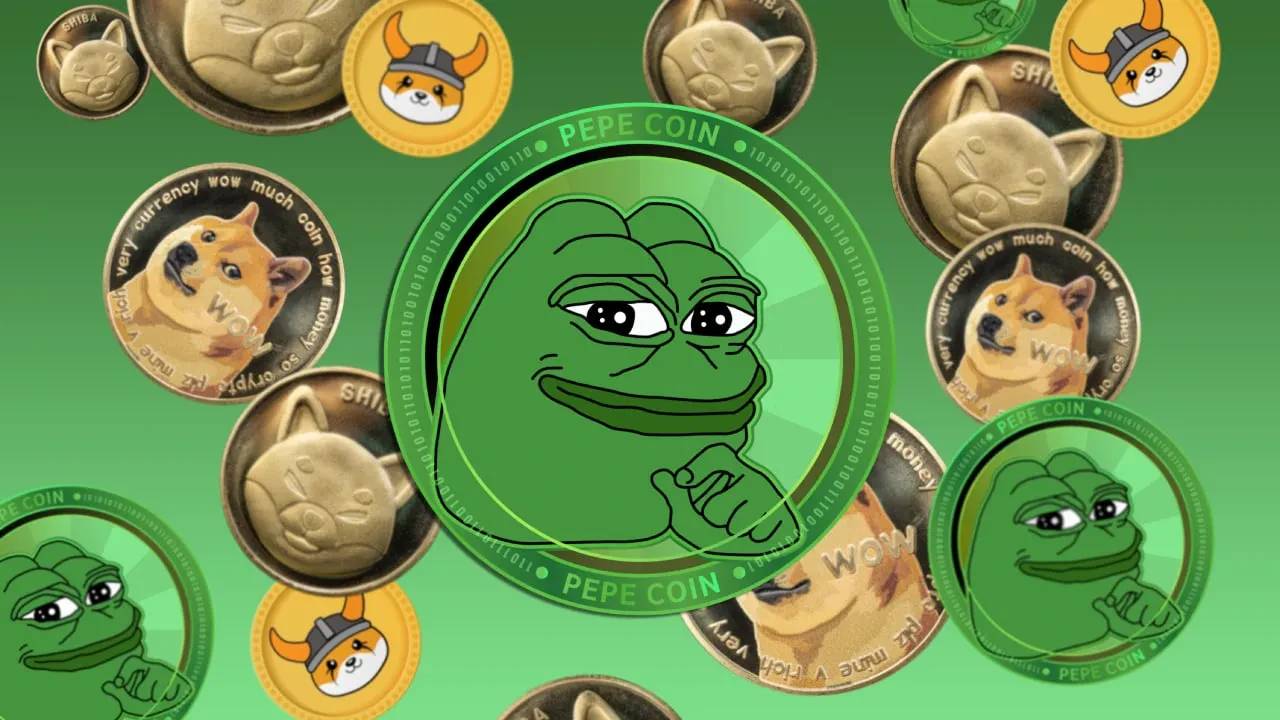
Dogecoin (DOGE) started it all. Created in 2013 by Jackson Palmer and Billy Markus as a satirical take on cryptocurrency, it uses the Scrypt hashing algorithm and proof of work. What began as a joke accumulated a loyal community and eventually caught the attention of high-profile figures who amplified it on social media.
Shiba Inu (SHIB) emerged later as a dog-themed ERC-20 token on Ethereum, riding the broader meme-coin wave. Unlike Dogecoin, which runs its own blockchain, SHIB is a token that depends entirely on Ethereum’s infrastructure.
Anyone with the technical knowledge and internet access can create and distribute a memecoin. That low barrier to entry is part of the appeal and part of the danger. Value depends heavily on community engagement and social-media momentum, which means the same forces that push a memecoin up can vanish just as quickly. Extreme volatility and speculative dynamics make memecoins the highest-risk category on this list. They can produce outsized short-term gains, but they can also go to zero without warning.
Privacy coins
Privacy coins are built specifically to shield transaction details, including sender, receiver, and amount, from public view on the blockchain. On most blockchains, every transaction is visible to anyone who looks. Privacy coins treat confidentiality as a core feature rather than an afterthought.
Monero (XMR) launched in 2014 using the CryptoNote protocol and RandomX proof-of-work hashing. It’s designed for scalability, decentralization, and transaction privacy by default, meaning every Monero transaction is private without the user needing to opt in. Ring signatures, stealth addresses, and confidential transactions work together to obscure the trail.
Zcash (ZEC) takes a different approach. Created by Zooko Wilcox and launched in 2016 using the Equihash algorithm, Zcash introduced zero-knowledge proofs (specifically zk-SNARKs) that let users choose between fully shielded (anonymous) or transparent transactions. Zero-knowledge proofs allow one party to prove something is true, like having enough funds to complete a transaction, without revealing any underlying data. This gives users flexibility that Monero’s always-private model doesn’t.
Dash, also launched in 2014, offers optional private transactions alongside instant transfers and a decentralized governance model. It uses the X11 hashing algorithm with proof of work plus a proof-of-service layer.
The regulatory picture for privacy coins is complicated. Multiple jurisdictions have scrutinized them, and some exchanges have delisted privacy coins entirely to comply with anti-money-laundering rules. If you hold privacy coins, be aware that your ability to trade them on mainstream platforms may be limited and could narrow further as regulations tighten.
Governance tokens
Governance tokens grant holders voting rights over protocol development decisions, parameter changes, and treasury allocation. They’re the blockchain equivalent of shareholder voting rights, giving token holders a direct say in how a protocol evolves.
Maker (MKR), originally created in 2014 with the token introduced in 2017, lets holders vote on proposals affecting the Maker Protocol and the behavior of the Dai stablecoin. That includes decisions like which collateral types are accepted, what stability fees to charge, and how the protocol responds to market stress. These aren’t abstract votes. They directly affect how a multi-billion-dollar stablecoin system operates.
Uniswap (UNI), founded in 2018 as an ERC-20 token on Ethereum, gives holders a voice in the development of the decentralized exchange protocol. Aave (AAVE), first deployed on Ethereum in 2020, and Compound (COMP), also an ERC-20 on Ethereum, serve similar governance roles in their respective DeFi lending and borrowing protocols.
Governance tokens align incentives between developers and users by giving the community skin in the game. The downside is that voting power is proportional to token holdings. When distribution is uneven, large holders (“whales”) can dominate votes, and voter apathy among smaller holders makes that concentration worse. A protocol technically governed by its community can end up effectively controlled by a handful of wallets.
Security tokens
Security tokens represent ownership of a real-world asset, whether that’s equity, debt, real estate, or other financial instruments, recorded on a blockchain. Because security tokens function as investment contracts, they fall under securities regulations, setting them apart from utility tokens as already described above.
Tokenizing real-world assets (RWAs) has gained institutional traction, with Ethereum positioned as a primary settlement layer for many RWA projects. The idea is straightforward: take an asset that’s traditionally illiquid or expensive to divide, like a commercial building or a private equity stake, and represent fractional ownership as tokens. Buyers can then trade those fractions on secondary markets, at least in theory.
In practice, regulatory clarity varies by jurisdiction. In the U.S., tokens classified as securities fall under SEC oversight, which means issuers need to comply with registration requirements or qualify for exemptions. This regulatory burden is exactly what sets security tokens apart from every other crypto category. It adds cost and complexity, but it also provides a legal framework that institutional investors expect before committing capital. As regulation matures, security tokens could bridge the gap between traditional finance and blockchain infrastructure, though that bridge is still being built.
Pros and cons of each cryptocurrency type
| Type | Pros | Cons |
|---|---|---|
| Payment currencies | Decentralized, censorship-resistant, borderless transfers | Price volatility, slower transaction speeds on PoW chains (Bitcoin ~10 min block time), energy consumption |
| Smart-contract platforms | Programmable, support dApps and DeFi, faster block times (Ethereum ~12 sec) | Potential centralization of development teams, unlimited supply concerns, competing chains fragment the ecosystem |
| Stablecoins | Price stability, high liquidity, useful as on-ramp and off-ramp between fiat and crypto | Counterparty risk tied to the issuer’s reserves, regulatory uncertainty, algorithmic models can lose their peg |
| Utility tokens | Unlock specific network functions, reduce friction in cross-border payments | Value tied to the success of a single platform, regulatory classification disputes |
| Memecoins | Low entry price, community-driven viral growth potential | Extreme speculation, no intrinsic utility, rug-pull risk from anonymous creators |
| Privacy coins | Transaction confidentiality, fungibility | Exchange delistings, regulatory friction, limited merchant acceptance |
| Governance tokens | Democratic protocol control, alignment of stakeholder incentives | Voter apathy, whale-dominated voting, token value linked to protocol adoption |
| Security tokens | Fractional ownership of real assets, blockchain transparency | Complex regulatory compliance, limited secondary-market liquidity |
Cost differences are worth highlighting. Solana fees run as low as fractions of a cent per transaction, while Bitcoin and Ethereum fees can exceed $0.50. That gap matters significantly if you’re making frequent transactions rather than occasional large transfers.
How to evaluate a cryptocurrency before investing
Before you put money into any token or coin, AXL Research Hub recommends working through a few concrete checks rather than relying on hype or price charts alone.
- Review tokenomics. Look at the supply cap, inflation or deflation schedule, burn mechanisms, and halving cycles. Bitcoin’s 21 million hard cap creates scarcity by design. Ethereum has no hard cap but burns a portion of supply with each transaction. These structures directly affect whether a token is likely to gain or lose purchasing power over time.
- Understand the consensus mechanism. Proof of work, proof of stake, and hybrid models each come with trade-offs in speed, energy use, and decentralization. A proof-of-work chain like Bitcoin is energy-intensive but widely considered more resistant to centralization. A proof-of-stake chain is faster and cheaper to run but may concentrate influence among large stakers.
- Assess decentralization. Check the number of validators or miners, how token holdings are distributed, and whether there’s a central development team. A network with thousands of independent validators is harder to compromise or shut down than one controlled by a small group.
- Check real-world adoption. Merchant acceptance, institutional holdings, ETF products, and developer activity all signal whether a project has traction beyond speculation. A coin with an active developer community and growing use cases is fundamentally different from one that exists only on an exchange order book.
- Evaluate security history. Has the network experienced outages, exploits, or 51% attack incidents? Past problems don’t necessarily disqualify a project, but they tell you how resilient the network is and how the team responds under pressure.
- Consider regulatory status. Whether an asset is classified as a commodity, a security, or a currency in relevant jurisdictions affects where you can buy it, how it’s taxed, and whether it might face restrictions. This is especially important for U.S.-based investors as regulatory frameworks take shape.
- Learn cybersecurity basics. Understand the difference between hot wallets and cold wallets, how private-key management works, and the irreversibility of blockchain transactions. Sending crypto to the wrong address or losing your private key means losing your funds permanently, with no bank to call for a reversal. Litecoin’s MWEB privacy feature, for example, hides sender and receiver wallet balances from public view, which is worth understanding if privacy is a factor in your choice.
Which crypto to stay away from and red flags to watch
Not every cryptocurrency is worth your time, and some are designed to take your money. Here are the warning signs:
- Anonymous or unverifiable founding teams. If you can’t find out who built a project and they have no public track record, treat that as a serious red flag. Legitimate teams are willing to put their names and reputations behind their work.
- Promises of guaranteed returns or fixed daily yields. No legitimate investment guarantees returns, and fixed daily payouts are a hallmark of Ponzi-style schemes that use new investor money to pay existing holders until the whole thing collapses.
- No working product, whitepaper, or verifiable code repository. A project that’s all marketing and no substance, with nothing you can actually inspect, is almost certainly not worth your money.
- Massive token allocation to insiders with short or nonexistent vesting schedules. If founders and early investors can dump their tokens immediately after launch, they have every incentive to pump the price and sell, leaving later buyers holding the bag.
- Sudden, unexplained price spikes driven purely by social-media hype. When a token’s price shoots up with no development milestones, no partnership announcements, and no technical progress to justify it, you’re likely looking at coordinated manipulation.
- Stablecoins that can’t produce transparent, third-party reserve attestations. If a stablecoin issuer claims 1:1 backing but won’t let independent auditors verify it, you’re trusting their word with no evidence.
- Projects that disable selling or impose hidden transaction taxes in the smart-contract code. Some tokens are coded so that buyers can purchase but can’t sell, or they lose a large percentage to hidden fees. Always check the contract before buying an unfamiliar token.
Frequently asked questions
What are the four main types of cryptocurrency?
Most classifications group cryptocurrencies into four broad buckets: payment currencies, platform and utility tokens, stablecoins, and security tokens. These four cover the primary functions, from transferring value and powering decentralized applications to maintaining price stability and representing ownership of real-world assets. The other categories discussed in this guide (memecoins, privacy coins, governance tokens) are subcategories or offshoots that fit within or alongside these four.
How many cryptocurrencies exist?
Estimates range widely depending on which aggregator you check. The UK FCA tracked over 20,000 crypto tokens by early 2023, while other listing services catalog nearly 58 million token entries when you include inactive, abandoned, and micro-cap listings. The real number of actively traded, legitimate projects is a small fraction of that total.
What is the difference between a coin and a token?
A coin runs on its own native blockchain. Bitcoin, for example, runs on the Bitcoin blockchain. A token is created on top of another blockchain through a standard such as ERC-20 on Ethereum. Tokens depend on the underlying chain to handle their transactions and keep them secure, so they inherit that chain’s strengths and limitations.
What are the 10 most popular cryptocurrencies?
The top ten by total crypto market cap typically include Bitcoin, Ethereum, a leading stablecoin like USDT or USDC, BNB, XRP, Solana, and TRON, along with several others that shift as market conditions change. Bitcoin was created in 2009, Litecoin in 2011, and Ethereum in 2015. Rankings beyond the top few fluctuate frequently, so it’s worth checking a live aggregator rather than relying on a static list.
Choosing the right type of cryptocurrency for your goals
Each category serves a different function. Payment currencies like Bitcoin are built for storing and transferring value. Stablecoins park funds without volatility. Utility tokens unlock the features of specific platforms and services. Governance tokens let you participate in protocol decisions. Security tokens offer fractional ownership of real-world assets.
Matching a cryptocurrency’s type to your actual goal narrows the field from tens of thousands of tokens to a manageable shortlist. If you’re looking for a long-term store of value, memecoins aren’t the place. If you need to move money across borders cheaply, a governance token won’t help.
Spreading exposure across categories rather than concentrating in one type can distribute risk across different return profiles. A portfolio that holds a payment currency, a smart-contract platform token, and a stablecoin position is exposed to different market forces than one that’s all memecoins.
Regulatory developments will keep changing how these markets work. The GENIUS Act, if it passes the House and is signed into law, would set new rules for which stablecoins can operate in the U.S. Ongoing research, tracking tokenomics updates, network upgrades, and adoption metrics, is part of the deal when you’re involved in crypto. The space moves fast, and the types of cryptocurrency that matter most to your goals today may shift as the technology and regulation evolve.