
USDT and USDC both peg to the US dollar, but they differ sharply in transparency, regulatory standing, and liquidity. Reserve composition, de-pegging history, chain fees, and tax treatment all pull in different directions, so the better pick depends on your trading style, your risk tolerance, and where you live.
What are stablecoins and why do they matter?
Stablecoins are digital tokens on a blockchain whose value is pegged to a stable asset, most commonly the US dollar, at a 1:1 ratio. Fiat-backed stablecoins hold reserves of cash or equivalent assets equal to their circulating supply to maintain that peg. The result is a token that combines the programmability and speed of blockchain with the price stability of traditional currency, cutting out the wild price swings you see in assets like Bitcoin or Ethereum.
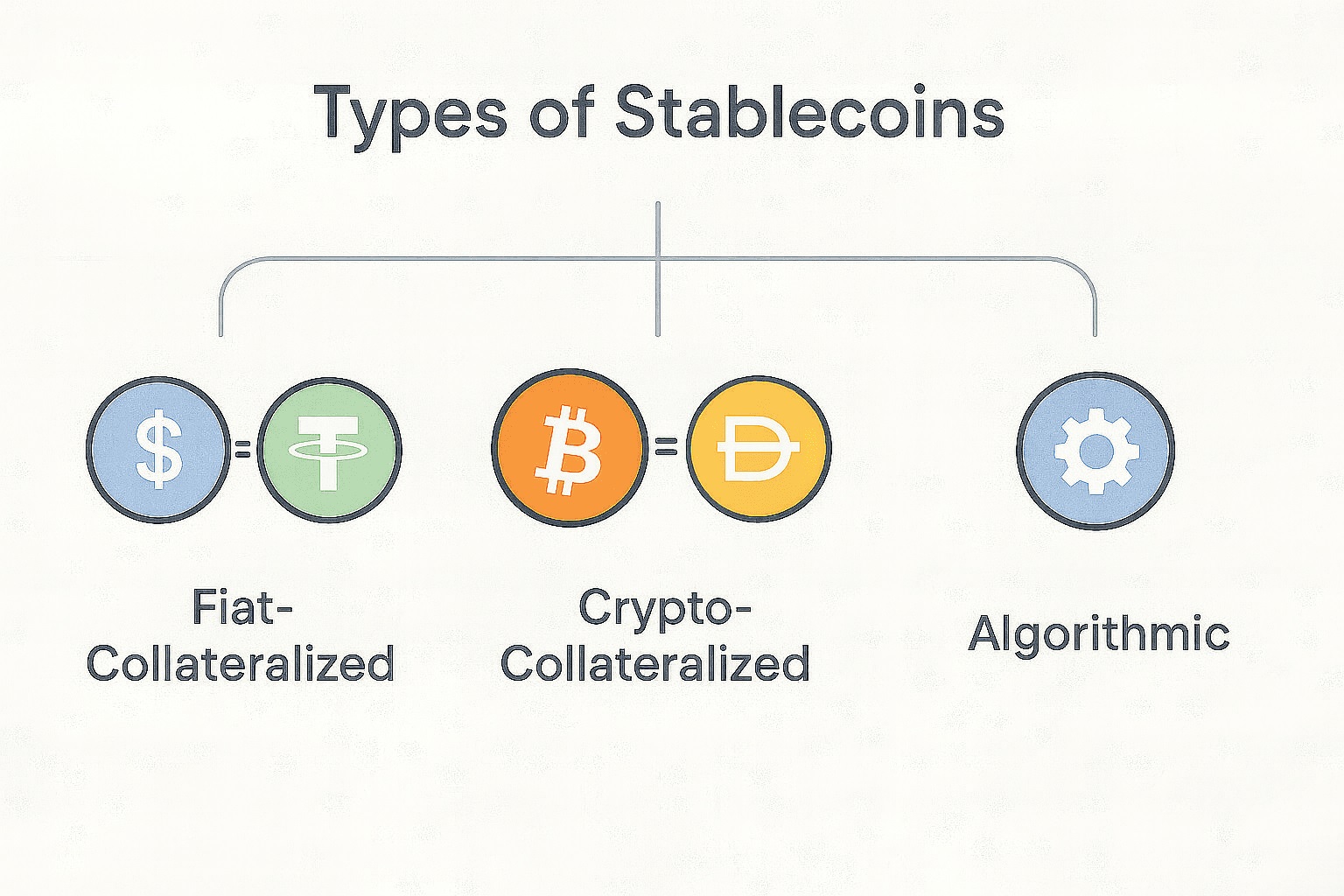
That stability makes stablecoins useful in several ways. Traders use them as a store of value inside crypto markets, parking funds during downturns without cashing out to fiat. They serve as a medium of exchange for payments and remittances, a base trading pair on exchanges, and collateral in DeFi lending protocols.
USD-denominated stablecoins dominate the market because the dollar is the global reserve currency. For many people worldwide who lack direct access to dollar banking, stablecoins offer a practical workaround. The two largest USD stablecoins by market cap are USDT and USDC, and together they account for the bulk of the stablecoin market.
What is USDT (Tether)?
USDT launched in 2014 by Tether Limited, making it the oldest widely adopted stablecoin (our guide to how USDT works covers its mechanics in depth). It’s pegged 1:1 to the US dollar and was designed as a bridge between crypto and traditional fiat currency. USDT operates on multiple blockchains, including Ethereum (ERC-20), Tron (TRC-20), Solana, Binance Smart Chain (BEP-20), Algorand, and several others, giving users flexibility in choosing networks based on speed and cost.
USDT holds the largest market cap among stablecoins and ranks as the third-largest crypto asset overall, with a market cap reported at over $137 billion as of early 2025. Daily trading volume has ranged from roughly $50 billion to over $101 billion depending on the period. That volume makes USDT available on virtually every major crypto exchange globally, with trading pairs for nearly every listed token.
Tether has reported that approximately 58% of its reserves are held in US Treasury bills. As of mid-2024, the company stated $118.4 billion in total reserves against roughly $113 billion in circulation.
USDT’s history hasn’t been without problems. A 2017 hack cost the network 31 million USDT tokens, but the bigger issue came when the New York Attorney General opened an investigation into Tether Limited over claims about its reserves. Tether eventually settled, with sources citing amounts ranging from $18.5 million to higher figures depending on how the settlement components are counted. That case left a lasting cloud over how transparent Tether’s reserve backing really is.
What is USDC (USD Coin)?
USDC launched in September 2018 by Circle, initially through a partnership called the Centre Consortium with Coinbase. After the consortium dissolved in 2023, Circle assumed sole governance of USDC.
Each USDC token is redeemable for one US dollar, with reserves held primarily in short-term US Treasury securities and cash. The split is roughly 75.6% Treasuries and 24.4% cash at regulated financial institutions. Grant Thornton LLP, an independent accounting firm, verifies that composition through monthly attestation reports. This regular, detailed disclosure sets USDC apart from most competitors.
Circle holds reserves with regulated US financial institutions and has obtained money-transmission licenses in multiple jurisdictions. The company is regulated by the SEC and complies with US anti-money-laundering (AML) and know-your-customer (KYC) requirements. USDC has also achieved compliance with the EU’s MiCA framework, positioning it for broader European market access.
USDC’s market cap is smaller than USDT’s, reported at approximately $34 billion to $45.7 billion depending on the period, but it’s the second-largest stablecoin and has been growing, particularly in regulated markets.
USDC vs USDT: side-by-side comparison
Here’s a quick side-by-side look at how USDC and USDT compare on the details that matter most. Keep in mind that market cap and volume figures shift constantly; the numbers here reflect data reported in early to mid-2025 and mid-2024.
| Feature | USDT (Tether) | USDC (Circle) |
|---|---|---|
| Launch year | 2014 | September 2018 |
| Market cap | Over $137 billion (early 2025) | Approximately $34B to $45.7B |
| Daily trading volume | Approximately $50B to $101.5B | Approximately $5B to $6.5B |
| Reserve composition | Diverse mix: US Treasuries (~58%), commercial paper, corporate bonds, secured loans, crypto | Predominantly US Treasuries (~75.6%) and cash at regulated institutions (~24.4%) |
| Transparency | Quarterly attestations; historical criticism for opacity | Monthly third-party attestations by Grant Thornton LLP |
| Regulatory compliance | Settled enforcement actions; compliance details less transparent | SEC-regulated, AML/KYC compliant, MiCA-compliant in EU, money-transmission licenses |
| Price peg | Targets $1; minor de-peg fluctuations over time | Targets $1; notable de-peg to ~$0.87 in March 2023, recovered in ~2 days |
| On-chain transaction volume | High globally | Higher on-chain volume in the US despite lower market cap |
| Growth trajectory | Established dominance | Adoption growing faster, including internationally |
The volume gap is the most striking number in this table. USDT’s daily trading volume is roughly ten times USDC’s, which translates directly into tighter spreads and less slippage for active traders. On the other hand, USDC’s on-chain transaction volume in the US actually surpasses USDT’s despite the smaller market cap, reflecting its stronger position among US-based and compliance-focused users.
Transparency and reserve audits
Reserve transparency is one of the sharpest dividing lines between these two stablecoins, and it matters because your confidence in a stablecoin’s redeemability depends on whether you trust what’s actually backing it.
Tether publishes quarterly attestation reports, not full audits. The distinction matters: an attestation confirms a snapshot of reserves at a specific moment, while a full audit examines processes, controls, and historical accuracy. Tether’s reserve composition has historically lacked detailed disclosure, and the company faced legal action over claims that USDT was fully backed 1:1 by cash. The investigation revealed that reserves included non-cash assets like commercial paper, corporate bonds, and secured loans, not just dollars in a bank account.
Circle takes a different approach. Every month, Grant Thornton LLP releases an attestation report confirming that USDC reserves fully cover the coins in circulation. Those reserves are held at regulated US banks, and each report breaks down how much sits in Treasuries (roughly 75.6%) versus cash (24.4%). Because this information comes out so frequently and in such detail, institutions and compliance-focused users tend to place more trust in Circle.
The practical takeaway: if you’re holding a large position in a stablecoin or using one for business treasury, the quality of reserve disclosure directly affects how much counterparty risk you’re carrying.
Regulatory compliance and risks
Circle has built its business around regulatory alignment. The company holds money-transmission licenses in various US states, complies with SEC oversight, and follows AML and KYC requirements. In Europe, USDC already qualifies as MiCA-compliant. The EU’s Markets in Crypto-Assets (MiCA) regulation requires stablecoin issuers to hold e-money licenses, maintain audited reserves, and meet specific transparency standards. That compliance gives USDC a clear path into European exchanges and financial products.
Tether Limited has settled regulatory enforcement actions and states that it follows compliance measures, but the details of its compliance framework remain less transparent. USDT’s status under MiCA is uncertain, and that uncertainty carries real consequences. Non-compliant stablecoins risk being restricted or delisted by European exchanges as MiCA enforcement tightens.
In the US, legislative efforts toward comprehensive stablecoin regulation continue. Bills under discussion would likely favor issuers with established regulatory relationships, which could benefit Circle’s positioning. Regulatory rules vary across jurisdictions, meaning USDT and USDC may have different levels of acceptance in different regions. If you’re trading or holding stablecoins across multiple countries, this patchwork of rules is something you’ll need to track.
De-pegging events and price stability
Both USDT and USDC target a $1.00 price, but neither has held that peg perfectly at all times. Understanding what caused each de-peg and how quickly it resolved tells you more about risk than any marketing claim.
The most significant de-pegging event in recent stablecoin history hit USDC in March 2023. Circle disclosed that $3.3 billion of its cash reserves were held at Silicon Valley Bank when the bank collapsed. The announcement triggered a wave of selling, and USDC’s price dropped to approximately $0.87. For holders watching in real time, that 13% drop felt alarming, especially for a token designed to never move. The peg recovered within about two days once federal regulators confirmed that depositors at Silicon Valley Bank would be made whole and Circle’s reserves were safe. The episode highlighted a specific risk: even well-audited reserves carry counterparty risk with banking partners.
USDT has experienced its own minor de-peg fluctuations over the years, though it has generally returned to $1 quickly. The causes have varied, from broad market panic to moments when questions about Tether’s reserves resurfaced. None of USDT’s de-pegs reached the depth of USDC’s March 2023 drop, but USDT’s longer history means it’s weathered more of these episodes overall.
De-pegging risk comes down to three factors: reserve composition, counterparty risk with the banks and institutions holding those reserves, and how much fear is circulating in the broader market. Both stablecoins maintain mechanisms designed to restore the peg after temporary dislocations, primarily through the ability to redeem tokens for the underlying dollar reserves.
Liquidity, exchange support, and trading pairs
USDT offers the deepest liquidity of any stablecoin. With daily trading volume ranging from approximately $50 billion to over $101.5 billion, it’s the default quote currency for most tokens on most exchanges worldwide. That liquidity advantage produces tighter bid-ask spreads and less slippage, which matters most when you’re trading large amounts or moving in and out of positions quickly. On non-US exchanges especially, USDT is often the only stablecoin with deep order books for smaller altcoins.
USDC is available on all major exchanges and has substantial liquidity, but it offers fewer trading pairs than USDT overall. Where USDC stands out is in the United States: it’s the only stablecoin natively supported by one of the largest US exchanges, and it actually moves more value on-chain within the US than USDT does. Institutional traders in regulated markets often choose USDC for compliance reasons, accepting slightly thinner order books in exchange for regulatory clarity.
If you’re primarily trading on US platforms and working within regulated frameworks, USDC’s liquidity is more than sufficient. If you’re trading globally, especially on Asian or emerging-market exchanges, USDT’s pair availability and depth are hard to match.
Choosing a blockchain network for lower fees
Both USDT and USDC are issued on multiple blockchain networks, and your choice of network has a direct effect on how much you pay per transaction and how fast it confirms.
USDT is available on Ethereum, Tron, Solana, Binance Smart Chain, Algorand, EOS, and the OMG Network, among others. USDC runs on Ethereum, Solana, Algorand, Tron, Avalanche, and Stellar. The overlap on Ethereum, Tron, and Solana means you can compare the same networks for both tokens.
Ethereum-based transfers (ERC-20) carry the highest gas fees of the three. During periods of network congestion, sending USDT or USDC on Ethereum can cost several dollars or more. The trade-off is access: Ethereum has the broadest DeFi integration, so if you’re depositing into Aave, Compound, or other lending protocols, ERC-20 is often the required standard.
Tron-based USDT (TRC-20) is popular for peer-to-peer transfers and remittances because fees are a fraction of a cent and confirmations are fast. A large share of USDT’s global transfer volume runs on Tron for exactly this reason. If you’re sending stablecoins to someone in another country and neither of you needs DeFi access, Tron is the cheapest option for USDT.
Solana supports both USDT and USDC with high throughput and low transaction costs, typically well under a cent per transfer. It’s a strong middle ground: cheaper than Ethereum, with a growing DeFi ecosystem that supports both tokens.
One critical point when choosing a network: the receiving wallet must support the same chain you’re sending on. Sending TRC-20 USDT to an Ethereum address, for example, will result in lost funds. Always confirm the recipient’s supported network before transferring.
Use cases: Trading, DeFi, business payments, and remittances
Which stablecoin you reach for depends on what you’re doing with it. Here’s how they break down across the most common use cases.
- Active trading: USDT dominates as the go-to stablecoin for entering and exiting positions quickly. Its superior liquidity and near-universal exchange availability mean you can move between assets with minimal slippage, even on smaller exchanges or with less liquid altcoin pairs.
- DeFi lending and borrowing: Both USDT and USDC are accepted on major DeFi protocols like Aave and Compound. USDC is increasingly preferred by compliance-focused protocols, and some DeFi platforms offer slightly different terms depending on which stablecoin you deposit.
- Business payments and treasury: USDC’s regulatory clarity reduces the compliance burden for companies accepting or holding stablecoins. If your business needs to account for stablecoin holdings to auditors or regulators, USDC’s transparent reserve structure simplifies that conversation.
- Cross-border remittances: Both stablecoins enable fast, low-cost international transfers compared to traditional wire services. Choosing between them often comes down to which networks are cheapest (Tron for USDT, Solana or Stellar for USDC) and which token the recipient can easily convert to local currency.
- Store of value in volatile markets: Traders regularly convert into USDT or USDC to preserve dollar-equivalent value without exiting crypto entirely. This avoids the delays and fees of cashing out to a bank account during a market dip.
One area that often gets overlooked is tax treatment. In the US, stablecoins are subject to capital gains tax upon disposal, even though the gain is typically near zero. Every swap from USDT or USDC into another token, or into fiat, is a taxable event. Accurate record-keeping is necessary, and if you’re making frequent trades using stablecoins as an intermediary, those transactions add up at tax time.
How to convert USDC or USDT to your bank account
Most US banks don’t accept direct stablecoin deposits, so you’ll need to convert to fiat USD first. The process is straightforward.
- Transfer your USDC or USDT to a centralized exchange that supports fiat withdrawals. Make sure the exchange is available in your state and that you’ve completed identity verification. Double-check that you’re sending on a blockchain network the exchange accepts.
- Sell or convert the stablecoin to USD on the exchange. Most exchanges let you do this with a simple swap or sell order. Some platforms, particularly for USDC, allow direct conversion to fiat with no intermediate trading step, skipping the need to place a sell order on an order book.
- Withdraw fiat USD to your linked bank account via ACH or wire transfer. ACH withdrawals are typically free or low-cost but take one to three business days. Wire transfers arrive faster, sometimes the same day, but usually carry a fee.
If you’re unsure which platform to use, our crypto exchange rankings compare fees, security, and fiat withdrawal options. The entire process, from sending stablecoins to the exchange to seeing dollars in your bank account, can take anywhere from minutes to a few business days depending on the exchange, the withdrawal method, and your bank’s processing speed.
Recent developments shaping the stablecoin market
The stablecoin market has changed quite a bit over the past couple of years. The Centre Consortium dissolved in 2023, leaving Circle as the sole decision-maker behind USDC. That centralized governance and let Circle move faster on compliance and partnerships.
MiCA regulation in the EU is putting increasing pressure on non-compliant stablecoin issuers. As European exchanges begin enforcing MiCA requirements, liquidity in the region could shift toward USDC, which already meets the standard. For USDT, the path forward in Europe remains unclear.
Established payment companies have entered the stablecoin space, intensifying competition and pushing existing issuers toward greater transparency. Tether has taken steps to improve its reporting in response to continued market and regulatory pressure, though the gap between its disclosures and Circle’s remains.
On the institutional side, more companies are adopting stablecoins for treasury management, payroll, and vendor payments. AXL Research Hub continues to track these shifts because they directly affect which stablecoin makes sense for different types of users. Companies that once viewed stablecoins as speculative tools are now incorporating them into routine financial operations.
How to decide which stablecoin fits your needs
There’s no single right answer here, and holding both is common practice.
If you need maximum liquidity and the widest range of trading pairs, USDT is the practical choice. It’s the default on most global exchanges, and its depth means you can execute large trades without moving the price. Traders in regions with limited fiat on-ramps also tend to favor USDT because of its broader exchange access.
If transparency, regulatory compliance, and audited reserves are priorities, USDC is the stronger pick. Users and businesses in the US or Europe benefit from USDC’s compliance posture, and its reserve disclosures provide a clearer picture of what’s actually backing each token. Lower-risk users who want the most straightforward redemption story lean this way.
DeFi participants should check which stablecoin their protocol supports and whether the protocol requires regulatory compliance. Some protocols accept both, while others favor one over the other.
Many experienced traders keep USDT for active trading, where liquidity and pair availability matter most, and hold USDC for longer-term savings or business operations, where transparency and regulatory standing carry more weight. That split lets you take advantage of each token’s strengths without committing entirely to one.
Frequently asked questions
Is USDC 100% safe?
No stablecoin is completely risk-free. USDC is considered one of the safer options because of its audited reserves, regulatory compliance, and transparent disclosures. But risks remain. The March 2023 de-peg showed that counterparty risk with banking partners is real, even when reserves are well-managed. Smart-contract vulnerabilities, while rare, are another layer of risk that applies to any token on a blockchain. USDC is among the lowest-risk stablecoins available, but treating any single asset as perfectly safe isn’t realistic.
Is USDT fully backed?
Tether states that its reserves exceed the circulating supply of USDT and include US Treasuries, cash, and other assets. As of mid-2024, the company reported $118.4 billion in total reserves against roughly $113 billion in circulation. However, independent full audits have not been published, so the claim remains a point of ongoing debate. The quarterly attestations Tether provides offer a snapshot, but they don’t carry the same weight as a comprehensive audit. Whether you’re comfortable with that level of verification is a personal risk decision.
Matching stablecoin choice to your strategy
USDT and USDC serve the same core purpose, giving you dollar-pegged stability on a blockchain, but they diverge meaningfully on transparency, liquidity, and regulatory standing. Neither is universally better. Your right pick depends on how you trade, where you’re located, and how much you value regulatory clarity versus raw market depth.
Regulatory momentum worldwide is moving toward stricter stablecoin oversight. Over time, that trend may narrow the compliance gap between USDT and USDC, but for now the differences are material. Keeping an eye on reserve reports, regulatory updates, and exchange support changes will help you stay aligned with whichever stablecoin you hold, or help you decide when it’s time to shift your balance between the two. For a deeper look at how trading platforms handle stablecoins and other digital assets, see our explainer on how crypto exchanges work.