
The gap between decentralized exchanges keeps widening. Some are built for stablecoin efficiency, others for perpetual futures, and a growing number aggregate liquidity across dozens of sources so you don’t have to hop between apps. Which design fits depends on the chains you trade on, your usual trade size, and how much you want your funds to stay in your own wallet.
What is a decentralized exchange?
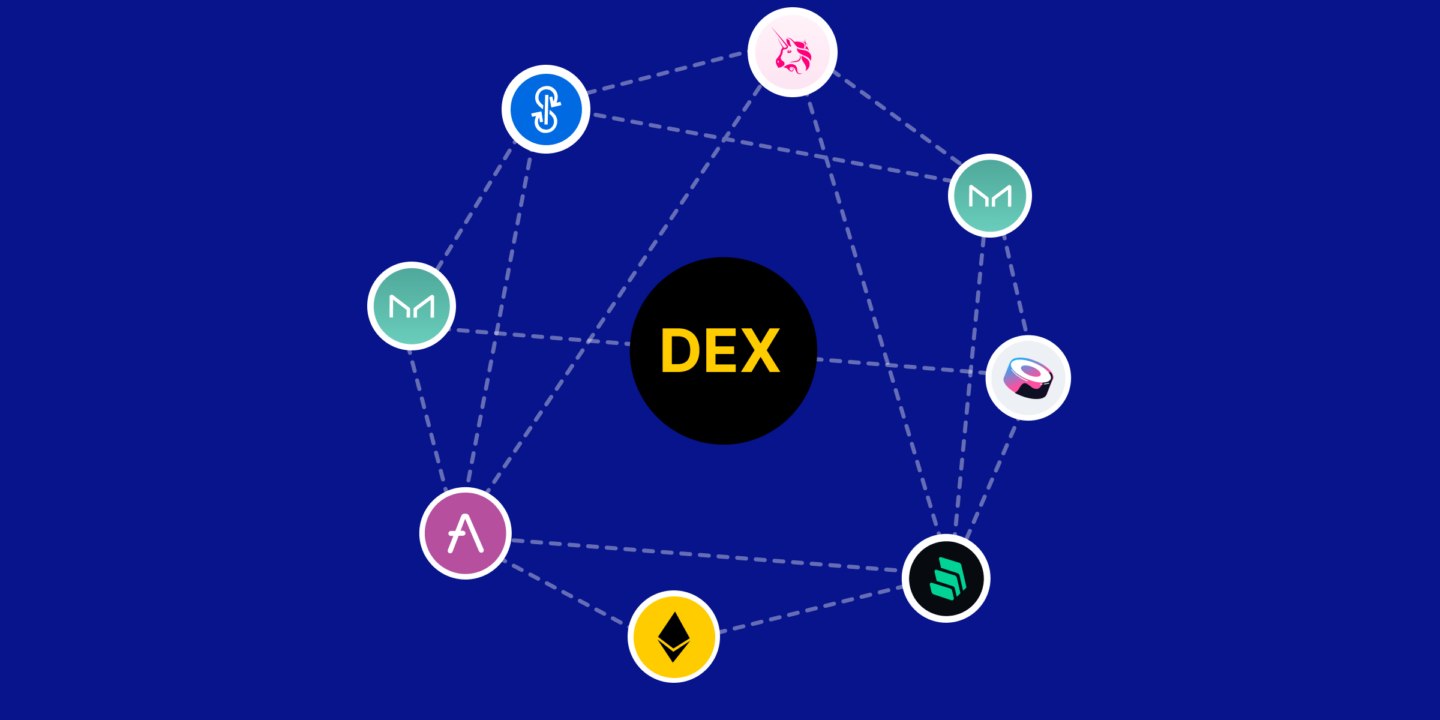
A decentralized exchange is a platform that lets you swap digital assets directly with other users, without handing your funds to a central operator. Trades run through smart contracts, which are self-executing programs on a blockchain that enforce the terms of every swap automatically. You connect a wallet, approve the transaction, and the contract handles matching, settlement, and fee distribution on its own.
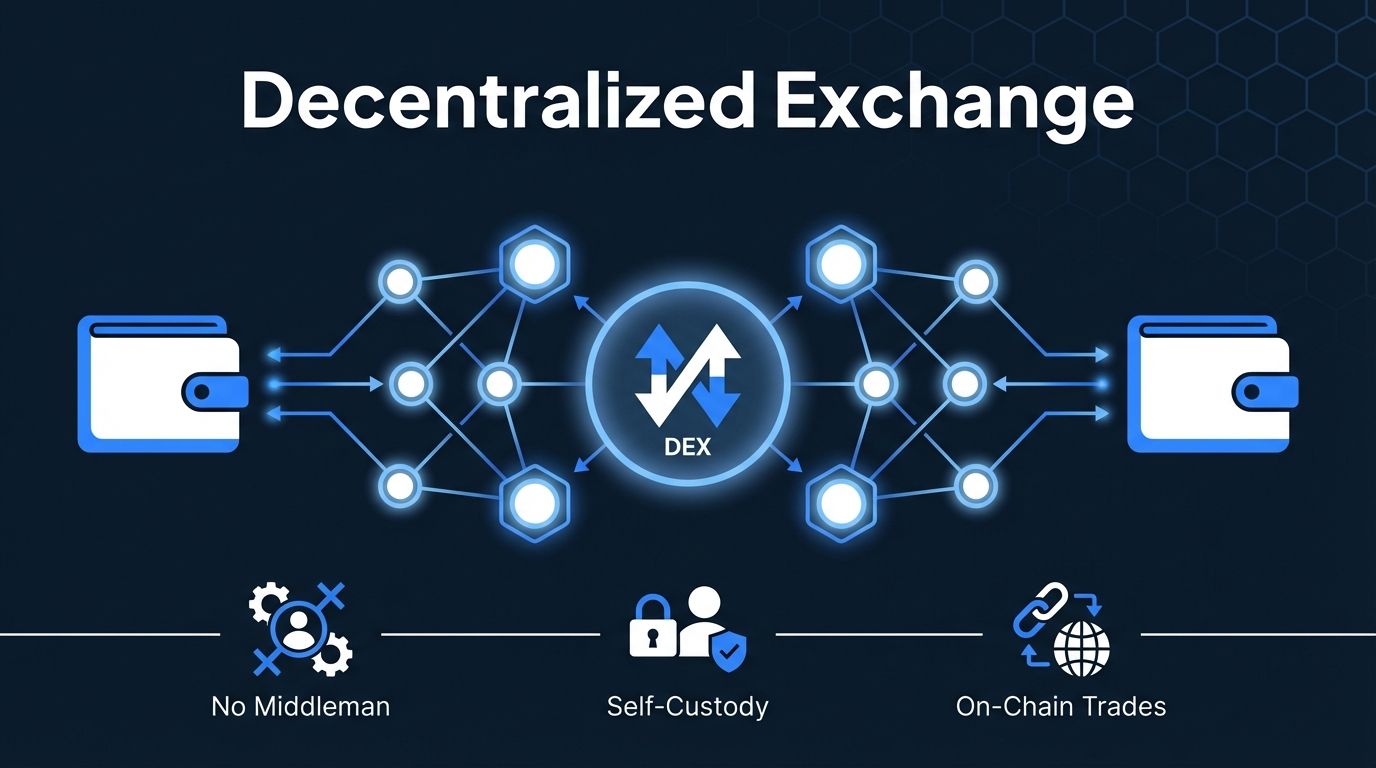
The key difference from a centralized exchange is custody, the heart of the CEX vs DEX debate. On a CEX, you deposit funds and the platform holds them on your behalf. On a DEX, your tokens never leave your wallet until the moment the smart contract executes the trade, and the output tokens land right back in that same wallet. That single distinction removes the risk of an exchange going insolvent or freezing withdrawals, something centralized users have experienced more than once.
This model lines up with the broader principles blockchain was built on: transparency, because every transaction is recorded on a public ledger; security, because there’s no central honeypot for attackers; and user autonomy, because nobody can block your access or move your funds without your private key.
The space has grown far beyond a handful of Ethereum-based swap apps. At one recent snapshot, 754 decentralized exchanges were tracked across dozens of blockchains, with total 24-hour DEX trading volume sitting at roughly $7.19 billion. That figure represented approximately 5.6% of global crypto trading volume, a share that continues to climb as more chains launch and Layer 2 networks cut costs.
How decentralized exchanges operate
Every DEX runs on a peer-to-peer network anchored to a blockchain, which means two users can trade directly without a middleman processing the transaction. Smart contracts do the heavy lifting: they match orders, settle trades, and distribute fees according to rules written into the code.
Most DEXs today use the automated market maker (AMM) model. Instead of a traditional order book where buyers and sellers post prices, an AMM relies on liquidity pools. These are reserves of token pairs deposited by users. When you swap token A for token B, you’re trading against the pool rather than waiting for another person to take the other side. The price adjusts algorithmically based on the ratio of tokens in the pool.
Order-book DEXs take a different approach. They match specific buy and sell orders, either fully on-chain or through a hybrid model where matching happens off-chain for speed and settlement happens on-chain for security. If you want to set a limit order and buy only at a specific price, an order-book DEX gives you that control, something most AMMs don’t natively support.
DEX aggregators add another layer. Rather than pulling liquidity from a single pool, an aggregator like Jupiter or 1inch routes your trade across multiple liquidity sources at once. If you’re swapping a large amount, the aggregator splits the order across several pools to reduce slippage and find you the best effective price. For traders who don’t want to manually compare rates across five different DEXs, aggregators handle that comparison in a single transaction.
Key benefits of trading on a DEX
DEXs offer a set of structural advantages over centralized platforms, and most of them stem from one fact: you keep your own keys.
- No identity verification on most platforms. The majority of DEXs don’t require KYC. You connect a wallet and trade. Your personal data stays with you, which matters if you value financial privacy or live in a region where centralized exchange access is limited.
- Your funds stay in your wallet. Because you never deposit assets into an exchange-controlled account, there’s no custodial risk. If a DEX’s front-end website goes down, the smart contracts still live on the blockchain, and your tokens are still in your wallet. This removes the scenario where an exchange collapse takes user funds with it.
- Harder for bad actors to manipulate markets. Decentralized liquidity pools make practices like wash trading, where someone trades with themselves to inflate volume, more difficult to sustain at scale compared to opaque centralized order books.
- Lower fees on many chains. Solana-based DEXs, for example, charge transaction fees under $0.0025 per trade. Even on costlier chains, you avoid the withdrawal fees that centralized exchanges tack on when you move tokens to your own wallet, because you’re already trading from your wallet.
- Faster and broader token access. New tokens show up on DEXs the moment someone creates a liquidity pool for them. On a centralized exchange, a token has to go through a listing process that can take weeks or months. If you trade newer projects or long-tail tokens, DEXs are often the only place to find them.
Risks and drawbacks to watch for
DEXs come with real risks, and understanding them before you trade is more useful than learning the hard way.
- Smart contract bugs can drain funds. Every DEX runs on code, and code can have vulnerabilities. Even audited contracts aren’t guaranteed to be flawless. An exploit in a poorly reviewed smart contract can result in permanent loss of funds deposited in a pool, and there’s no customer support line to call.
- No regulatory filter on token listings. Because anyone can create a liquidity pool, fraudulent and scam tokens show up on DEXs regularly. A token with a familiar-sounding name might be a copycat designed to trick you into swapping real value for something worthless. Centralized exchanges at least screen listings before adding them.
- Slippage hits harder in thin pools. When a liquidity pool doesn’t hold much value, your trade moves the price against you. A swap you expected to execute at $1.00 might fill at $0.96 or worse. You can set slippage tolerance manually on most DEXs, but setting it too tight means your transaction fails, and setting it too loose means you accept a bad price.
- Sending tokens on the wrong chain means losing them. If a DEX runs on Ethereum and you send tokens from the BNB Smart Chain to its contract address, those tokens are gone. There’s no recovery process. Always confirm you’re on the correct network before approving a transaction.
- The learning curve is steep for newcomers. Connecting a wallet, approving token spending, understanding gas fees, and reading slippage estimates is a lot to absorb at once. The interface on most DEXs assumes you already know what you’re doing, and one wrong click can be expensive.
How to choose the best decentralized exchange
No single DEX is the right fit for every trader. Here’s what to weigh before you commit to one platform.
- Liquidity depth matters most for execution quality. A DEX with deep pools fills your trade closer to the quoted price. Shallow pools mean more slippage, especially on larger orders. Check the total value locked (TVL) in the specific pair you want to trade, not just the platform’s overall TVL.
- Make sure the DEX supports the chain your tokens live on. If you hold tokens on Solana, an Ethereum-only DEX won’t help you. Some DEXs operate on a single chain, while others have deployed across multiple networks. Verify the chain before you connect your wallet.
- Look at the security track record. Has the DEX been audited by a reputable third-party firm? Does it use multi-signature wallets for treasury funds? Does it publish proof-of-reserves data? A clean audit history doesn’t eliminate risk, but it tells you the team has at least submitted their code for outside review.
- Consider your own experience level. Some DEXs invest heavily in clean interfaces and educational resources. Others are built for power users and assume you know how to read a liquidity chart. If you’re newer to DeFi and its core concepts, a platform with clear labels and built-in tooltips saves you from costly mistakes.
- Cross-chain capability varies widely. DEXs like THORChain can swap native assets between entirely different blockchains without bridges or wrapped tokens. Others only work on one chain. If you regularly move between chains, a cross-chain DEX or a multi-source aggregator saves you steps and fees.
- The DEX’s jurisdiction affects its long-term reliability. A protocol operating in a jurisdiction with evolving crypto regulations could see its front-end interface restricted or shut down. While the smart contracts remain on-chain regardless, losing the primary interface makes trading less convenient.
Top decentralized exchanges ranked by volume and features
The DEXs below are ranked by 24-hour trading volume, with profiles covering each platform’s chain focus, trading model, and what sets it apart. Token market caps and prices referenced here are snapshot figures, not live data.
Uniswap
Uniswap consistently holds the top spot among DEXs by trading volume. It launched on Ethereum for ERC-20 token swaps but has since expanded to multiple blockchains, including several Layer 2 networks. Its AMM model runs across multiple protocol versions simultaneously: V3 introduced concentrated liquidity, which lets providers focus their capital on specific price ranges rather than spreading it across the entire curve, and V4 added further customization through hook contracts.
The interface is one of the more approachable in the DEX space, and the depth of its Ethereum-based pools means slippage stays tight on major trading pairs. For anyone trading within the Ethereum ecosystem, Uniswap is typically the first stop.
The UNI governance token had a market cap of approximately $2.68 billion and traded near $4.30 at one observed point, according to Forbes.
PancakeSwap
PancakeSwap started as the go-to DEX on BNB Smart Chain and has grown into a multichain platform operating across nine or more networks. Beyond basic token swaps, it offers yield farming, a lottery system, and perpetual futures trading, making it more of a DeFi hub than a simple swap interface.
Its V3 variant regularly ranks among the highest-volume DEXs by daily trading activity. The main draw for many users is cost: gas fees on BNB Smart Chain are a fraction of what Ethereum charges, which makes PancakeSwap attractive for high-frequency traders and users working with smaller balances who’d otherwise lose a chunk of each trade to transaction costs.
CAKE, its native token, had a market cap of roughly $551.82 million with a token price near $1.72 at a recent snapshot.
Hyperliquid
Hyperliquid is a decentralized perpetual-futures exchange built on its own Layer-1 blockchain, purpose-designed for speed. Its one-click trading feature removes the need to approve each individual transaction in your wallet, which shaves seconds off execution, something that matters when you’re trading leveraged positions in a fast-moving market.
At one observed point HYPE had reached roughly $18.22 billion in market cap with a price near $81.91, placing it at the top of the DEX-token leaderboard. That rapid rise reflects how quickly derivatives traders have adopted the platform, drawn by the combination of decentralized custody and centralized-exchange-level speed.
Jupiter
Jupiter is a DEX aggregator built on Solana. Instead of holding its own reserves, Jupiter scans multiple Solana-based liquidity sources in real time, splitting your order across whichever pools yield the tightest effective price.
For Solana traders, Jupiter has become the central hub for DeFi swaps. Instead of checking prices on Raydium, Orca, and others individually, you enter your trade on Jupiter and it handles the comparison and routing in one step. The platform has also started expanding beyond Solana to additional chains.
JUP carried an approximate market cap of $714.58 million, trading near $0.22.
SushiSwap
SushiSwap originally forked from Uniswap’s code, but it has since carved out its own identity. The platform now supports trading on more than 20 blockchains, giving it one of the widest multi-chain footprints in the DEX space. On top of swaps, it offers lending features and yield-farming programs.
That multi-chain reach is SushiSwap’s main strength. If you hold tokens across several chains, including Ethereum, Arbitrum, Polygon, Avalanche, and others, you can access them from a single interface rather than switching between chain-specific DEXs.
SUSHI traded near $0.20 with a market cap of approximately $57 million.
Curve Finance
Curve Finance is built for one thing: efficient stablecoin swaps with minimal slippage. Its pool design uses a bonding curve optimized for assets that should trade near the same value, so swapping USDC for USDT or DAI happens with almost no price impact.
That specialty makes Curve a foundation for much of DeFi. Other protocols route their stablecoin liquidity through Curve pools because the slippage is consistently lower than what general-purpose AMMs offer. It’s deployed on Ethereum and several additional chains.
CRV, the platform’s token, had a market cap near $495 million and traded around $0.32.
Other notable DEXs
Several more DEXs fill important niches depending on your chain and trading style.
- Raydium is an AMM on Solana that also taps into central-limit order-book liquidity, which means tighter spreads than a pure AMM can offer on its own. RAY had a market cap of approximately $212.81 million.
- Orca is a Solana-native DEX focused on SPL token trading. It uses incentivized liquidity pools to attract deposits and keep spreads competitive for Solana pairs. ORCA’s market cap sat near $77.15 million.
- THORChain stands out for true cross-chain swaps. You can trade native Bitcoin for native Ethereum (or other Layer-1 assets) without wrapped tokens or bridges. RUNE carried an approximate market cap of $160.99 million.
- Aerodrome Finance operates on Base, Coinbase’s Layer 2 network, offering swaps, liquidity pools, and a vote-escrowed tokenomics model that rewards long-term liquidity providers. AERO’s market cap was roughly $509.64 million.
- dYdX is an order-book-based decentralized derivatives exchange. It matches orders at centralized-exchange speed while settling on-chain, making it a strong option for traders who want limit orders and leverage without giving up custody.
- 1inch is a DEX aggregator, similar to Jupiter but across EVM-compatible chains. It splits your order across multiple sources to reduce slippage and avoid large price impacts on any single pool.
DEX tokens and market caps explained
Most major DEXs issue a native token that serves as a governance tool, a fee-discount mechanism, or both. Holding UNI, for example, gives you voting rights on Uniswap protocol upgrades. CAKE holders on PancakeSwap can stake tokens for yield-farming rewards. Some tokens also reduce trading fees for holders or grant access to platform features.
According to Forbes, the combined market cap of all DEX tokens stood at roughly $25.61 billion when last surveyed. That number offers a rough gauge of how much capital investors have committed to decentralized trading infrastructure as a category.
These rankings shift regularly. Hyperliquid’s HYPE token, for instance, climbed to the top of the DEX-token leaderboard on the strength of rapid user adoption, while older tokens like SUSHI have seen their market caps shrink as trading volume migrated to newer platforms. A high token market cap doesn’t automatically mean a DEX is the best fit for your needs, but it does reflect where market attention is concentrated at a given moment.
Trading fees on decentralized exchanges
When you trade on a DEX, you pay two separate costs: the protocol’s swap fee and the blockchain’s gas or transaction fee. Understanding both helps you estimate what a trade actually costs before you confirm it.
Swap fees vary by protocol and, in many cases, by the specific pool you’re trading in. Some DEXs let pool creators set custom fee tiers. On Uniswap V3, for instance, pools exist at different fee levels depending on the volatility of the pair: stablecoin pools run lower fees because the price barely moves, while exotic pairs charge more to compensate liquidity providers for higher risk.
Gas costs are where the real variation shows up. On Solana, a transaction costs fractions of a cent. One Solana-based order-book DEX sets its taker fee at 4 basis points (0.04%), and the chain’s gas cost is negligible on top of that. On Ethereum, gas fluctuates with network congestion. During busy periods, a single swap can cost $10 or more in gas alone, though quieter times bring it down considerably. You can set a custom gas price on Ethereum-based DEXs: lower gas means your transaction waits longer for confirmation, while higher gas pushes it through faster.
Layer 2 rollups have changed the math for Ethereum traders. Optimistic Rollups (like Arbitrum and Optimism) and zk-Rollups batch transactions off the main chain and settle them on Ethereum in compressed form, cutting gas costs significantly. If you’re trading on an Ethereum-ecosystem DEX and gas is eating into your returns, moving to a Layer 2 deployment of that same DEX often drops the cost to under a dollar per swap.
One less obvious cost factor is pool liquidity itself. Deeper pools produce tighter spreads, which means the difference between the quoted price and your execution price shrinks. On a thin pool, you might save on the swap fee but lose more to slippage than you would on a slightly more expensive pool with ten times the liquidity.
Earning fees as a liquidity provider
Liquidity pools are smart-contract-held reserves of token pairs that make instant swaps possible without needing a counterparty on the other side of your trade. When you swap ETH for USDC on an AMM, you’re pulling USDC out of a pool and pushing ETH into it. The pool’s algorithm adjusts the price based on the new ratio.
Anyone can become a liquidity provider (LP) by depositing an equal value of both tokens in a pair. In return, you receive a proportional share of the trading fees generated by that pool. If you deposit 1% of a pool’s total value, you earn 1% of the fees collected from every swap that runs through it.
The concentrated-liquidity design that Uniswap V3 introduced lets you allocate capital to a specific price range rather than across the entire curve from zero to infinity. If ETH is trading at $3,000 and you expect it to stay between $2,800 and $3,200, you can concentrate your liquidity in that band. Your capital works harder within that range, earning more fees per dollar deposited than a full-range position would. The tradeoff is that if the price moves outside your range, your position stops earning entirely until it comes back.
The main risk for liquidity providers is impermanent loss. This happens when the price ratio of the two tokens in your pool changes after you deposit. Suppose you provide liquidity to an ETH/USDC pool. If ETH’s price rises 50%, the pool rebalances, and you end up holding more USDC and less ETH than you started with. When you withdraw, the combined dollar value of your tokens may be less than if you’d simply held both tokens in your wallet without providing liquidity. The loss is called “impermanent” because it reverses if the price returns to where it was when you deposited, but if you withdraw while the ratio is shifted, the loss becomes real.
Yield farming programs try to offset this risk by offering additional token rewards on top of swap fees. A DEX might distribute its native token to LPs as an incentive, boosting the effective return. Whether the extra yield actually compensates for impermanent loss depends on the size of the price move, the pool’s trading volume, and the value of the reward tokens, so it’s worth running the numbers before committing capital.
Security measures on DEXs
DEXs are built on a non-custodial model, but “non-custodial” doesn’t mean “risk-free.” Here’s how security layers stack up across the space.
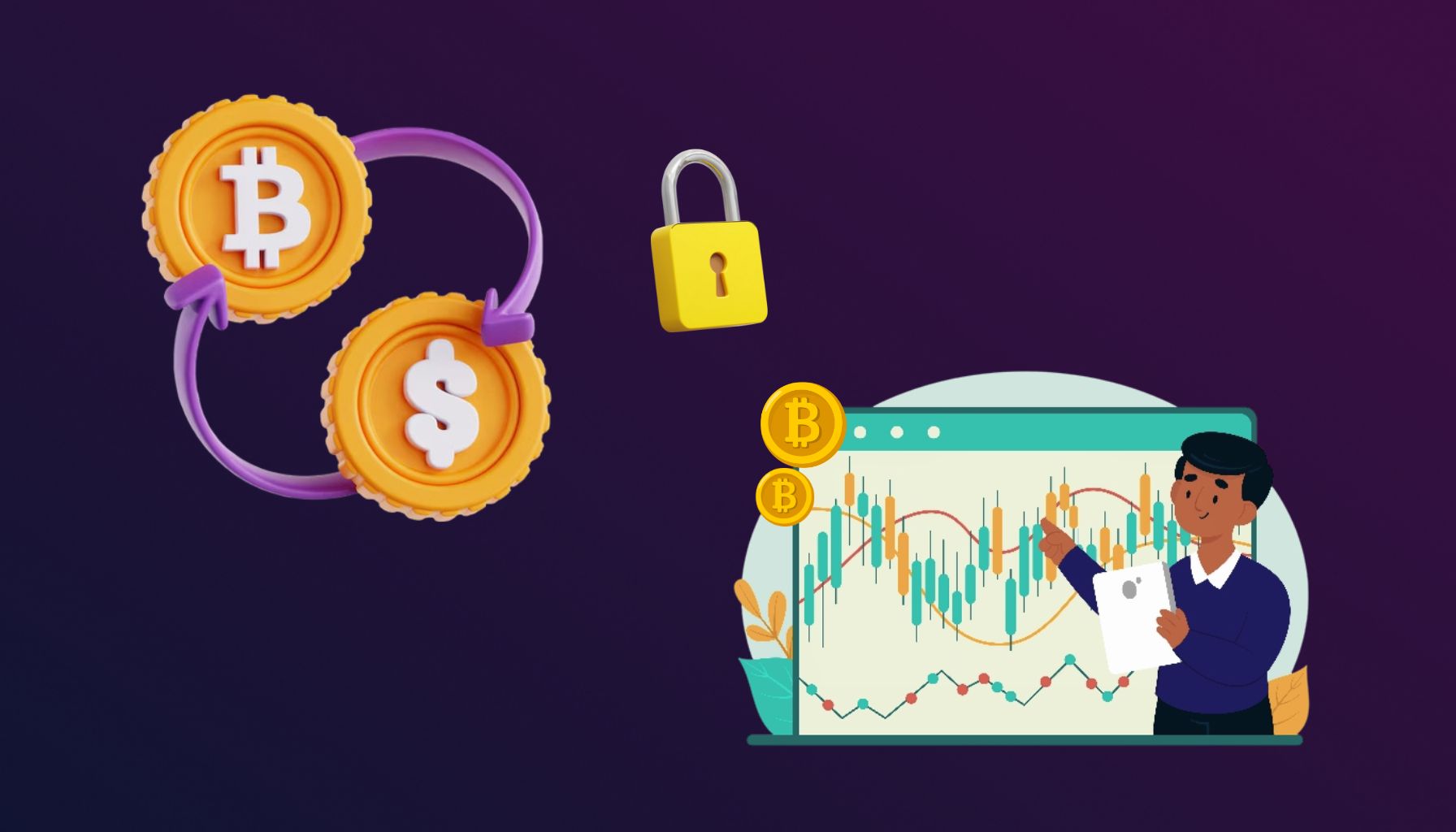
- You hold your own private keys. Because a DEX never takes custody of your funds, a breach of the DEX’s website or servers can’t drain your wallet. Your tokens are only at risk if someone compromises your private key or if you approve a malicious smart contract.
- Every transaction lives on-chain. The blockchain serves as a transparent, tamper-proof audit trail. Anyone can verify what happened in a given trade or pool interaction, which makes it much harder to hide fraudulent activity compared to opaque off-chain systems.
- Multi-signature wallets protect protocol treasuries. Many DEX teams use multi-sig setups that require multiple key holders to approve any movement of funds. This prevents a single compromised account from emptying the project’s treasury.
- Cold storage keeps large reserves offline. Protocols that hold significant token reserves typically store the bulk of those funds in wallets disconnected from the internet, reducing the attack surface for online exploits.
- Proof of reserves lets you verify backing. Some DEXs publish proof-of-reserves data that allows users to independently check whether the protocol holds the assets it claims. This is more common on hybrid platforms but is gradually spreading across DeFi.
- Third-party smart contract audits are standard practice. Reputable DEXs submit their code to independent security firms for review before deploying updates. Audits reduce code-level vulnerabilities, though they don’t catch every possible exploit. Checking whether a DEX has been audited, and by whom, is one of the first things to verify before you trade.
Connecting a wallet and making your first trade
If you’ve never used a DEX before, here’s the step-by-step process from wallet setup to completed swap.
- Pick a non-custodial wallet that matches the DEX’s blockchain. For Ethereum and EVM-compatible chains (Arbitrum, Polygon, BNB Smart Chain, Base), a browser-extension wallet like MetaMask is the most widely supported option. For Solana DEXs, a Solana-native wallet like Phantom or Solflare integrates more smoothly. If you need help getting started, our guide to create a crypto wallet walks you through the setup process in minutes.
- Fund your wallet with two things: the chain’s native token for gas (ETH for Ethereum, SOL for Solana, BNB for BNB Smart Chain) and the token you want to trade. You can transfer these from a centralized exchange or receive them from another wallet.
- Go to the DEX’s interface and connect your wallet. Every DEX has a “Connect Wallet” button, usually in the top right corner. Click it, select your wallet type, and approve the connection in the pop-up. This doesn’t give the DEX access to your funds; it just lets the interface read your balances and prepare transactions for your approval.
- Select the trading pair and enter your amount. Choose the token you’re selling and the token you’re buying. Type in the amount, and the interface will show you the estimated output, the exchange rate, and the expected slippage. If slippage looks high, the pool might be thin, so consider trading a smaller amount or checking whether a DEX aggregator finds a better route.
- Confirm the transaction in your wallet. When you click “Swap,” your wallet pops up asking you to approve the transaction. Review the gas cost and the details, then confirm. On your very first trade with a new token, you’ll also need to approve a token-spending allowance, which is a separate transaction that authorizes the smart contract to access that specific token in your wallet.
- The smart contract executes the swap. Once confirmed, the transaction goes to the blockchain for processing. Depending on the chain, this takes anywhere from under a second (Solana) to a minute or more (Ethereum during congestion). When it completes, the new tokens appear in your wallet.
- Disconnect your wallet or revoke token approvals when you’re done. Disconnecting from the DEX’s front end is a basic hygiene step. For stronger protection, use a tool to revoke the token approvals you granted during the swap. An active approval lets that smart contract interact with your tokens indefinitely, so revoking it closes that door until you choose to open it again.
DEX vs. centralized exchange: key differences
| Feature | Decentralized exchange | Centralized exchange |
|---|---|---|
| Custody | You hold your own keys; funds stay in your wallet | The exchange holds your deposits |
| Fee structure | Swap fee plus blockchain gas cost | Trading fee, withdrawal fee, possible deposit fee |
| Token range | Any token on the supported chain, including newly launched tokens | Curated listings that go through a vetting process |
| Speed | Depends on block time and chain throughput | Generally faster order matching via internal systems |
| Regulation | Largely operates without direct regulatory oversight | Operates under exchange licenses in most jurisdictions |
| Main risks | Smart contract vulnerabilities, slippage in thin pools | Custodial risk, platform insolvency |
| Privacy | Most require no identity verification | KYC typically required for full access |
The choice between the two isn’t always either/or. Many traders use centralized exchanges for fiat on-ramps and high-volume pairs, then move to a DEX for long-tail tokens, privacy, or yield farming. To understand what a crypto exchange is and how the centralized model works, our separate guide covers the fundamentals in detail.
Innovations shaping the future of DEXs
Concentrated-liquidity models, pioneered by Uniswap V3, are being adopted and refined across more platforms. Because providers concentrate deposits in narrow bands, each dollar in the pool captures a larger share of swap fees than it would in a full-range position. Newer versions are experimenting with automated rebalancing so providers don’t have to manually adjust their ranges when prices drift.
Order-book DEXs are gaining ground in derivatives trading. Platforms like Hyperliquid and dYdX have pushed this model into derivatives, offering perpetual futures with sub-second matching while keeping settlement on-chain so traders retain custody throughout. This category barely existed a few years ago and now accounts for significant volume.
On the liquidity-management side, several protocols are testing AI-driven systems that adjust pool parameters, rebalance positions, and refine trading strategies without manual input from providers. These tools are still early, but by handling the active monitoring and adjustment that providers currently do themselves, they could lower the barrier to earning yield as an LP.
Cross-chain interoperability keeps improving. Protocols like THORChain already enable native swaps between different Layer-1 blockchains without requiring bridges or wrapped tokens, and newer interoperability layers are expanding the number of chains that can talk to each other directly. This matters because bridges have historically been one of DeFi’s biggest attack surfaces.
Layer 2 scaling solutions continue to push costs down for Ethereum-based DEXs. As more trading activity moves to rollups, the per-transaction cost drops while throughput increases, making DEXs competitive with centralized platforms on speed for everyday swaps.
Front-end design is finally getting attention. Mobile-first interfaces, simplified swap screens, and built-in educational prompts are all aimed at reducing the learning curve. The technology under the hood has matured faster than the user experience, and that gap is starting to close.
Frequently asked questions
What is the best decentralized wallet for using DEXs?
It depends on the blockchain. For Ethereum and EVM-compatible chains like Arbitrum, Polygon, and BNB Smart Chain, browser-extension wallets such as MetaMask offer the widest DEX compatibility. For Solana-based DEXs, Solana-native wallets like Phantom or Solflare integrate more smoothly with platforms like Jupiter and Raydium. The key is matching your wallet to the chain the DEX operates on, since a Solana wallet won’t connect to an Ethereum DEX and vice versa.
How are DEXs ranked?
The most common ranking metric is 24-hour trading volume, which reflects how much value flows through the platform in a day. Other factors include total value locked in liquidity pools, the number of supported trading pairs, and the native token’s market cap. Volume alone doesn’t tell the full story, though. A DEX with moderate volume but deep, stable liquidity pools can offer better execution than a higher-volume platform with fragmented liquidity.
Can I trade Bitcoin directly on a DEX?
On cross-chain DEXs like THORChain, yes. You can swap native BTC for native ETH or other Layer-1 assets without wrapping or bridging. On single-chain DEXs that run on Ethereum or Solana, you’d trade a wrapped version of Bitcoin (like WBTC on Ethereum) rather than native BTC. To learn what is Bitcoin and how the original network operates, our beginner guide covers the essentials.
Do DEXs require KYC?
Most don’t. The majority of DEX smart contracts are permissionless, meaning anyone with a wallet can interact with them without providing identity documents. That said, some front-end interfaces operated in regulated jurisdictions have started adding optional or required verification steps. Even in those cases, you can often interact with the underlying smart contract directly or through an alternative front end that doesn’t impose those requirements.
Picking the right DEX for your trading style
If you mostly do spot swaps between major tokens and stablecoins, an AMM-based DEX with deep pools handles that cleanly. Uniswap on Ethereum, PancakeSwap on BNB Smart Chain, or Curve for stablecoin pairs all fit that profile. The priority is liquidity depth in the pairs you trade most.
Active traders who want limit orders, leverage, or perpetual futures should look at order-book DEXs like Hyperliquid or dYdX. These platforms feel closer to a centralized trading experience while keeping your funds in your own wallet.
If you’re providing liquidity to earn yield, compare farming incentives, pool volume, and impermanent-loss exposure across protocols. A pool offering high reward-token incentives might not be worth it if the underlying pair is volatile enough to generate significant impermanent loss. At AXL Research Hub, we find that running even rough impermanent-loss estimates before depositing saves providers from surprises down the line.
Traders who work across multiple chains benefit most from DEX aggregators like Jupiter (on Solana) or 1inch (across EVM chains), or from cross-chain DEXs like THORChain that handle native swaps without bridges. For those who prefer centralized platforms for certain pairs, our list of the best crypto exchanges covers the top options side by side.
No single ranking captures the full picture. Fees, liquidity, chain support, security track record, and interface quality all matter, and they matter in different proportions depending on how you trade. If you also trade from your phone, our roundup of the best crypto apps compares mobile options across fees, security, and features. Start with the factor that affects your trades most, whether that’s gas cost, token availability, or execution speed, and narrow from there.