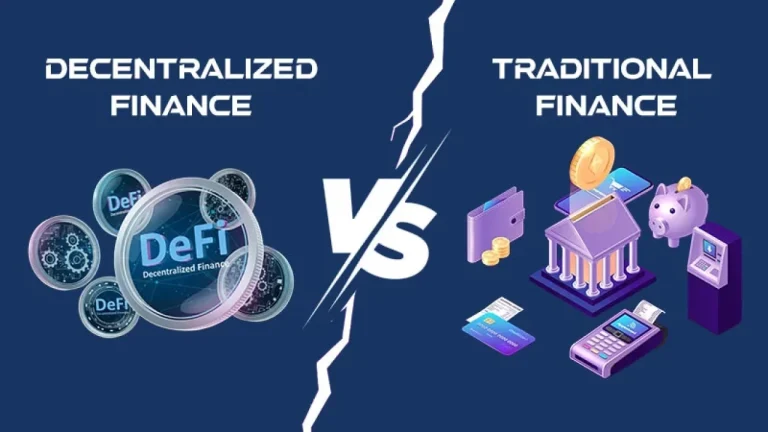


DeFi, short for decentralized finance, is reshaping how people lend, borrow, trade, and save by cutting banks and brokers out of the equation. Instead of relying on a financial institution to hold your money or approve a transaction, you interact directly with software running on a public blockchain.
What is decentralized finance (DeFi)?
DeFi is an umbrella term for financial products and services built on public blockchains, primarily Ethereum. The core idea is peer-to-peer: you can lend, borrow, trade, or earn interest by transacting directly with other people or with automated protocols, no bank or brokerage standing in the middle.
Users interact through decentralized applications, commonly called dApps, which are powered by smart contracts. A smart contract is a self-executing digital agreement that runs automatically when preset conditions are met. Think of it as a vending machine for financial transactions: put in the right inputs, and the contract delivers the output, every time, without a clerk processing paperwork.
Anyone with an internet connection and a crypto wallet can participate. There are no application forms, no account approvals, and no business-hour restrictions. DeFi markets operate around the clock, 365 days a year.
The term “DeFi” itself first appeared in August 2018, coined in a Telegram chat among Ethereum developers and entrepreneurs. But the movement’s roots go deeper. Bitcoin was the first protocol that let people own and transfer value on a decentralized ledger without a trusted intermediary. Ethereum expanded on that breakthrough by introducing programmable smart contracts, which opened the door to a full range of financial applications rather than just sending and receiving coins.
DeFi vs traditional finance
The differences between DeFi and traditional finance come down to who holds the money, who sets the rules, and how fast things move.
| Feature | DeFi | Traditional finance |
|---|---|---|
| Custody of funds | Users hold their own funds in personal wallets | Institutions hold assets on users’ behalf |
| Transfer speed | Settles in minutes | Can take days due to manual clearing processes |
| Identity requirements | Pseudonymous; no personal info required | Tightly coupled with personal identity and credit history |
| Access | Open to anyone with a wallet | Requires applications, credit checks, and identity verification |
| Market hours | Never closes | Exchanges and banks follow business hours |
| Transparency | Code is public and auditable | Institutions operate as closed books |
| Fees | Protocol and network fees | Layered intermediary costs: custodial, brokerage, and clearing fees |
| Authority over funds | No centralized authority can freeze funds or block access | Governments and banks can freeze accounts or shut down markets |
Is DeFi the same as crypto?
No. Cryptocurrencies like Bitcoin and Ethereum are digital assets you can store and exchange on blockchain networks. DeFi is the broader set of financial applications built on top of those networks. It’s not a single currency.
A cryptocurrency can exist without DeFi. If you buy Bitcoin and use it strictly as a payment method or a store of value, you’re using crypto but not DeFi. The reverse doesn’t hold: DeFi relies on crypto assets and blockchain infrastructure to function. Without tokens to lend, trade, or pledge as collateral, and without a blockchain to record those transactions, there’s no DeFi.
What DeFi adds is programmability. Through smart contracts, it extends crypto into lending, borrowing, derivatives, insurance, and dozens of other financial services. The clearest way to think about the relationship: crypto is the asset layer, and DeFi is the services-and-applications layer built over it. If you’re still building foundational knowledge, our guide on crypto fundamentals covers the basics of that asset layer.
How does DeFi work?
You start by connecting a crypto wallet to a dApp. There’s no sign-up form, no paperwork, and no waiting period. Your wallet is your identity and your access credential in one.
Smart contracts replace the roles that banks and brokers play in traditional finance. They hold funds in escrow and release them automatically when coded conditions are met. Once a smart contract is deployed on the blockchain, it runs exactly as programmed. No party, not even the developer who wrote it, can alter its logic after deployment.
Because the code behind these contracts is public, anyone can read and audit it. In practice, this means bad code gets spotted faster than a flawed internal process at a private company might. That said, auditing still relies heavily on technically skilled community members who can parse the code line by line. As readability tools and formal verification methods improve, reviewing a contract’s safety should get easier, but right now it’s still a specialized skill.
The DeFi technology stack
DeFi isn’t one piece of software. It’s a stack of layers, each building on the one below it. Understanding these layers helps you see where value is created, where risks live, and why different protocols can plug into each other.
- Layer 1, the blockchain: This is the foundation. It stores the full transaction history and the current state of every account. Ethereum is the dominant base layer for DeFi, though it isn’t the only one.
- Layer 2, the assets: These are the tokens that move through the system: ETH, ERC-20 tokens, stablecoins, and other digital tokens. Most DeFi tokens on Ethereum follow the ERC-20 standard, a common set of rules that lets tokens interact predictably with any protocol built to that standard. ETH itself doesn’t natively follow ERC-20 rules, so it’s often wrapped into WETH (Wrapped Ether) for compatibility with ERC-20-based dApps.
- Layer 3, the protocols: Smart contracts that provide specific financial functions, such as lending, trading, or insurance. Each protocol is a set of rules governing how a particular service works.
- Layer 4, the applications (dApps): The user-facing interfaces you actually click through. A dApp connects your wallet to one or more protocols, translating raw smart-contract interactions into buttons, dashboards, and input fields.
One of the most powerful properties of this stack is composability. Tokens you earn on one protocol can be fed directly into another. You might deposit a stablecoin into a lending protocol, receive a representative token in return, and then use that representative token as collateral somewhere else. This layered interplay is why the DeFi community calls these tools “money Legos”: each piece snaps into the next.
Role of Ethereum and blockchain in DeFi
Ethereum’s contribution to DeFi goes beyond hosting smart contracts. It introduced the concept of programmable money, code that can do far more than Bitcoin’s store-and-send capability. With Ethereum, developers can write contracts that handle lending terms, automate market-making, and enforce insurance payouts, all without a middleman. Our beginner’s guide to the Ethereum network breaks down the network’s architecture in more detail.
No single entity owns Ethereum or the smart contracts deployed on it, which means the rules of any given protocol can’t be changed unilaterally by a company or a government. Every DeFi product on Ethereum shares the same base language and the same ledger tracking ownership and transactions. That shared foundation acts as a built-in settlement layer and makes interoperability across protocols possible: a token created by one team’s lending contract can be read and used by another team’s trading contract.
Bitcoin plays a different but foundational role. Its rules, like its fixed supply and open access, are written directly into the protocol. No government can inflate its supply, and that monetary predictability is one reason Bitcoin remains a cornerstone of the broader crypto space even as Ethereum dominates DeFi application development. Our guide to Bitcoin basics covers those fundamentals in detail.
Ethereum isn’t the only blockchain hosting DeFi, though. Networks like Cosmos also support DeFi protocols, and cross-chain technology is increasingly spreading demand across multiple blockchains. This reduces congestion on any single network and gives users more choices about where they transact.
DeFi use cases and applications
DeFi covers a wide range of financial services. Some mirror what banks offer. Others have no traditional equivalent at all.
Lending and borrowing are the most straightforward use cases. You deposit crypto into a lending protocol, and interest accrues in real time, not in monthly statements. If you deposit 100 Dai into a lending protocol, you might receive 100 representative tokens (for example, aDai), and over the following days or hours your balance grows to 100.1234 as interest accumulates.
Borrowing works differently than a bank loan. Instead of a credit check and income verification, you pledge crypto as collateral. If the value of your collateral drops below a threshold, the protocol automatically seizes it to cover the loan. Some protocols even accept NFTs as collateral.
Flash loans are one of DeFi’s most unusual inventions. They let you borrow funds without posting any collateral, but with a strict catch: you must repay the loan within the same blockchain transaction. If repayment fails, the entire transaction reverts as if it never happened. This opened up arbitrage strategies that were previously available only to well-capitalized traders. For example, a flash-loan user could borrow an asset priced at $1.00 on exchange A, sell it at $1.10 on exchange B, repay the loan, and pocket the difference minus the transaction fee, all in a single atomic transaction.
Decentralized exchanges (DEXs) let you swap tokens peer-to-peer, 24 hours a day. Instead of a traditional order book matching buyers and sellers, most DEXs use automated market makers. These are smart contracts managing liquidity pools that adjust prices algorithmically based on supply and demand. To understand how DEXs compare with their centralized counterparts, our explainer on what a crypto exchange is covers the key differences.
Stablecoins solve one of crypto’s biggest practical problems: price volatility. Tokens like Dai and USDC are pegged to the US dollar, with their value staying within cents of one dollar. That stability makes them usable for everyday spending and saving in a way that Bitcoin or Ether, with their price swings, aren’t. Stablecoins have found particularly strong adoption in Latin America, where people use them to protect savings from local-currency inflation.
Derivatives and advanced trading bring limit orders, perpetual contracts, and margin trading to decentralized platforms. These tools offer global liquidity while letting users retain custody of their assets, a stark contrast to centralized exchanges where you hand over control of your funds (the CEX vs DEX trade-off in a nutshell).
Savings protocols function like high-frequency savings accounts. You deposit crypto into an interest-bearing protocol, and rates can update as frequently as every 15 seconds, adjusting dynamically to supply and demand for that asset.
Insurance in DeFi aims for cheaper premiums, faster payouts, and transparent claims data compared to traditional coverage. Early products focus on protecting against smart-contract exploits, covering the risk that a bug in a protocol’s code could drain your deposited funds.
Portfolio management and aggregators provide dashboards that consolidate your DeFi positions across multiple protocols into a single interface, so you don’t have to check five different dApps to see your full picture.
Crowdfunding and quadratic funding bring transparency to fundraising. Funders can see exactly how capital is raised and spent. Quadratic funding is a matching mechanism that weights distributions toward projects with the most unique donors rather than the largest single donation. A project receiving 100 donations of $1 each can receive more matching funds than a project receiving one $10,000 donation, because the formula rewards breadth of support.
Payment streaming lets salaries flow by the second over the blockchain, giving workers instant access to earned wages instead of waiting for a biweekly paycheck.
DeFi even supports creative financial structures like no-loss lotteries. You buy 100 tickets with 100 Dai, and the prize pool is generated from the interest earned on all deposited tickets. If you don’t win, you get your full deposit back.
Benefits of DeFi
DeFi’s advantages come from removing intermediaries and putting users in direct contact with open-source financial protocols.
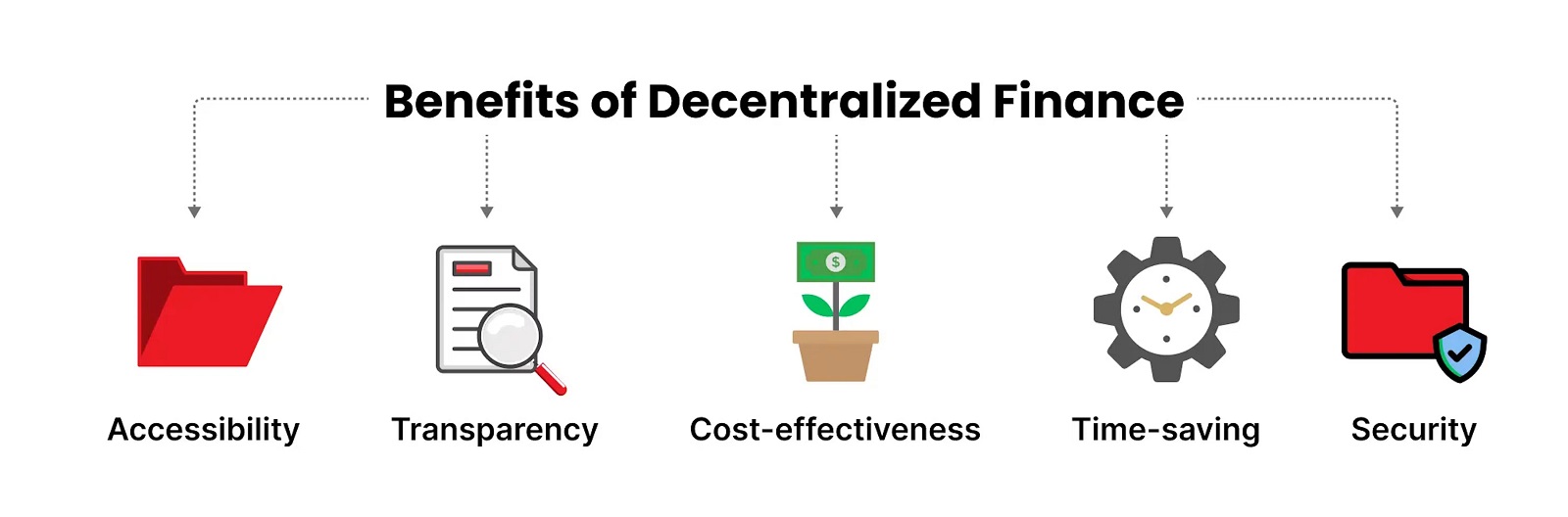
- Accessibility: Anyone with a crypto wallet and internet access can participate. There are no gatekeepers deciding who qualifies.
- Privacy: No personal information is required to use a DeFi protocol. All activity is linked to a wallet’s private key, not a name or Social Security number.
- Speed: Transfers and interest updates happen in minutes or seconds rather than the days a bank wire can take.
- Transparency: Every transaction is recorded on a public blockchain, and the smart-contract code governing each protocol is viewable and auditable by anyone.
- User control: Most protocols never take custody of your funds. You retain ownership throughout the transaction.
- Flexibility: Assets can move anywhere, anytime, without requiring permission or paying costly transfer fees to an intermediary.
- Openness to innovation: Because protocols are open-source, any developer can fork, combine, or extend existing code. This accelerates the pace at which new financial products appear.
- Financial inclusion: DeFi removes barriers for people who lack access to bank accounts or formal financial services, offering participation based on internet access rather than geography or financial history.
Risks and downsides of DeFi
DeFi carries real risks, and understanding them before you put money in is more important than understanding the upside.
- Smart-contract bugs and exploits: Errors in a protocol’s code can lead to a complete loss of deposited funds. Professional audits reduce this risk but don’t eliminate it. A contract that passed an audit can still contain vulnerabilities the auditors missed.
- High volatility: The crypto assets underlying DeFi can swing sharply in value. A lending position that looks healthy in the morning can face liquidation by the afternoon if the collateral token drops fast enough.
- Scams and fraud: Rug pulls, where developers drain a protocol’s liquidity and disappear, remain a persistent problem. Phishing attacks targeting wallet credentials are common, and fraudulent projects continue to erode trust across the space.
- Fluctuating fees: Network transaction fees (called gas on Ethereum) and protocol rates change constantly. During periods of high demand, gas fees can spike to levels that make small transactions uneconomical.
- Regulatory uncertainty: Rules vary by jurisdiction and continue to evolve. What’s permitted in one country or US state may not be in another, creating compliance ambiguity for users and builders alike.
- No consumer protections: There’s no equivalent to bank deposit insurance (like FDIC coverage) or chargeback rights. If something goes wrong, you have no institution to call.
- Self-custody responsibility: You are the bank. Losing your private key or seed phrase means permanent, irreversible loss of your assets. No customer support line can reset your credentials.
- Tax and record-keeping burden: You’re responsible for tracking and reporting every transaction for tax purposes. With DeFi activity spread across multiple protocols, this can get complicated fast.
- Liquidity and bank-run risk: Because DeFi withdrawals are automated and instant, a rush of users pulling funds can drain a protocol’s reserves faster than traditional safeguards could respond.
Is DeFi legal in the US?
There’s no blanket federal law that declares DeFi legal or illegal. How it’s regulated depends on the specific activity and the asset involved.
Securities regulators, commodities regulators, and tax authorities each claim jurisdiction over different aspects of DeFi. A token that looks like a security falls under one set of rules. A token that functions more like a commodity falls under another. Regardless of classification, tax obligations apply: crypto gains and DeFi yields are reportable income. Users bear the responsibility for tracking every transaction and filing accordingly.
The broader regulatory framework is still taking shape. Proposed legislation and enforcement actions continue to define the boundaries, and those boundaries shift with each new ruling or congressional hearing. Regulations also differ across states, so a DeFi activity that’s straightforward in one state might face additional compliance requirements in another.
The global picture is similarly fragmented. Different countries adopt different stances toward DeFi, which affects cross-border participation. A protocol accessible from the US may face restrictions in another jurisdiction, or vice versa. For US users, the practical takeaway is that you should treat DeFi income as taxable, keep detailed records of your transactions, and stay aware that the rules are actively evolving.
Emerging trends in decentralized finance
DeFi continues to expand beyond its original lending-and-trading roots. Several trends are shaping where it goes next.
- Real-world asset tokenization (RWAs): Protocols are bringing real estate, commodities, and bonds on-chain, creating a bridge between traditional and decentralized markets. Instead of investing in a property through a REIT or a broker, you could hold a token representing a share of that asset directly on a blockchain.
- Cross-chain interoperability: New protocols are enabling DeFi activity across multiple blockchains. This distributes demand across multiple chains, easing the load on any one network while giving users access to liquidity and applications they couldn’t reach from a single chain.
- AI agents: Autonomous software programs are beginning to transact on-chain, handling automated trading, portfolio rebalancing, and protocol interactions without human input for each decision.
- Prediction markets: Decentralized platforms let users wager on the outcomes of future events, from elections to sporting events, without intermediaries setting odds or taking a house cut.
- Decentralized payments: Stablecoins running on blockchain rails are being used for fast, low-cost global transfers outside traditional banking infrastructure, particularly in corridors where bank fees are high or access is limited.
Looking further ahead, there’s growing recognition that DeFi needs global standards. Organizations are working to define common terminology and interoperability frameworks so DeFi and traditional finance can work together smoothly. International Financial Reporting Standards and the Basel Accords serve as models for what that kind of alignment might look like in a decentralized context.
What will determine DeFi’s trajectory are practical questions: how useful the applications are, whether transaction fees stay manageable, how easy it is to move between fiat currency and crypto, and whether regulation provides clarity without stifling development.
Frequently asked questions about DeFi
Is DeFi good or bad?
DeFi offers genuine benefits, including financial inclusion, transparency, and the ability to earn yield or borrow without a bank. But it also carries volatility, scam risk, regulatory uncertainty, and the weight of self-custody responsibility. Whether DeFi is “good” for you depends on your knowledge of how these protocols work and your tolerance for risk. It’s a set of tools, and the outcome depends heavily on how you use them.
Is XRP DeFi?
XRP is a cryptocurrency, not a DeFi application. It operates on the XRP Ledger, which has some centralized characteristics that don’t fit the fully decentralized model most definitions of DeFi describe. That said, DeFi applications can be built on the XRP Ledger, so XRP can participate in DeFi even if it isn’t DeFi itself.
What is a DeFi wallet?
A DeFi wallet is a non-custodial crypto wallet that lets you connect directly to dApps. You retain full control of your private keys and your funds. No intermediary holds your assets or can block your access. If you need help setting one up, our guide on crypto wallet setup walks through the process step by step.
Do I need technical knowledge to use DeFi?
You’ll need a basic understanding of how wallets work, what a seed phrase is, and how gas fees function. Without that foundation, it’s easy to make costly mistakes like sending tokens to the wrong network or approving a malicious contract. User interfaces are improving, but they’re still less intuitive than a banking app. Starting with small amounts while you learn the mechanics is a practical approach.
Where DeFi stands today, what comes next
Tens of billions of dollars in crypto have flowed through DeFi applications, and the space keeps growing. The open-source ethos at its core means anyone can inspect, fork, and build on existing protocols, which accelerates development in ways traditional finance can’t match.
The long-term trajectory hinges on three things: clearer regulation that gives builders and users confidence without locking down innovation, improved security tooling that makes smart contracts safer and easier to verify, and simpler onboarding that doesn’t require a tutorial video before you can make your first transaction. Standardized definitions, like those being developed by international councils, aim to align public and private sectors worldwide on what DeFi terms actually mean.
At AXL Research Hub, we’ll continue covering the protocols, wallets, and tools that make up this space as it matures. As smart contracts become easier to audit and interfaces grow more user-friendly, the barriers to mainstream participation will keep shrinking. Whether DeFi becomes the default financial layer or remains a specialized alternative, understanding how it works puts you in a better position to make informed decisions about your money.