
Every crypto transfer follows one of two paths: on-chain, where the transaction is recorded directly on a blockchain, or off-chain, where it’s processed outside the main chain through a secondary layer or platform. The path you use shapes what you pay, how long you wait, and how much risk you carry. Knowing the difference helps you avoid overpaying for routine transfers and under-securing large ones.
What is the difference between on-chain and off-chain transactions?
On-chain transactions are recorded and validated directly on a blockchain, becoming part of a permanent, publicly visible ledger. Every participant on the network can verify these transactions independently, and once they’re confirmed, the data can’t be altered or deleted. This path prioritizes security, transparency, and immutability.
Off-chain transactions are processed outside the main blockchain. They move through secondary layers, private channels, internal platform ledgers, or side networks. The trade-off is deliberate: off-chain paths prioritize speed, lower cost, and the ability to handle higher transaction volume.
Both types coexist throughout crypto. A single user might send Bitcoin on-chain to a hardware wallet for long-term storage, then use the Lightning Network for a quick off-chain coffee payment an hour later. The distinction between the two affects fees, confirmation time, privacy, the trust model you’re relying on, and the risk profile of every transfer you make.
How on-chain transactions work
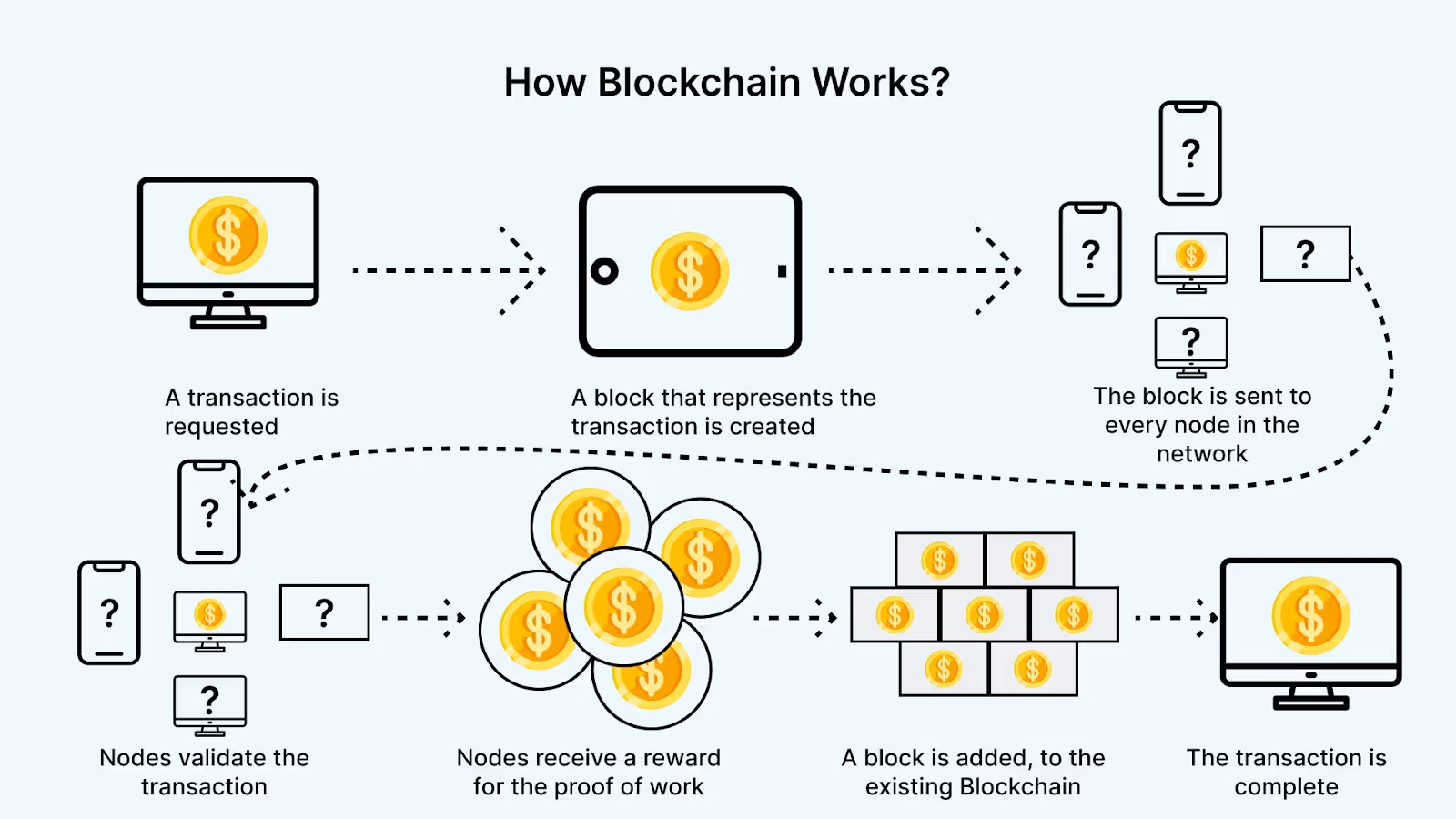
- Sign the transaction in your wallet. You specify the recipient address, the amount, and the fee you’re willing to pay. The wallet uses your private key to cryptographically sign the transaction, proving you authorized it.
- The transaction broadcasts to the network and enters the mempool. The mempool is a holding area for unconfirmed transactions. Every node on the network maintains its own version of this pool, and your transaction sits there until a miner or validator picks it up.
- Miners or validators select transactions from the mempool. They typically prioritize transactions offering higher fees, since that’s their economic incentive. During busy periods, lower-fee transactions can sit in the mempool for minutes or even hours.
- Selected transactions undergo consensus validation. The network uses its consensus mechanism, either Proof of Work (like Bitcoin) or Proof of Stake (like Ethereum), to agree that the transaction is legitimate and the sender actually has the funds.
- The validated transaction is added to a block and earns confirmations. Each new block built on top of the one containing your transaction adds another confirmation. Finality arrives when reversal becomes economically impractical, meaning it would cost an attacker more to undo the transaction than they’d gain from doing so.
Two factors can complicate this process. First, chain reorganizations can rarely revert very recent transactions. A reorg happens when the blockchain rearranges its latest state, usually because two valid blocks were produced nearly simultaneously and the network eventually settles on one chain over the other. Transactions in the discarded branch return to the mempool and need to be re-included. This is why merchants and exchanges often wait for multiple confirmations before treating a payment as final.
Second, network congestion during peak periods increases both wait times and gas fees. When more people want block space than is available, the bidding war for inclusion drives costs up and pushes lower-fee transactions further down the queue.
On-chain transaction strengths
On-chain transfers carry several structural advantages that come directly from how blockchains work.
- Trustless transfer. No intermediary is needed because decentralized consensus enforces validity. You don’t have to trust a bank, a payment processor, or a platform operator to confirm that the transfer happened correctly.
- Immutability. Once a transaction is confirmed and buried under enough subsequent blocks, it becomes practically impossible to change or remove the record. This creates a reliable, tamper-resistant record.
- Reduced counterparty risk. Settlement doesn’t depend on a third party’s solvency. If a centralized platform goes bankrupt, its internal ledger entries may be worthless, but an on-chain settlement has already been finalized by the network itself.
- Atomic settlement. The transfer either executes in full or doesn’t execute at all. There’s no halfway state where funds leave one account but never arrive at the other.
On-chain transaction limitations
The same properties that make on-chain transactions secure also introduce friction.
- Slower processing during high network activity. Resource-intensive consensus means every transaction competes for limited block space. When the network is busy, confirmation times stretch.
- Variable and spike-prone fees. Transaction fees rise when demand for block space increases. A transfer that costs a few cents on a quiet day can cost significantly more during a surge in activity.
- Scalability ceiling. As transaction volume grows, congestion builds, confirmation times lengthen, and costs climb. The base layer of most blockchains can only process so many transactions per second.
- Micropayment impracticality. A fee applies to every transaction regardless of value. Sending $0.50 on-chain when the fee itself might exceed that amount doesn’t make economic sense.
- Integration challenges with traditional finance. Connecting blockchain settlement to conventional banking systems, payment rails, and compliance frameworks adds complexity that slows adoption in some sectors.
How off-chain transactions work
In an off-chain system, value moves between participants without writing each individual transfer to the base chain. The transfers happen inside a secondary system, whether that’s a payment channel, a rollup, a sidechain, or a centralized platform’s internal ledger. The base blockchain doesn’t see every hop along the way.
Periodically, the off-chain system settles back to the main blockchain. It posts the net result, a compressed summary, or a cryptographic proof to Layer 1, anchoring the off-chain activity with on-chain finality. Think of it like running a tab at a bar all day and settling once in cash at the end. You get speed and convenience off-chain, and the final tally gets the security and permanence of the main chain.
What actually gets posted to Layer 1 varies by method. It might be a balance update showing each party’s final holdings, a batch summary covering thousands of transactions, or a zero-knowledge proof that mathematically confirms correctness without revealing individual transfer details.
Off-chain transaction strengths
Off-chain paths solve many of the friction points that on-chain transactions struggle with.
- Near-instant execution. Transfers skip the global consensus process, so they can confirm in fractions of a second rather than minutes.
- Lower per-transaction fees. On-chain costs are spread across many off-chain transfers. When thousands of transactions share a single settlement, the per-transfer cost drops dramatically.
- Scalability. Thousands of transactions can be bundled before a single on-chain settlement touches the base layer. This removes the bottleneck that makes Layer 1 congestion expensive.
- Enhanced privacy. Transaction details aren’t immediately published on the public blockchain. Depending on the system, individual transfer amounts and participants may stay hidden until settlement, or may never appear on-chain at all.
- Practical for micropayments, streaming payments, and high-frequency transfers. When the per-transaction fee approaches zero, sending a fraction of a cent per second for content streaming or paying tiny amounts for in-game items becomes viable.
Off-chain transaction drawbacks
Off-chain speed and efficiency come with trade-offs that shift risk back toward the user.
- Counterparty risk. You must trust the off-chain operator, platform, or validator set to honor balances. If the operator is dishonest or insolvent, your balance on their system may not be recoverable.
- Security gap between execution and settlement. There’s a window between when a transfer happens off-chain and when it settles on-chain. If developers don’t account for this gap carefully, it can be exploited.
- Reduced transparency. Off-chain records aren’t publicly verifiable unless the system is specifically designed to expose them. You often can’t independently confirm what’s happening inside the off-chain layer the way you can on a block explorer.
- Potential loss of immutability. If the secondary network is compromised, records that haven’t yet settled to the main chain could be altered or lost.
- Ownership lag. The actual ownership transfer happens off-chain, but it isn’t reflected on the base chain until settlement. This creates both a legal and a technical gap: you may own the asset in the off-chain system’s records but not yet on-chain.
Common off-chain transaction methods
Several technologies handle off-chain transactions, and they differ significantly in their trust models, speed profiles, and risk trade-offs. Picking the right one depends on what you’re transferring, how often, and how much trust you’re comfortable placing outside the base chain.

Payment channels
Two participants open a payment channel by funding it with a single on-chain transaction. That transaction locks value into a multisignature arrangement, meaning both parties must agree to release the funds. Once the channel is open, the two participants can make unlimited transfers between each other off-chain. Each transfer updates their shared balance privately, with no gas fees and no waiting for block confirmations.
Only two transactions ever touch the blockchain: the opening deposit and the closing settlement. Everything in between stays off-chain. When either party wants to close the channel, they broadcast the final agreed-upon balance to the base chain, and the locked funds are distributed accordingly.
State channels extend this concept beyond simple payments. They allow arbitrary off-chain state updates, like moves in a game or changes to a smart contract’s variables, with the same open-transact-close pattern.
Lightning Network
The Lightning Network is a Layer 2 payment network built on Bitcoin that weaves individual payment channels into a routed mesh. To participate, you open a channel with an on-chain Bitcoin deposit, after which you can route payments off-chain through interconnected channels without needing a direct link to the person you’re paying, because the network automatically discovers a path through existing channels.
Security across multiple hops relies on HTLC (hashed timelock contract) technology. HTLCs create conditional payments: each node along the route can only claim the forwarded funds by revealing a cryptographic secret within a time window. This ensures that either the entire payment completes across all hops, or it fails and everyone keeps their original balance.
When a user is done, closing the channel broadcasts the final balance back to the Bitcoin blockchain for settlement.
Rollups
Rollups batch thousands of off-chain transactions, compress them, and post a summary or proof back to Layer 1. They’re the dominant scaling approach on Ethereum and come in two main flavors.
Optimistic rollups assume all transactions are valid by default. They post transaction data to Layer 1 and open a dispute window during which anyone can submit a fraud proof to challenge an invalid state transition. If nobody challenges, the batch is accepted. If someone does, the disputed transaction is re-executed on-chain. Optimism and Arbitrum are the most widely used optimistic rollups.
ZK rollups take the opposite approach. They use zero-knowledge cryptographic proofs to verify correctness upfront, mathematically proving that every transaction in the batch followed the rules without revealing sensitive transaction data. Because validity is proven before posting, there’s no dispute window. zkSync, Starknet, and Scroll are prominent ZK rollup projects.
In both types, a sequencer orders transactions off-chain for the rollup before posting them to the base chain. The sequencer’s role is a centralization point that most rollup teams are actively working to decentralize.
Data availability is a critical design consideration. For anyone to reconstruct account balances or verify what happened, the underlying transaction data needs to be accessible. Standard rollups post this data to Layer 1, which is secure but expensive. Validiums store data off-chain instead, gaining more speed and lower cost but depending on separate off-chain data availability guarantees. If those guarantees fail and the data disappears, users could lose the ability to prove their balances and withdraw funds.
Sidechains
A sidechain is a separate blockchain running alongside a main chain, connected through a cross-chain bridge. Users move assets from the main chain to the sidechain, transact freely on it with its own fee structure and speed, and can move assets back to the main chain later.
Unlike a rollup, a sidechain runs its own consensus through an independent validator set or federation rather than inheriting the main chain’s security guarantees. Polygon PoS, Gnosis Chain, and Rootstock are examples of sidechains connected to Ethereum or Bitcoin.
Bridge infrastructure lets tokens cross between chains, typically by locking the original token on one chain and minting a representation on the other, or by using smart contracts to coordinate the transfer. However, this bridge layer doubles as the biggest vulnerability in the sidechain ecosystem. According to Chainalysis, approximately $2 billion was stolen across 13 cross-chain bridge hacks as of August 2022, which is why evaluating bridge security matters before moving substantial value to a sidechain.
Security trade-offs when value moves off-chain
On-chain, a confirmed transaction is tamper-resistant, verifiable by anyone running a node, and settled with finality backed by the full weight of the network’s consensus. Moving value off-chain trades some of that security for speed and cost savings, and the specific risks depend on the method.
Payment channels require participants to stay online and monitor the channel for fraud. If your counterparty tries to close the channel with an outdated balance that favors them, you need to catch it and submit the correct state before the dispute window expires. If one party disappears before the channel is properly settled, recovering funds depends entirely on the dispute mechanisms built into the channel’s smart contract.
Custodial off-chain systems, like exchange internal ledgers, introduce single-point-of-failure exposure. A centralized operator manages the ledger, and if that operator is hacked, goes bankrupt, or freezes withdrawals, your balance exists only as a database entry you can’t independently enforce.
Rollup security splits along the two types. Optimistic rollups rely on watchers, independent participants who monitor the chain and catch fraudulent state submissions during the dispute window. If no watcher is paying attention or able to submit a fraud proof, a bad batch could slip through. ZK rollups depend on the correctness of their cryptographic proofs and on data availability. If the proof system has a bug, or if the transaction data needed to reconstruct state becomes inaccessible, the security model weakens.
Off-chain, auditability becomes a design decision because records aren’t public by default. Some systems publish enough data to Layer 1 that anyone can reconstruct the state. Others keep everything private until settlement. Well-designed off-chain systems still rest on a set of assumptions: that proofs are computed correctly, that watchers will catch fraud in time, and that fallback logic will work as intended when something goes wrong. Each assumption is a potential failure point, and understanding which ones you’re relying on is part of choosing your transfer method.
On-chain vs off-chain comparison at a glance
| Factor | On-chain | Payment channels | Rollups | Centralized ledger |
|---|---|---|---|---|
| Security | Layer 1 consensus | Channel smart contracts | Fraud proofs (optimistic) or validity proofs (ZK) | Platform operational controls |
| Finality | Native L1 finality | Instant off-chain, final on L1 at channel close | Final after proof verification or dispute window | Instant internally, final on L1 only on withdrawal |
| Fees | Gas fee per transaction, variable with congestion | Very low per update | Low (L1 fees amortized across batch) | Usually free internally |
| Speed | Seconds to minutes | Sub-second to seconds | Seconds for inclusion | Near-instant |
| Privacy | Fully public | Better recipient privacy per hop | Varies (ZK rollups can hide details) | Private to the platform |
| Transparency | Fully reconstructable | Visible at open and close | Data posted to L1 (or kept off-chain for validiums) | Opaque on-chain until settlement |
| Examples | Bitcoin mainnet, Ethereum mainnet | Lightning Network, Raiden-style Ethereum state channels | Optimism, Arbitrum, zkSync, Starknet | Internal transfers on major exchanges |
Custodial vs non-custodial wallets and transaction type
The type of wallet you use often determines whether your transfer runs on-chain or off-chain before you even think about it.
A custodial wallet means the provider holds the private keys on your behalf. When you send crypto to another user on the same platform, say transferring USDT to a friend who also uses the same exchange, that transfer typically runs off-chain on the platform’s internal ledger. No blockchain transaction is created. The exchange simply updates two database entries: your balance goes down, your friend’s goes up. It’s fast and usually free, but the trade-off is real. You’re carrying provider-failure risk, hack exposure, and the possibility of withdrawal freezes. If the platform locks up, your balance is a claim against the company, not a cryptographic asset you control.
A non-custodial crypto wallet puts the private keys in your hands. Transactions from these wallets generally interact directly with the blockchain or with a non-custodial Layer 2 network where you retain control of your funds through smart contracts. The risk shifts accordingly: there’s no platform that can freeze your assets, but if you lose your keys or seed phrase, no one can recover them for you. User error replaces platform risk as the primary danger.
Understanding this distinction matters because your wallet choice quietly decides your trust model. Two people sending the same amount of the same token can have completely different risk profiles depending on whether their wallet is custodial or non-custodial.
Industries using hybrid on-chain and off-chain models
Many real-world applications don’t pick one path exclusively. They combine both, using off-chain processing for speed and on-chain settlement for trust.
- Payments and commerce. Millions of low-value transactions are processed off-chain in real time, keeping checkout fast and fees manageable. Batches are then settled on-chain periodically, preserving an audit trail without paying a gas fee for every individual purchase.
- Gaming and digital goods. In-game actions like moving characters, trading items between players, or tracking scores run off-chain so the game stays responsive. Minting rare items or transferring ownership of high-value assets gets recorded on-chain, giving players provable ownership. NFT metadata, the image files, descriptions, and attributes, is often stored in distributed storage systems, while the ownership proof itself lives on-chain.
- Supply chain and asset tracking. Routine data points like temperature readings from a refrigerated truck or GPS pings from a shipping container stay off-chain. Recording every sensor reading on a blockchain would be prohibitively expensive and unnecessary. Critical events, like customs clearance, bills of lading, or change-of-custody moments, are anchored on-chain to establish provenance that any party in the supply chain can verify.
How to choose between on-chain and off-chain
The right path depends on what you’re sending, how much it’s worth, and what risks you’re willing to accept.
- Large or high-value transfers where security, immutability, and a public audit trail matter most favor on-chain. The higher fees and slower speed are worth it when the stakes are high.
- Small, frequent, or same-platform transfers where cost and speed are the priority favor off-chain or Layer 2. Paying full gas fees for a $5 transfer rarely makes sense.
- Check fees before sending. On-chain and off-chain costs vary widely depending on network load and the specific method. A transfer that’s cheap on one rollup might cost more through a bridge to a sidechain.
- Confirm settlement rules for the method you’re using. Not all off-chain funds are instantly spendable. Some off-chain methods delay access to withdrawn funds; optimistic rollups, for example, enforce a challenge period before you can spend on Layer 1.
- Assess counterparty and custody risk. Understand who holds the keys during the transfer. If you’re moving funds through a custodial platform, you’re trusting that platform’s security and solvency.
- Test with a small amount first before sending large sums on any unfamiliar platform or channel. This catches address errors, unexpected fees, and settlement delays before they’re costly.
How to tell if a transfer was on-chain or off-chain
The simplest test: an on-chain transfer always generates a unique transaction hash that you can search on a block explorer like Etherscan (for Ethereum) or Mempool.space (for Bitcoin). Paste the hash into the explorer, and you’ll see the sender, recipient, amount, fee, and confirmation status. If you can find it there, it was on-chain.
An off-chain transfer doesn’t produce a publicly visible transaction hash. Your confirmation comes from the platform or channel itself, typically as an in-app notification, an email receipt, or a balance update in your account.
On many exchanges, the destination determines the path. Sending to someone else who uses the same platform usually stays off-chain, handled by the exchange’s internal ledger. Sending to an external wallet address triggers an on-chain transaction because the funds need to leave the platform and reach an address on the blockchain.
Some wallets give you a choice. They’ll let you pick between an on-chain send and a Layer 2 send, each with its own fee and speed trade-off displayed before you confirm. Others default to one path based on the destination type without asking. If you’re unsure which path a specific transfer took, check whether you received a transaction hash you can look up on a public block explorer. No hash, no on-chain record.
Frequently asked questions
Are transfers between users on the same exchange really off-chain?
Yes. When you transfer crypto to a fellow user on the same exchange, the exchange updates its internal ledger instead of broadcasting a transaction to the blockchain. Your balance decreases and the recipient’s increases in the exchange’s database, but nothing is written to the chain. It’s faster and usually free, but it also means neither transfer is publicly recorded or independently verifiable until one of you withdraws to an external wallet.
Is off-chain always cheaper than on-chain?
Not always. While individual off-chain transfers often cost less than on-chain transactions, the total cost can add up. Platform fees, bridge fees for moving between chains, withdrawal costs when you want to return to Layer 1, and settlement fees can accumulate across both paths. The cheapest route depends on the specific method, the network’s current load, and whether you factor in the cost of getting funds on and off the off-chain system.
Are off-chain transactions always faster?
Usually, but not guaranteed. Exchange compliance checks can add delays to what should be an instant internal transfer. Channel liquidity issues might prevent a Lightning payment from routing successfully on the first try. Bridge processing between a sidechain and the main chain takes time. Withdrawing from an optimistic rollup means waiting through a challenge period that can stretch to several days. And final settlement to Layer 1 still depends on on-chain confirmation times. The off-chain leg is typically fast, but the full journey from send to settled isn’t always instant.
Can off-chain transfers be tracked like on-chain ones?
Not in the same public way. On-chain transfers appear on blockchain explorers where anyone can look them up by transaction hash. Off-chain transfers remain inside the specific app, service, or channel that processed them. You can usually see the transfer in your account history on that platform, but an outside observer can’t find it on a public block explorer. Some Layer 2 systems have their own explorers, but the visibility still depends on how the system is designed.
Matching your transfer method to your goals
On-chain and off-chain paths each blend trust, cost, speed, and transparency differently. Neither is universally better. A high-value transfer to a cold wallet deserves the full security of on-chain settlement. A quick payment to a friend on the same exchange doesn’t need to pay gas fees and wait for block confirmations.
The practical skill is matching the method to the transfer. Consider the amount, how urgently it needs to arrive, what you’re willing to pay in fees, and how much you trust the intermediary (if there is one). Layer 2 solutions and hybrid models continue closing the gap between on-chain security and off-chain speed, giving you more options than ever. The AXL Research Hub exchange and wallet reviews break down these tools and methods so you can evaluate each option with the specifics that matter to your situation.
Getting this match right means you won’t overpay for a simple transfer or leave a large one exposed to risks you didn’t account for.