
Every encrypted message, signed document, and cryptocurrency transaction relies on two mathematically linked keys working as a pair. Your public key is safe to share with the world, but if your private key leaks, an attacker can decrypt your messages and forge your signature, so understanding the difference between the two is essential for protecting data across the internet and the blockchain.
What is the difference between a public key and a private key?
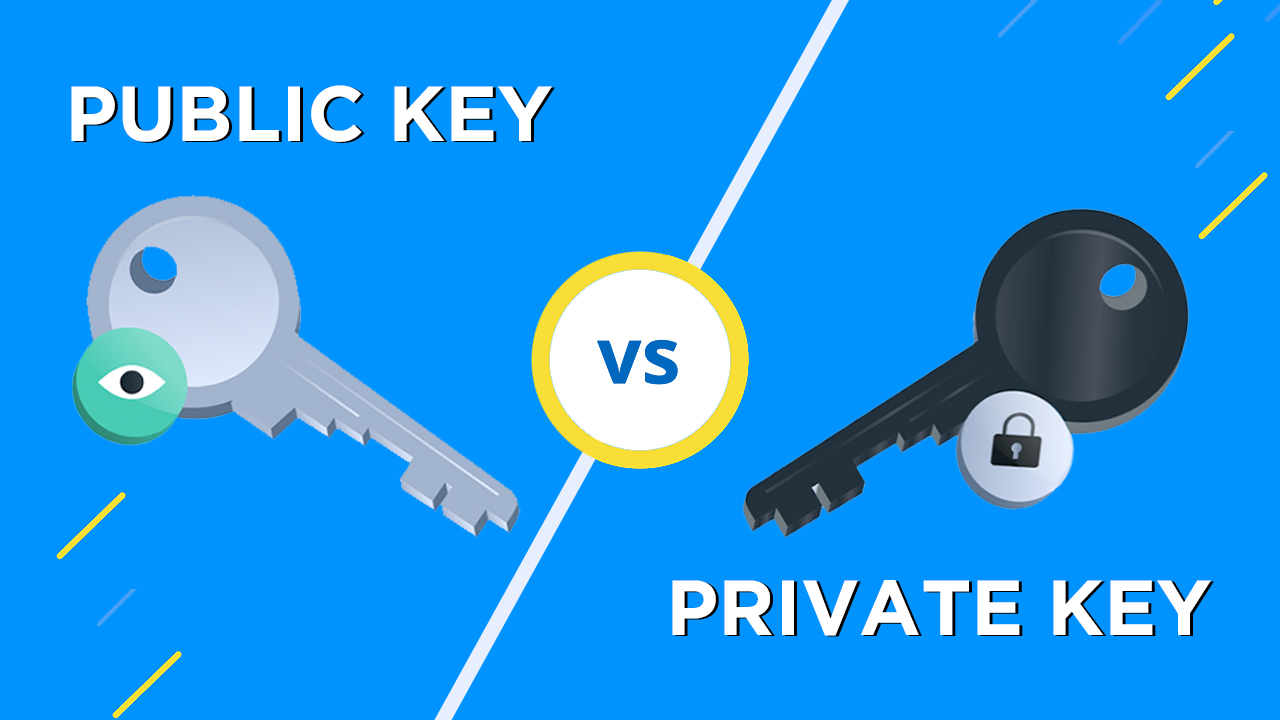
A public key is a large number you share openly with anyone, while a private key is its mathematically linked counterpart that only you keep. Together they form the basis of public-key cryptography, also called asymmetric cryptography.
The public key handles two jobs: encrypting data that only the matching private key can unlock, and verifying digital signatures created by that private key. The private key does the reverse: it decrypts incoming data and produces signatures that prove a message came from you.
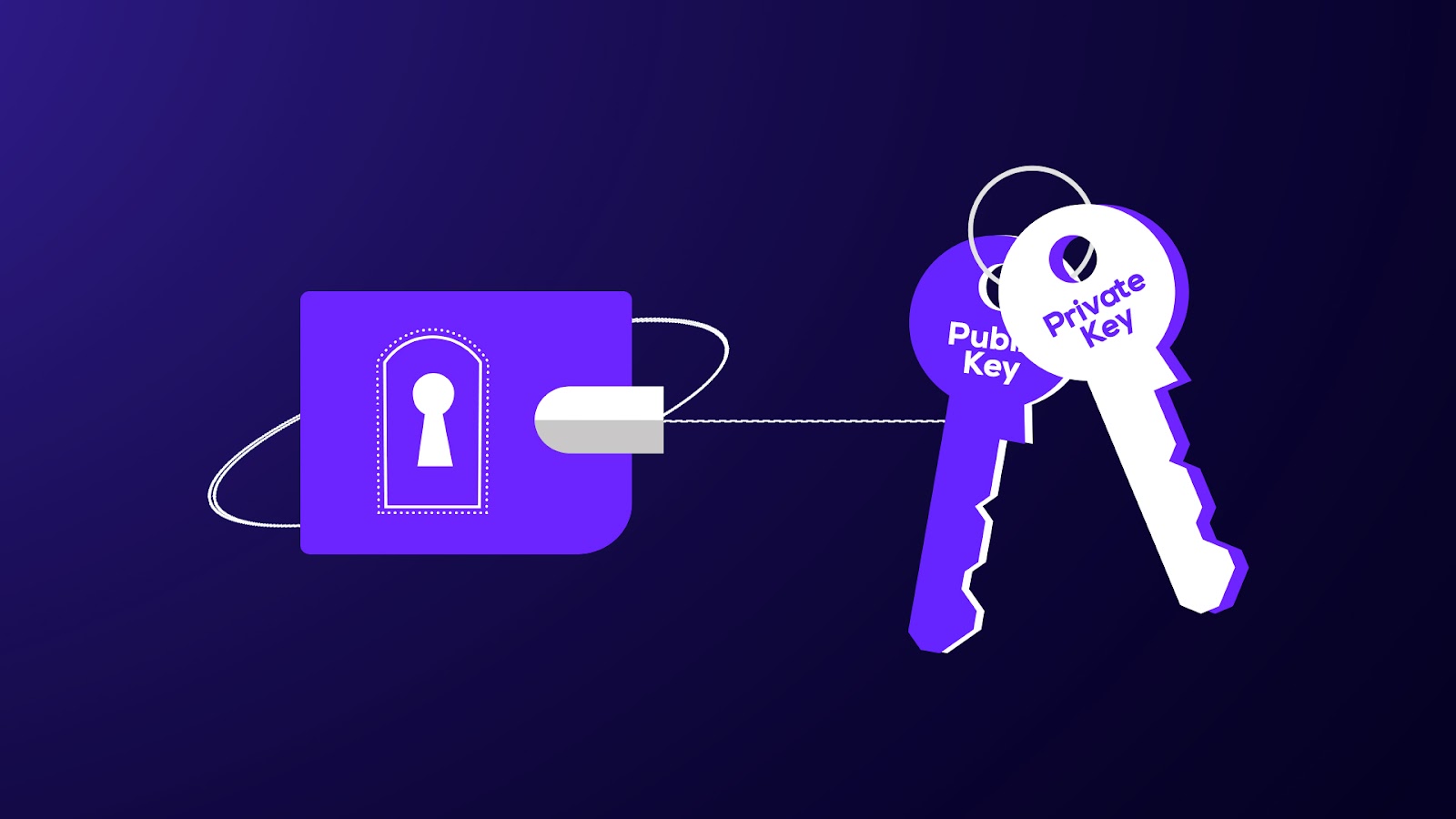
What ties the two together is a one-way mathematical function. Both keys are generated at the same time from the same process, and when you encrypt data with one, only the other can decrypt it. According to NIST, the pair consists of two very large numbers with a unique mathematical relationship, where one is kept secret and the other is shared freely.
The critical rule is simple: the private key must stay secret. If someone else gets hold of it, they can decrypt every message meant for you and forge your digital signature. The math behind the pair makes it computationally infeasible to derive the private key from the public key, so sharing the public key doesn’t put the private key at risk, but exposing the private key compromises everything the pair protects.
How public and private keys work together in encryption
When someone wants to send you a confidential message, they encrypt it using your public key. The resulting ciphertext is unreadable to anyone who intercepts it because only your private key can reverse the encryption. An attacker sitting between you and the sender sees scrambled data and can’t do anything with it.
When you reply, the process flips. You encrypt your response with the original sender’s public key, and only their private key can decrypt it. Each direction of the conversation uses the recipient’s public key for encryption and the recipient’s private key for decryption.
Alice and Bob: a step-by-step example
- Bob obtains Alice’s public key, which she’s made freely available.
- Bob encrypts his message using Alice’s public key and sends the ciphertext to her.
- Alice receives the ciphertext and decrypts it with her private key, reading the original message.
- An attacker who compromises the server in between sees only ciphertext. Without Alice’s private key, the message stays unreadable.
- Alice writes a reply, encrypts it with Bob’s public key, and sends it back.
- Bob decrypts Alice’s reply with his own private key.
Each step depends on the same principle: encryption locks a message to one specific recipient, and only that recipient’s private key opens it.
Key differences between public and private keys at a glance
| Feature | Public key | Private key |
|---|---|---|
| Availability | Distributed openly to anyone | Stored only by its owner |
| Role in encryption | Encrypts data sent to the key holder | Decrypts data received by the key holder |
| Role in signatures | Verifies a digital signature | Creates a digital signature |
| Exposure risk | Safe to share | Must remain secret at all times |
| Speed context | Asymmetric operations are slower than symmetric; often combined in hybrid schemes for bulk data | Same asymmetric overhead applies |
Because asymmetric encryption is slower than symmetric encryption, most real-world systems don’t encrypt entire data streams with a public key. Instead, the public and private keys negotiate a temporary symmetric key, and that faster key handles the heavy lifting.
Symmetric vs asymmetric encryption
| Attribute | Symmetric encryption | Asymmetric encryption |
|---|---|---|
| Keys used | One shared secret key for both encryption and decryption | A key pair: one public, one private |
| Speed | Faster, requires less computational power | Slower, more computationally intensive |
| Best fit | Bulk data encryption when both parties already share a key | Secure key exchange, identity verification, digital signatures |
| Key distribution | Requires a secure channel to share the key beforehand | Public key can travel over an insecure channel |
| Scalability | Management grows complex as user count rises | Each user needs only one key pair, regardless of how many people they communicate with |
| Common algorithms | AES-128, AES-192, AES-256 | RSA, DSS, ECC |
AES key sizes of 128, 192, and 256 bits reflect the trade-off between speed and security strength within the symmetric world. On the asymmetric side, algorithms like RSA need much larger key sizes to achieve comparable protection, which is one reason asymmetric operations run slower.
The two types aren’t competitors. Most production systems combine them in a hybrid model: asymmetric keys handle the initial handshake and key exchange, then a symmetric key takes over for the actual data stream.
Common algorithms used to generate key pairs
Several algorithms handle asymmetric key generation, each built on a different mathematical problem. The key pairs they produce can vary in size, and larger keys increase security at the cost of more computation time.
- RSA is the oldest widely used public-key system. It’s based on the difficulty of factoring the product of two large prime numbers. RSA is frequently used to transmit shared keys that then drive symmetric encryption for the rest of a session.
- DSS (Digital Signature Standard) is a federal standard specifying algorithms for generating and verifying digital signatures. NIST adopted DSS, and it remains common in government and enterprise systems where authenticated signatures are required.
- ECC (Elliptic Curve Cryptography) relies on the algebraic structure of elliptic curves over finite fields. It produces shorter keys than RSA for comparable security levels, which makes it attractive on devices with limited processing power or bandwidth. Curve25519 and NIST P-256 are two named elliptic curves used in widely deployed ECC implementations.
- Diffie-Hellman key exchange lets two parties who share no prior secret establish a shared symmetric key over an insecure channel. Each party generates a key pair, they exchange public keys, and each independently computes the same shared secret without ever transmitting it directly.
Choosing between RSA and ECC often comes down to key size and performance. ECC achieves similar security strength with significantly smaller keys, which means faster operations and lower bandwidth. RSA’s longer track record means broader compatibility with older systems, so the decision depends on your infrastructure and performance constraints.
Where public keys and private keys are used
Encrypted email is one of the most straightforward applications. The sender encrypts a message with the recipient’s public key, and the recipient decrypts it with their private key. The message stays confidential from sender to recipient, even if an attacker intercepts it in transit.
Digital signatures work in the opposite direction: the sender signs a message with their own private key, and anyone who has the sender’s public key can verify that signature. That verification step confirms two things at once, that the message actually came from the claimed sender and that the content hasn’t been altered along the way. Without signatures, a man-in-the-middle attacker who obtains the recipient’s public key could impersonate the sender by encrypting a fake message that looks legitimate.
TLS/SSL is what secures web traffic. When your browser connects to a website, the browser and server use asymmetric keys during the handshake to agree on a symmetric session key. That session key then encrypts all the data flowing back and forth for the rest of the connection.
For SSH authentication, your private key (the identity key) stays on your local machine while the corresponding public key (the authorized key) sits on the server you want to access. When you connect, the server challenges your client to prove it holds the matching private key, all without the private key ever leaving your device.
Cryptocurrency transactions tie public and private keys directly to ownership. A wallet’s public key, or more precisely a hash of it, becomes the address that receives funds on a crypto exchange or directly on-chain, while the private key authorizes spending from that address by signing each transaction. We cover this in more detail in the cryptocurrency wallets section below.
Digital certificates within public key infrastructure
A digital certificate binds a public key to the identity of its owner. A trusted third party called a certificate authority (CA) verifies the key holder’s identity before issuing the certificate, so anyone who receives the certificate can trust that the public key inside it actually belongs to the person or organization it claims to represent.
Browsers and operating systems maintain built-in lists of trusted certificate authorities. When you visit an HTTPS website, your browser checks the site’s certificate against these lists automatically. If the certificate was issued by a recognized CA and hasn’t expired or been revoked, the browser proceeds with the encrypted connection.
When a private key is compromised, the corresponding certificate needs to be revoked immediately. Certificate authorities publish revocation lists and support online status protocols that let browsers and other software check whether a certificate is still valid before trusting it.
The broader framework tying all of this together is called public key infrastructure (PKI). PKI covers the policies, hardware, and software that manage the full lifecycle of digital certificates, from creation and distribution to revocation. It’s the organizational backbone that makes public-key cryptography work at internet scale.
Benefits of public-private key encryption
Each benefit addresses a distinct security need, and together they explain why asymmetric encryption became the foundation of secure communication.
- Confidentiality. Only the private-key holder can decrypt content encrypted with the matching public key. Even if encrypted data is intercepted, it’s useless without access to the private key.
- Integrity. The decryption process confirms the received message matches what was originally sent. Any alteration in transit, even a single changed bit, causes decryption to fail or produces garbled output, making tampering detectable.
- Authenticity. A valid digital signature proves the message originated from the holder of a specific private key, not an impersonator. Recipients verify the signature with the signer’s public key, confirming both identity and intent.
- No pre-shared secret required. Two parties can start communicating securely without ever meeting in person or using a secure courier to exchange a key. The public key travels openly, and the private key never moves.
- Scalability. Each user needs only one key pair, no matter how many people they correspond with. Symmetric schemes, by contrast, require a separate shared key for every pair of users, and that number grows fast as the network expands.
How to generate a public key from a private key
Key generation starts with a large, unpredictable random number. Depending on the algorithm, this number either becomes the private key directly or serves as the seed from which the private key is derived. The quality of this randomness matters: a predictable starting point produces a predictable key pair, which defeats the purpose entirely.
A one-way mathematical function, specific to the chosen algorithm, then processes the private key to produce the public key. “One-way” means the calculation runs efficiently in one direction but is computationally infeasible to reverse with current hardware. You can always derive the public key from the private key, but you can’t work backward from the public key to recover the private key.
RSA generation starts by selecting two large prime numbers. These primes are multiplied together, and their product forms part of the public key. The primes themselves remain embedded in the private key. RSA is secure because factoring a very large number back into its two prime components takes an impractical amount of time. As the primes get bigger, the factoring problem gets exponentially harder.
ECC generation takes a different approach. The private key is a random integer, and the public key is a point on a chosen elliptic curve, calculated by multiplying the curve’s generator point by that integer. The underlying hard problem here is the elliptic curve discrete logarithm problem: given the generator point and the resulting public-key point, recovering the integer (the private key) is infeasible. This is why ECC achieves strong security with shorter keys than RSA. A 256-bit ECC key, for instance, offers security comparable to a much larger RSA key.
In practice, you don’t need to perform this math manually. Command-line tools like OpenSSL and ssh-keygen automate key-pair creation for common algorithms. With OpenSSL, generating an ECC key pair on a named curve like P-256 takes a single command. The tool handles the random number generation, applies the curve math, and outputs both keys in standard formats you can use immediately for TLS certificates, SSH authentication, or other applications.
Public and private keys in cryptocurrency wallets
Cryptocurrency wallets are one of the most visible, high-stakes applications of public-private key pairs. Wallet security is a recurring topic on AXL Research Hub because the consequences of mishandling keys in crypto are permanent.
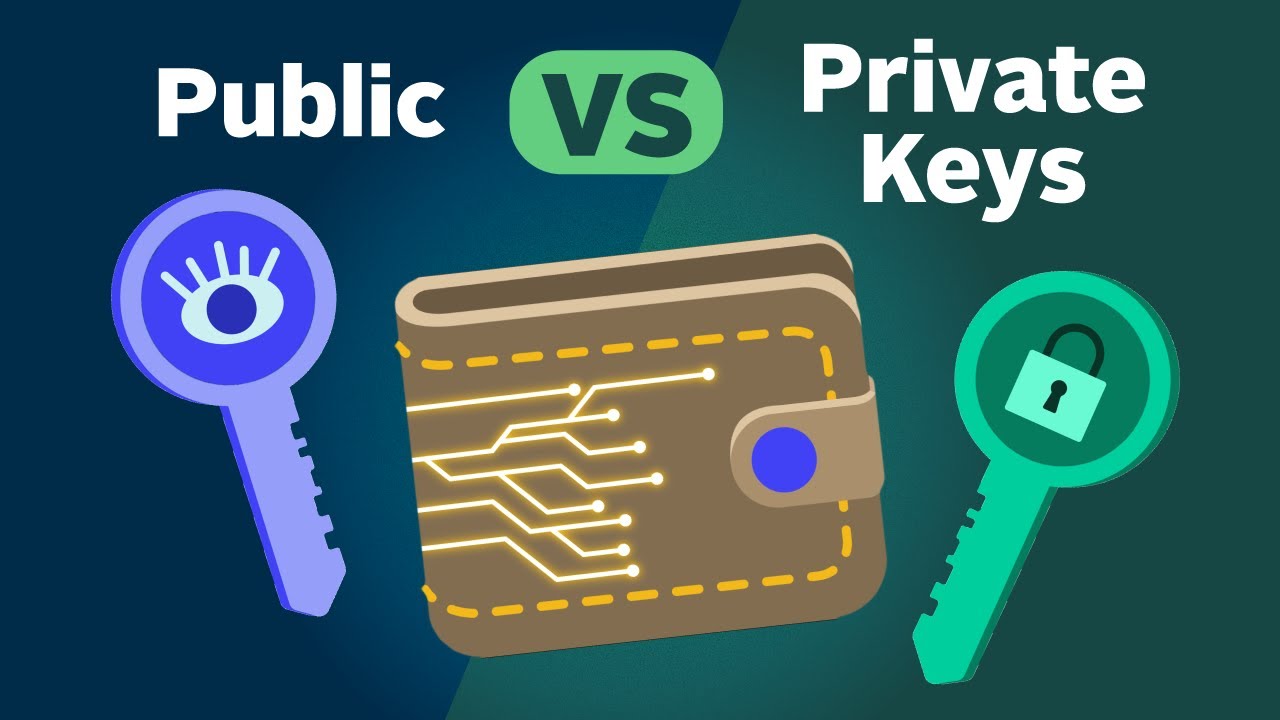
Wallet software generates an asymmetric key pair when you create a new wallet. The private key controls ownership of funds on the blockchain. The public key, or more commonly a hash of it, becomes the wallet address visible on the network. When someone sends you Bitcoin or another cryptocurrency, they’re sending it to an address derived from your public key.
Spending those funds requires signing the transaction with your private key. This signature proves you own the address without revealing the private key itself. Network nodes then verify the signature using your public key. If the signature checks out, the transaction is broadcast and eventually confirmed on the blockchain.
Losing the private key means permanent loss of access to the associated funds. Most blockchains have no recovery mechanism, no password reset, no customer support to call. The funds remain visible on the blockchain forever, but no one can move them.
Hardware wallets address this risk by storing private keys inside a secure chip that never exposes the key to the host computer. When you sign a transaction, the signing happens on the device itself. Malware on your computer can’t extract the key because it never leaves the chip.
Seed phrases provide a human-readable backup of the private key, typically as a sequence of 12 or 24 words. Recovering a wallet from a seed phrase regenerates the same key pair, so safeguarding the seed phrase is equivalent to safeguarding the private key. Anyone who obtains your seed phrase controls your funds.
Key management best practices
Strong keys are only as secure as the way you store and handle them. These practices apply whether you’re managing keys for a web server, an enterprise system, or a personal crypto wallet.
- Store private keys in hardware security modules (HSMs) or dedicated hardware wallets rather than plain-text files on a general-purpose computer. HSMs are tamper-resistant devices designed specifically to protect cryptographic keys. For individual crypto users, hardware wallets serve the same function at a smaller scale.
- Use strong randomness sources during key generation. Weak or predictable random number generators produce keys that an attacker can guess. Operating systems provide cryptographically secure random number generators, and reputable key-generation tools rely on them by default.
- Rotate keys on a defined schedule. Retiring old keys limits the window of exposure if a key is compromised without your knowledge. The rotation interval depends on the sensitivity of what the keys protect and the threat environment.
- Revoke and replace a key pair immediately if the private key is suspected of exposure. Delayed revocation gives an attacker more time to use the compromised key. In PKI environments, revocation lists and online status protocols notify other parties that the certificate is no longer trustworthy.
- Back up private keys or seed phrases in physically secure, geographically separated locations. A single backup in one place is vulnerable to fire, flood, or theft. Multiple copies stored in different secure locations reduce that risk.
- Restrict access to private keys through role-based permissions in organizational settings. Not everyone in a company needs access to signing keys. Multi-signature schemes add another layer by requiring more than one key holder to authorize an action, preventing a single compromised account from causing damage.
Choosing the right key type for your security needs
Symmetric encryption is the right fit when both parties already share a key securely and need to encrypt large volumes of data. It’s faster and computationally cheaper, which is why it handles the bulk of data encryption in practice.
Asymmetric encryption is the right fit when you need to exchange keys over an untrusted channel, verify someone’s identity, or create digital signatures. It solves problems that symmetric encryption can’t, but it’s too slow to use for encrypting large data streams on its own.
Most real-world systems don’t choose one or the other. They combine both in a hybrid model: asymmetric keys negotiate a session key at the start of a connection, and symmetric encryption handles the actual data. TLS works this way, and so do most VPN protocols and encrypted messaging apps.
When choosing between asymmetric algorithms, RSA and ECC represent different trade-offs. RSA has wider compatibility with legacy systems. ECC achieves comparable security with smaller keys, which translates to faster operations and lower bandwidth usage. Your decision depends on the key sizes your infrastructure supports, the performance constraints of your devices, and compatibility requirements with existing systems.
Ongoing research into post-quantum algorithms aims to replace current asymmetric schemes before large-scale quantum computers become viable. Quantum computers, if built at sufficient scale, could break the mathematical problems that RSA and ECC rely on. NIST has been evaluating post-quantum cryptographic standards, and organizations with long-term security requirements are already tracking these developments to plan future migrations.