
Crypto arbitrage turns price gaps between exchanges into profit by buying an asset where it’s cheaper and selling where it’s more expensive. The strategy sounds straightforward, but pulling it off consistently means understanding how spreads form, which variations fit your capital and skill level, and what costs eat into your margins before you ever place a trade.
What is crypto arbitrage trading?
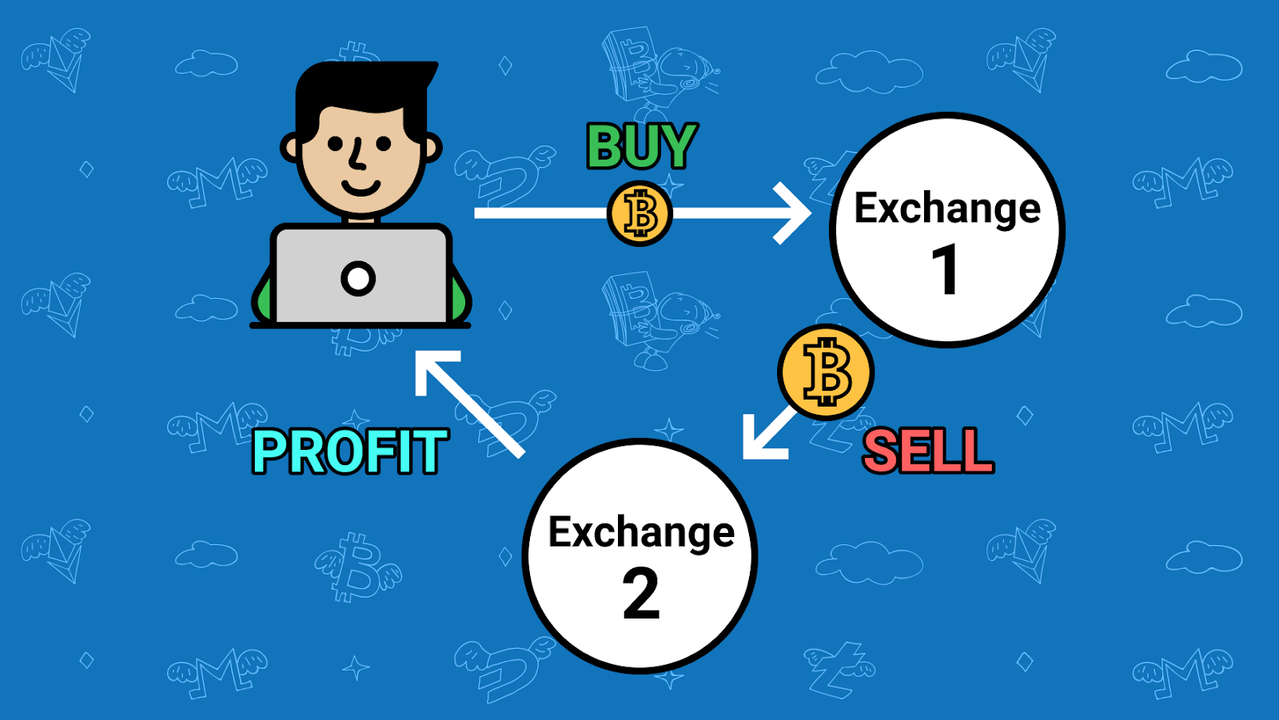
Crypto arbitrage exploits price differences of the same digital asset across separate markets or trading pairs. A trader buys the asset on a crypto exchange at the lower price and sells it at the higher price, pocketing the spread. The concept comes from traditional finance, where arbitrageurs have long corrected mispricings between stock exchanges and currency markets. In the world of cryptocurrency and digital assets, the opportunity is amplified by hundreds of independent exchanges, round-the-clock trading, high volatility, and fragmented liquidity spread across platforms worldwide.
Unlike equities, which converge on a consolidated tape, crypto has no single centralized pricing mechanism. Each exchange sets its own price through its own order book or, in the case of decentralized platforms, through an automated market maker algorithm. That structural fragmentation is what keeps arbitrage alive.
Speed is the defining requirement. Price gaps can close within seconds as other participants and automated systems act on them. A spread that looks profitable on a dashboard may vanish by the time you’ve confirmed your order, which is why execution infrastructure matters as much as spotting the opportunity.
Academic research documented by MIT Sloan (Vol. 135, No. 2, 2020) documents recurrent, large arbitrage opportunities across crypto exchanges. That same study found that a common volume component across exchanges explains roughly 80% of bitcoin returns, meaning that while prices move in the same general direction, the timing and magnitude of those moves differ enough from platform to platform to create exploitable gaps.
Why price differences exist between exchanges
Every exchange operates as its own independent market with its own pool of buyers and sellers. When one platform has more sell pressure than another, the price on that platform drops relative to the rest. Differences in liquidity depth, trading volume, and user base create these supply-demand imbalances constantly.
Geographic factors push prices apart even further. Regional demand surges, local fiat on-ramps, and time-zone activity patterns produce different equilibrium prices. A sudden spike in buying from South Korean traders, for instance, can push the local Bitcoin and crypto price above the global average, a phenomenon sometimes called the “Kimchi premium.” Capital controls amplify these gaps because they restrict cross-border money flow, making it harder for arbitrage capital to move in and equalize the price. According to MIT Sloan research, countries with higher bitcoin premia over the US price see those premia widen further during periods of bitcoin appreciation, and the gap between domestic exchanges within the same country is consistently smaller than the gap between countries.
Platform-level differences also play a role. Fee structures vary from exchange to exchange, slightly shifting the effective buy and sell prices traders face. There’s no real-time data synchronization across platforms, so temporary mispricings can persist until enough traders notice and act on them. Idiosyncratic volume on individual exchanges, meaning trading activity driven by that platform’s own user base rather than the broader market, helps explain the size of arbitrage spreads between them.
Prices on each exchange fluctuate independently until enough arbitrage activity brings them toward equilibrium. That pull toward equilibrium is never permanent, though. New imbalances form as quickly as old ones close.
Types of crypto arbitrage
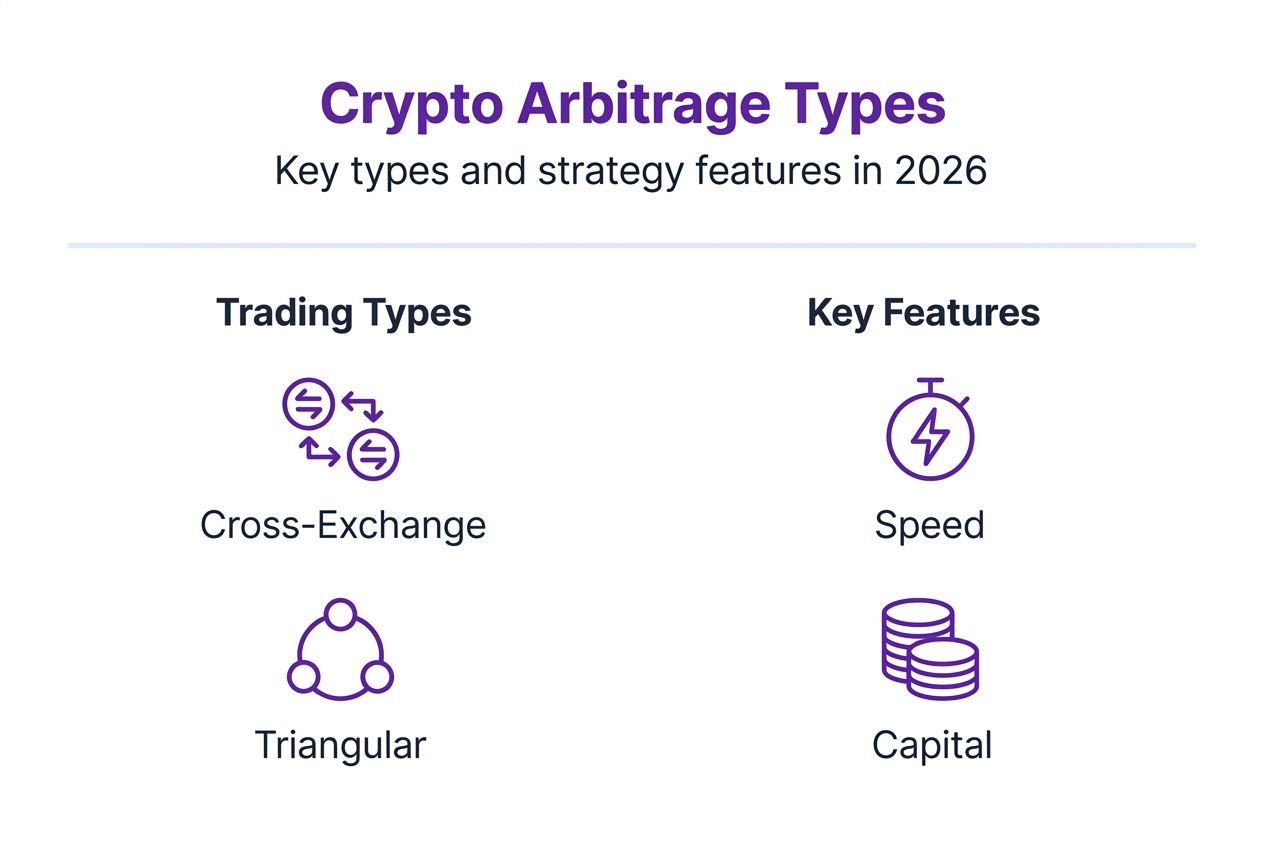
Several distinct arbitrage types exist, each with different execution mechanics, capital requirements, and risk profiles. They all share the core logic of buying low and selling high on a price discrepancy, but they differ in where that discrepancy sits and how you capture it.
Cross-exchange (spatial) arbitrage
This is the most intuitive form. You buy an asset on the exchange where it’s cheaper and sell it on the exchange where it’s more expensive. If BTC is trading at $67,400 on one platform and $67,650 on another, the $250 spread is your gross opportunity.
Execution relies on speed and efficient fund transfers between platforms. Transaction fees, withdrawal fees, and network confirmation times directly reduce the net spread. If moving bitcoin between exchanges takes 30 minutes and costs $5 in network fees plus trading fees on both sides, the spread needs to be wide enough to cover all of that and still leave a margin. Pre-funding accounts on multiple exchanges (covered later) is how experienced arbitrageurs avoid the transfer delay entirely.
Triangular arbitrage
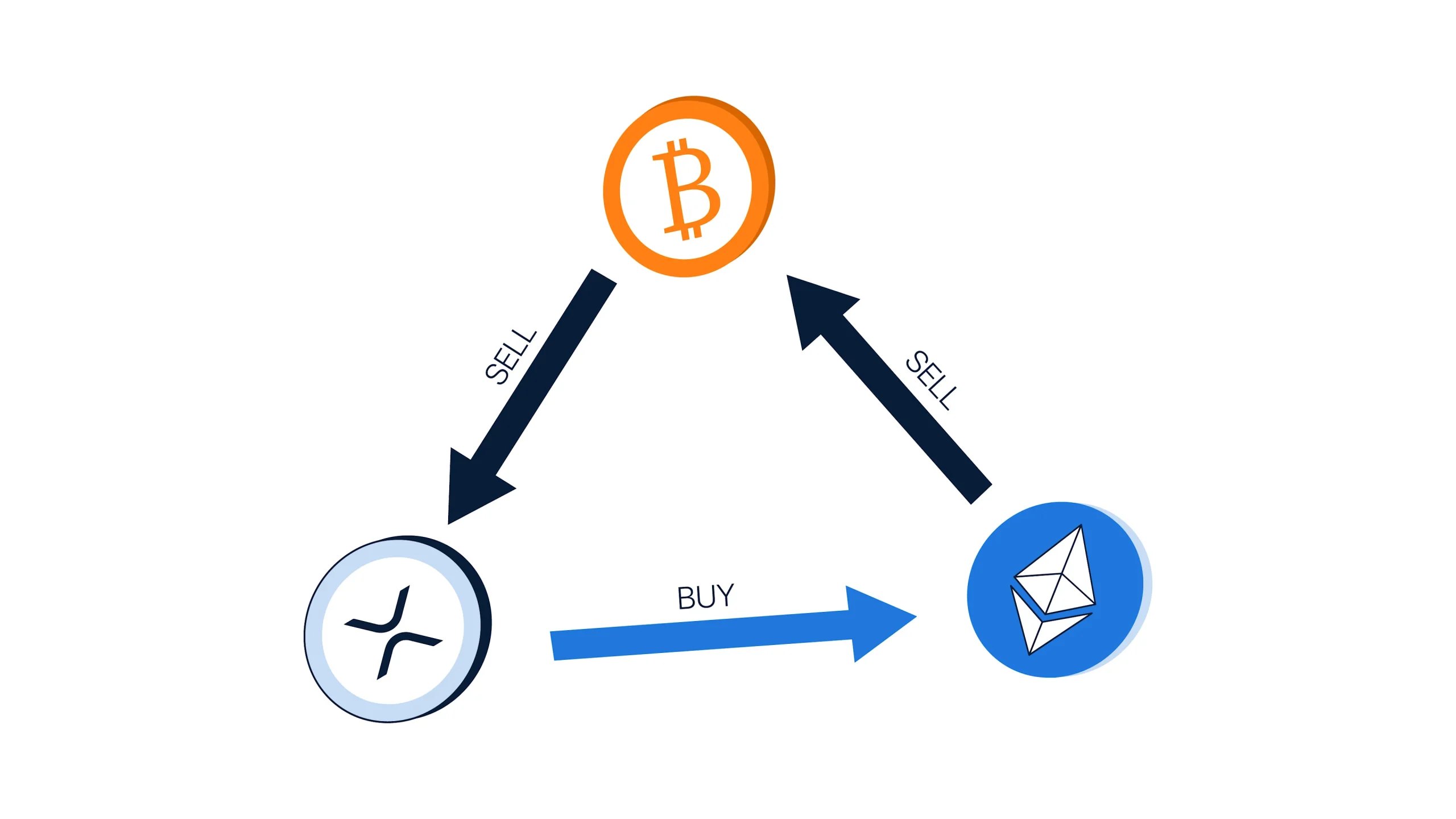
Triangular arbitrage exploits mispricing among three trading pairs on the same exchange. You cycle through three assets, ending with more of the starting asset if a discrepancy exists. A typical cycle might look like this: BTC → ETH → USDT → BTC. If the implied exchange rates across those three pairs don’t perfectly align, the difference is your profit.
Because all three legs execute on one platform, you eliminate cross-exchange transfer delays entirely. The tradeoff is that these mispricings tend to be smaller and shorter-lived, since they exist within a single order book system. High-speed execution is non-negotiable: all three legs must close before the exchange’s internal prices converge. Most traders who run triangular arbitrage rely on bots that can calculate and execute the full cycle in milliseconds.
Intra-exchange arbitrage (spot vs. futures)
On many exchanges, the same asset trades on both the spot market and the futures market, and those two prices don’t always match. When the futures price sits above the spot price (a state called contango), you can go long on spot and short the futures contract, locking in the spread. When the gap narrows, as it does by the contract’s expiration, you close both positions and collect the difference.
This strategy requires a solid understanding of margin, leverage, and contract mechanics on the chosen platform. You’ll need enough margin to maintain the short futures position without getting liquidated if the price spikes temporarily. The profit per trade is often modest, but the risk is contained because you’re hedged: you hold the asset on one side and are short on the other. The main danger is a liquidation event on the short leg before convergence happens.
Statistical arbitrage
Statistical arbitrage doesn’t rely on spotting a live price gap in real time. Instead, it uses quantitative models and historical price relationships to identify when correlated assets deviate from their normal relationship, then bets on mean reversion. If two tokens have historically tracked each other closely and one suddenly drops while the other holds, a statistical arbitrage model would buy the laggard and short the leader, expecting the relationship to normalize.
This approach requires large datasets, automated trading infrastructure, and low-latency execution. It’s predominantly used by institutional and algorithmic trading operations because the upfront investment in data, modeling, and infrastructure is substantial. The edge comes from having better models or faster data than the competition.
DEX vs. CEX arbitrage
Decentralized exchanges price assets through automated market makers (AMMs), while centralized exchanges use traditional order books. These two pricing mechanisms respond to supply and demand differently, especially during volatile conditions, creating structural price discrepancies characteristic of the CEX vs DEX divide.
During high volatility or periods of low DEX liquidity, the gaps widen. A token might trade at one price on Uniswap and a noticeably different price on a centralized exchange, giving an arbitrageur room to buy on the cheaper venue and sell on the pricier one. The additional costs here include on-chain gas fees, slippage on DEX pools (since AMMs adjust prices with each trade), and blockchain confirmation times. This segment is growing as DEX trading volume expands, but profitability depends heavily on gas costs and network speed.
Funding-rate arbitrage
Perpetual futures contracts on crypto exchanges use a funding rate mechanism to keep the contract price anchored to the spot price. When the funding rate is positive, traders holding long perpetual positions pay a fee to traders holding short positions at fixed intervals, commonly every eight hours.
Funding-rate arbitrage takes advantage of this by buying the asset on the spot market and simultaneously opening a short perpetual futures position. You’re market-neutral because the long spot position and the short futures position offset each other. Profit comes from two sources: convergence of spot and futures prices, and periodic funding payments received by the short side. You hold the position until the price gap closes, accumulating funding payments over that period.
As an example, a funding rate of 0.15% every eight hours would produce roughly 0.45% per day in funding income on top of any spread profit. That rate fluctuates with market sentiment, so it’s not a fixed return, but during extended bullish periods when longs dominate the futures market, funding rates can stay elevated for days or weeks.
How to find crypto arbitrage opportunities
Finding a real, executable arbitrage opportunity means more than spotting a price difference on a chart. Here’s how to move from raw data to a trade worth taking.
- Monitor prices across exchanges. Compare real-time bid and ask prices for the same asset on several platforms simultaneously. A price aggregator or scanner (more on these below) makes this manageable. You’re looking for the bid price on one exchange to exceed the ask price on another after accounting for costs.
- Evaluate liquidity and volume. A visible price gap is exploitable only if enough order-book depth exists to fill your trade at the quoted price. Check the order book on both sides. Low-volume pairs carry high slippage risk, meaning the price you see isn’t the price you’ll get once your order starts eating through the book.
- Calculate all costs before trading. Sum trading fees on both the buy and sell side, withdrawal fees if you’re moving the asset between exchanges, network (gas) fees, and expected slippage. The spread must exceed total costs for the trade to be profitable. Skipping this step is the most common reason beginners end up with a negative result on what looked like a winning trade.
- Watch for market inefficiency triggers. Rapid price movements, regional demand spikes, surprise news events, and exchange-specific delays create temporary mispricings. New token listings are another trigger, since the asset may launch on one exchange before others add it. These moments are when spreads widen beyond typical levels.
- Act within seconds. The window of opportunity shrinks as more traders and automated systems detect and act on the same discrepancy. Delayed execution can turn a projected profit into a loss if the spread closes or reverses while you’re mid-trade.
Step-by-step execution of a crypto arbitrage trade
Once you’ve found an opportunity, executing it cleanly is where the money is made or lost.
- Select reliable exchanges. Prioritize platforms with deep liquidity, proven security records, fast execution engines, and transparent fee schedules among top crypto exchanges. An exchange that freezes withdrawals during high volatility or has a history of downtime during market swings adds risk you can’t model away.
- Fund accounts on multiple platforms in advance. Pre-positioned balances eliminate the need to transfer funds during a time-sensitive trade. If you keep USDT on three exchanges and the target asset on two of them, you can act on a cross-exchange spread without waiting for a single blockchain confirmation.
- Identify a price discrepancy. Use a scanner, dashboard, or manual monitoring across your chosen exchanges. The signal is a spread between the bid on one exchange and the ask on another that exceeds your cost threshold.
- Verify the spread exceeds all combined costs. This means trading fees on both sides, withdrawal fees if a transfer is needed, network fees, and potential slippage. Run the numbers before you click.
- Execute buy and sell orders as close to simultaneously as possible. Place the buy on the cheaper exchange and the sell on the more expensive exchange at the same time. Automated systems reduce the gap between the two legs to milliseconds; manual execution adds seconds of exposure to price movement.
- Consolidate and secure profits. Transfer gains to a single account or convert to a stablecoin to lock in the dollar value. Factor in transfer time and fees when rebalancing your capital across exchanges for the next trade.
Tools and bots for crypto arbitrage trading
Four main categories of tools serve different levels of trader sophistication and automation preference.
Automated arbitrage bots
These are software programs that continuously scan multiple exchanges, identify spreads that meet your criteria, and execute trades without human intervention. You set the parameters: minimum spread threshold, position size limits, and risk levels. The bot handles the rest around the clock.
Bots remove emotional decision-making and can act on opportunities at any hour. But they don’t guarantee profit. Market conditions, fees, and latency still affect outcomes, and a poorly configured bot can lose money faster than a cautious manual trader. Testing with small positions before scaling up is standard practice.
Arbitrage scanners and screeners
Scanners aggregate pricing data from many exchanges and display side-by-side comparisons. You can filter results by spread size, fee-adjusted profitability, withdrawal network availability, and liquidity depth. They provide the information layer but don’t auto-execute. You decide and act manually.
This category fits traders who want data-driven decisions while keeping full control of execution. The tradeoff is speed: by the time you review and act, the fastest bots may have already closed the gap.
Real-time price trackers and alert systems
Price trackers deliver live feeds and customizable alerts when a spread reaches a threshold you define. Dashboards show real-time charts across multiple exchanges in a single view. Alert notifications, whether by push notification, email, or SMS, speed up reaction time. These tools pair well with manual or semi-automated strategies where you want to stay informed without watching screens all day.
API-based trading systems
For traders with programming skills, connecting directly to exchange APIs lets you build custom data collection and order-execution pipelines tailored to your exact strategy. API-based systems provide maximum flexibility, speed, and granularity.
The barrier is significant: you need programming knowledge, server infrastructure, and familiarity with each exchange’s API documentation and rate limits. Professional and algorithmic traders often combine API access with bot and scanner tools to create an end-to-end arbitrage workflow that handles everything from detection through execution and logging.
Manual vs. automated crypto arbitrage
Choosing between manual and automated approaches depends on your technical skills, budget, and how much time you can dedicate.
| Factor | Manual arbitrage | Automated arbitrage |
|---|---|---|
| Setup cost | Low; just exchange accounts and a scanner | Higher; bot software, API infrastructure, or subscription fees |
| Speed | Slower; limited by human reaction time | Fast; executes in milliseconds |
| Coverage | Can watch a handful of exchanges and pairs | Processes hundreds of pairs across dozens of exchanges simultaneously |
| Emotional risk | Prone to hesitation, FOMO, or partial fills in fast markets | Emotion-free; follows parameters strictly |
| Technical barrier | Low; basic trading knowledge is enough | Higher; requires configuration, testing, and monitoring |
| Risk from errors | Manual miscalculations or typos | Bugs, API downtime, or incorrect parameters can cause losses |
| Best fit | Beginners learning the mechanics; traders with small capital | Active traders seeking scale and consistency |
Most arbitrage windows last only seconds to minutes, which gives automation a clear speed advantage. That said, automation doesn’t eliminate risk. A bot running on incorrect parameters, or one that keeps trading during an exchange outage, can rack up losses quickly.
A hybrid approach works for some traders: use scanners for detection, then execute manually after a quick cost verification. This lets you benefit from automated data collection without fully trusting a bot with your capital.
Risks and challenges of crypto arbitrage
Arbitrage carries real risk, even though the strategy is often framed as low-risk compared to directional trading. Here’s what can go wrong.

- Transaction delays. Slow blockchain confirmations, exchange processing times, and internet latency can close a spread before your trade completes. A bitcoin transfer that takes 30 minutes during network congestion may arrive after the price gap has disappeared or reversed.
- Exchange fees and hidden costs. Trading fees, withdrawal fees, deposit fees, spread markups, slippage, and funding rates all erode margins. A spread that looks like 0.5% gross can easily become negative after stacking four or five cost layers.
- Market volatility. The same price swings that create opportunities can move against you between the buy and sell legs. If you buy on Exchange A and the price drops before you can sell on Exchange B, you’re holding an asset at a loss.
- Withdrawal limits. Daily or account-based caps restrict how quickly you can redeploy capital to another platform. If you’ve hit your daily withdrawal limit, you can’t move funds to the exchange where the next opportunity sits.
- Liquidity risk. Thin order books mean the actual execution price may differ significantly from the quoted price. Placing a large order on a low-liquidity pair can cause enough slippage to wipe out the expected profit entirely.
- Counterparty and platform risk. Exchange outages, frozen withdrawals, or insolvency can trap your funds. Spreading capital across multiple platforms reduces this risk but doesn’t eliminate it.
- Regulatory risk. Rules differ by jurisdiction. Some countries impose capital controls that block certain transfers, and regulatory changes can disrupt strategies that were previously viable. Cross-border arbitrage is particularly exposed here.
Is crypto arbitrage still profitable?
Profit potential exists, but margins have narrowed as more traders and bots compete for the same spreads. The easy, wide-open gaps that existed in crypto’s earlier years are rarer on major pairs across top-tier exchanges.
Profitability depends on several variables working together: speed of execution, total fee load, available capital, and choice of exchanges and pairs. Small per-trade margins, often fractions of a percent, require either high volume or larger position sizes to produce meaningful returns. A larger capital base amplifies those thin margins but also increases your total exposure if something goes wrong.
Market events create the best conditions. Sharp rallies, flash crashes, and new token listings temporarily widen spreads and open higher-margin windows. During extreme price moves, arbitrage spreads across major exchanges have been documented at 10 to 15% per round, though these moments are brief and competitive.
Consistent profit requires ongoing work. Negotiating lower fees with exchanges (higher-volume traders often qualify for lower tiers), picking the fastest and cheapest withdrawal networks, and tuning bot parameters are all part of staying ahead. This isn’t a passive income stream. Active monitoring, tool maintenance, and risk management are continuous tasks. Anyone promising a specific daily income figure from arbitrage is selling something, not trading.
Is crypto arbitrage legal?
Arbitrage itself is a recognized trading strategy in both traditional and crypto markets. It’s not inherently illegal. Buying an asset on one market and selling it on another is standard market activity that, in fact, helps prices converge and improves market efficiency.
That said, legality varies by jurisdiction. Traders must comply with local securities regulations, tax laws, and anti-money-laundering (AML) requirements wherever they operate.
In the US, the IRS treats profits from crypto arbitrage as taxable events. Each buy and sell is a disposition that may trigger a capital gain or loss. When assets are held for less than one year, which covers virtually every arbitrage trade, short-term capital gains rates apply. Those rates match your ordinary income tax bracket, so the tax bite can be significant. Keeping detailed records of every buy, sell, and transfer is important for accurate tax reporting. This includes timestamps, amounts, prices, fees paid, and the exchanges involved. Crypto tax software can help automate record-keeping across multiple platforms.
Capital controls in some countries may restrict moving funds across borders, limiting certain cross-country arbitrage strategies. A trade that’s perfectly legal domestically could create compliance issues if it involves transferring fiat from a country with strict currency controls.
Using arbitrage bots and scanners is legal, but connecting to an exchange via API must follow that exchange’s terms of service. Violating rate limits or using exploitative tactics that an exchange prohibits in its TOS could result in account suspension.
How to maximize profit from crypto arbitrage
Thin margins mean every fraction of a percent matters. These practices help you keep more of each spread.
- Choose exchanges with the lowest combined fee structures. Compare maker/taker fees, withdrawal fees, and network fees across platforms. A difference of 0.05% on each leg adds up over hundreds of trades.
- Automate scanning and execution. Short-lived spreads that vanish in seconds are invisible to manual traders. Even a basic bot running on tested parameters captures opportunities you’d otherwise miss.
- Scale trade size gradually. Jumping in with large orders on thin order books causes slippage that erodes margins. Start small, measure actual slippage at each size level, and increase only when the order book depth supports it.
- Diversify across multiple trading pairs and exchanges. Relying on a single pair or two exchanges limits your opportunities and concentrates your counterparty risk. Spreading across more markets gives you more chances per day.
- Time entries around volatility events. New listings, major news, and rapid price swings are when spreads tend to widen. Having capital ready and bots running during these periods captures higher-margin trades.
- Pre-fund accounts on several platforms. Transfer delays during active opportunities cost you the trade. Keeping balances distributed across your target exchanges means you can act instantly.
- Monitor network conditions. Congested blockchains increase confirmation times and gas fees, both of which eat into cross-exchange arbitrage margins. Choosing a less congested withdrawal network (when the exchange supports multiple options) can save time and money.
Capital controls and the geographic price premium
Crypto prices in countries with strict capital controls often trade at a premium over global benchmark prices. When local investors can’t easily move money out of the country to buy crypto abroad, domestic demand pushes the local price above what the same asset costs on US or European exchanges.
This premium widens during bitcoin appreciation. As prices rise globally, local demand in restricted markets outpaces the limited flow of arbitrage capital into those countries. The result is a self-reinforcing cycle: rising prices attract more local buyers, but capital controls prevent outside sellers from flooding in to meet that demand.
Cross-country arbitrage is more profitable in theory than any other form. The spreads are larger and more persistent. But execution is harder because moving fiat across borders faces banking and regulatory barriers. You can’t simply wire dollars into a South Korean exchange and sell at the premium. Banking restrictions, KYC requirements, and currency conversion costs all stand in the way.
Exchange-level factors layer on top of the geographic spread. Local liquidity depth, fiat gateway availability, and platform-specific user behavior all contribute. The MIT Sloan study on crypto arbitrage confirms that price deviations between countries are consistently larger than deviations between exchanges within the same country. These deviations tend to move in sync across countries and grow larger when bitcoin prices are rising sharply, which points to systemic forces behind the premiums rather than isolated, random events.
For traders outside the restricted country, the practical takeaway is that geographic premiums signal where the largest inefficiencies live, even if those specific trades are hard to access. Understanding the dynamic helps you anticipate when and where spreads on accessible exchanges might also widen in sympathy.
Keeping an edge as arbitrage margins tighten
Markets grow more efficient over time as participation and automation increase. The typical spread on a major pair across two top exchanges is smaller today than it was a few years ago. That’s the natural result of more capital chasing the same opportunities.
Traders who continuously refine their tools, fee structures, and exchange selection maintain an advantage longer than those who set up a bot and walk away. Negotiating lower fee tiers, switching to faster withdrawal networks as they become available, and adjusting bot parameters in response to changing market conditions are all part of the upkeep.
Emerging niches offer wider margins before competition catches up. DEX-CEX spreads, funding-rate arbitrage, and newly listed tokens all fit this pattern. Early movers in a new niche can earn outsized returns until more traders and bots pile in. The cycle then repeats with the next structural inefficiency.
AXL Research Hub covers exchange features, fee structures, and trading tools that directly affect arbitrage execution. Ongoing education and access to reliable data remain the foundation of any sustainable arbitrage practice. The traders who last in this space aren’t the ones who found one good setup; they’re the ones who keep adapting.