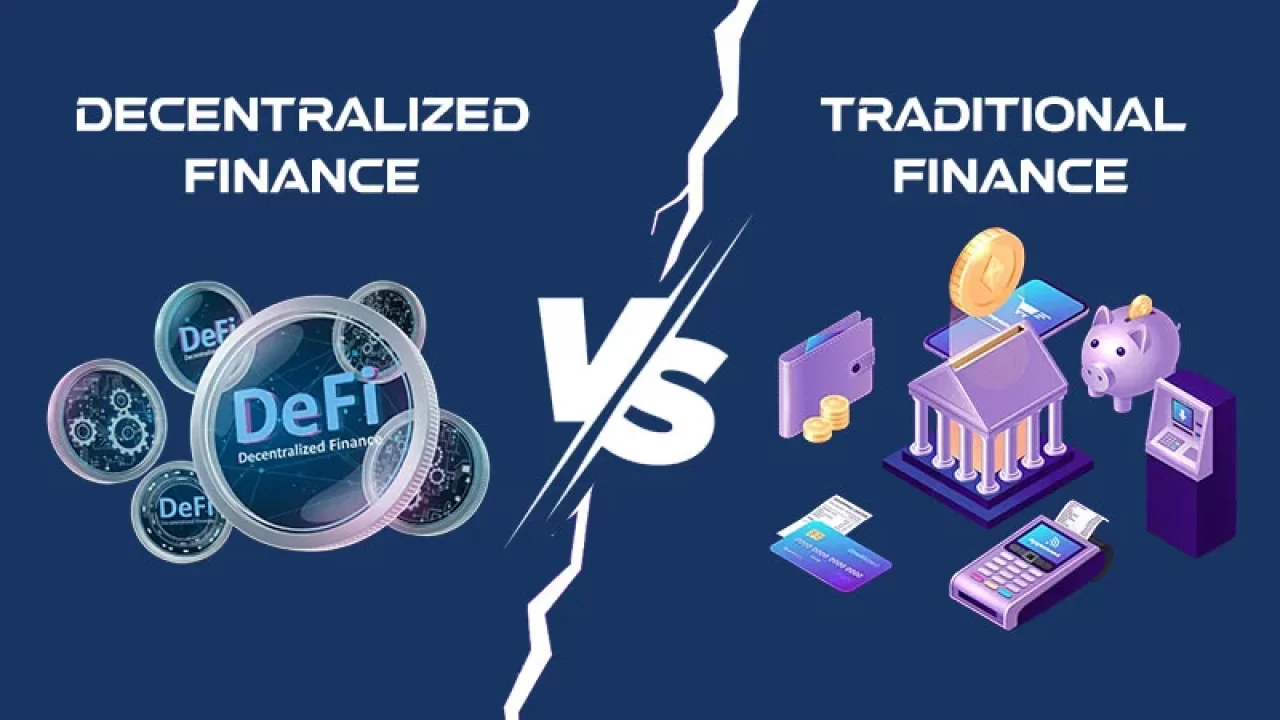

DeFi and traditional finance handle money in fundamentally different ways, and the choice between them shapes how you save, borrow, and move funds. One puts a bank in charge of your assets, the other puts you in charge through a crypto wallet and code running on a blockchain. Understanding both systems helps you pick the right tool for each financial goal.
What is DeFi and how does it differ from traditional finance?
The core distinction comes down to who holds control. In traditional finance (TradFi), a central authority, whether a bank, broker, or payment processor, custodies your money and approves your transactions. In DeFi, you hold your own funds in a personal wallet, and smart contracts on a blockchain handle the rules that would normally require a middleman.
The term “DeFi” was coined in August 2018 during a Telegram chat among Ethereum developers and entrepreneurs. Since then, it’s grown into a broad category of financial tools, from lending and borrowing to trading and earning yield, all running without the centralized institutions that TradFi depends on.
Traditional finance at a glance
TradFi relies on centralized institutions, such as commercial banks, insurance companies, and stock exchanges, to custody funds and settle transactions. When you deposit money in a bank account, the bank takes responsibility for safeguarding it. When you buy stocks through a broker, the broker holds those shares on your behalf.
The entire system runs on fiat currency. You use credit cards, checking accounts, wire transfers, and regulated investment accounts to move and grow your money. Each layer involves an institution that follows rules set by government regulators.
Origins and mechanics of DeFi
DeFi emerged from the Ethereum developer community, with the term first appearing in that August 2018 Telegram conversation. The idea was straightforward: rebuild financial services on top of blockchain networks so that no single entity controls access or settlement.
Smart contracts make this possible. A smart contract is a piece of code deployed on a blockchain that executes automatically when predefined conditions are met. If you deposit collateral into a lending contract and someone borrows against it, the contract handles the interest calculation, the collateral lockup, and the repayment terms without a loan officer approving each step. DeFi runs entirely on cryptocurrencies and digital assets rather than fiat, which means every interaction, from depositing funds to swapping tokens, happens on-chain.
How traditional finance works
Commercial banks, central banks, and payment networks form the backbone of TradFi infrastructure. Commercial banks accept deposits and issue loans. Central banks set monetary policy and act as lenders of last resort. Payment networks like Visa, Mastercard, and the SWIFT network, established in the 1970s for international bank-to-bank messaging, move money between institutions and across borders.

Custody and ownership model
When you put money in a bank, the bank holds it on your behalf. You own a claim to that balance, not the actual dollars sitting in a vault. The same principle applies to brokerage accounts: your stocks are registered in your broker’s name, and you hold an entitlement.
This arrangement gives institutions significant power over your assets. Banks can freeze accounts, reverse transactions, or impose withdrawal limits. During financial crises or legal disputes, your access to your own money depends on the institution’s decisions and the regulatory framework it follows. The trade-off is that these institutions also protect you: if someone steals your debit card number, the bank can reverse the charge.
Regulatory and compliance requirements
Before you can open a bank account, apply for a loan, or trade securities, you go through identity verification. Know Your Customer (KYC) checks, anti-money-laundering (AML) screening, and credit evaluations gate access to most TradFi services.
Behind the scenes, regulatory frameworks enforce stability through licensing requirements, mandatory audits, capital reserves, and government oversight. These layers add cost and slow down the process, but they’re designed to reduce fraud, protect consumers, and prevent systemic collapse.
Infrastructure and innovation constraints
Much of TradFi still runs on infrastructure built decades ago. The SWIFT network, for example, has been the standard for cross-border messaging between financial institutions since the 1970s. It works, but it wasn’t designed for instant settlement or transparency.
TradFi innovates slowly because every new product has to pass through compliance layers, regulatory approval, and integration with legacy systems. A new payment feature might take years to go from concept to launch. Open collaboration across competing institutions is rare, which limits the pace of change compared with open-source development environments.
How decentralized finance works
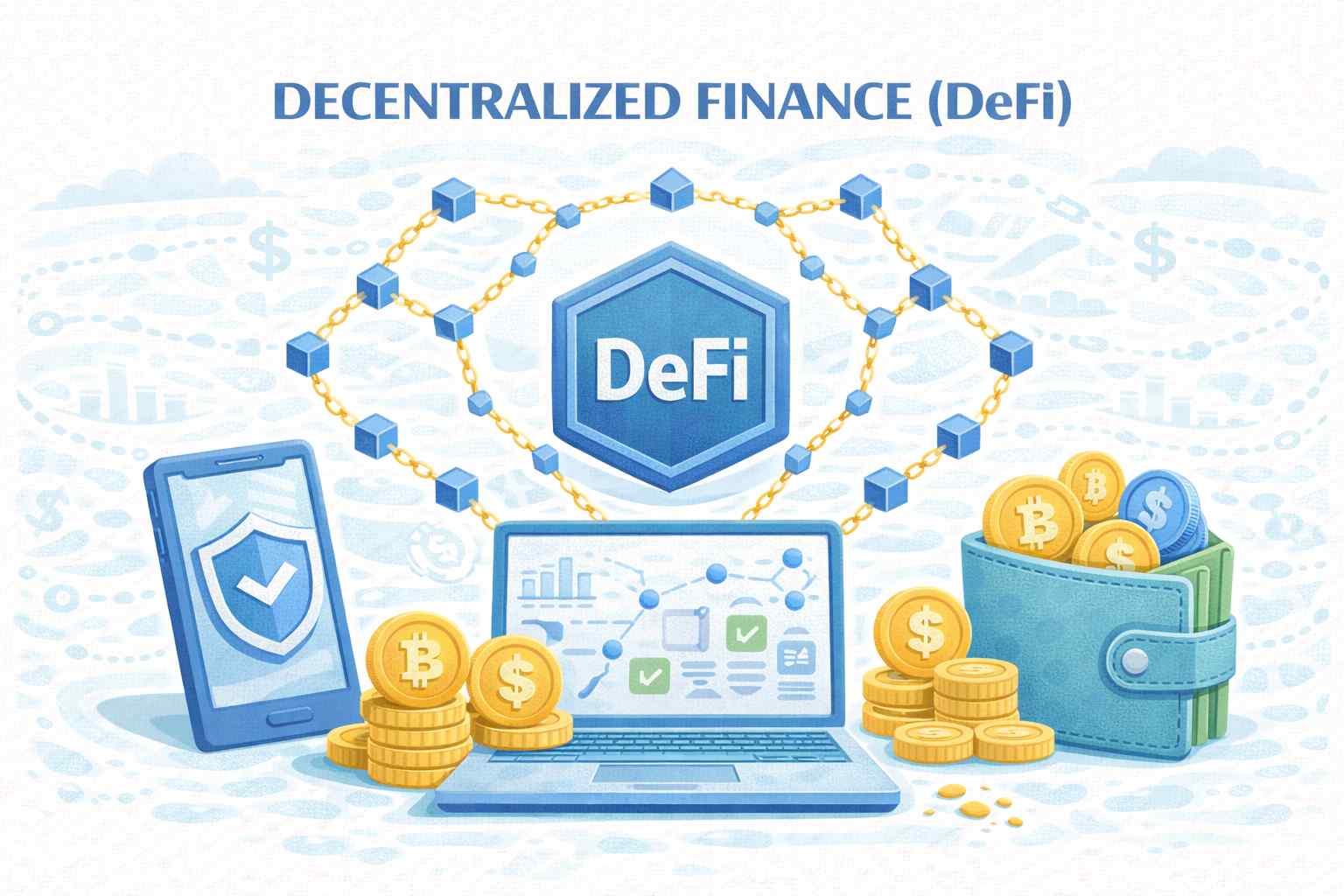
DeFi takes the services you’d normally get from a bank or broker and rebuilds them as software running on public blockchains. There’s no headquarters, no branch office, and no application form. The entire system operates through code, crypto wallets, and peer-to-peer networks.
Architecture and user interaction
Users interact with DeFi through dApps (decentralized applications), which are front-end interfaces connected to smart contracts on blockchain networks like Ethereum. When you use a decentralized exchange to swap one token for another, you’re sending a transaction to a smart contract that matches your trade against a liquidity pool, not against another person’s order on a centralized order book.
Smart contracts replace intermediaries across the board. Lending, borrowing, trading, and interest distribution all happen automatically through code. A lending protocol, for instance, accepts deposits into a pool, lends them out to borrowers who post collateral, and distributes interest to depositors, all without a human approving or denying any step.
Self-custody and permissionless access
In DeFi, your funds sit in your own crypto wallet. You control access through private keys, which are cryptographic credentials that prove ownership. No bank holds your balance, and no institution can freeze your account or block a transfer.
This comes with real responsibility. If you lose your private keys or seed phrase, no one can recover your funds. There’s no customer service number to call. But the upside is permissionless entry: anyone with an internet connection and a wallet can participate. You don’t need an ID, a credit history, proof of residency, or approval from any authority. That opens financial services to billions of people who can’t access traditional banking.
Transparency and common activities
Every DeFi transaction gets recorded on a public blockchain. Anyone can look up wallet balances, trace fund movements, and inspect the logic inside a smart contract. This level of transparency doesn’t exist in TradFi, where internal operations, risk models, and fee structures are typically hidden from customers.
Common DeFi activities include lending and borrowing through protocols, swapping tokens on decentralized exchanges, providing liquidity to trading pools in exchange for fees, staking crypto to help secure a network and earn rewards, and yield farming, which involves moving assets between protocols to chase the best returns. Each of these has a TradFi equivalent (savings accounts, stock exchanges, market-making, bond interest), but in DeFi, they run on open-source code rather than institutional infrastructure.
Key differences between DeFi and TradFi
| Feature | Traditional finance | DeFi |
|---|---|---|
| Control of funds | Bank holds and manages assets on your behalf | User controls funds directly via private keys |
| Geographic access | Limited by residency, local regulations, branch availability | Borderless; requires only an internet connection |
| Transaction speed | Domestic transfers take hours to days; cross-border even longer (securities settlement sometimes T+2 or longer) | Seconds to minutes depending on blockchain congestion |
| Availability | Business hours, weekdays; holidays apply | 24/7/365 globally |
| Fee structure | Maintenance fees, wire fees, and hidden charges | Gas fees tied to network load; more transparent but less predictable |
| Transparency | Opaque internal operations | Every transaction on a public ledger; smart-contract code inspectable |
| Consumer protection | Deposit insurance, chargebacks, legal recourse | No refunds or reversal after hacks or user error |
| Regulation | Heavy oversight, strict compliance requirements | Largely unregulated; varies by jurisdiction |
| Security model | Institutional systems, insured deposits, fraud monitoring | Cryptographic security; reliance on smart-contract audits |
| Privacy | Full identity verification; all activity monitored | Pseudonymous wallet addresses; public but not name-linked |
| Barriers to entry | ID, credit checks, proof of address | No paperwork; a smartphone and wallet are sufficient |
| Yield | Small, stable returns via savings accounts and bonds | Higher potential through staking and lending, paired with higher risk |
| Innovation speed | Years-long product cycles | New protocols and tools launched weekly |
Advantages of traditional finance
TradFi’s strengths come from decades of infrastructure building and regulatory development. For everyday financial needs, these advantages matter.
- Regulated environment. Government oversight, capital requirements, and mandatory audits create stability and reduce systemic risk. If your bank fails in the U.S., FDIC insurance covers deposits up to the insured limit.
- Familiar systems. Most people already understand how checking accounts, credit cards, and savings accounts work. There’s no learning curve for basic financial tasks.
- Lower personal responsibility. Institutions safeguard funds on your behalf. If your card gets stolen or a transaction goes wrong, the bank handles recovery.
- Widely accepted for daily use. Payroll, rent, bill payments, and point-of-sale purchases all run through TradFi rails. You don’t need to convert anything to use them.
- Lower asset-price volatility. Dollar deposits don’t swing 10% overnight the way crypto assets can, which makes budgeting and saving more predictable.
Limitations of traditional finance
The same centralized structure that provides stability also creates friction and exclusion.
- Geographic and access barriers. Branch-dependent services and residency requirements exclude rural and underserved populations. If there’s no bank branch or ATM nearby, your options shrink.
- Credit-based gatekeeping. Centralized credit checks and documentation requirements lock out people with thin credit files or non-standard income sources, even when they can afford the service.
- Hidden fees and opaque pricing. Maintenance charges, overdraft fees, wire transfer costs, and foreign-exchange markups stack up, and the true total is often difficult to calculate in advance.
- Unilateral account control. A bank or government authority can restrict your account or halt a transfer without your consent. You may have legal recourse, but your funds are inaccessible in the meantime.
- Slow cross-border transactions. International wires can take multiple business days, and settlement windows for securities sometimes stretch to T+2 or longer.
- Constrained innovation. New products and features move at the pace the governing organization chooses. Legacy systems and compliance layers slow down the kind of open, rapid development seen in open-source communities.
Advantages of DeFi
DeFi’s strengths mirror TradFi’s weaknesses, which is why the two systems complement each other more often than they compete head-to-head.
- Full user control. Your funds stay in your wallet. No third party needs to approve a withdrawal, transfer, or investment. You decide what happens with your money.
- Global accessibility. All you need is an internet connection and a crypto wallet to participate, regardless of nationality, credit history, or proof of residency. That’s a meaningful difference for people in countries with limited banking infrastructure.
- On-chain transparency. Every transaction, balance, and contract interaction is recorded on a public ledger. You can verify fees, check a protocol’s reserves, and read the smart-contract code before committing funds.
- Near-instant settlement. Compared with multi-day bank transfers and T+2 securities settlement, DeFi transactions typically settle in seconds to minutes.
- Rapid, open-source innovation. Anyone can build on existing protocols, propose improvements, or launch new tools. Community collaboration drives development cycles measured in weeks, not years.
Risks of DeFi
DeFi’s openness and lack of centralized control create real risks that don’t exist in traditional finance. Before using any DeFi protocol, you should understand what you’re taking on.

Security and financial risks
- No consumer safety net. If you send funds to the wrong address or lose your private keys, the transaction is irreversible. There’s no chargeback, no fraud department, and no insurance fund to make you whole.
- Smart-contract vulnerabilities. Bugs or exploits in smart-contract code can drain entire pools of funds. Even audited contracts have been exploited, affecting every user who deposited into the pool.
- Unpredictable gas fees. Transaction fees on networks like Ethereum spike during periods of high congestion. A swap that costs a few dollars at off-peak times can cost significantly more during a busy period, making small transactions impractical.
- Scams and bad actors. Pseudonymity makes it easier for scammers to launch fraudulent tokens, execute rug pulls (draining liquidity after attracting deposits), and disappear without accountability.
Technical and regulatory challenges
- Scalability constraints. Public blockchains still process far fewer transactions per second than centralized payment networks. High demand leads to congestion, slower confirmations, and higher fees.
- Low interoperability. Moving assets between different blockchain ecosystems (Ethereum, Solana, Avalanche, and others) often requires bridges or wrapped tokens, adding complexity and risk.
- Regulatory uncertainty. Rules around DeFi vary widely by jurisdiction and can change quickly. A protocol that’s accessible today might face restrictions tomorrow depending on where you live.
Self-custody burden
- Technical knowledge required. Managing your own wallet, securing private keys, evaluating smart contracts, and navigating dApps all demand a level of technical comfort that most people don’t have yet.
- Permanent loss from mistakes. Losing your seed phrase, the backup that restores access to your wallet, means permanent, irrecoverable loss of every asset in that wallet. There’s no reset option.
Role of intermediaries in TradFi versus DeFi
Traditional finance is built on layers of intermediaries. Banks accept deposits and issue loans. Brokers execute trades. Clearinghouses settle securities transactions. Payment processors route card swipes. Each layer adds stability, compliance checks, and consumer protections, but each one also charges fees and introduces a potential point of failure or delay.
When you send an international wire, for example, the payment may pass through your bank, a correspondent bank, the SWIFT network, and the recipient’s bank before it arrives. Each handoff takes time and costs money. A stock trade goes through a broker, a clearinghouse, and a custodian before settlement is final.
DeFi replaces these layers with smart contracts that execute rules automatically and settle on-chain. A decentralized exchange doesn’t need a clearinghouse because the swap settles in the same transaction. A lending protocol doesn’t need an underwriter because collateral is locked in code.
The trade-off is significant: removing intermediaries also removes the human ability to intervene when something goes wrong. If a smart contract has a bug, there’s no customer service team to reverse the damage. If you’re scammed, there’s no fraud department to file a claim with. Fintech and big-tech credit platforms have appeared as a middle ground, complementing rather than fully replacing traditional bank lending while offering faster digital experiences.
DeFi challenges to traditional lending markets
Lending is one of the clearest areas where DeFi and TradFi differ in how they operate and who they serve.
In traditional lending, a bank evaluates your creditworthiness through credit scores, income verification, and employment history, then sets the interest rate based on its own cost of funds, risk models, and competitive positioning. A central rate committee or internal pricing team makes those pricing decisions. Because the process can take days to weeks and the criteria are rigid, borrowers who don’t fit the bank’s risk profile are often excluded entirely.
DeFi lending protocols work differently at every step. Instead of bank underwriting, lending happens peer-to-peer or through shared pools. A user deposits crypto assets into a lending pool via a smart contract. Borrowers draw from that pool by posting collateral, typically other crypto assets locked in the same contract. There’s no credit score involved and no identity check.
The collateralization model is one of the biggest differences. TradFi lending often uses the borrower’s creditworthiness as a form of unsecured or partially secured lending (think credit cards or personal loans). DeFi lending almost always requires overcollateralization: you might need to lock up $150 in crypto to borrow $100, because there’s no legal system to chase you if you default. If the value of your collateral drops below a threshold, the smart contract automatically liquidates it to repay the loan.
Interest rates in DeFi are set algorithmically based on supply and demand within the protocol. When a lending pool has plenty of available funds and few borrowers, rates drop. When demand for borrowing spikes, rates rise. This happens in real time, not through quarterly committee meetings.
This model creates real pressure on traditional lenders. Stablecoins and tokenized money can attract deposits away from banks, reducing the funding base that banks rely on to issue loans. At the same time, DeFi lending bypasses KYC entirely, expanding access to anyone with collateral but raising anti-money-laundering concerns that regulators are actively working to address.
The risk profile also shifts. In TradFi, the primary lending risk is borrower default. In DeFi, smart-contract risk replaces default risk. A bug in the lending contract can affect every participant in the pool simultaneously, not just one borrower-lender pair.
Transparency in DeFi versus centralized finance
Transparency is one of DeFi’s strongest selling points, but it’s more nuanced than “everything is public.”
Every DeFi transaction is recorded on-chain: amounts, wallet addresses, timestamps, and contract interactions are all visible to anyone with a block explorer. Smart-contract source code is often published and open for audit, letting users verify the rules a protocol follows before committing funds. You can check a lending protocol’s total deposits, outstanding loans, and interest rates in real time. You can read the exact logic that determines when collateral gets liquidated.
TradFi institutions rarely offer this level of visibility. Internal risk models, lending criteria, fee calculations, and counterparty exposures are typically proprietary. You generally don’t know how your bank invests your deposits or what its true exposure to certain asset classes looks like. This opacity creates room for hidden fees and undisclosed risks that you may not discover until something goes wrong.
Public-ledger transparency reduces the chance of those hidden costs, but it doesn’t eliminate risk. Visible code can still contain exploitable flaws. A smart contract might be fully readable and still have a vulnerability that a skilled attacker can find. Audits help, but they don’t catch everything.
An emerging area worth watching is zero-knowledge proofs, a cryptographic technique that lets one party prove something to another (like solvency or regulatory compliance) without revealing the underlying private data on-chain. This technology could bridge the gap between DeFi’s radical transparency and TradFi’s privacy requirements, allowing institutions to participate in on-chain finance while meeting regulatory obligations around data protection.
How DeFi and TradFi are converging
The line between DeFi and TradFi is getting blurrier. Rather than one replacing the other, institutions are finding ways to capture new payment flows and wallet-based activity without ripping out existing infrastructure.
Institutional blockchain adoption
Banks are experimenting with blockchain-based settlement to speed up payment processing. Instead of routing transactions through multiple intermediaries over several days, blockchain settlement can compress that timeline significantly. Large financial institutions are also exploring their own stablecoins or tokenized deposit instruments, essentially putting traditional bank deposits on-chain while keeping them within a regulated framework.
Regulatory groundwork
Regulators are laying the foundation for this convergence rather than fighting it. In 2025, the OCC (Office of the Comptroller of the Currency) granted conditional approvals for five national trust bank charter applications from crypto-focused firms. That same year, the Federal Reserve published a request for information on a reserve-bank payment account prototype in December 2025, signaling interest in how blockchain-based payment systems might connect to the existing financial plumbing.
A Federal Reserve Bank of Kansas City analysis found that stablecoins may increase demand for U.S. Treasuries while reducing demand for other asset classes, an observation that underscores how deeply crypto-native instruments are starting to interact with traditional markets.
Hybrid infrastructure and compliance integration
The most practical convergence is happening at the infrastructure level. Progressive institutions are prioritizing tokenized deposits and money-market instruments on-chain, starting with products that map cleanly onto existing regulatory categories.
Hybrid ledgers act as translation layers between legacy core banking systems and decentralized networks. These systems let a bank’s existing software communicate with blockchain-based settlement without requiring a full technology overhaul. Compliance and governance rules get embedded directly into smart-contract logic within these hybrid architectures, so regulatory requirements are enforced automatically rather than bolted on after the fact.
On the DeFi side, protocols are adopting compliance tools, identity verification layers, and regulated on-ramps. This creates a middle ground: the speed and transparency of on-chain finance combined with the identity checks and consumer protections that regulators require.
Stablecoins as a bridge between DeFi and TradFi
Stablecoins are one of the clearest connection points between the two financial systems. They maintain a value pegged to fiat currencies like the U.S. dollar, which strips out the price volatility that makes other cryptocurrencies impractical for everyday transactions.
For users, stablecoins let you hold a dollar-equivalent asset in a self-custody wallet, earn yield through DeFi lending protocols, and move funds globally without waiting for bank settlement. For institutions, growing stablecoin usage introduces a real challenge: deposits that might have sat in a traditional bank account are now flowing into stablecoin issuers, reducing the deposit base that banks use to fund lending.
Smaller banks and credit unions have an opportunity here. They can serve as regulated on- and off-ramps for tokenized money, handling the KYC and AML checks that DeFi protocols skip while giving their customers access to on-chain finance. By supporting tokenized deposits alongside stablecoin orchestration, these institutions can retain demand deposits on their balance sheets instead of losing them to purely crypto-native alternatives.
The Kansas City Fed’s analysis adds an important macroeconomic angle: as stablecoins grow, they could increase demand for U.S. Treasuries (since many stablecoin issuers hold Treasuries as reserves) while shifting demand away from other asset classes. This shift actively reshapes how capital flows through the broader financial system.
When to use DeFi or traditional finance
DeFi and TradFi aren’t interchangeable, and most people will use both depending on what they’re trying to accomplish.
DeFi fits when you want speed, global access, higher yield potential, or direct control over your assets. Staking tokens, swapping on a decentralized exchange, or lending crypto through a protocol all work best on-chain. If you’re in a region with limited banking infrastructure or you want to move funds across borders without waiting days, DeFi removes friction that TradFi can’t.
TradFi fits when you need consumer protections, predictable fees, human support, and regulatory stability. Paying rent, receiving payroll, building credit history, and holding insured deposits are all things the traditional system handles well. If something goes wrong, you have legal recourse and someone to call.
The deciding factors come down to your risk tolerance, technical comfort, and the specific financial goal. Earning yield on idle crypto? DeFi protocols may offer better rates than a savings account, but the risk is proportionally higher. Saving for a home down payment? An insured bank account offers certainty that no DeFi protocol can match.
At AXL Research Hub, we cover both DeFi protocols and traditional financial tools through our exchange reviews, wallet guides, and comparison articles, so you can evaluate each option with the details that matter for your situation.
Beginners benefit from understanding both systems before committing funds to either. Start small, learn how wallets and transactions work, and don’t put more into DeFi than you can afford to lose while you’re still building your knowledge.
Choosing between open finance and legacy systems
Neither DeFi nor TradFi fully replaces the other. Each fills gaps the other leaves open.
TradFi provides the regulated backbone of everyday commerce. It’s where salaries land, mortgages originate, and insured savings sit. DeFi extends financial access to anyone with an internet connection, offers transparent on-chain operations, and moves faster than institutions built on decades-old infrastructure.
Convergence between the two is accelerating. Tokenized money, hybrid ledgers, and blockchain-based settlement are moving from pilot programs to production environments. The OCC’s charter approvals and the Federal Reserve’s payment account prototype signal that regulators see a future where these systems coexist rather than compete.
Users who learn how both systems work put themselves in a better position to take advantage of the hybrid products emerging at the intersection. Rather than replacing one system with the other, the financial world is building bridges between them.