

Cryptocurrency has moved from an experimental niche to a widely held asset class, and the question of whether crypto is a good investment doesn’t have a one-size-fits-all answer. According to 2025 survey data, 41% of Americans consider it a good investment, including many former skeptics, while roughly half of both crypto holders and non-holders describe it as high risk.
Is crypto a good investment?
Cryptocurrency refers to digital assets secured by cryptography on decentralized blockchain networks. What started as a curiosity among technologists is now something nearly half of American investors report having owned at some point, and Pew Research Center data shows 17% of U.S. adults have invested in or used a cryptocurrency.

The appeal rests on a few core beliefs: the potential for outsized gains compared to traditional assets, the ability to send and receive value without going through banks or brokers, and a conviction that blockchain technology represents the next major shift in how finance works. For people who got in early on major tokens, those beliefs paid off handsomely.
But the other side of the coin is just as real. Roughly 53% of crypto investors and 50% of non-crypto investors describe crypto as high risk. That’s not fearmongering; it reflects genuine volatility, regulatory uncertainty, and the absence of the safety nets that protect bank deposits and brokerage accounts.
Whether crypto fits your life depends on your financial situation, your time horizon, and how much volatility you can stomach without making panic decisions. The rest of this article walks through the specifics so you can weigh those factors with real information instead of hype.
How cryptocurrency differs from stocks and fiat currency
Crypto, stocks, and fiat currency serve different purposes and operate under very different rules. The table below lays out the key distinctions side by side.
| Feature | Cryptocurrency | Stocks | Fiat currency |
|---|---|---|---|
| What it is | Digital asset on a decentralized blockchain ledger | Ownership share in a regulated company | Government-issued legal tender |
| Regulation | Still evolving across multiple agencies (SEC, CFTC) | Decades of established regulatory infrastructure | Central bank and treasury oversight |
| Insurance/protection | No FDIC equivalent; minimal consumer protections | Investor protections through regulated exchanges | Bank deposits carry federal insurance |
| Valuation basis | Adoption rates, on-chain activity, network metrics, transaction fees | Earnings, revenue, dividends, and other fundamentals | Backed by government authority; U.S. dollar holds 58% of world reserve currency (IMF, June 2024) |
| Volatility | Bitcoin roughly 3× as volatile as the S&P 500; smaller tokens even more volatile | Moderate; varies by sector and company | Low; designed for price stability |
| Trading hours | 24/7, year-round | Set market hours (weekdays) | N/A |
| Transaction reversibility | Generally irreversible once confirmed | Trades go through clearinghouses with settlement safeguards | Bank transfers can often be reversed or disputed |
The biggest structural difference is what happens when something goes wrong. If your bank fails, FDIC insurance covers your deposits. If your brokerage collapses, SIPC provides certain protections. If a crypto exchange goes down or gets hacked, there’s no federal backstop waiting to make you whole.
Crypto also lacks the traditional fundamentals investors use to value stocks. You can’t pull up a cryptocurrency’s quarterly earnings report or dividend yield. Instead, you’re evaluating adoption curves, developer activity, and network usage, which are harder to pin down and less standardized.
Potential rewards of investing in crypto
Crypto’s upside is real, even if it comes with serious caveats. Here’s what draws investors in.
- High-return potential. Early or well-timed investors in major cryptocurrencies have seen gains that dwarf what traditional markets typically deliver over the same periods. That said, past performance never guarantees future results, and those high returns came alongside stretches of severe drawdowns.
- Decentralization. Crypto removes reliance on banks and central intermediaries for transferring value. You can send funds directly to another person anywhere in the world without needing a bank to approve or process the transfer.
- Accessibility. Anyone with an internet connection and a wallet can participate. There are no credit checks, income requirements, or minimum account balances at most platforms. That’s a meaningful difference for people who’ve been shut out of traditional financial products.
- Blockchain transparency. Every transaction on a public blockchain is visible and trackable on an immutable ledger. This level of transparency doesn’t exist in most traditional financial systems.
- Faster cross-border transfers. Crypto transfers can settle within minutes, compared to the 24-to-48-hour window that’s standard for international bank wires. Fees on certain networks can also be significantly lower.
- Growing mainstream adoption. Financial institutions, corporations, and some national governments are recognizing or integrating crypto into their operations. That trend signals staying power, even if it doesn’t reduce short-term volatility.
- Smart contract functionality. Platforms like Ethereum allow smart contracts that automatically execute when preset conditions are met, enabling a wide range of decentralized applications beyond simple value transfer.
None of these rewards comes without a flip side, and the next section covers exactly that.
Risks you need to know before investing in crypto
The risks in crypto aren’t hypothetical. Many of them have already played out at scale.
- Extreme price volatility. Crypto prices swing sharply and frequently. The crypto market lost roughly $2 trillion in value during 2022, a figure reported by the World Economic Forum. A downturn of that magnitude can wipe out years of gains in a matter of months.
- Regulatory uncertainty. Rules differ by country and by state, and they continue to evolve. New laws could change how crypto is bought, sold, or taxed, sometimes with little notice. The SEC and CFTC are both involved in oversight, and the boundaries of their authority are still being drawn.
- Fraud, scams, and market manipulation. Crypto markets are less mature and, in many areas, less regulated than stock markets. That makes them more vulnerable to coordinated pump-and-dump schemes and outright fraud. In one 2017 case, the SEC intervened against an ICO that promised investors a 1,354% return in less than a month.
- Irreversible transactions. If you send crypto to the wrong wallet address, those funds are likely gone permanently. There’s no bank to call and no chargeback process.
- Counterparty risk. Exchanges and custodians can be hacked, suffer outages, or go bankrupt. When that happens, users can be locked out of their assets for months or permanently.
- Technical risk. Losing your private keys, a hard-drive failure, or wallet corruption can permanently destroy access to your holdings. Unlike a forgotten bank password, there’s often no recovery path.
- Sentiment-driven trading. The crypto market broadly trades on sentiment and momentum rather than fundamentals, which amplifies swings in both directions.
- Management risk. Projects led by inexperienced or deceptive teams may fail entirely. Many tokens from the 2017 and 2021 bull runs no longer exist.
- Programming risk. Smart contract bugs or vulnerabilities can be exploited, draining funds from protocols. This has happened repeatedly across DeFi platforms.
Crypto scams and how to avoid them
Crypto scams cause real financial harm every year, and certain demographics face a disproportionate share of that targeting.
Pew Research Center data shows that 24% of Asian adults and 21% of Black or Hispanic adults report having invested in or used crypto, compared to 14% of White adults. Black investors are more likely than White investors to believe crypto is safe (33% vs. 18%) and regulated by the government (30% vs. 14%). Scam campaigns often exploit these gaps in perception, framing crypto as a tool for democratizing finance while hiding the risks. Younger investors and minority communities are disproportionately targeted through social media.
So-called “finfluencers” add another layer of risk. Some are paid by crypto companies to promote tokens regardless of whether their followers profit, and they don’t always disclose that arrangement clearly.
Here’s how to protect yourself:
- Watch for guaranteed-return language. Promises of specific high returns, “get rich quick” framing, or unsolicited offers through social media or payment apps are almost always scams. If an opportunity sounds too good to be true, treat it as a scam until proven otherwise.
- Stick to established platforms. Use reputable trading platforms with strong cybersecurity practices and transparent internal controls. At AXL Research Hub, our exchange reviews are built to help you compare platforms on exactly these factors.
- Vet unfamiliar tokens. Avoid newly launched coins that lack verifiable whitepapers and transparent, identifiable teams. If you can’t find out who’s building the project and what problem it solves, that’s a red flag. You can meet our team to see how AXL Research Hub holds itself to the same transparency standard we recommend.
- Report suspected fraud. If you encounter a scam, report it to the SEC or your local financial regulator. Reporting helps protect other investors.
How crypto is taxed in the United States
For tax purposes, the IRS classifies cryptocurrency the same way it classifies real estate or stocks: as property rather than currency. That distinction has practical consequences that catch many investors off guard.
Every sale, trade, or exchange of crypto for another asset is a taxable event. So is using crypto to pay for goods or services. If you buy a coffee with Bitcoin, you technically owe capital gains tax on any appreciation between what you paid for that Bitcoin and its value at the time you spent it. IRS Notice 2014-21 provides the foundational guidance on how virtual currency is taxed.
Under crypto tax rules, short-term capital gains, on assets held one year or less, are taxed at your ordinary income tax rate. Because ordinary income rates can far exceed long-term capital gains rates, flipping positions often means handing a much bigger slice of your profits to the IRS. Beyond the transaction fees, you’re paying top-rate taxes on every profitable short-term trade.
Losses work in your favor to a degree. Capital losses can offset other capital gains dollar for dollar. If your losses exceed your gains, you can deduct up to $3,000 of that excess against ordinary income per year. Any remaining losses carry forward indefinitely, offsetting gains or income in future tax years.
All of this tracking falls on you. Even if a platform never sends you a tax form, the IRS still expects you to report every taxable crypto event. That means keeping detailed records of purchase dates, cost basis, and sale prices for every transaction, because without them there’s no way to stay compliant. For most active investors, the cost of working with a crypto-savvy tax professional pays for itself.
Tax treatment of crypto ETFs and the wash-sale question
Crypto ETFs introduce a wrinkle that doesn’t have a clear answer yet. ETF shares are generally treated as securities for tax purposes, the same as stocks or bonds. Bitcoin itself, however, is classified as property, not a security, so it falls outside the wash-sale rule. The wash-sale rule prevents you from claiming a tax loss if you buy a “substantially identical” security within 30 days before or after the sale.
Here’s where it gets murky: if you sell a Bitcoin ETF at a loss and then buy a different crypto ETF, or buy Bitcoin directly, does the wash-sale rule apply? The IRS hasn’t issued specific guidance on cryptocurrency ETF taxation. That ambiguity means you could take a position either way, but you’d be doing so without clear regulatory backing.
If you’ve realized losses in a crypto ETF, consult a tax professional before making a related purchase within that 30-day window. The stakes of getting this wrong aren’t trivial, especially for large positions.
Crypto vs. stocks: which fits your portfolio?
Stocks offer regulated markets, established valuation frameworks built on earnings, dividends, and cash flow, and historical data spanning well over a century. You can look at a company’s quarterly reports, compare price-to-earnings ratios across a sector, and draw on decades of academic research about expected returns. That infrastructure doesn’t make stocks risk-free, but it gives you concrete tools for making decisions.
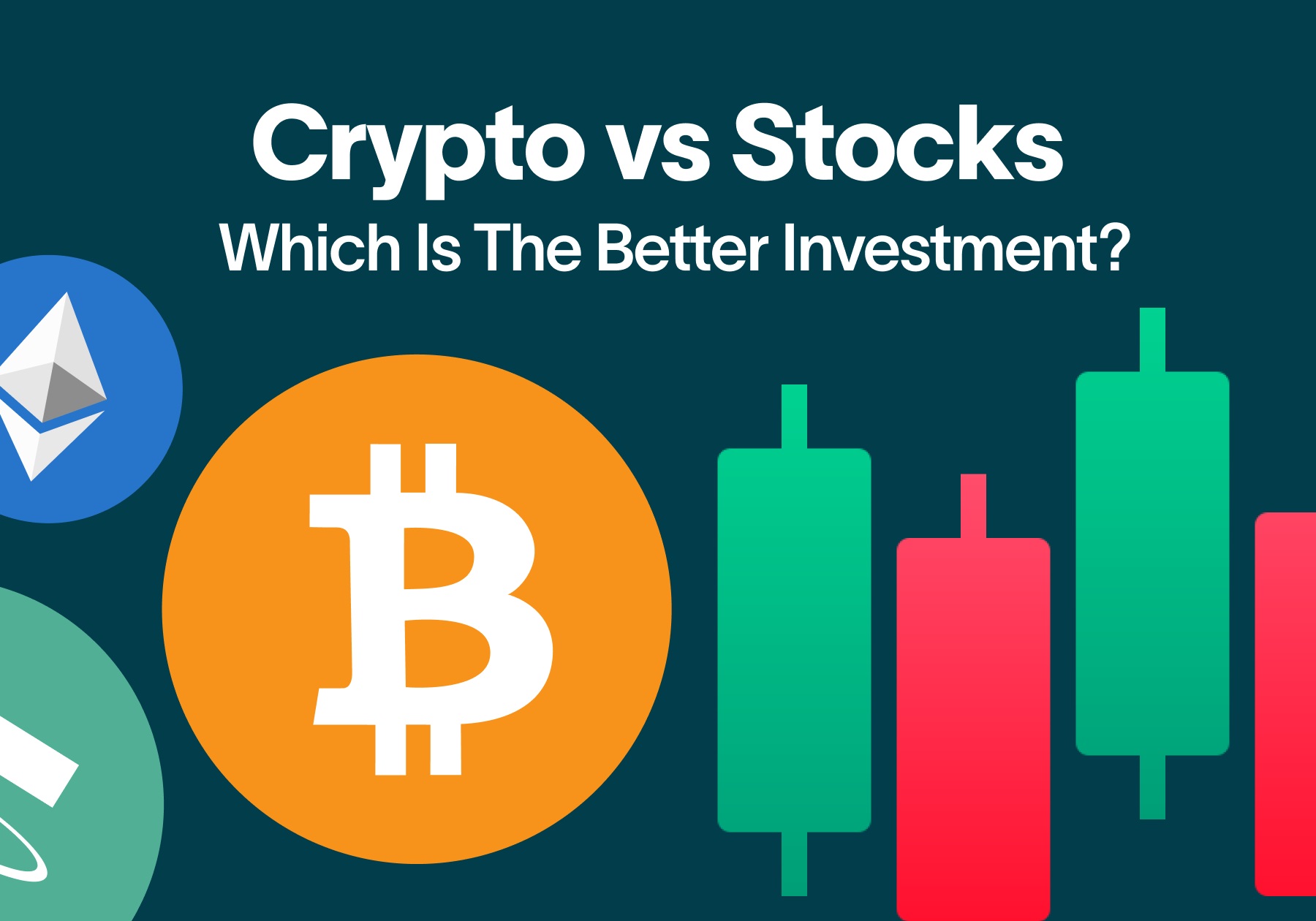
Crypto offers the potential for higher short-term gains but with correspondingly higher volatility and far less transparency into what drives a token’s value. Bitcoin is roughly three times as volatile as the S&P 500, and smaller tokens can swing even more wildly. Valuation proxies for crypto include adoption rates, on-chain activity, and network usage, but none of these are as standardized or widely understood as traditional financial metrics.
One frequently cited argument for adding crypto to a portfolio is diversification. Over multi-year periods, cryptocurrencies have shown low correlation to stocks, meaning they don’t always move in the same direction. But over shorter periods, that correlation can spike, especially during market stress. In a broad sell-off, crypto and stocks have dropped together.
Crypto also doesn’t generate income the way stocks can. There are no dividends and no interest payments unless you stake tokens on a proof-of-stake network, which introduces its own risks. Stocks, particularly through broad index funds, offer both growth potential and income.
Index funds have historically outperformed many individual crypto assets on a risk-adjusted basis and carry lower risk for most investors. That doesn’t mean crypto has no place, but it means the starting point for most portfolios should be traditional, diversified holdings. Crypto fits as a speculative allocation layered on top of that foundation, not as a replacement for it. Position sizing matters: a 2% to 5% crypto allocation changes a portfolio’s risk profile differently than a 25% allocation.
Is Bitcoin still a good investment?
Bitcoin is the original cryptocurrency, introduced in 2009, and it remains the largest by market capitalization. Its track record includes dramatic bull runs that generated massive returns for early or well-timed investors, alongside steep losses for those who bought at peaks.
The volatility is easier to understand with specific numbers. In 2021 alone, Bitcoin’s price was $57,271 on March 12, dropped to $34,682 by July 3, and climbed back to $50,519 by December 9. That kind of movement, a 39% drop followed by a 46% recovery within the same year, is far outside what stock investors typically experience.
Bitcoin’s viability as an inflation hedge remains unproven. During 2021 and 2022, inflation rose consistently while Bitcoin swung sharply in both directions. Its performance as rates declined in 2023 looked even less like an inflation hedge. The narrative is appealing, but the data doesn’t support the claim yet.
As a medium of exchange, Bitcoin falls short on the three characteristics economists use to define a viable currency: it isn’t an inexpensive, reliable medium of exchange (transaction fees and speed vary); it doesn’t function well as a unit of account (too volatile to price goods against); and its record as a store of value is too short and too erratic to draw conclusions from.
One meaningful development is the SEC’s approval of spot Bitcoin ETFs in early 2024. These trade on regulated exchanges and provide exposure to Bitcoin’s price movement without requiring you to manage wallets or private keys. Bitcoin is classified as a commodity, and ETFs receive a higher level of oversight compared with unregulated spot exchanges. For investors who want Bitcoin exposure within a traditional brokerage account, ETFs lower the friction significantly.
How to gain crypto exposure without owning coins directly
You don’t have to hold crypto in a wallet to get exposure to its price movements. Several regulated vehicles let you participate through a standard brokerage account.
- Spot Bitcoin and spot Ether ETFs. These hold the underlying asset directly and trade like traditional ETFs on regulated exchanges. You get price exposure without managing private keys or worrying about wallet security.
- Futures-based Bitcoin ETFs. These track Bitcoin’s price through futures contracts rather than holding Bitcoin itself. Because they must roll contracts as they expire, there’s potential for tracking error and underperformance compared to spot ETFs over time.
- Crypto-focused mutual funds and ETPs. Certain exchange-traded products and mutual funds provide crypto exposure, including to Ethereum as an investment, within a familiar investment wrapper. No wallet or key management needed.
- Stocks of crypto-related companies. Miners, infrastructure providers, and companies with significant crypto holdings offer indirect exposure. Their share prices tend to move with the broader crypto market, so you’re not avoiding crypto volatility entirely.
Each of these vehicles carries its own fee structure and risk profile. None eliminates crypto-market volatility; they just change the packaging around it. The right choice depends on how much friction you want between yourself and the underlying asset, and how much regulatory oversight matters to you.
Five questions to ask yourself before buying crypto
Before putting money into crypto, run through these five checkpoints honestly. They won’t tell you whether Bitcoin will go up or down, but they’ll tell you whether you’re in a position to handle either outcome.
- Is your financial foundation solid? You should have three to six months of emergency savings in place, your retirement contributions should at least capture any employer match, and you should have a debt repayment plan. Crypto is a speculative bet, and speculative bets come after the basics are covered, not before.
- Can you absorb a major loss? Picture a 30% to 40% drop in your portfolio’s value. Would that derail a short-term goal like a down payment, or affect your ability to pay bills? If the answer is yes, you’re allocating too much to volatile assets. Crypto’s drawdowns aren’t theoretical; they’ve happened repeatedly.
- What’s driving your decision? Fear of missing out and social-media hype lead people to skip fundamentals and ignore their own risk tolerance. If you’re buying because everyone on your feed is talking about a token, pause. The people who post gains rarely post losses.
- When will you need this money? Funds earmarked for a major expense within one to two years generally don’t belong in high-volatility assets. A downturn at the wrong time could force you to sell at a loss precisely when you need the cash.
- How do you react to big price swings emotionally? Understanding your psychological response to watching an investment lose 30% of its value overnight is as important as understanding blockchain mechanics. If you’d panic-sell during a crash, crypto’s 24/7 trading availability makes that impulse even harder to resist.
Best practices for managing a crypto investment
If you’ve worked through the questions above and decided crypto has a place in your portfolio, these practices help you manage the downside.

- Research before you buy. Read the project’s whitepaper. Study on-chain adoption metrics: active addresses, transaction volume, developer activity. Verify the team behind any project. If the founders are anonymous and the whitepaper reads like marketing copy, move on.
- Keep the allocation small. Limit crypto to a small percentage of your overall portfolio. It fits as a speculative allocation outside your core holdings. The exact percentage depends on your risk tolerance, but the idea is that even a total loss wouldn’t meaningfully damage your financial position.
- Think long-term. Adopt a buy-and-hold strategy built around the best long-term crypto investments rather than day-trading. Every time you flip a position, you’re paying transaction fees and, as noted above, getting taxed at the higher short-term rate on any profit. The combination eats into returns quickly.
- Secure your holdings. Decide between custodial services (where an exchange holds your keys) and self-custody using a hardware or cold wallet. Custodial services are more convenient but expose you to counterparty risk. Self-custody gives you full control but puts the entire burden of security on you. Losing a hardware wallet without a backup of your seed phrase means losing your crypto.
- Check in periodically, but don’t obsess. The 24/7 nature of crypto trading makes it easy to watch prices constantly, and that amplifies emotional decision-making. Set a schedule for reviewing your positions, and stick to it.
- Work with a tax professional. Every sale, swap, and purchase with crypto is a taxable event. A qualified professional can help you track cost basis, harvest losses strategically, and stay compliant with IRS requirements.
- Invest only what you can afford to lose entirely. This isn’t a cliché in crypto; it’s a practical guideline. Projects fail, exchanges collapse, and tokens go to zero. Your crypto allocation should be money you’ve mentally written off.
Frequently asked questions about crypto investing
What would $1,000 invested in Bitcoin five years ago be worth today?
Bitcoin’s price has multiplied significantly over various five-year windows, and early investors who held through the volatility saw substantial gains. But the exact return depends entirely on your purchase date. Someone who bought during a dip in 2020 saw a very different outcome than someone who bought at the 2021 peak. And “held through” is doing a lot of work in that sentence: Bitcoin’s drawdowns along the way exceeded 50% at times. Past performance doesn’t predict future results.
Is investing $100 in Bitcoin worth it?
Yes, in the sense that fractional buying is standard on most platforms, so $100 gives you real exposure to Bitcoin’s price movement. The dollar amount isn’t the deciding factor. What matters is whether you can afford to lose that $100 entirely. If $100 is money you need for rent or groceries, it doesn’t belong in a volatile asset regardless of upside potential.
Will Bitcoin become the new global currency?
Significant barriers stand in the way. Bitcoin’s volatility makes it impractical for everyday pricing; transaction fees fluctuate and can spike during periods of network congestion; it isn’t widely accepted as a unit of account; and it lacks legal-tender status in most countries. The U.S. dollar alone accounts for 58% of world reserve currency holdings according to IMF data from June 2024, with the euro at about 20%. Displacing that kind of entrenchment would require changes far beyond what the technology alone can deliver.
Can Bitcoin hedge against inflation?
The evidence is inconclusive. Bitcoin rallied and fell sharply during 2021 and 2022 while inflation climbed steadily, and even during the 2023 rate pullback it failed to behave the way an inflation hedge should. The theoretical case, that a fixed-supply asset should hold value when currencies inflate, is logical on paper but hasn’t been supported by Bitcoin’s actual price behavior during inflationary periods so far.
Where crypto investing stands today and what comes next
Crypto is no longer experimental, but it’s still a young, fast-evolving asset class with an uncertain regulatory path. The approval of spot ETFs, growing corporate blockchain integration, and increasing government engagement all signal staying power. None of that eliminates the volatility, the fraud risk, or the possibility of total loss on any individual holding.
The fundamentals of sound investing, having a plan, being consistent, diversifying, and building financial literacy, apply whether crypto is part of your portfolio or not. Crypto belongs in the mix only when you’ve done the research, secured your financial foundation, and genuinely accepted the possibility that your investment could go to zero. If you’ve done that work, a measured allocation can make sense. If you haven’t, the smartest move is to get those basics in order first.