
Axiom is a non-custodial trading interface built on Solana: your keys stay in your own wallet, and orders execute on-chain rather than inside an exchange account. One-click entries with paired limit orders, MEV-resistant routing, copy trading, and a wallet tracker make up the core toolkit, with perpetuals routed through a Hyperliquid integration.
Axiom crypto trading platform overview
Axiom is a non-custodial, on-chain trading interface built around the Solana blockchain. Because it uses a self-custody wallet architecture, you keep control of your private keys and funds at all times. The platform doesn’t hold your crypto the way a centralized exchange would.
The core feature set covers a lot of ground. One-click strategy execution lets you place entries and companion limit orders at the same time. MEV-resistant order routing is designed to shield your trades from front-running and sandwich attacks, though it reduces rather than fully eliminates that risk. Copy trading mirrors the positions of selected traders automatically, and a wallet tracker monitors activity across multiple addresses. Advanced charting, algorithmic automation, and standard technical indicators round out the toolkit.
Supported assets center on Solana and Solana-based tokens, so it helps to understand how Solana works before you trade here. Bitcoin and Ethereum pricing is displayed for reference, but those aren’t direct trading pairs on the platform. Perpetuals are accessible through a Hyperliquid integration using a supported stablecoin. Stock and forex views show up in the interface too, but they function as monitoring and context tools rather than direct spot trading venues.
Axiom is backed by Y Combinator, which adds early-stage credibility from a well-known accelerator. That said, Y Combinator backing doesn’t equal regulatory oversight, and the platform is not presented as a licensed or regulated broker or exchange.
For fiat onramping, there’s a no-KYC purchase window of up to $500 per week through a Coinbase onramp. Beyond that threshold, or through other third-party rails, identity checks may apply depending on the provider and your jurisdiction.
Account setup, funding, and first steps
Getting started on Axiom takes a few minutes, and if you’re still weighing GMGN vs Axiom, the setup below shows exactly what Axiom asks of you. Here’s the process from signup through your first funded dashboard view:
- Create your account. You can sign up with an email address, Google sign-in, or by connecting a Phantom wallet. If you use a referral link during registration, you’ll get a permanent 10% reduction on trading fees.
- Complete your profile. Sign-up collects your name, email, and phone number. You’ll need to confirm your email before you can proceed.
- Back up your recovery phrase. After account creation, a recovery phrase is generated and accessible in the security settings. Write it down and store it somewhere safe. This is your wallet backup, and losing it means losing access to your funds.
- Fund your wallet. You can deposit through a connected Phantom wallet or by copying your deposit address from the interface and sending Solana from another wallet.
- Convert for perpetuals (if needed). If you plan to trade perpetuals, head to the convert tab to swap Solana into the required stablecoin for the Hyperliquid integration.
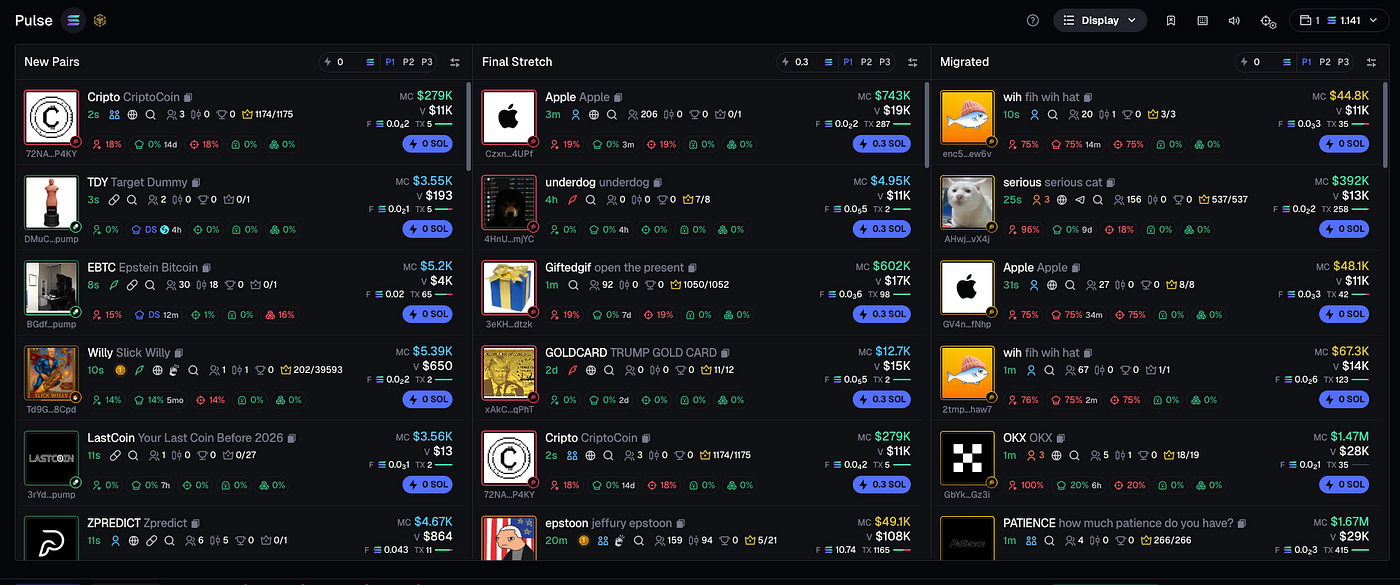
- Explore the dashboard. The main view looks like a DEX screener. You’ll see trending pairs, market caps, liquidity metrics, volume data, and audit logs. A filter system lets you narrow results by protocol, keyword, or metric thresholds.
- Set your trading presets. Before placing trades, configure your slippage tolerance, priority fees, and bribe fees in the settings panel. Getting these right upfront saves headaches on fast-moving tokens.
Affiliate link: we may earn a commission at no extra cost to you.
Eligible assets on the platform can earn up to 15% APY with instant withdrawals, which gives idle funds a place to work while you’re between trades.
Trading tools and strategy features
Axiom’s one-click strategy engine is the centerpiece of its trading toolkit. It places your entry and companion limit orders simultaneously, which matters most during volatile windows where a few seconds of delay can change your fill price. You set your target entry, your take-profit, and your stop, and the system fires them together.
Beyond the standard candlestick view, Axiom offers three proprietary chart types: filter bar charts that let you sort and filter directly inside the dashboard, log stream charts that display real-time system and order events as they happen, and scatter charts for mapping relationships between metrics. Standard technical indicators like MACD, Ichimoku Cloud, and moving averages are available alongside these proprietary visuals, so you’re not giving up familiar analysis tools.
The algorithmic trading hub takes things further for users comfortable with code. You can build strategy automations using Python, run them 24/7 on cloud infrastructure, and backtest against historical data across multiple timeframes. Position sizing and risk limits stay fully configurable on your end, so the automation doesn’t override your risk management.
Copy trading mirrors the trades of selected wallets automatically. You pick a trader whose performance and style match your goals, and the system follows their moves. The wallet tracker complements this by letting you build a watchlist of addresses worth following before you commit to copying anyone.
The trading panel itself shows real-time executions, order flow pressure, and liquidity shifts, giving you a live read on where buying and selling momentum sits at any moment.
Fees, pricing, and volume incentives
Axiom’s trading fees come in below what many competing Solana trading interfaces charge, a gap you can see in our Solana trading tool comparison. Here’s how the cost structure breaks down:
| Fee type | Details |
|---|---|
| Trading fee | 0.7% to 0.9% per trade |
| Competitor benchmark | 1% (common on other Solana interfaces) |
| Network (gas) fees | Paid separately on-chain; can spike during congestion |
| Withdrawal fee | No separate fee; withdrawals are on-chain sends subject to network fees |
| Onramp/provider fees | Vary by third-party rail; may include spreads, processing charges, or compliance-related limits |
| Volume incentives | Tiered Solana rebates that lower effective cost as trading activity increases |
The difference between 0.7% and 1% might sound small, but it compounds. On a $10,000 order, that gap works out to roughly $300 in savings compared to a platform charging 1%. For active traders placing multiple orders a day, the tiered rebate system pushes effective fees even lower as volume grows.
Network fees are worth watching separately. Because every trade settles on-chain, you’ll pay Solana gas fees on top of the platform’s trading fee. During periods of heavy network activity, those gas costs can jump noticeably.
Speed, MEV protection, and execution quality
Axiom’s proprietary execution engine frequently completes orders within a single Solana block. Strategically placed nodes narrow the gap between the moment you submit an order and when it confirms on-chain. In like-for-like conditions, the speed advantage comes out to roughly a couple of seconds faster than leading Solana trading interfaces, which sounds small but matters when you’re sniping a new token launch or reacting to a sudden price move. The platform reports approximate daily volume of $400 million, which speaks to the amount of order flow running through its infrastructure.
The routing layer mentioned earlier works to insulate your orders from front-running and sandwich attacks. These are tactics where bots detect your pending transaction and place their own trades around it to extract value at your expense. While Axiom’s routing raises the difficulty for would-be exploiters, it doesn’t fully eliminate the risk. On-chain manipulation is a structural reality of public blockchains, and no routing system can guarantee complete protection.
Power users commonly target 10% to 15% slippage on volatile tokens and adjust dynamically based on conditions. Setting priority and bribe fees near 0.01 SOL can improve confirmation times without burning through excessive fees. These are the kinds of micro-adjustments that separate profitable snipers from traders who consistently get worse fills.
Migration sniping support is another feature aimed at experienced traders. It allows entries before tokens reach major AMM listings, capturing earlier market caps when the price is still low. For users who want even more reliability during high-traffic moments, a VPS-backed setup option strengthens connectivity so your connection doesn’t drop when the network is under load.
Safety checks and scam detection tools
Axiom builds several scam detection layers directly into the trading interface. These don’t guarantee you won’t lose money on a bad token, but they surface red flags that are hard to spot manually:
- Bundle checker flags tokens where snipers hold more than 30% of the total supply. That level of concentrated ownership means a small number of wallets could dump their holdings and crash the price at any time. If the bundle checker fires, it’s a signal to investigate further before buying.
- Bubble maps visualize how a token’s supply is distributed across wallets. In thinly traded assets, these maps expose whale concentrations that might not be obvious from a price chart alone. A token where three wallets hold most of the supply behaves very differently from one with broad distribution.
- Auto-sell trigger activates when the system suspects a developer dump is underway. It acts as a defensive mechanism, selling your position before the price craters further. It’s reactive rather than preventive, so it won’t catch everything, but it adds a layer of automated protection.
- Twitter username history shows past identities of token promoters when you hover over their profiles. Promoters who’ve changed their handles repeatedly may be recycling credibility from previous projects, and this tool makes that pattern visible.
Because Axiom is non-custodial, there’s no pooled-custody insurance like you’d find on a centralized exchange. You bear full responsibility for key security and transaction finality. That means strong password hygiene, keeping your recovery phrase offline, and enabling two-step login where it’s available aren’t optional, they’re the baseline.
Is Axiom safe for trading?
Axiom is not a regulated broker or exchange, and the protections you’d expect from a licensed financial platform (dispute resolution, transaction reversals, formal complaint pathways) aren’t part of the picture here. That’s the trade-off of a non-custodial model: the platform can’t withhold your funds, but there’s also no custodial safety net if something goes wrong.
User sentiment is sharply divided. Independent reviewers have rated real-world performance at 4.8 out of 5, but user reviews on one aggregator sit at 1.6 out of 5 across just 6 reviews. That gap is wide enough to warrant caution. Negative reports cite losses from one-click strategy use, skepticism about whether the MEV protection works as advertised, and complaints about fees. On the positive side, Y Combinator backing, a transparent fee structure, and active development signal that the team is invested in the product’s longevity.
Putting those two sides together: the platform’s tooling is genuinely advanced for the Solana ecosystem, and the non-custodial design means your funds aren’t sitting in someone else’s wallet. But advanced tools in the hands of inexperienced traders can accelerate losses just as fast as they accelerate gains. One-click strategy execution on volatile memecoins is high-risk by nature, and the platform’s speed and automation don’t change the underlying risk of the tokens being traded.
Standard on-chain risks apply regardless of which platform you use: token quality varies wildly, liquidity can disappear in seconds, execution conditions shift during congestion, and smart-contract vulnerabilities are always a possibility.
Withdrawals are straightforward. You send funds directly from your self-custody wallet on-chain. Common issues people run into aren’t platform-side fund holds. They’re things like not having enough SOL left to cover gas fees, selecting the wrong chain or address type, waiting on pending network confirmations, or delays from third-party fiat rails.
Frequently asked questions
What countries can access the Axiom crypto platform?
Because it’s a self-custody interface rather than a centralized exchange, Axiom is generally accessible wherever crypto trading tools are permitted. The main restrictions come from third-party onramp availability and local sanctions or prohibitions. If you can access a Solana wallet, you can likely use the platform’s core trading features, but fiat onramps may not be available in every region.
Does the Axiom crypto platform require KYC?
Core on-chain trading does not require KYC. You can trade Solana-based tokens without submitting identity documents. However, if you use fiat purchases or card flows through third-party providers, those providers may impose their own identity verification depending on who they are and where you’re located. The no-KYC purchase window covers up to $500 per week through the Coinbase onramp.
What cryptocurrencies does the platform support?
Axiom focuses primarily on Solana and Solana-based tokens. Perpetual contracts are accessible via the same Hyperliquid integration mentioned above, requiring a supported stablecoin. Bitcoin and Ethereum appear in the interface as reference pricing, but they aren’t direct trading pairs on the platform.
Can you withdraw money from the Axiom platform?
Yes. Since the platform is non-custodial, withdrawals are on-chain wallet sends that you initiate at any time. There’s no separate withdrawal fee from Axiom itself; you just pay the standard Solana network fee. Common issues that trip people up include not keeping enough SOL in the wallet to cover gas, selecting the wrong chain, and waiting on pending network confirmations.
The most important things to understand before committing funds are the non-custodial model and the fee structure. You control your keys, which means no one can freeze your account, but it also means mistakes are permanent. The 0.7% to 0.9% trading fee is competitive on Solana, and tiered rebates reward volume, but network fees during congestion can eat into those savings. Start small, get comfortable with the presets and slippage settings, and don’t use one-click strategies on volatile tokens until you understand exactly how they work.
Affiliate link: we may earn a commission at no extra cost to you.