
Mining a single Bitcoin can take anywhere from about 10 minutes to decades, depending almost entirely on how much hashrate you control relative to the rest of the network. One top-tier ASIC running alone needs roughly 10 years to accumulate 1 BTC; a 1,000-machine commercial farm gets there in about four days.
How long does it take to mine 1 Bitcoin?
The shortest theoretical answer is about 10 minutes. That’s the average time between blocks, and if a solo miner solves one, the current block reward of 3.125 BTC lands in their wallet all at once, well past the 1 BTC mark. But the odds of any single machine doing that are vanishingly small, so the practical answer depends on hardware scale.
Under mid-2026 conditions and assuming difficulty stays flat (it won’t, but more on that later), here’s how long different setups would take to accumulate 1 BTC:
| Setup | Approx. hashrate | Estimated time to 1 BTC |
|---|---|---|
| One top-tier ASIC (S23 Hydro class) | ~563 TH/s | ~10 years (~3,561 days) |
| One mid-tier ASIC (S21 XP class) | ~270 TH/s | ~20 years (~7,425 days) |
| One older ASIC (S19 XP class) | ~141 TH/s | ~39 years (~14,218 days) |
| Five top-tier ASICs | ~2,815 TH/s | ~2 years (~712 days) |
| Ten top-tier ASICs | ~5,630 TH/s | ~12 months (~356 days) |
| One hundred top-tier ASICs | ~56,300 TH/s | ~5 weeks (~36 days) |
| Commercial farm of 1,000 ASICs | ~563,000 TH/s | ~4 days |
The pattern is straightforward: scaling up hardware is the only reliable way to compress the timeline. Double your hashrate and you roughly halve the wait.
Every number in that table assumes difficulty doesn’t change. In reality, difficulty has trended upward for most of Bitcoin’s history, so these estimates are best-case floors. Your actual timeline will almost certainly run longer.
It’s also worth understanding that mining is a stochastic process, more like a lottery than a paycheck. Each hash your machine computes has the same tiny probability of solving a block, regardless of how many hashes came before it. Past effort doesn’t increase your odds on the next attempt.
How Bitcoin mining works
Miners validate pending transactions by solving cryptographic puzzles using the SHA-256 hash algorithm. SHA-256 takes the data packed into a block header (version, previous block hash, Merkle root, timestamp, target, and nonce) and transforms it into a 256-bit hash. The miner’s job is to vary the nonce, a small adjustable value in the header, over and over until the resulting hash falls at or below a target value set by the network.
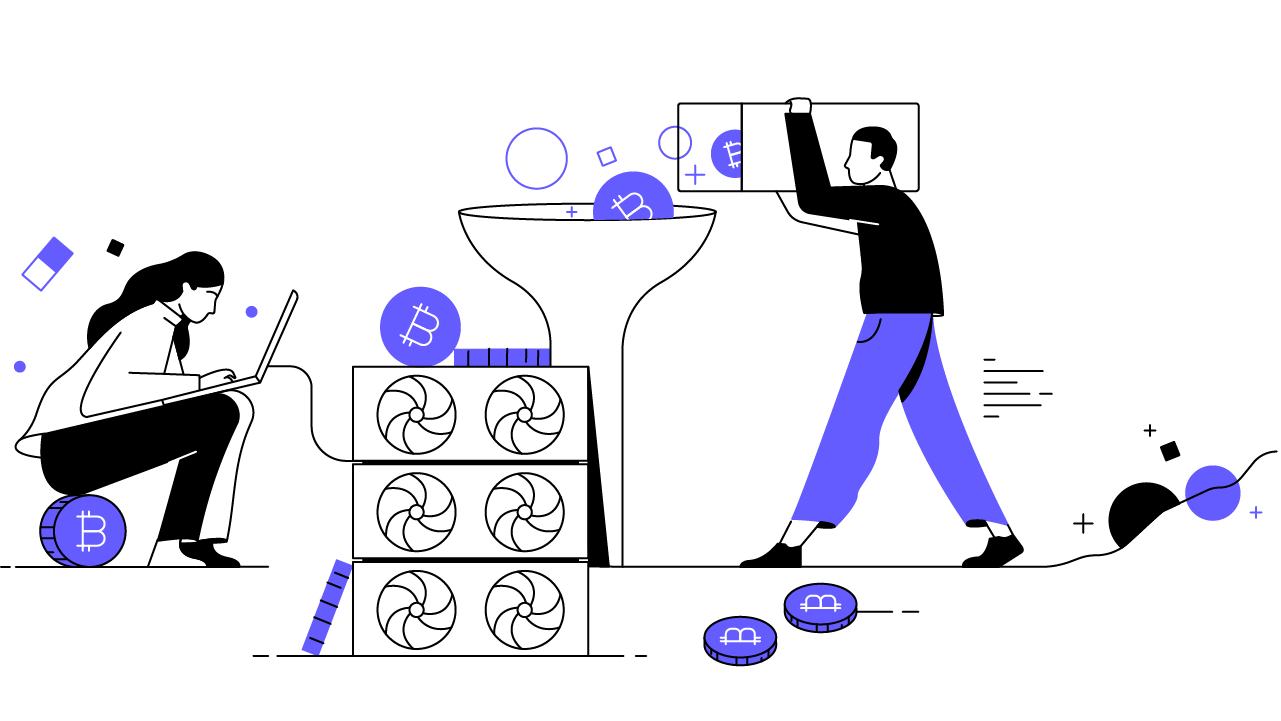
When a miner finds a valid solution, they add that block to the blockchain and collect the block reward plus any transaction fees included in the block’s transactions. The process is computationally heavy on the mining side, but once a valid hash is found, other nodes on the network can verify it almost instantly.
The word “mining” is a metaphor. There’s no physical digging. The actual work is transaction validation and block creation, and the reward is the incentive that keeps miners doing it.
Factors that determine how long it takes to mine 1 Bitcoin
Three variables drive every timeline estimate: your hashrate, the total network hashrate (which sets difficulty), and the block reward. Your share of the network’s hashrate directly determines your expected BTC earnings over time.
Here’s the core concept as a formula you can use yourself:
(your hashrate ÷ total network hashrate) × block reward ÷ 10 = BTC earned per minute
Say your setup hashes at 563 TH/s and the network sits around 925 EH/s. Your share is 563 ÷ 925,000,000 = roughly 0.000000609. Multiply that by the 3.125 BTC block reward and divide by 10 (minutes per block), and you get about 0.000000019 BTC per minute. Scale that up to a day and you’re earning a tiny fraction of a bitcoin, which is why a single machine needs years.
All three inputs shift continuously. Difficulty adjusts every two weeks, network hashrate rises as new miners come online, and the block reward halves on a fixed schedule. That makes every calculation dynamic and probabilistic, not a guarantee.
Hashrate and your share of the network
Hashrate measures how many guesses per second a machine makes, expressed in terahashes per second (TH/s). Think of each guess as a lottery ticket in the race to solve the next block. More hashrate means more tickets.
Your odds on any given block equal your hashrate divided by the total network hashrate. One 563 TH/s machine running against a network of approximately 925 EH/s holds roughly one share in 1.6 million. That’s tiny, but it’s nonzero, and over thousands of blocks those odds translate into a statistical expectation of BTC earned.
To put the scale in perspective: the network hashrate briefly surpassed 1,000 EH/s (1 ZH/s) around early January 2025, roughly doubling from about 510 EH/s in January 2024. As competing hashrate grows, your proportional slice shrinks even if your own machines haven’t changed.
Another example makes this concrete. A 100 TH/s miner running against a 150 EH/s network holds about 1/1,500,000 of the total hash power. Statistically, that miner would solve one block every 1,500,000 blocks, which at 10 minutes per block works out to roughly 28.5 years.
Bitcoin’s difficulty adjustment
Difficulty recalculates every 2,016 blocks, roughly every two weeks. This mechanism, central to how Bitcoin works, keeps average block production at one block per 10 minutes no matter how much total hashrate is pointed at the network.
The logic is simple. If the previous 2,016 blocks were mined faster than two weeks, difficulty goes up, making the target hash harder to hit. If they took longer, difficulty drops. The result is a self-correcting system that absorbs swings in total hashrate.
For individual miners, rising difficulty is the persistent headwind. Your machine’s absolute hashrate matters less than your share of the network’s total. If you hold steady at 563 TH/s while the rest of the network adds capacity, your relative share shrinks and your expected daily BTC output falls with it.
Difficulty has risen steadily throughout Bitcoin’s history. That’s why static timeline projections, the kind a mining calculator spits out, are inherently optimistic. They assume today’s difficulty holds forever. It almost certainly won’t.
Block reward and the halving cycle
The current block reward is 3.125 BTC per block, set by the April 2024 halving. Before that halving, each block paid 6.25 BTC. Before that, 12.5 BTC. The original reward when Bitcoin launched in 2009 was 50 BTC per block.
The reward halves approximately every four years (every 210,000 blocks). The next halving is estimated around April 2028, cutting the reward to 1.5625 BTC per block. That single event roughly doubles the time needed to mine 1 BTC at the same hashrate, because each solved block contributes half as much toward your goal. A machine that could accumulate 1 BTC in 10 years under the 3.125 BTC reward would need about 20 years under a 1.5625 BTC reward, all else being equal.
This schedule also means new supply is running out. Over 19.9 million BTC were already in circulation as of late 2024, with approximately 1.1 million left to mine, less than 5% of the total 21 million coin cap.
Miners don’t rely on the block subsidy alone. Each block also includes transaction fees paid by users, which add variable income on top of the fixed reward. As halvings continue to shrink the subsidy, transaction fees become a larger piece of miner revenue.
Mining hardware: ASIC vs. GPU vs. FPGA
ASICs (application-specific integrated circuits) are purpose-built chips designed to do one thing: run SHA-256 hashing as fast and efficiently as possible. They dominate Bitcoin mining because nothing else comes close in performance per watt.
Modern ASICs range from roughly 141 TH/s for older models (S19 XP class) to 563 TH/s or more for top-tier hydro-cooled units (S23 Hydro class), all drawing between 2,000 and 3,000 watts. That four-fold hashrate spread translates directly into timeline differences: a machine running at 563 TH/s reaches the 1 BTC mark in roughly a quarter of the time an older 141 TH/s unit would need.
FPGAs (field-programmable gate arrays) are reconfigurable chips that sit between general-purpose hardware and ASICs. They’re more efficient than CPUs and GPUs for hashing, but they can’t match a dedicated ASIC’s throughput or power efficiency on SHA-256.
GPUs lack the efficiency to mine Bitcoin profitably at current difficulty levels. Their architecture isn’t built for SHA-256 the way an ASIC’s is. If you already own a GPU and want Bitcoin exposure through mining, the common advice is to mine GPU-friendly proof-of-work coins and convert the proceeds to BTC.
CPU mining has been obsolete for Bitcoin for many years. A standard desktop or laptop processor simply can’t generate hashes at competitive speeds.
Can you mine 1 Bitcoin with an RTX 4090?
Consumer GPUs like the RTX 4090 produce SHA-256 hashrates that are orders of magnitude below even an entry-level ASIC. At current network difficulty, a single RTX 4090 would take an impractically long time, decades or more, to accumulate 1 BTC through direct Bitcoin mining.
The economics make it worse. The electricity a GPU consumes while grinding through SHA-256 hashes would far exceed the value of whatever fraction of a bitcoin it produces. You’d spend more on power than you’d ever earn.
If you have an RTX 4090 and want to mine your way toward Bitcoin, the practical route is to mine altcoins that are better suited to GPU architectures and then exchange those coins for BTC on any major exchange. That path won’t be fast either, but at least the hardware is working on something it was designed to handle.
Solo mining vs. pool mining
Solo mining and pool mining reach 1 BTC in the same expected time at the same total hashrate. The difference isn’t speed; it’s variance.
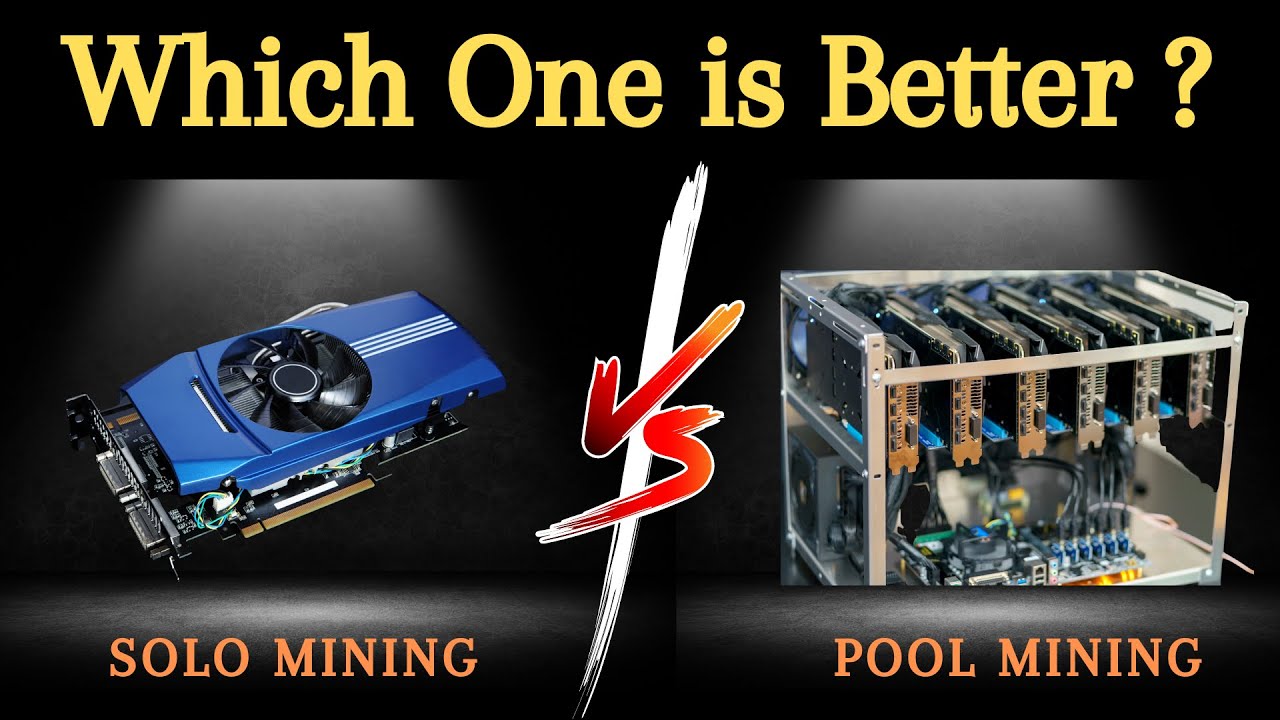
Solo mining is a pure lottery: if your machine solves a block, you receive the full 3.125 BTC reward, but the wait between wins is enormous for a small operation. A top-tier 563 TH/s ASIC would, on average, solo-mine one block roughly every 30 years, while a 270 TH/s machine pushes that to about 64 years and an older 141 TH/s unit to roughly 122 years. You could get lucky and solve a block next week, or you could run for decades and never hit one, which is what high variance looks like.
Pool mining replaces that lottery with steady, smaller payouts. Pools combine the hashrate of thousands of miners, increasing the group’s collective chance of solving blocks. When the pool finds a block, the reward is split proportionally based on each miner’s contributed hashrate. Your balance climbs toward 1 BTC in a much steadier line.
Pools charge fees for this service, typically a percentage of your mined coins. Those fees reduce your gross payout, so you keep slightly less per hash than a solo miner would in a perfect world. The tradeoff is dramatically reduced income variance. For anyone who needs predictable cash flow to cover electricity bills, that tradeoff usually makes sense.
When choosing a pool, look at the pool’s reputation, its collective hashrate, the fee structure, and the defenses it has in place against attacks. A larger pool finds blocks more frequently, which means more consistent payouts, but your share of each block is smaller since more miners are splitting it.
Can you mine 1 Bitcoin in a day?
Not with a single machine. Even the fastest ASIC available needs years, not hours, to accumulate 1 BTC.
The entire Bitcoin network produces one block, worth 3.125 BTC, roughly every 10 minutes. That’s about 450 BTC per day across all miners worldwide. Capturing 1 BTC in a single day means your operation needs to win or share a meaningful fraction of those blocks.
A commercial farm running 1,000 top-tier ASICs at a combined hashrate of approximately 563,000 TH/s can reach 1 BTC in roughly 4 days, not one. Getting to a single day would require even more machines.
For most individuals, the realistic timeframe is months to years. That’s not a reason to avoid mining, but it is a reason to set expectations correctly before buying hardware.
How to estimate your own timeline with a mining calculator
Online mining calculators give you a quick estimate of how long it’ll take to hit 1 BTC with your specific setup. The output is only as good as the numbers you feed in, so it helps to understand each field.
- Enter your machine’s hashrate in TH/s and its power consumption in watts. Both figures are listed on the manufacturer’s spec sheet. Use the rated, not overclocked, values unless you’re actually running at higher clock speeds.
- Enter the current network hashrate and difficulty. You can find both on blockchain explorer sites. These numbers change with every difficulty adjustment, so grab a recent figure rather than relying on one that’s weeks old.
- Enter your electricity cost per kilowatt-hour. This is the single most impactful cost input. Residential rates in the U.S. often run $0.16 to $0.20/kWh. Hosted or industrial setups may pay $0.07 to $0.08/kWh. That gap matters more than it looks: a miner paying $0.07/kWh keeps a much larger share of mined BTC as profit than someone paying $0.18/kWh for the same machine doing the same work.
- Set the current block reward (3.125 BTC) and, if you’re pool mining, the pool fee percentage. Leaving the pool fee out inflates your estimated earnings. Even a small fee compounds over months.
- Read the output. The key numbers are daily BTC earned, daily electricity cost, and estimated days to accumulate 1 BTC. Some calculators also show a breakeven price, the BTC price at which your mined coins exactly cover your power bill.
Filling in all fields, hashrate, difficulty, electricity cost, and pool fee, gives a much more accurate picture than entering hashrate alone.
One important caveat: static calculators assume difficulty stays flat. Given that upward trend in difficulty noted earlier, treat the calculator’s result as a best-case floor, not a promise. Your actual timeline will likely run longer as difficulty adjusts.
Bitcoin mining profitability in 2026
Revenue in BTC is the straightforward part: your hashrate share multiplied by the block reward tells you roughly how much bitcoin you’ll earn per day. Profitability is what’s left after you subtract electricity, hardware costs, and operational overhead.
Bitcoin’s difficulty adjustment creates a natural economic treadmill. Over time, mining 1 BTC tends to cost close to the market price of 1 BTC. When Bitcoin’s price drops, some miners shut down because their electricity costs exceed their revenue. That reduces the network hashrate, which lowers difficulty, giving the remaining miners a larger share of block rewards. When the price rises, new miners come online, difficulty increases, and each existing miner’s BTC-denominated revenue shrinks, though their fiat-denominated revenue may still climb because each coin is worth more.
Because this self-correcting cycle compresses profit margins, energy cost, the largest operating expense by far, often decides whether a mining operation stays in the black. The gap between $0.07/kWh and $0.18/kWh can separate a profitable setup from one that bleeds money.
Downtime is another profit killer. Machines that go offline for repairs, cooling failures, or electrical issues earn nothing until they resume hashing, but the fixed costs of the facility keep running. Uptime isn’t glamorous, but it’s a major factor in whether a mining operation makes money.
The halving cycle adds another layer of pressure. The April 2024 halving cut revenue per block from 6.25 to 3.125 BTC, squeezing margins for any miner who couldn’t reduce costs to match. The next halving around April 2028 will cut it again to 1.5625 BTC, and miners who are barely profitable today will need cheaper power, more efficient hardware, or both to survive.
Hashprice, a metric that expresses revenue per terahash per day in dollar terms, sat near $0.03844 per TH/day as a mid-2026 figure. That number captures the combined effect of Bitcoin’s price, network difficulty, and block reward in a single data point miners use to gauge whether running their machines makes financial sense compared with other ways to earn with Bitcoin.
Cloud mining is an alternative for people who don’t want to own and maintain hardware. You lease server capacity or buy a mining contract from a provider. Upfront costs can start around $2,000, with daily fees on top. The convenience comes at a cost, and cloud mining contracts don’t always beat simply buying Bitcoin on an exchange, so compare carefully before committing.
How many Bitcoins are left to mine?
Bitcoin’s total supply is capped at 21 million coins by protocol. By late 2024, roughly 19.9 million BTC had already been mined, leaving only about 1.1 million still available.
The halving cycle progressively slows the rate of new coin creation. Each halving cuts the block reward in half, meaning fewer new coins enter circulation with every four-year cycle. The result is increasing scarcity over time.
If the protocol remains unchanged, the last bitcoin is projected to be mined around the year 2140. At that point, miners will earn only transaction fees, with no block subsidy at all. How that shift affects network security and miner incentives is an open question in the Bitcoin community, and one that won’t be fully answered for over a century.
Frequently asked questions
How many years does it take to mine 1 Bitcoin with one ASIC?
Under mid-2026 conditions, one top-tier ASIC (~563 TH/s) takes roughly 10 years. A mid-tier machine (~270 TH/s) stretches that to about 20 years, and an older model (~141 TH/s) to approximately 39 years. These estimates assume flat difficulty. Given the long-term upward trend in difficulty discussed earlier, actual timelines will likely be longer.
How long does a mining farm take to mine 1 Bitcoin?
A farm running 1,000 or more top-tier ASICs, with a combined hashrate around 563,000 TH/s, can accumulate 1 BTC in roughly 4 days. The timeline scales linearly with total hashrate: double the machines and you roughly halve the wait.
Does pool mining get you to 1 Bitcoin faster than solo mining?
No. At the same hashrate, pool mining and solo mining have the same expected time to reach 1 BTC. The difference is variance. Pool mining delivers small, steady payouts that build toward 1 BTC in a predictable line. Solo mining pays nothing until you solve a block, then delivers the full 3.125 BTC reward all at once.
How difficult is it to mine Bitcoin?
Difficulty recalibrates every 2,016 blocks, a span of about two weeks, to hold average block time near 10 minutes. As noted above, difficulty has generally increased over time, meaning any fixed amount of hardware earns less BTC as the network grows.
Is Bitcoin mining still profitable?
It depends on your electricity cost, hardware efficiency, and Bitcoin’s market price. The marginal cost of mining tends toward the coin’s price over time, which keeps profit margins thin for most operators. Miners with access to cheap power and efficient machines have the widest margins; those paying high residential electricity rates often struggle to break even.
Hashrate drives the timeline, not luck
Accumulating 1 BTC depends on sustained hashrate relative to the network, not lucky guessing. Mining feels random on a block-by-block basis, but over long stretches the math smooths out, and what determines your outcome is how much hashing power you’re running compared to everyone else.
Scaling hardware is the only controllable lever you have. Doubling your hashrate halves your expected timeline. Everything else, difficulty, block reward, Bitcoin’s price, moves on its own schedule.
Rising difficulty over time erodes any static plan. A setup that looks like a 10-year project today may become a 15-year project two years from now if the network keeps growing at its recent pace. Miners who stay competitive don’t set up machines and walk away. They continually add or upgrade hardware to maintain their share of the network.
Uptime and low electricity cost determine how much of the mined BTC translates into actual profit rather than overhead. At AXL Research Hub, we keep tracking these numbers because the economics change with every difficulty adjustment and every halving. The miners who thrive are the ones who treat this as an ongoing operation, not a one-time bet.