
Dogecoin started as a joke in December 2013, but more than a decade later it still ranks among the largest cryptocurrencies by market cap. That staying power raises a fair question: is Dogecoin a good investment for your portfolio right now? The short answer is that it depends entirely on your risk tolerance, how you size the position, and whether you can stomach drawdowns that routinely exceed 50%.
Is Dogecoin a good investment in 2026?
Dogecoin’s investment case hasn’t changed in kind since its earliest days: its value rests on community enthusiasm, social-media momentum, and celebrity endorsements rather than traditional financial fundamentals like revenue, earnings, or scarcity. That doesn’t make it worthless, but it does mean DOGE plays by different rules than most assets you’ll find in a conventional portfolio.
The coin reached an all-time high of $0.7376 in May 2021, driven by a wave of retail speculation and Elon Musk’s public championing of the token. Since then, it has given back the vast majority of those gains while its circulating supply has continued to climb, sitting at approximately 146.85 billion DOGE.
Whether DOGE belongs in your portfolio comes down to three questions: Can you afford to lose the entire amount you put in? Are you comfortable with price swings that can erase half your position in weeks? And do you have a plan for when to take profits instead of riding the next cycle all the way back down? If the answer to any of those is no, DOGE probably isn’t the right fit. If the answer to all three is yes, a small, carefully sized position can make sense as a speculative satellite holding.
What is Dogecoin and how does it work?
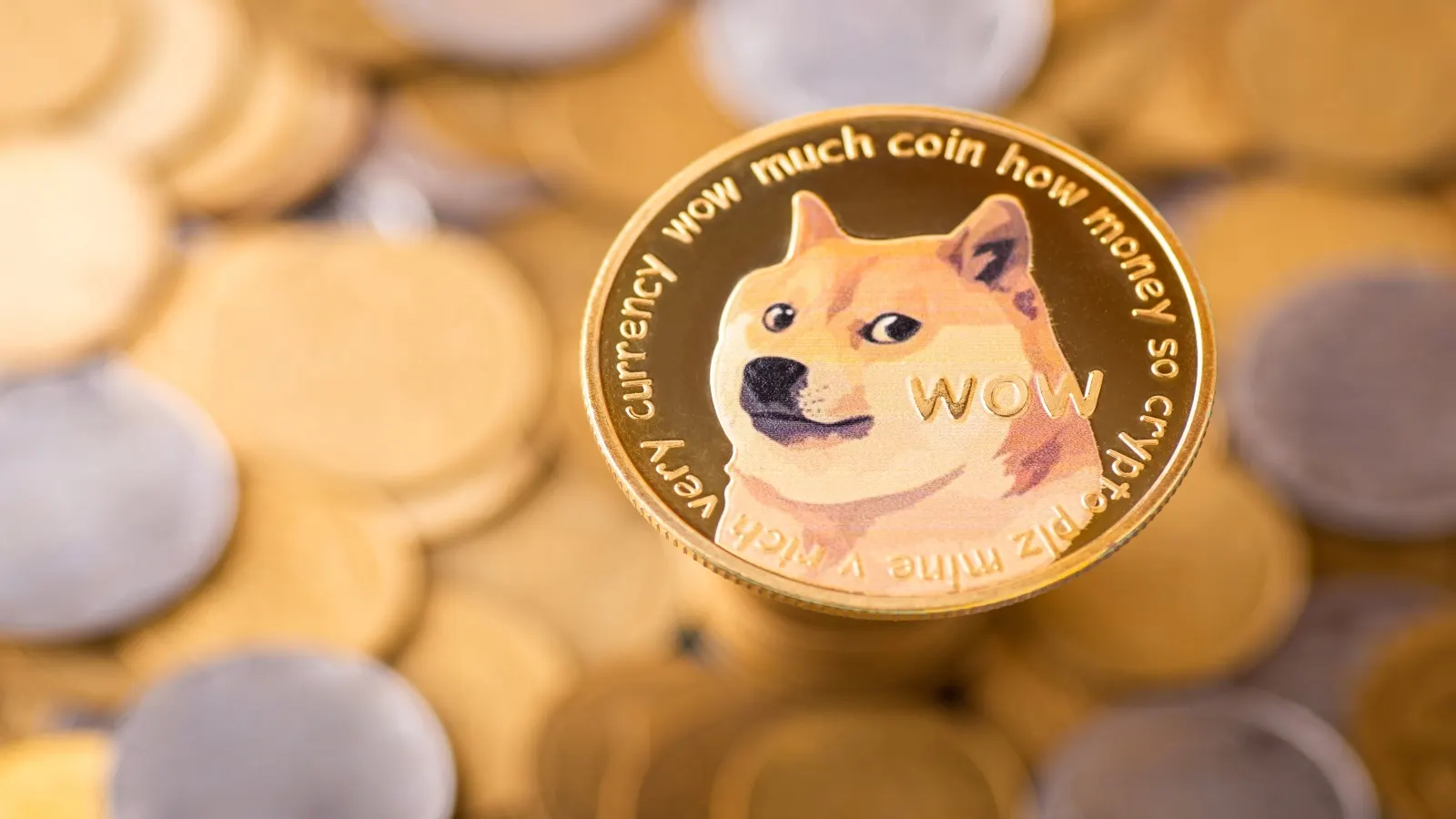
Dogecoin is an open-source, peer-to-peer digital currency created by software engineers Billy Markus and Jackson Palmer as a deliberate parody of the early crypto speculation craze. It uses the Shiba Inu dog from the “Doge” internet meme as its logo and brand, a choice that turned out to be one of the most recognizable pieces of branding in all of crypto.
Technically, Dogecoin is built on a fork of Luckycoin, which itself was derived from Litecoin. It shares Litecoin’s Scrypt hashing algorithm and uses a Proof-of-Work consensus mechanism. One feature that often gets overlooked is merged mining with Litecoin. This means miners can secure both the Dogecoin and Litecoin networks simultaneously without spending extra energy or computational power. For Dogecoin, merged mining is a significant security advantage: it effectively borrows hash rate from Litecoin’s much larger mining pool, making a 51% attack far more expensive than Dogecoin’s standalone market cap would otherwise justify. Without merged mining, a coin of DOGE’s size would be considerably more vulnerable.
Block times tell you a lot about how a cryptocurrency feels in daily use. Dogecoin produces a new block roughly every minute, compared to about 10 minutes for Bitcoin and 2.5 minutes for Litecoin. That faster block time, combined with transaction fees that are often less than one cent, makes DOGE practical for small payments and tips in a way that Bitcoin’s base layer simply isn’t anymore.
What Dogecoin doesn’t have is smart-contract functionality. It can’t host decentralized apps, DeFi protocols, or NFTs the way Ethereum and similar programmable blockchains can. That’s a deliberate trade-off in its design: DOGE does one thing (move value quickly and cheaply), and it leaves the programmability to other networks.
How Dogecoin’s inflationary supply affects its price
Unlike Bitcoin, which has a hard cap of 21 million coins, Dogecoin has no maximum supply. New DOGE is minted indefinitely through mining rewards at a fixed rate of approximately 5 billion coins per year, or 10,000 DOGE per block. An original supply cap of 100 billion coins was removed in a 2014 code update, and since then the supply has grown without limit.
The math here matters: a token’s price equals its total market capitalization divided by its total circulating supply, so when that supply keeps growing, the market needs a matching inflow of new buying pressure every single year just to keep the price flat. Pushing the price higher is even harder, because demand must outpace both existing sell pressure and the constant dilution from newly minted coins. That ongoing dilution is the structural headwind separating DOGE from scarce assets like Bitcoin, where the fixed 21-million cap creates the “digital gold” narrative.
There’s a nuance worth noting, though. While the absolute number of new coins stays constant at roughly 5 billion per year, the inflation rate as a percentage of total supply declines over time. When there were 100 billion coins in circulation, 5 billion new coins represented 5% inflation. At 150 billion coins, the same 5 billion represents about 3.3%. Over decades, that percentage approaches zero, though the absolute dilution never stops.
This design was intentional. By discouraging hoarding and encouraging spending, Dogecoin positions itself as a medium of exchange rather than a store of value. That’s a perfectly valid design philosophy for a payment coin, but it means investors can’t rely on scarcity alone to push the price higher the way Bitcoin holders often do.
What drives Dogecoin’s price?
Dogecoin’s price responds to a mix of macro conditions, crypto-specific cycles, and cultural forces that are unlike anything traditional investors are used to.
Broad crypto-market conditions set the stage: in risk-on environments, when interest rates are falling or liquidity is expanding, speculative assets like DOGE tend to rise. When sentiment turns risk-off, however, DOGE typically falls harder than the broader market because it effectively acts as an amplified bet on crypto enthusiasm itself.
Bitcoin’s market cycle is the single biggest external factor. DOGE tends to move in the same direction as Bitcoin but with amplified swings in both directions. When Bitcoin rallies, DOGE often outperforms on the way up. When Bitcoin corrects, DOGE usually drops further and faster. Understanding Bitcoin basics and how its cycles work provides essential context for evaluating DOGE’s price movements.
Social media and community momentum create the rapid, short-lived price spikes DOGE is known for. A trending Reddit thread, a viral post on X, or commentary from a popular influencer can move the price within hours. These moves are real, but they’re often temporary, and buying into them after the spike has already started is where most retail losses happen.
Meme-coin sector rotation also plays a role. When capital flows into the meme-coin category, DOGE benefits from its name recognition and deep liquidity, but it also competes with newer meme tokens that promise larger percentage gains from smaller market caps.
Because regulatory developments can shift demand quickly in either direction, they deserve ongoing attention: clearer frameworks tend to attract cautious capital, while sudden uncertainty pushes it away.
Payment and merchant adoption provide a slower but more durable price floor. Actual transaction activity, growing active addresses, and new payment-processor integrations strengthen the argument that DOGE has utility beyond speculation.
Unit-bias psychology reinforces all of these demand drivers. Trading at fractions of a dollar, DOGE feels “cheap” to new investors who’d rather own thousands of whole coins than 0.001 Bitcoin. This psychological preference is well documented in retail investing behavior, and it funnels a meaningful share of first-time crypto buyers toward low-unit-price tokens like DOGE.
The scale of sentiment-driven moves can be staggering. DOGE surged approximately 167% in one month after the November 2024 U.S. presidential election and posted a 250% gain across calendar year 2024.
The role of Elon Musk and social sentiment
No discussion of Dogecoin’s price is complete without Elon Musk, who has called himself the “Dogefather.” His relationship with DOGE spans years of tweets, memes, and real business integration: select Tesla and SpaceX merchandise has been purchasable with DOGE at various points.
Every Musk mention triggers a near-instant market reaction, with trading volume spiking and the price often jumping in minutes. The Department of Government Efficiency, which uses the acronym D.O.G.E., has kept the coin visible in mainstream news cycles even when the initiative itself has nothing to do with cryptocurrency. That viral feedback loop is unique to Dogecoin. No other asset gets free advertising from a federal government acronym.
The downside of this dynamic is real. Depending on a single public figure’s social output makes DOGE an asset that demands active monitoring. You can’t buy it and forget about it the way you might with a broad index fund. Sentiment-driven price moves historically reverse once attention fades, which creates both opportunity for disciplined traders and downside risk for anyone who buys during the excitement and holds through the fade.
Real-world utility beyond speculation
Dogecoin’s original claim to fame was as a tipping currency for content creators on Reddit and Twitter, and that peer-to-peer payment DNA still defines its strongest use cases. Today, DOGE is used for peer-to-peer payments, online tipping, micro-transactions, and charitable donations.
On the merchant side, DOGE is accepted at over 2,100 businesses, though most are small or niche operations. Major names that have accepted DOGE include Tesla (for merchandise), AMC Theatres, and several travel-booking platforms. Third-party crypto payment processors bridge the gap for merchants who want to accept DOGE without holding it, settling transactions into fiat currency instantly.
Low fees and one-minute block times make DOGE closer to digital cash than Bitcoin’s base layer, which has increasingly shifted toward a store-of-value role. For someone sending $5 worth of crypto to a friend or tipping a content creator, DOGE works better than Bitcoin for that specific job.
The ceiling on utility, though, is set by Dogecoin’s lack of smart-contract support. It can’t natively host DeFi protocols, decentralized applications, or NFTs. That limits what developers can build on top of it and narrows the range of use cases compared to programmable blockchains like Ethereum, a gap that feeds directly into Ethereum’s investment case. On top of this, the developer community around Dogecoin remains small relative to major chains, which slows technical upgrades and feature expansion. DOGE does payments well, but payments alone may not be enough to sustain long-term demand growth against the constant inflationary supply.
Dogecoin vs. Bitcoin, Ethereum, and other meme coins
Dogecoin doesn’t compete directly with Bitcoin or Ethereum. Its niche is a simple, approachable payment system powered by community culture. But comparing it side by side with other major tokens helps clarify what you’re actually buying when you buy DOGE.
| Feature | Bitcoin (BTC) | Ethereum (ETH) | Dogecoin (DOGE) | Shiba Inu (SHIB) | XRP |
|---|---|---|---|---|---|
| Primary role | Scarce digital store of value | Decentralized computing platform (DeFi, dApps, NFTs) | Meme-driven payment coin | Meme token with broader ecosystem (DEX, burn mechanism) | Payments and settlement |
| Supply model | Fixed cap of 21 million coins | No hard cap, but net issuance reduced post-merge | Inflationary, approximately 5 billion new coins per year | Extremely high supply; ERC-20 token on Ethereum | Fixed total supply with controlled release |
| Key strength | Strongest brand, deepest network effects, scarcity narrative | High utility, massive developer ecosystem | Brand recognition, liquidity, low fees, fast blocks | Ethereum-based ecosystem with DeFi features | Fast, low-cost cross-border transactions |
| Price driver | Macro cycles, institutional adoption, halving events | Platform usage, DeFi growth, network upgrades | Community sentiment, celebrity influence, meme cycles | Meme sentiment, burn rate, ecosystem expansion | Adoption by financial institutions, regulatory clarity |
| Main risk | Market and regulatory volatility | Ecosystem complexity, competition from other L1s | Sentiment dependence, inflationary supply | Higher gas fees, sentiment dependence, extreme supply | Adoption competition, supply distribution concerns |
One thing the table makes clear: holding multiple meme coins (say, DOGE and SHIB together) doesn’t automatically diversify your risk. If both react to the same crypto-market sentiment shifts and meme-coin rotation cycles, they’ll often move in the same direction at the same time.
Can Dogecoin reach $1?
Reaching $1 would require Dogecoin’s total market capitalization to rise far above where it has ever been, and it would need to absorb the billions of new coins minted each year on the way there. Because the supply has grown significantly since the May 2021 bull run, hitting $1 today demands a much larger market cap than it would have required back then.
There are three plausible paths. A hype-driven peak during intense retail euphoria could push DOGE toward $1 temporarily, similar to the dynamics that drove the 2021 rally but at a larger scale. Gradual adoption-based growth, driven by expanding merchant acceptance and payment-processor integrations, could build a more durable price floor over time. Or moderate appreciation across normal crypto cycles could inch the price higher over several years if demand consistently outpaces new supply.
None of these paths is guaranteed. Each one requires both rising liquidity in the broader crypto market and continued cultural relevance for Dogecoin specifically. For an inflationary asset, large price milestones depend on demand consistently outrunning new supply creation, and that’s a race that never ends.
Dogecoin’s historical returns and drawdown risk
Dogecoin’s price history follows a pattern of rapid rallies followed by deep, prolonged corrections. This is common among sentiment-driven assets, but the severity of DOGE’s drawdowns stands out even within the crypto market.
As of late January 2026, DOGE traded approximately 82% below its May 2021 peak. For context, Shiba Inu declined 91% from its own all-time high over a comparable span, illustrating that steep drawdowns are a feature of meme-coin investing, not a bug specific to Dogecoin.
During one recent 12-month window, DOGE’s price ranged from a low near $0.092 to a high near $0.47. That’s the kind of volatility that can turn a modest position into a windfall or cut it by 80%, depending on when you buy and whether you have a plan for taking profits.
DOGE can remain below a previous peak for years, which tests investor patience in ways that quarterly earnings reports or dividend payments never do. Buying after a sudden viral rally, when excitement is highest, dramatically increases your downside exposure because sentiment-driven spikes tend to reverse once attention moves elsewhere.
Large historical returns don’t guarantee similar future gains. Position sizing and risk management matter more than timing the perfect entry. Many investors lose money not because they picked the wrong asset, but because they allocated too much, used leverage, or held through a full cycle without ever taking a profit.
Who should consider Dogecoin, who should not
Not every investor belongs in the same trade. DOGE fits some portfolio strategies and actively harms others.
- Conservative or income-focused investors are generally better off elsewhere. DOGE lacks scarcity, produces no yield, and has no stable fundamentals to anchor a valuation. If your portfolio is built around capital preservation or steady income, a meme coin adds risk without the structural return drivers you’re looking for.
- Short-term traders and high-risk speculators can potentially profit from DOGE’s large price swings, but only with strict risk management and small position sizes. The volatility that creates opportunity also creates rapid losses if you’re wrong on timing or direction.
- Investors seeking meme-coin exposure as a satellite position may find that a small, defined allocation with a clear exit strategy fits within a diversified portfolio. The key word is “defined.” Knowing when you’ll sell, and at what level, before you buy is what separates a strategy from a gamble.
- Anyone who can’t tolerate 50%+ drawdowns or is investing with borrowed capital should avoid DOGE entirely. Leverage on a highly volatile, sentiment-driven asset compounds losses in ways that can wipe out a position before a recovery even begins.
Dogecoin rewards patience and discipline more than emotion-driven buying during hype spikes. The suggested allocation ranges from the research we reviewed: 0 to 1% for conservative portfolios, 1 to 3% for moderate-risk investors, and 3 to 5% for those with a high risk tolerance.
On-chain metrics worth tracking in 2026
Price charts tell you where DOGE has been. On-chain metrics and external catalysts give you a better read on where demand might be heading.
- DOGE trading volume is one of the most immediate signals. Rising volume during a flat or rising price suggests accumulating demand, where buyers are stepping in without pushing sellers out. Rising volume during a falling price, on the other hand, often signals distribution.
- Active-address growth tracks how many unique addresses are actually using the network. More active addresses suggest organic adoption rather than price movement driven purely by exchange speculation.
- Whale-wallet concentration deserves close attention. When a small number of wallets hold a disproportionate share of the total supply, a single large holder exiting can trigger a sudden sell-off that cascades through the order book. Monitoring known whale wallets through on-chain explorers gives you an early warning that no price chart provides.
- Bitcoin’s broader trend remains the tide that lifts or sinks most crypto boats. DOGE historically amplifies Bitcoin’s moves in both directions, so a strong Bitcoin cycle tends to carry DOGE higher (and vice versa).
- Search interest and social-media engagement often spike before short-term price moves. Google Trends data and social-volume trackers can flag when DOGE is gaining attention before that attention hits the order books.
- Merchant and payment-processor integrations provide harder data than most crypto catalysts. Actual adoption numbers, new partnerships, and transaction-count growth carry more weight than announcements or rumors.
- Regulatory developments could reshape the regulatory environment quickly. Potential ETF approvals or clearer crypto frameworks in the U.S. would likely shift both institutional and retail demand for DOGE and the broader meme-coin sector.
- Meme-coin sector rotation determines whether DOGE captures or loses speculative attention. When capital rotates into meme coins as a category, DOGE benefits from its liquidity and name recognition. When capital rotates out, DOGE drops along with the rest.
How to manage risk when investing in Dogecoin
At AXL Research Hub, we see the same pattern repeatedly in reader questions: losses from poor risk management far outnumber losses from picking the wrong coin. Here’s how to approach DOGE if you decide it fits your portfolio.
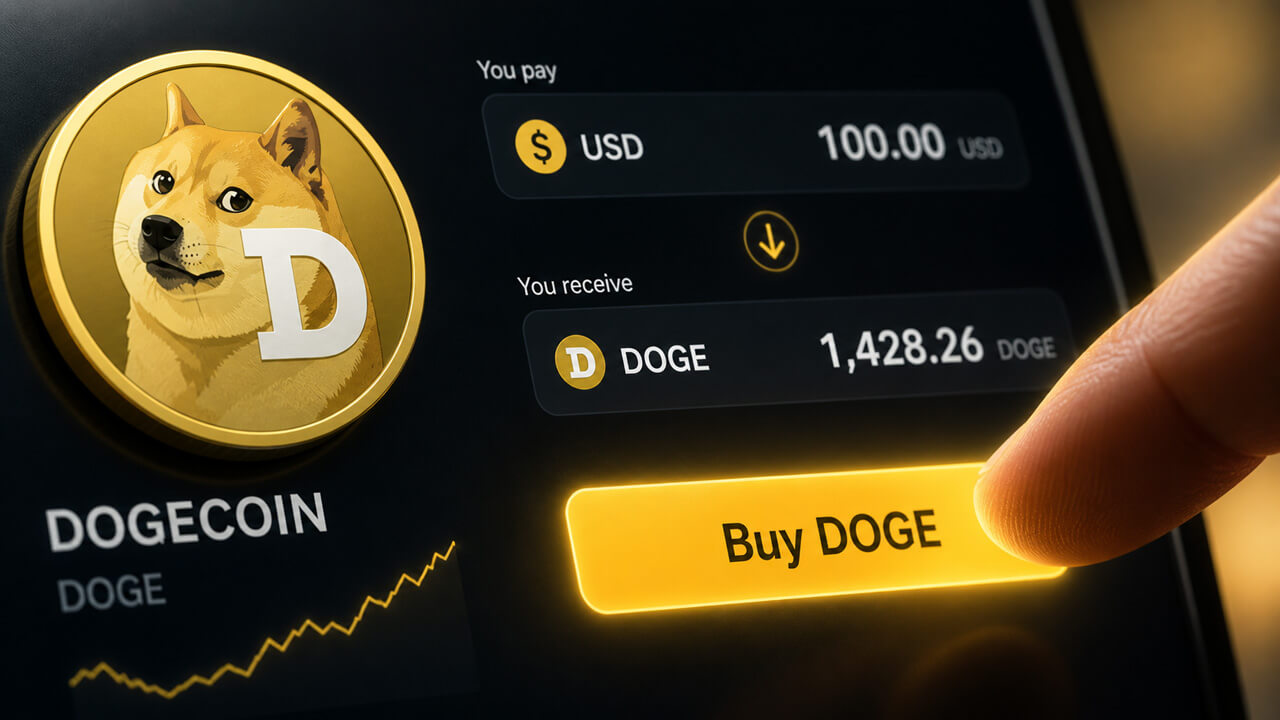
- Allocate only capital you can afford to lose entirely. If losing this money would affect your rent, your emergency fund, or your ability to meet financial obligations, the position is too large. Period.
- Set a clear time horizon and take profits along the way. Rebalancing after large gains, rather than holding through an entire cycle without ever selling, locks in returns and reduces your exposure to the inevitable correction.
- Avoid leverage completely. Amplified positions in a highly volatile asset compound losses at a speed that can liquidate you before you have time to react. DOGE is volatile enough without borrowing to make it more so.
- Use reputable exchanges with deep DOGE liquidity. Understanding what a crypto exchange is and how it handles order flow helps you avoid wide spreads and slippage on both entries and exits.
- Store long-term holdings in a hardware wallet. Exchange hacks and platform failures have cost crypto investors billions over the years. A hardware wallet keeps your private keys offline and under your control.
- Enable two-factor authentication on every platform you use. This is basic security hygiene, but it’s still the single most common failure point for investors who lose funds to account compromise.
- Protect private keys and recovery phrases offline. Don’t screenshot them. Don’t store them in cloud notes. Write them on paper or use a metal backup, and keep them somewhere physically secure. Many investor losses stem from security failures, not price declines.
Rather than reacting to every headline, monitor sentiment indicators alongside on-chain data and broader market trends. Combining these signals gives you a more grounded view than any single tweet or news article can provide.
Frequently asked questions
Is Dogecoin safe?
The Dogecoin blockchain itself is technically secure. Its Proof-of-Work consensus, merged-mined with Litecoin, gives it hash-rate protection well beyond what its own market cap would support. The risk with DOGE isn’t the network going down; it’s the extreme, sentiment-driven price volatility. Your coins are safe on the blockchain, but their dollar value can swing wildly based on social-media trends, celebrity posts, and broader crypto-market conditions.
What will DOGE be worth in 5 years?
No one can answer this with certainty. Long-term value depends on whether cultural relevance and community energy hold up, whether demand growth outpaces the roughly 5 billion new coins minted every year, and whether the broader crypto market enters sustained growth cycles. Bitcoin’s fixed cap of 21 million coins gives it a scarcity argument that DOGE simply doesn’t have, which means DOGE needs to work harder on the demand side to appreciate over time. Any specific price target you see online is speculation, not a guarantee.
Is it too late to invest in Dogecoin?
DOGE trades far below its all-time high of $0.7376, so the price entry point is lower than it was during the May 2021 peak. But a lower price doesn’t automatically mean a good buy. Future gains depend on unpredictable hype cycles, sustained adoption growth, and market conditions that you cannot forecast reliably. The question isn’t whether the price is low enough; it’s whether you have a risk-managed plan for what you’ll do if it drops further or if it rallies and you need to decide when to sell.
Weighing Dogecoin’s staying power against its structural risks
Dogecoin has survived multiple crypto winters and outlasted thousands of projects that had stronger technical roadmaps and more active development teams. That longevity itself builds a degree of credibility. In risk assessment, this is sometimes called the Lindy effect: the longer something has survived, the longer it’s likely to continue surviving. A token that has weathered the collapses of 2014, 2018, and 2022 without disappearing has demonstrated something that a freshly launched meme coin hasn’t.
Its cultural capital and brand recognition are real economic forces. People who have never bought crypto know what Dogecoin is. That awareness translates into liquidity, exchange listings, and merchant acceptance in ways that matter for a payment-focused token. But whether cultural relevance can turn into sustainable long-term value remains an open question. Brand recognition alone doesn’t solve the inflationary supply problem.
The structural headwinds are persistent: inflationary tokenomics that demand constant new buying pressure, a small developer community that limits the pace of technical upgrades, and a price that lives and dies by social sentiment. These aren’t temporary problems. They’re built into Dogecoin’s design.
For investors who size positions carefully and accept the speculative nature of the asset, DOGE can occupy a defined role inside a diversified crypto allocation. Weighing whether crypto is a good investment at all is a necessary first step before committing to any individual token like DOGE. Whether Dogecoin thrives over the next decade hinges on whether community energy, merchant adoption, and payment use cases can grow fast enough to keep pace with the perpetual creation of new coins. That’s not a bet on technology. It’s a bet on culture, and culture is harder to model than code.