
Keeping tabs on crypto spread across multiple exchanges, wallets, and DeFi protocols is a chore no spreadsheet handles well. Past two or three platforms, staking rewards and liquidity-pool positions quietly fall out of view, and syncing those accounts into a single dashboard is the only practical fix. The trackers that do it differ more than most roundups let on.
What is a crypto portfolio tracker and why do you need one?
A crypto portfolio tracker is a tool that syncs with your wallets, exchanges, and blockchains to monitor all of your cryptocurrency investments from a single dashboard. Instead of logging into three exchanges and two wallets every morning, you see your total value, profit-and-loss figures, and price movements in one place.
Trackers pull real-time updates on prices, market caps, and P/L across every connected account. That consolidated view does more than save time. It lets you see how your entire portfolio is positioned, which makes decisions like rebalancing, setting profit targets, or cutting losses much easier to act on.
Once you’re holding assets on more than two or three platforms, or you’ve started using DeFi protocols alongside centralized exchanges, manual tracking becomes impractical. The number of exchanges, Layer 1 and Layer 2 chains, and DeFi apps has grown to a point where even organized investors lose track of staking rewards, liquidity pool positions, or small altcoin bags sitting in forgotten wallets. A portfolio tracker closes those gaps automatically, working alongside whichever of the top crypto apps you trade on.
Features to look for in a crypto portfolio tracker
Not every tracker covers the same ground, and the features that matter most depend on how you invest. Before comparing individual platforms, here’s what separates a useful tracker from one you’ll abandon in a week.
- Wallet and exchange integrations. Automatic sync via API keys or public wallet addresses removes the need for manual entry. The more integrations a tracker supports, the fewer gaps you’ll have in your data. If your exchange or wallet isn’t supported, the tracker is already working against you.
- Cross-chain coverage. Your tracker should aggregate assets across multiple blockchains in a single view. Holding tokens on Ethereum, Solana, Arbitrum, and a handful of other chains is common now, and switching between chain-specific dashboards defeats the purpose.
- Real-time price alerts. Custom thresholds for price, volume, or market cap, plus automatic alerts that flag sudden moves, let you act on opportunities or risks without watching charts all day.
- Profit-and-loss analytics. Look for daily and cumulative P/L, a clear split between unrealized and realized gains, and cost-basis tracking. Without cost-basis data, you can’t accurately judge whether a position is actually profitable after accounting for your entry points.
- Tax reporting integration. Generating capital gains, losses, and income tax forms directly from the tracker saves hours during tax season. Some trackers build this in; others partner with dedicated crypto tax software. Either way, it beats reconstructing a year’s worth of trades by hand.
- Mobile app availability. iOS and Android apps with home-screen widget support let you check your portfolio without opening a full app. If you trade actively, this matters daily.
- Security model. Understand what access level a tracker requires. Read-only API access means the tracker can view balances but never move your funds. Some trackers store data locally on your device, while others use cloud storage with encryption and audit protections. The distinction is worth checking before you connect anything.
- Free tier vs. paid plans. Check how many wallets, transactions, and features are available before you hit a paywall. Some trackers are generous with free tiers; others lock core analytics behind a subscription from day one.
- User interface clarity. A simple, intuitive design reduces friction for daily use. If the dashboard is cluttered or confusing, you’ll stop using it, and a tracker you ignore is worse than none at all.
Best crypto portfolio trackers compared
The table below lines up the key differentiators so you can scan for what matters most before reading the detailed breakdowns in the sections that follow.
| Tracker type | Approximate price | Free tier | Integration count | DeFi/NFT support | Tax features | Mobile apps |
|---|---|---|---|---|---|---|
| Full-featured (wallet + exchange sync) | ~$14-$16/mo or ~$120-$167/yr; lifetime ~$399 | Yes (capped wallets and transactions) | 300+ wallets/exchanges, 50+ blockchains | 10,000+ DeFi protocols, NFT tracking | Built-in via tax software partnerships | iOS and Android |
| Trade analytics focused | ~$13/mo or ~$60/yr | Yes (2 connected exchanges/wallets) | Fewer exchanges than full-featured options | Limited | Varies | Limited or no mobile app |
| Free / manual entry | Free | Fully free, no paid tier | None (manual entry only) | No | No | iOS and Android (some) |
| Apple ecosystem | ~$8/mo | Limited | 90+ exchanges, 180+ wallets | Limited | Varies | iPhone, iPad, Mac, Apple Watch |
| Multi-asset (crypto + stocks + real estate) | ~$250/yr (personal); ~$2,500/yr (multi-entity) | No (14-day trial only) | Connects to banks, brokerages, exchanges | Crypto-focused DeFi varies | Varies | iOS and Android |
Pricing and integration counts can change, so treat these as reference points rather than locked-in figures. The sections below go deeper into each category.
Full-featured trackers with wallet and exchange sync
This category covers the trackers that try to do everything: auto-import from hundreds of exchanges and wallets via API keys or public addresses, track DeFi and NFT positions, and bundle tax tools into one platform.
The broadest option in this space integrates with over 300 wallets and exchanges across more than 50 blockchains, with support for over 10,000 DeFi protocols. That kind of coverage means your Ethereum staking, Solana DEX trades, and centralized exchange holdings all show up in the same dashboard. It’s the closest thing to a single view for crypto investors who are spread across many platforms.
DeFi protocol support in these trackers goes beyond just showing token balances. The better ones track decentralized lending positions, margin trades, stablecoin yields, and DEX liquidity pools. NFT tracking runs alongside CeFi and DeFi in the same interface, surfacing collection data and floor prices without making you jump to a separate app.
Some full-featured trackers include built-in wallet functionality, letting you buy, swap, and earn yield without leaving the dashboard. AI-powered price predictions and exit-strategy tools analyze historical data and market trends to suggest potential sell targets. Whether those suggestions are useful depends on your trading style, but they add a layer of analysis you won’t get from simpler tools.
On the analytics side, expect a profit/loss breakdown covering total cost, unrealized P/L, realized P/L, and combined P/L. Crypto news aggregated from over 140 sources inside the app keeps research close to your portfolio data. Home-screen and lock-screen widgets deliver real-time portfolio and price updates at a glance.
Tax reporting typically works through built-in partnerships with crypto tax software rather than a proprietary engine. That integration means your transaction history flows into tax forms without re-entering data, though the depth of tax support can vary by plan tier.
The trade-off is cost. Premium monthly subscriptions run roughly $14 to $16, with annual plans in the $120 to $167 range. A lifetime option around $399 removes recurring fees entirely. Free tiers exist but cap the number of wallets and transactions you can connect, which pushes heavy users toward paid plans relatively quickly.
User reception has been strong. One leading platform in this category holds a 4.8 rating on the App Store across roughly 85,000 reviews and a 4.5 rating on Google Play across about 105,000 reviews, with over one million reported users.
Trackers built for trade analytics and insights
Analytics-focused trackers take a different approach. Instead of trying to be an all-in-one dashboard, they concentrate on showing you exactly what’s happening inside your trading activity: detailed asset splits, asset-location breakdowns, trade history timelines, and data on which exchanges you use most.
Direct links to coin websites, whitepapers, and social channels are built into the interface, so research happens alongside your portfolio view rather than in a separate browser tab. You can view portfolio values denominated in BTC, ETH, or any local fiat currency, which is useful when you’re measuring performance against crypto benchmarks rather than just dollars. Watchlist features let you monitor coins you don’t hold yet, keeping potential trades on your radar.
Paid tiers unlock deeper metrics and multi-device sync. Journaling features auto-generate performance reports that break down which trading strategies have actually worked over time. That kind of feedback loop is hard to replicate manually, and it’s where analytics-focused trackers justify their subscription cost.
One analytics-heavy tracker partners with Binance to deliver exchange-specific portfolio analytics, which is a clear advantage if most of your volume runs through that platform.
Free tiers in this category tend to be tighter. One tracker limits free users to two connected exchanges or wallets. Paid plans start at roughly $13 per month or $60 per year.
The trade-off is real: some analytics-oriented trackers lack mobile apps entirely or connect with fewer exchanges than their full-featured competitors. If you need broad integration coverage or on-the-go monitoring, this category may not check every box. But if your priority is understanding your own trading patterns, these trackers go deeper than the alternatives.
Free and manual-entry portfolio trackers
If you hold a handful of coins and don’t want to pay for a subscription, free trackers with manual entry are a straightforward option. You type in each buy, sell, and transfer yourself. There are no API connections and no automatic imports.
That doesn’t mean you’re stuck with stale data. Real-time price feeds still update automatically once you’ve entered an asset, so your portfolio value stays current even though the transaction history is manually maintained. Cloud-based options sync between desktop and mobile without a subscription, and market-insight dashboards aggregate pricing data from major exchanges at no cost.
One free tracker covers over 5,000 coins with no paid tier at all, giving you a web-based dashboard that tracks thousands of altcoins without hitting a paywall. Another offers iOS and Android apps that sync across devices, also at no charge.
The limitation is time and accuracy. No automatic import means more time spent every time you make a trade, and manual data entry raises the risk of errors, especially if you’re making frequent transactions or moving assets between wallets. For casual holders of a few positions, this is a minor inconvenience. For active traders, it becomes a bottleneck fast.
Apple ecosystem trackers for device-specific use
One tracker in this space started as a simple Bitcoin ticker on the original Apple Watch and has since expanded to cover the full Apple ecosystem: iPhone, iPad, Mac, and Apple Watch, all synced through iCloud.
Automatic sync covers over 90 exchanges and 180 cryptocurrency wallets, with manual entry available for anything not supported. The tracker handles more than 5,000 cryptocurrencies, so even deep altcoin portfolios are covered.
What sets this option apart is its privacy model. All user data is encrypted and stored locally on each device. The app uses no analytics or external tracking, so your portfolio data never leaves your hardware. For investors who treat data privacy as a hard requirement rather than a nice-to-have, this is a meaningful differentiator.
The Mac menu-bar widget is a small but practical touch: you get instant price updates without opening the full app, which fits naturally into a workflow where you’re already on your Mac.
Paid plans start at roughly $8 per month. There’s no free tier with full functionality, but the lower price point compared to full-featured trackers makes it accessible. If your devices are all Apple and privacy matters to you, this tracker is built specifically for that setup.
Multi-asset trackers for diverse portfolios
Some investors hold crypto alongside stocks, real estate, vehicles, domain names, and other alternative assets. Multi-asset trackers are built for that situation, connecting to bank accounts, brokerages, and exchanges worldwide through custom aggregation architecture.
Non-account-based assets like property, domains, and collectibles can be added manually, with real-time valuation pulled from specialist data providers. That means your rental property’s current estimated value sits next to your Bitcoin and your brokerage account in the same dashboard.
The analytics go beyond simple P/L. Internal rate of return (IRR) calculations factor in original cost, current value, cash flow, and holding time, then benchmark your performance against popular indices. A recap feature summarizes asset performance on daily, weekly, monthly, quarterly, and yearly intervals, giving you a long-term view that most crypto-only trackers don’t attempt, which is useful if you’re building around long-term crypto holdings.
The platform is available on iOS and Android with no restrictions on asset type. A white-label version lets financial advisors offer the dashboard to their own clients, which signals the depth of the toolset.
There’s no free tier here. The personal plan runs about $250 per year, and a complex multi-entity plan for investors managing multiple portfolios or entities costs roughly $2,500 per year. A 14-day free trial is available before you commit. The cost is significantly higher than crypto-only trackers, but if you need a unified view of everything you own, not just your crypto, you’ll outgrow a crypto-only tool quickly.
Tracking DeFi, NFTs, and multi-chain assets in one tracker
DeFi and NFT support is where trackers diverge the most, and it’s where AXL Research Hub sees the biggest gap in how competing guides cover this topic. Most roundups check a box for “DeFi support” without explaining what that actually means in practice.

DeFi protocol coverage ranges from a handful to over 10,000 protocols depending on the tracker. The difference matters. A tracker that supports 1,000+ DeFi protocols across 10 or more chains will pick up your lending positions, staking rewards, yield farming returns, liquidity pool balances, and DEX positions automatically. A tracker that “supports DeFi” but only covers a few major protocols will leave blind spots wherever you’re using smaller or newer platforms.
Another platform tracks portfolios across more than 200 chains and 1,700+ protocols. That level of cross-chain depth means you don’t need to switch views or add chains manually when you bridge assets to a new network.
Multi-chain dashboards aggregate everything without forcing you to select one chain at a time. When these dashboards work well, your Arbitrum LP position, your Avalanche staking rewards, and your Ethereum NFT collection show up together with accurate, current values.
NFT tracking in the better platforms goes beyond listing what you own. Floor prices, market cap, volume, owner count, and supply data for top collections surface directly in your portfolio view. Smart-alert algorithms aggregate NFT buying activity across wallets to flag potential opportunities, though the usefulness of these signals depends on how actively you trade NFTs.
On-chain analytics like smart-money flows and centralized exchange inflows/outflows add context to token performance. If large wallets are accumulating a token or significant amounts are moving to exchanges (often a sign of incoming sell pressure), these signals show up alongside your portfolio data.
Some trackers in this space include non-custodial wallet functionality, letting you manage funds directly without leaving the platform. That’s convenient, but it also raises questions about the security model, which we cover in the next section.
Security and privacy considerations
The security model a tracker uses determines how much risk you take on by connecting your accounts. This is worth understanding before you paste a single API key.
Read-only API access is the lowest-risk model. The tracker can view your balances and transaction history but can never start trades or move funds. Most reputable trackers default to this, but always confirm the permission scope before connecting. If a tracker asks for trade or withdrawal permissions, pause and ask why.
Encryption protects data at rest and in transit. Some trackers store everything locally on your device, so your portfolio data never touches a remote server. Others rely on cloud infrastructure secured by encryption and regular audits. Neither approach is inherently bad, but cloud-based trackers should be transparent about their encryption standards, audit practices, and who inside the company can access user data.
Free-tier apps deserve extra scrutiny. Some monetize through data aggregation or advertising, which means your portfolio data may be analyzed in ways you didn’t expect. Reading the privacy policy before connecting wallets is tedious but worth it.

The collapse of FTX in November 2022 is the sharpest reminder that platforms disappear. FTX had previously acquired the popular portfolio tracking app Blockfolio, folding it into the exchange’s ecosystem. When FTX collapsed (its founder was later convicted and sentenced to 25 years in prison), users who relied on that tracker lost access to it along with the exchange. Other tracking tools have been acquired and shut down with little warning.
Keeping your own personal records of holdings across platforms, even a simple backup spreadsheet, protects against sudden tracker or exchange failures. Favoring trackers that operate independently of any single exchange reduces single-point-of-failure risk. If the tracker’s business model depends on one exchange’s survival, your tracking tool is only as stable as that exchange.
Can a crypto portfolio tracker help with tax reporting?
Yes. Several trackers either build tax reporting directly into the platform or partner with dedicated crypto tax software to generate the forms you need.
The most practical tax feature is automated transaction import. When a tracker pulls your full trade history from every connected exchange and wallet, it prevents the errors that come from manually reconstructing a year of trades. Missed transactions mean inaccurate cost-basis calculations, which can lead to overpaying or underreporting.
Tax-loss harvesting identification is another feature worth looking for. Trackers with this capability flag underperforming assets that you could sell to realize a loss, offsetting gains elsewhere in your portfolio and potentially reducing your tax bill.
Not all trackers handle taxes equally, though. Manual-entry trackers generally lack tax features entirely, which means you’ll need a separate tool that understands how crypto is taxed at filing time. Full-featured trackers with broad exchange integrations tend to offer the strongest tax support, because they already have the transaction data needed to generate accurate reports. Analytics-focused trackers fall somewhere in between, sometimes offering tax exports but rarely matching the depth of a dedicated tax integration.
If tax reporting is a priority, check whether the tracker’s tax features are included in the free tier or locked behind a paid plan. In many cases, tax tools are a premium feature.
Can the IRS see your crypto wallet?
Blockchain transactions are recorded on a public ledger, which means anyone, including government agencies, can view on-chain activity. The IRS doesn’t need your portfolio tracker to see your transactions. Centralized exchanges operating in the U.S. already report user data to the IRS under existing regulations.
Using a portfolio tracker doesn’t increase or decrease IRS visibility into your holdings. The tracker pulls the same data that’s already on-chain or reported by exchanges. The tracker’s own data is private to you unless the platform’s privacy policy allows sharing, so it’s worth reading those terms.
Accurate portfolio tracking actually helps with compliance rather than hurting it. When your reported figures match your on-chain records and exchange statements, you reduce the risk of discrepancies that trigger audits. A tracker that imports transactions automatically and calculates cost basis correctly gives you a cleaner paper trail than a pile of screenshots and exchange CSVs.
Best crypto portfolio tracker for beginners vs. advanced investors
The right tracker depends on where you are as an investor, and picking one that’s too simple or too complex creates its own problems.
Beginners benefit from free tiers, clean interfaces, and manual-entry options that don’t require API setup. If you hold two or three coins on one exchange, a free tracker with basic P/L displays and price alerts is all you need. The learning curve stays low, and you’re not paying for features you won’t use for months. Educational resources bundled into the app help newer investors understand what the numbers mean, which matters more than advanced analytics at this stage.
Advanced investors and active traders need a different set of tools. Asset-source breakdowns showing where each holding lives, trade journals that reveal which strategies actually produce returns, IRR benchmarks that compare your performance against indices, and AI-driven exit-strategy suggestions all become valuable once you’re managing a larger, more complex portfolio. High-volume traders should also prioritize broad exchange and DeFi integration counts alongside automated tax reporting, because manually reconciling hundreds of trades across five platforms and eight chains isn’t realistic.
The mistake to avoid is paying for a premium tracker when a free one covers your needs, or sticking with a basic tool after you’ve outgrown it. A casual holder spending $250 per year on a multi-asset tracker is wasting money, while an active DeFi trader relying on a free manual-entry tool is wasting time and likely missing positions. In both cases, the fix is the same: match the tracker’s complexity to your actual activity level.
Choosing the tracker that fits your portfolio
The best crypto portfolio tracker is the one that matches your portfolio size, asset diversity, and trading frequency without making you pay for things you don’t use or leaving gaps in your data.
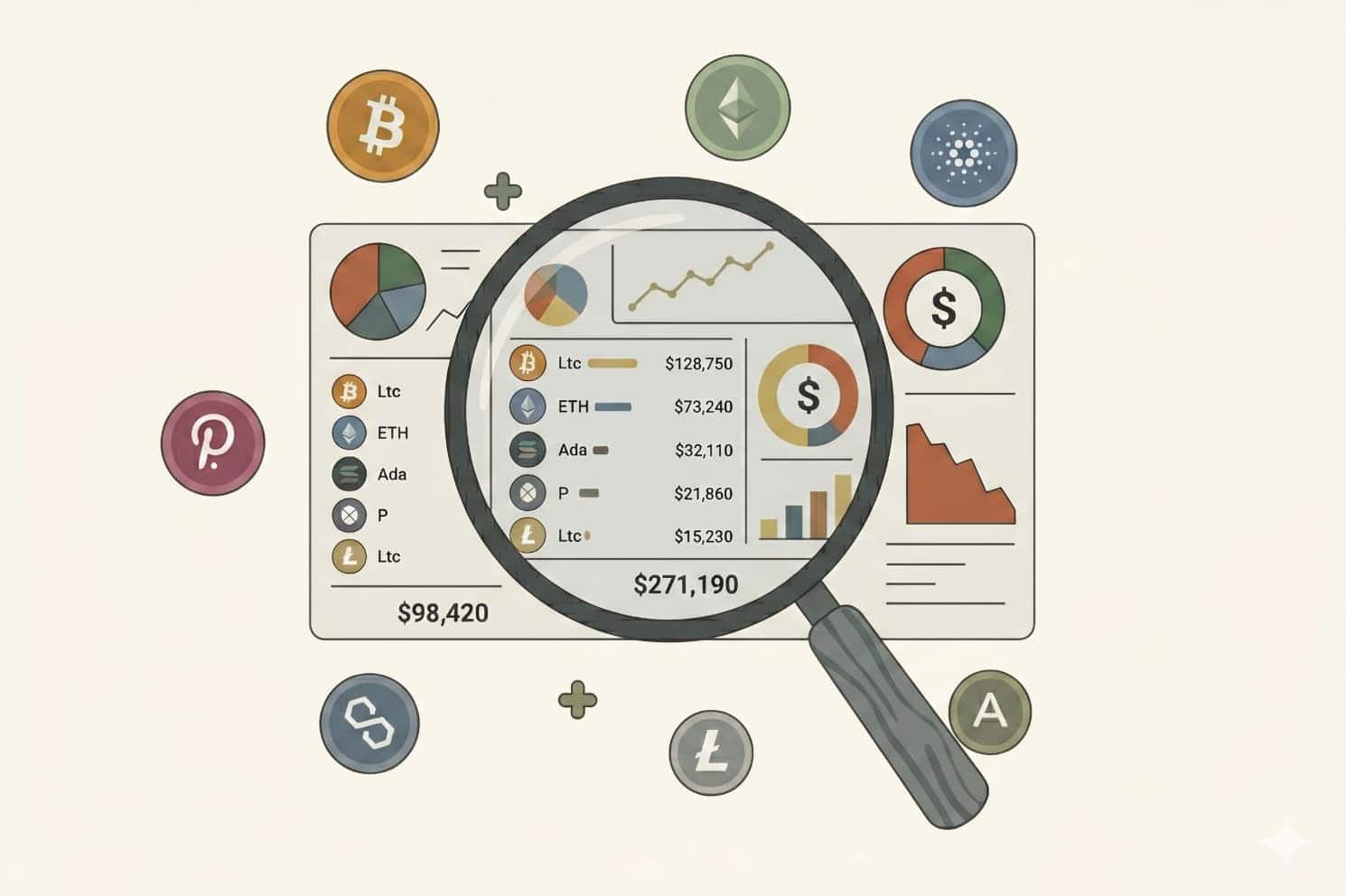
If your holdings are limited to a few coins and you trade only occasionally, a free manual-entry tracker covers the basics. If you’re active across multiple exchanges and DeFi protocols, a full-featured paid platform with broad integrations and tax tools will save you more time than it costs. If your investments span crypto, stocks, and real estate, a multi-asset tracker pulls everything into one view, though the price reflects that scope.
We’d recommend prioritizing independence from any single exchange. Trackers tied to one exchange’s ecosystem carry the risk that you lose access to your tracking data if that exchange shuts down or gets acquired. Independent trackers that connect to many platforms but don’t depend on any one of them are more resilient.
Before locking into an annual plan, test a free tier or trial period. Connect your actual wallets and exchanges, check whether the integrations work smoothly, and see if the analytics answer the questions you actually ask about your portfolio. Fourteen days with your real data tells you more than any feature list.