
MoonPay sits in a strange spot in crypto. It isn’t an exchange and it isn’t a wallet, but millions of people use it to move dollars into Bitcoin, Ethereum, and dozens of other tokens every day.
What is MoonPay and how does it work?
MoonPay is a fiat-to-crypto payment processor, sometimes called an on-ramp and off-ramp. Instead of running its own order book like Coinbase or Kraken, it provides an embedded checkout widget that’s built into more than 500 crypto apps, wallets, and partner platforms. When you tap “Buy” inside a wallet like MetaMask or Trust Wallet, there’s a good chance MoonPay is the service handling your purchase behind the scenes.
The model is non-custodial. MoonPay processes the payment and delivers the crypto, but it doesn’t hold your coins or control your private keys. Once a transaction settles, the tokens land in whatever wallet you specified, such as MetaMask or Trust Wallet (see MetaMask versus Trust Wallet), or in MoonPay’s own in-app wallet if you don’t provide an external address.
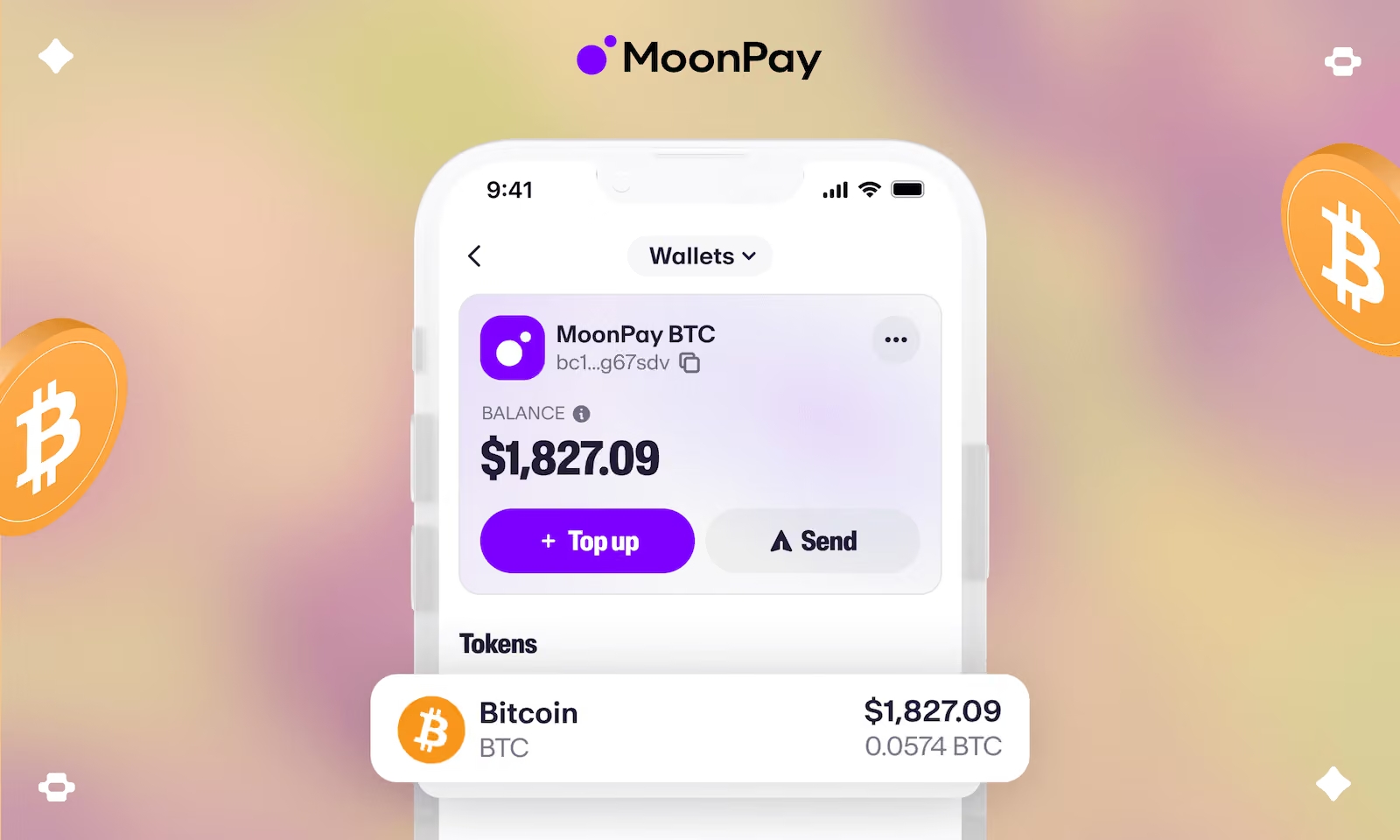
You can buy, sell, and swap crypto using conventional payment methods like credit cards, debit cards, Apple Pay, bank transfers, and PayPal. The platform supports over 170 cryptocurrencies across 40+ blockchains and operates in more than 180 countries. MoonPay reports over 35 million verified accounts.
The minimum purchase is $20, which makes it accessible for people just getting started. There’s a mobile app on both iOS and Android, with a 4.4-star rating on the Apple App Store (9.6K ratings) and 4.5 stars on Google Play (14.3K reviews). You can also buy directly through MoonPay’s website without downloading anything.
MoonPay fees breakdown
Fees depend on how you pay and how much you’re buying. Smaller transactions get hit harder because MoonPay charges a flat minimum fee when the percentage-based fee would fall below a certain threshold. Here’s how the fee tiers break down:
| Payment method | Buy fee | Sell fee | Minimum fee |
|---|---|---|---|
| MoonPay Balance | 0% | 0% | None |
| Credit/debit card | Up to 4.5% | — | $3.99 |
| Apple Pay / Google Pay | Up to 4.5% | — | $3.99 |
| Bank transfer (ACH, SEPA, etc.) | Up to 1% | Up to 1% | $3.99 |
| PayPal / Venmo | Up to 4.5% | Up to 3.5% | $3.99 |
| PIX (Brazil only) | Up to 2.95% | — | Minimum equivalent |
| NFT checkout (card / mobile wallet) | Up to 4.5% | — | Minimum applies |
If you use a referral code, the minimum fee rises to $4.50.
Crypto-to-crypto swaps carry no MoonPay processing fee. You’ll still pay blockchain network (gas) fees, which fluctuate with congestion on whatever chain you’re using. MoonPay shows the network fee on the confirmation screen before you finalize the transaction, so you won’t be surprised.
The practical effect of that $3.99 minimum is significant for small purchases. On a $20 buy with a card, you’re paying roughly 20% in fees. On a $200 buy, the 4.5% rate applies and your cost drops to $9. Larger purchases are substantially more cost-efficient, and if you plan ahead, MoonPay Balance eliminates MoonPay’s fee entirely.
MoonPay Balance: zero-fee buying and selling
MoonPay Balance is a separate fiat balance inside the app that you fund before purchasing crypto. Once the money is in your balance, buying and selling through it costs 0% in MoonPay fees. That’s the single biggest way to cut costs on the platform.
The catch is speed. Funding your balance via ACH in the US can take 3 to 10 business days in some cases, compared to a card purchase that processes within minutes. You’re trading instant access for lower cost, which works well if you’re not trying to catch a price move right now.
MoonPay Balance is available in most US states (the same states where MoonPay itself operates), the UK, and the EU, including the Netherlands and Germany. Once the deposit clears, buying crypto is a separate step: you go through the normal purchase flow, but select your balance as the funding source instead of a card or bank.
Withdrawals from MoonPay Balance are free, though the funds must return to the same source you used to deposit. You can also set up recurring top-ups to keep your balance funded and ready to go, which pairs well with recurring buy schedules if you’re dollar-cost averaging.
For anyone buying crypto regularly and willing to plan a few days ahead, MoonPay Balance closes the fee gap between MoonPay and traditional exchanges almost entirely.
Payment methods MoonPay accepts
MoonPay supports a wider range of payment methods than most on-ramps. What you choose affects both the fee you pay and how fast your transaction settles.
- Credit and debit cards (Visa, Mastercard, American Express): Fastest option, typically processed within minutes. Carries the highest fee tier at up to 4.5%.
- Apple Pay and Google Pay: Same fee structure as cards, with the convenience of mobile-wallet checkout.
- PayPal: Available in the US, UK, and select EU countries. Buy fees match card rates (up to 4.5%), but selling fees are slightly lower at up to 3.5%.
- Venmo: US only. Fee structure mirrors PayPal.
- Bank transfers: ACH in the US, SEPA and SEPA Instant in the eurozone, UK Faster Payments. The lowest fee tier at up to 1%, but slower settlement.
- PIX: Available to Brazilian users at up to 2.95%.
- MoonPay Balance: Internal funding method with 0% MoonPay fees. Requires pre-funding via bank transfer.
- Region-specific options: Revolut Pay, Interac (Canada), Yellow Card (Africa), and Paysafe are available depending on your location.
The payment method you pick has the single biggest effect on your fees. If you don’t need instant settlement, bank transfers or MoonPay Balance save you a meaningful amount on every transaction.
Supported cryptocurrencies and blockchains
MoonPay lists over 170 cryptocurrencies available for direct fiat purchase, covering the major tokens most buyers are looking for: Bitcoin, Ethereum, Solana, XRP, Litecoin, and Cardano, along with various meme coins and smaller-cap tokens.
Crypto-to-crypto swaps expand the selection further, covering more than 2,000 trading pairs across multiple chains. The platform supports wallets on 40+ blockchains, including Ethereum, Solana, Base, BNB Smart Chain, and Bitcoin.
NFT purchases are also supported. MoonPay’s NFT checkout is integrated with over 100 marketplaces, letting you buy collectibles with a card or mobile wallet and manage them inside the app.
Token availability isn’t uniform across the US. Certain tokens like ADA, BNB, and BUSD face additional restrictions in states such as Louisiana, New York, and Texas. Regional regulations drive these differences, so what you can buy depends partly on where you live.
Is MoonPay safe to use?
MoonPay is a legitimate, regulated company with a strong set of security credentials. It’s registered with the UK Financial Conduct Authority (FCA) and licensed in more than 40 US states.
On the technical side, MoonPay uses AES-256 encryption and Transport Layer Security (TLS) to protect data in transit. Credit card data is handled under PCI DSS compliance, which was recertified in 2024. The company also holds SOC 2 Type 2 certification, meaning third-party auditors have verified its data security and system reliability on an ongoing basis, not just at a single point in time. ISO 27018 certification covers how personal data is protected in cloud environments.
MoonPay runs a bug bounty program that pays external security researchers to find and report vulnerabilities, which adds another layer of scrutiny beyond internal testing. Personal information is handled in compliance with GDPR.
The non-custodial architecture is itself a security feature. Because MoonPay never holds your crypto, a breach of MoonPay’s systems wouldn’t put your coins at risk the way a custodial exchange hack would. Your tokens go directly to the wallet address you provide.
That said, you will go through KYC verification before you can use the platform. That means submitting a photo of a government-issued ID, completing a selfie or liveness check, and providing your address and tax details. The process is standard for regulated financial services in the US, but it does mean MoonPay holds your identity documents.
MoonPay founding team and funding
Ivan Soto-Wright and Victor Faramond co-founded MoonPay in Miami in 2019. Soto-Wright serves as CEO and brings a fintech background that includes founding an AI-driven savings startup and working in financial advisory. Faramond leads engineering as Chief Engineer.
The company’s president is Asiff Hirji, formerly the COO of a major US crypto exchange, which adds strong operational experience to the leadership team.
MoonPay has raised over $650 million in venture funding. The bulk came from a $555 million Series A round in 2021, led by Tiger Global and Coatue Management, which valued the company at $3.4 billion. A follow-on round in 2022 brought in $87 million from celebrity backers connected to NFTs and Web3. The company remains privately owned by its co-founders.
How to buy crypto on MoonPay step by step
- Download the MoonPay app from the App Store or Google Play, or go to the MoonPay website and click Buy Crypto.
- Sign in using your Apple account, Google account, or an email address.
- Complete KYC verification. Submit your personal details, upload a photo of your government-issued ID, and complete a selfie or liveness scan. This is a one-time step for new accounts.
- Select the cryptocurrency you want to buy and enter the dollar amount. The minimum purchase is $20.
- Choose your payment method. The fee and processing speed differ by method. Faster payment options like cards and mobile wallets carry higher fees, while the cheaper routes take longer to settle.
- Enter a wallet address if you want the crypto sent to an external wallet. If you skip this step, it goes to MoonPay’s built-in app wallet by default.
- Review the order summary. MoonPay shows the market rate, the network fee, and its own processing fee before you confirm.
- Confirm payment. Card transactions typically arrive within minutes after KYC is complete. Bank-transfer purchases may take 1 to 2 hours.
- Track your order through real-time status updates in the app and via email notifications.
How to sell crypto on MoonPay
Selling on MoonPay is available to users in the US, EU, and UK, though availability may differ in other regions. The process mirrors buying but adds a few extra steps for payout.
- Select the crypto asset you want to sell and the fiat currency you want to receive.
- Enter the amount on the quote screen. MoonPay will display the current rate and applicable fees.
- Provide a crypto wallet address for refund handling. This gives MoonPay a way to return your crypto if the transaction runs into issues.
- Enter your bank account details for the fiat payout. Payouts can go to a linked bank account, back to the card you used, or into your in-app balance.
- Review and confirm. Selling via bank transfer carries a fee of up to 1%. Selling from MoonPay Balance incurs no MoonPay fee.
One friction point worth knowing about: minimum sell and withdrawal thresholds exist. If your balance is small, you may not be able to cash out until you meet the minimum. This can leave small amounts stranded in the app, which is a common complaint in user reviews. There’s no workaround other than buying more crypto to push the balance above the threshold or waiting for MoonPay to adjust the limits.
Key features beyond buying and selling
MoonPay has been adding features that push it beyond a simple buy button. Some of these are mature, and others are still rolling out.
- Recurring buys let you set automated purchase schedules for dollar-cost averaging. You pick the token, the amount, and the frequency, and MoonPay handles the rest. This feature is expanding to more countries over time.
- MoonPay Pots is a staking feature that started with Solana. You can stake as little as $1 in SOL, and rewards are paid out each epoch, which is roughly every two days. The APY fluctuates daily; for the epoch ending July 21, 2024, it reached up to 8.49%, but that number changes with network conditions and shouldn’t be treated as a guaranteed rate.
- NFT checkout is integrated with over 100 marketplaces and supports Visa, Mastercard, and American Express. You can buy and manage collectibles directly inside the MoonPay app.
- MoonTags are custom handles that let you send and receive crypto without copying and pasting wallet addresses. Think of them as usernames for your wallet.
- Market insights screen shows top-performing assets with price charts, giving you a quick way to scan the market without switching to another app.
- Unified wallet view displays separate blockchain wallets in one interface, so you can see your holdings across chains without toggling between them.
- Enterprise stablecoin APIs are available for developers building payment flows into their own platforms.
US state restrictions and regional availability
MoonPay operates in more than 180 countries, but coverage within the United States is incomplete. Several states and territories are excluded, and the exact list varies slightly depending on the source.
States and territories that consistently appear in restriction lists include Hawaii, New York, and the US Virgin Islands. Other states mentioned across various sources include Montana, Nevada, Virginia, Louisiana, Rhode Island, and Texas. Puerto Rico also appears as restricted in at least one source.
These exclusions aren’t unusual for crypto on-ramps. State-level money transmitter licensing requirements differ, and companies roll out coverage as they secure approvals. But it does mean you should check MoonPay’s current availability page for your specific state before creating an account.
Outside the US, MoonPay is available in Canada, India, the UK, and across the EU, among other regions. Service was discontinued in Nigeria.
Certain tokens also face state-level restrictions beyond the platform-wide exclusions. As mentioned earlier, ADA, BNB, and BUSD are among the tokens restricted in states like Louisiana, New York, and Texas.
MoonPay pros and cons
What works well:
- Beginner-friendly interface with fast onboarding. You can go from download to first purchase in minutes.
- Broad payment-method selection, including Apple Pay, Google Pay, PayPal, and Venmo, which most exchanges don’t support.
- Wide global reach across 180+ countries.
- 24/7 support via chat, email, and phone (phone is US only).
- Pre-funding your balance brings MoonPay’s processing cost down to zero.
Where it falls short:
- Card and mobile-wallet fees of up to 4.5% are steep compared to bank-transfer rates and to fees on traditional exchanges.
- The $3.99 flat minimum fee eats into small transactions disproportionately. A $20 purchase loses roughly a fifth to fees.
- No advanced trading tools. There are no limit orders, futures, leverage, or charting tools. This is purely a buy-and-sell service.
- Unavailable in several US states, with no timeline on when that will change.
- Some users report accounts being disabled during or after KYC with limited explanation from support.
- Withdrawal minimums can lock small balances in the app with no way to cash them out.
- Mixed customer-support feedback. Positive experiences exist, but complaints about slow refunds and repetitive responses come up frequently.
- Mandatory KYC may deter privacy-focused users, though this is true of any regulated on-ramp.
What real users say: app-store and review-site feedback
Aggregate ratings paint a broadly positive picture. MoonPay holds a 4.6 out of 5 on the Apple App Store from 9.6K ratings. On Trustpilot, the platform had a 4.2-star rating from over 95,000 reviews at the time we reviewed the data, though that number may have shifted since.
Positive reviews tend to focus on speed and simplicity. Users frequently mention how quickly card purchases settle and how smooth the wallet-integration experience is when buying through a partner app. Real-time order-status notifications get called out as a specific plus, especially for first-time buyers who want reassurance that their money is moving.
The negative reviews cluster around a few recurring patterns that are worth taking seriously:
Account disabling during verification is the most common complaint. Users describe submitting their KYC documents, having the account flagged or disabled, and then receiving little to no explanation about why. For someone who’s already sent money, this creates genuine anxiety.
Payment-method lockouts come up repeatedly as well. Some users report that a single declined transaction, sometimes caused by the bank rather than MoonPay, results in that payment method being permanently blocked on their account. Getting it reinstated requires back-and-forth with support that doesn’t always resolve the issue.
Difficulty selling or withdrawing after successful buying is another thread. Users describe verification mismatches between their buy-side and sell-side accounts, or withdrawal minimums that prevent them from cashing out small balances. The frustration is amplified when support responses feel scripted and don’t address the specific problem.
Phishing sites impersonating MoonPay have also appeared in search-engine ads, according to user reports. This isn’t MoonPay’s fault, but it’s a risk to be aware of. Always navigate directly to moonpay.com rather than clicking ads.
Developer responses on the app stores consistently direct users to the support portal. In some cases that leads to resolution; in others, users report the same canned replies without a fix.
MoonPay customer support channels
MoonPay offers several ways to get help, though the quality of that help varies depending on the complexity of your issue.
The online support center has searchable articles and guides that cover common tasks like verifying your identity, adding a payment method, and tracking an order. For straightforward questions, this is the fastest route.
An AI chatbot handles the first line of contact and can answer basic questions immediately. If your issue is more complex, you can connect with a live-chat agent. Reported wait times hover around a few minutes, which is better than most crypto services.
Email support is available for detailed case resolution, and it’s the typical path for issues involving locked accounts or missing transactions.
Phone support is available for US-based users only. MoonPay has publicly stated that it does not make outbound phone calls, so any unsolicited call claiming to be from MoonPay is a scam. Treat it accordingly.
User sentiment on support is genuinely mixed. Quick, helpful responses show up in reviews alongside complaints about unhelpful or repetitive replies, particularly for account-level issues like disabled accounts or blocked payment methods. If your issue is routine, support works fine. If it’s not, persistence may be required.
Who MoonPay is best for and who should look elsewhere
MoonPay fits a specific type of buyer well. If you’re new to crypto and want to skip the learning curve of a full exchange with order books and trading pairs, MoonPay’s purchase flow is about as simple as it gets. You pick a coin, enter a dollar amount, and pay.
It’s also a good fit if you prefer paying with Apple Pay, Google Pay, PayPal, or Venmo. Most exchanges don’t accept these methods at all, and MoonPay makes them first-class options.
Loading your balance via ACH before you buy removes MoonPay’s fee from the equation, putting it on par with exchanges from a cost standpoint. This works best for people who buy crypto on a regular schedule and don’t mind the ACH settlement window.
MoonPay isn’t the right choice if you’re making very small purchases. The $3.99 minimum fee makes transactions under $100 expensive on a percentage basis. It’s also not built for active traders who need the tools offered by the top crypto exchanges. There are no limit orders, no futures, and no leverage.
And if you’re in one of the excluded US states, MoonPay simply isn’t available to you. You’ll need a different on-ramp.
Frequently asked questions
Is MoonPay legal in the US?
Yes. MoonPay holds money transmitter licenses across more than 40 states. However, it isn’t available in every state or territory. Several states, including Hawaii and New York, are excluded, and the specific list may shift over time as licensing changes.
Is MoonPay a wallet or an exchange?
Neither. MoonPay is a fiat payment processor that helps you buy, sell, and swap crypto. It connects your payment method to the crypto market without operating an exchange order book. While it does offer an in-app wallet for convenience, the core service is processing the fiat-to-crypto transaction.
Can I use MoonPay without the app?
Yes. You can make purchases directly through MoonPay’s website by navigating to their Buy Crypto page. The app adds features like portfolio tracking, MoonPay Pots, and MoonTags, but it isn’t required for basic buying.
Where is MoonPay headquartered?
MoonPay is headquartered in Miami, Florida, with additional offices in the UK.
Weighing MoonPay’s convenience against its cost
MoonPay does one thing and does it well: it turns dollars into crypto with minimal friction. The onboarding is fast, the payment options are broader than what you’ll find on most exchanges, and the non-custodial model means you keep control of your keys.
The cost of that convenience is real, though. Paying by card or mobile wallet at rates up to 4.5% gets expensive fast, and that flat minimum takes a heavy toll on low-dollar buys. MoonPay Balance is the clearest answer to this problem, dropping fees to zero if you’re patient enough to wait for ACH settlement.
The security credentials are solid. FCA registration, SOC 2 Type 2 certification, PCI DSS compliance, and a non-custodial architecture put MoonPay ahead of many competitors on trust. At the same time, the recurring complaints about account lockouts during KYC and withdrawal minimums trapping small balances are friction points that show up too consistently in reviews to dismiss.
At AXL Research Hub, we see MoonPay as a strong choice for its intended purpose: a fiat-to-crypto on-ramp for people who value simplicity over cost. It doesn’t try to replace a full-featured trading platform, and it shouldn’t be judged as one. If you go in knowing the fee structure, fund your balance ahead of time when possible, and verify that your state is supported, MoonPay delivers on what it promises.