
A smart contract is a self-executing computer program stored on a blockchain, with the terms of an agreement written directly into code. Instead of relying on a lawyer, notary, or escrow agent to enforce a deal, the contract itself handles enforcement the moment its conditions are met. If you’ve bought a token, swapped assets on a decentralized exchange, or minted an NFT, a smart contract did the heavy lifting.
What is a smart contract?
A smart contract is a program deployed on a blockchain that automatically executes predefined actions when specific conditions are satisfied, with no human intervention required. The concept originated with Nick Szabo, who coined the term and described digital promises built around predefined conditions that trigger outcomes on their own.
The logic is straightforward: if a condition is met, then the contract performs a programmed action. Think of a vending machine. You insert the right amount of money (the condition), and the machine delivers your snack (the action). Szabo himself cited vending machines as the earliest technology analogous to smart-contract logic. No cashier checks your payment or hands you the product. The machine does it all because the rules are built in.
Smart contracts follow the same if-then logic, but they live on a decentralized, tamper-proof ledger where every authorized party sees the same data and no single person or company controls the record. That distinction is what separates them from e-contracts, which are simply paperless agreements exchanged by email or fax with preset terms that still depend on people to enforce. A smart contract goes further by adding automatic execution through blockchain technology, making the code itself the enforcer.
How smart contracts work on a blockchain
A blockchain stores data in linked blocks. Each block carries a cryptographic hash that ties it to the previous block, forming a chain. Every node in the peer-to-peer network holds a copy of this ledger, and any change requires validation across connected nodes. This structure, known as distributed ledger technology (DLT), provides decentralization, immutability, and data integrity through hashing algorithms.
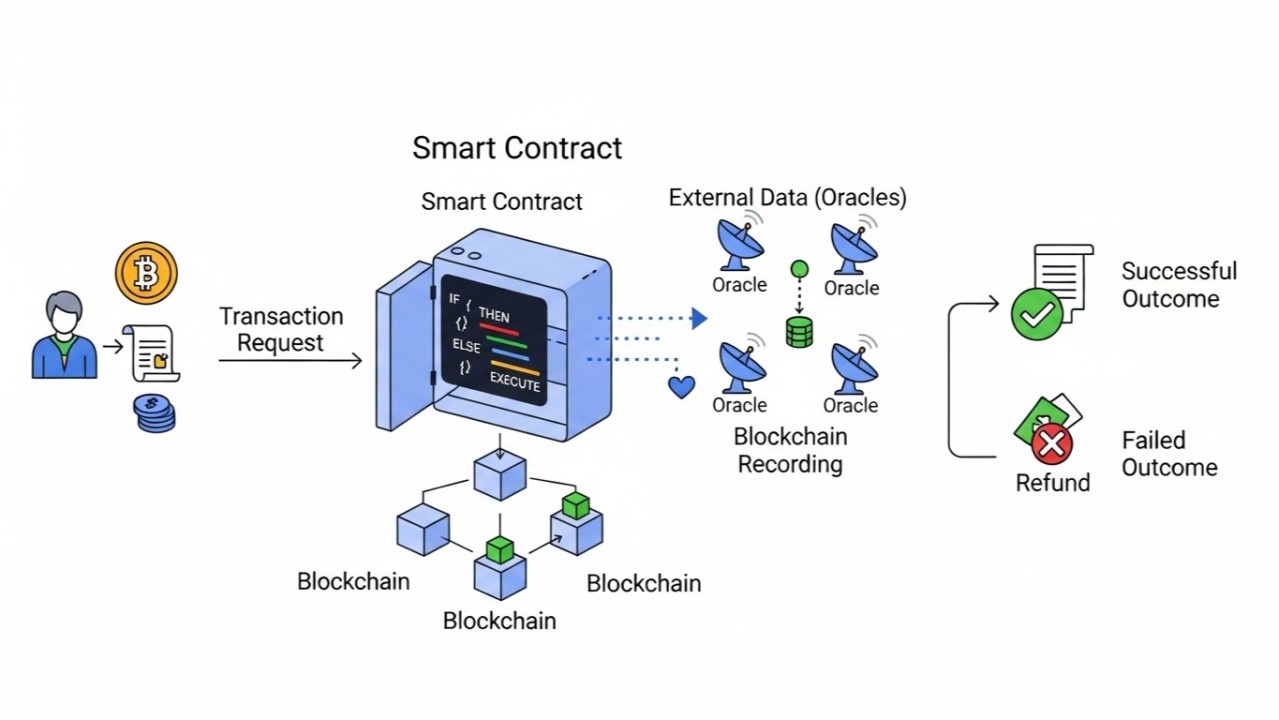
Smart-contract code compiles into bytecode that runs inside the blockchain’s virtual machine. When a trigger event occurs, the virtual machine evaluates the contract’s conditions against the incoming data. If the conditions check out, the coded outcome executes. Each transaction linked to the contract becomes a permanent, auditable record on the chain.
Consider a rental agreement. A tenant makes an online payment, and the smart contract verifies that the payment matches the agreed amount. Once confirmed, the contract automatically releases a digital key to the property. Both steps, the payment and the key release, are visible to all parties on the blockchain. No landlord needs to manually confirm receipt, and no tenant has to wait for a phone call.
Smart contracts also support inner transactions, where one contract calls another. This composability is what makes decentralized applications possible. A lending contract can call a price-feed contract, which can call a liquidation contract, all in a single chain of execution. Each call is recorded, and each outcome feeds into the next.
Smart contracts vs. traditional contracts
Smart contracts and traditional contracts differ in how terms are enforced, who’s involved, and how fast things move.
| Feature | Traditional contract | Smart contract |
|---|---|---|
| Enforcement | Relies on intermediaries: courts, lawyers, escrow agents | Automated through code execution on-chain |
| Ambiguity | Can contain lexical ambiguities open to interpretation | Executes exactly as coded, removing interpretive disputes |
| Speed | Subject to litigation timelines for enforcement | Settles in the time a transaction confirms on-chain |
| Cost | Legal fees, notary costs, third-party charges | Reduces or eliminates intermediary layers |
| Modification | Allows negotiated amendments between parties | Immutable once deployed; changes require redeployment |
| Trust model | Demands trust between parties or legal recourse | Operates in a trustless environment secured by cryptography |
Immutability cuts both ways. Traditional contracts let parties sit down and renegotiate when circumstances change. A smart contract locked on-chain can’t be edited. If you need to update the terms, you deploy a new version of the contract entirely. That rigidity is a strength when you want certainty, but it demands careful planning before deployment.
Types of smart contracts
Not every smart contract looks the same. The two main categories differ in how much of the agreement lives in code versus in a traditional written document.

Code-only smart contracts encode all pre-negotiated terms into executable code handled entirely by the blockchain. Every condition, every payout trigger, every rule lives in the program. These work best for fully automatable scenarios where the outcome is binary and verifiable on-chain, like instant payouts based on data feeds.
Ancillary smart contracts combine executable code with a conventional text-based agreement attached for legal enforceability. The code handles the parts that can be automated, while the written agreement covers the broader legal context.
Flight insurance is a clear example of both types working together. An insurer encodes specific delay thresholds into a code-only contract. If a flight is delayed past the threshold, the contract pays out automatically based on verifiable flight data. Meanwhile, an ancillary contract governs the broader policy terms: coverage limits, exclusions, dispute resolution, and regulatory compliance. The code handles speed; the written agreement handles the legal gray areas that code alone can’t cover.
Programming languages used to write smart contracts
The language a developer uses depends on which blockchain they’re building for, because each chain’s virtual machine accepts specific bytecode formats.
- Solidity is the primary language for writing smart contracts on the Ethereum Virtual Machine (EVM). It was purpose-built for on-chain logic and remains the most widely used smart-contract language. Most DeFi protocols, NFT contracts, and dApps on EVM-compatible chains are written in Solidity.
- Vyper targets the same EVM but takes a different approach. Its syntax resembles Python, and it prioritizes simplicity and auditability over flexibility. Contracts written in Vyper tend to be easier to review for security vulnerabilities because the language deliberately limits complexity.
- Rust is used on several newer blockchains that compile to WebAssembly (Wasm). Developers who already know Rust from systems programming can carry those skills into smart-contract development on Wasm-based chains.
- TEAL is an assembly-like language whose bytecode is interpreted by the Algorand Virtual Machine (AVM). Writing raw TEAL isn’t common for most developers, though. Higher-level code in Python or TypeScript compiles down to TEAL bytecode, letting developers use familiar tools while still deploying to Algorand.
Standard Python and TypeScript variants that compile to lower-level bytecode exist across several ecosystems. The choice ultimately comes down to the target blockchain’s virtual machine and the developer’s existing skill set. A Solidity developer won’t switch to Rust without reason, and a Rust developer won’t learn Solidity just because Ethereum is popular, unless the project demands it.
Key benefits of smart contracts
Smart contracts solve a set of problems that show up whenever two or more parties need to agree on terms and trust each other to follow through.

- Automation. Execution fires as soon as coded conditions are met. You don’t need to press a button, send an email, or sign a form. The contract handles the action on its own.
- Cost reduction. Removing intermediaries like lawyers, escrow agents, and notaries lowers the overhead of each transaction. Parties pay for the on-chain execution rather than hourly professional fees.
- Speed. Validation and settlement happen on-chain in minutes or seconds, depending on the blockchain. Compare that to the days or weeks a traditional agreement might take to enforce through standard channels.
- Transparency. Every party with access reads the same immutable record. There’s no version of the contract sitting in one lawyer’s filing cabinet that differs from another’s. This reduces information asymmetry between parties.
- Security. Cryptographic encryption and decentralized storage protect data from tampering. Altering a record would require controlling a majority of the network’s nodes, which is computationally impractical on large blockchains.
- Accuracy. Deterministic code eliminates clerical errors that creep into manual processing. The contract does the same thing every time, regardless of who triggers it.
- Trustless operation. Parties transact without needing to trust each other personally. The protocol enforces the terms, so the relationship between the parties matters less than the quality of the code.
- Unstoppable execution. Once triggered, the contract runs to completion without external interruption. No party can call a timeout or stall the process mid-execution.
These benefits compound in situations involving multiple parties, frequent transactions, or cross-border dealings where legal systems don’t overlap neatly.
Common use cases for smart contracts
Smart contracts show up wherever a transaction can be reduced to verifiable conditions and automated outcomes. Some of these use cases are already mature; others are still developing.
- Decentralized finance (DeFi). Lending, borrowing, and token swaps are governed by on-chain contracts. Users deposit collateral into a contract, and the contract handles interest calculations, liquidations, and repayments without a bank in the middle.
- Supply chain management. IoT sensors feed delivery data to contracts that release payments or reorder stock when inventory falls to a predefined threshold. The contract acts on real data in real time rather than waiting for a purchasing manager to notice a shortfall.
- Insurance. Automatic claim payouts trigger when verifiable data, like a confirmed flight delay or a recorded weather event, meets the conditions written into the policy contract.
- Real estate. A property sale closes automatically when the buyer’s payment reaches the contract. This requires the property title to be tokenized on-chain so the contract can transfer ownership digitally.
- Escrow. Funds sit in the contract and release only when both parties meet coded conditions, replacing a third-party escrow agent. Neither side can pull the funds out unilaterally.
- Digital identity. A contract shares only the identity attributes a counterparty needs (proof of age, for example) while keeping other personal data hidden. The user controls what gets disclosed.
- Procurement. Purchase orders, invoicing, and compliance checks are encoded into contracts, automating coordination across multiple parties. Cap-table management for stock splits, dividends, and liability tracking can also run through smart contracts.
- Clinical trials. Cross-organizational data sharing uses privacy-preserving automation for authentication and authorization, letting research institutions collaborate without exposing raw patient data.
- Mortgage processing. Loan terms are encoded so disbursement and repayment triggers execute without manual paperwork at each stage.
- Government operations. Land-title recording and property-transfer management run through transparent, auditable contracts, reducing the clerical delays in public registries.
Smart contracts in procurement and supply chain
Procurement is one area where smart contracts replace a tangle of emails, spreadsheets, and phone calls with a single source of truth.
Purchase-order terms get embedded directly in the contract. When a supplier confirms delivery and the IoT sensors on the shipment verify arrival, the contract auto-triggers payment. No invoice sits in someone’s inbox for two weeks. No accounts-payable clerk manually cross-references a PO number with a delivery receipt.
Inventory tracking tied to IoT sensors gives real-time visibility into stock levels. When a warehouse hits a preset threshold, the contract fires a restocking order to the next supplier in the chain. That kind of automated restocking cuts lead times and prevents the stockouts that happen when reorder decisions depend on a person checking a dashboard.
Compliance rules can be encoded so regulatory requirements are checked before each transaction completes. If a shipment doesn’t meet a required certification or a supplier’s license has lapsed, the contract blocks the transaction rather than letting it through for someone to catch later.
Multi-party coordination across suppliers, logistics providers, and buyers is managed in a single contract framework. Everyone sees the same transaction history, which simplifies auditing and reduces fraud risk. Verification is faster, leading to fewer incidents of counterfeiting and theft because every handoff is recorded.
For organizations looking to implement this, a practical path looks like: map existing procurement bottlenecks first, then select a blockchain platform that fits the transaction volume and privacy requirements. From there, develop and audit the contract code, test it in a sandbox environment, integrate with legacy ERP systems through custom APIs, and roll out in phases starting with a pilot. Trying to convert an entire procurement operation at once is a common way to stall the project before it produces results.
Downsides and risks of smart contracts
Smart contracts carry real risks that don’t disappear just because the technology is decentralized.

- Immutability cuts both ways. Bugs in deployed code can’t be patched in place. A coding error gets locked into the contract, and fixing it means deploying a new version and migrating users or funds to it. That process is neither instant nor cheap.
- Code vulnerabilities. Exploits like reentrancy attacks can drain funds from a contract if the code hasn’t been audited properly. Reentrancy happens when a malicious contract calls back into the vulnerable contract before the first execution finishes, letting the attacker withdraw funds repeatedly in a single transaction. Logic errors and flash-loan exploits are other common attack vectors. A contract that hasn’t gone through a rigorous third-party audit is a gamble.
- Oracle dependency. Smart contracts can’t natively access off-chain data. They rely on external data feeds called oracles to bring in real-world information like prices, weather conditions, or flight statuses. That oracle becomes a trust point. If the oracle delivers bad data, the contract executes faithfully on wrong information. The “garbage in, garbage out” problem doesn’t go away just because the contract itself is tamper-proof.
- Legal uncertainty. No universal legal framework governs smart contracts. Enforceability varies by jurisdiction and is still evolving. A contract that’s recognized in one state or country may have no legal standing in another.
- Complexity. Writing, auditing, and securing smart-contract code requires specialized developer expertise. The barrier to entry is higher than drafting a traditional agreement, and qualified auditors are in limited supply.
- Integration difficulty. Connecting smart contracts with legacy enterprise systems demands custom APIs and change management. Most organizations can’t just plug a smart contract into their existing software stack.
- Privacy concerns. Data stored on a public blockchain is visible to all participants unless privacy layers are added. For contracts involving sensitive business or personal information, this visibility is a problem, not a feature.
- Irreversibility. Once a transaction executes, there’s no built-in mechanism to reverse it. If conditions change after execution or an error surfaces, you can’t hit undo.
- Scalability constraints. High transaction volume on certain blockchains raises both execution time and cost. A contract that works fine in testing may become impractical when thousands of users interact with it simultaneously.
Legal status of smart contracts
No single global legal framework governs smart contracts. Recognition depends on national and state-level legislation, and coverage varies widely from one jurisdiction to the next.
In the United States, the Uniform Commercial Code (UCC) doesn’t require contracts to be wholly written, which leaves room for code-based agreements. The Uniform Electronic Transactions Act (UETA), enacted in 1999, recognizes electronic agents acting on electronic records. UETA is in effect across 47 states. Nevada and Arizona have gone further, amending their UETA provisions to explicitly incorporate smart contracts into their state legal systems.
In the United Kingdom, a smart contract carries binding effect provided it meets the standard legal requirements of contract law in England and Wales. Australia takes a similar approach: smart contracts are enforceable when they satisfy common-law principles of contract formation, meaning offer, acceptance, consideration, and intention to create legal relations. Belarus was one of the earliest jurisdictions to explicitly recognize smart contracts as legally enforceable, though the detailed framework there remains limited.
The core elements of contract law, offer, acceptance, consideration, legal intent, and mutual assent, can each be satisfied by a properly structured smart contract. Coded terms displayed on-screen constitute the offer. Clicking a confirmation button, entering a private key, or making a payment constitutes acceptance. Consideration typically takes the form of cryptocurrency assets or services exchanged when a triggering event occurs. Commercial smart contracts carry a presumption of legal intent, similar to other business agreements. Mutual assent (sometimes called consensus ad idem) is met when the coded terms are clear and unambiguous to both parties.
The gap between what code can enforce and what courts will recognize remains the central challenge. A smart contract might execute flawlessly on-chain while still lacking enforceability in a courtroom if the jurisdiction hasn’t addressed the question. Parties entering into high-value smart contracts still benefit from attaching a written legal layer, especially across borders.
Is Bitcoin a smart contract?
Bitcoin is a cryptocurrency and payment network, not a smart-contract platform in the way programmable blockchains are. Its scripting language is intentionally limited. It can handle basic conditions like multi-signature requirements, where a transaction needs approval from multiple private keys before it executes. But it lacks the Turing-complete logic needed for complex contract execution.
Programmable blockchains such as the Ethereum network introduced full smart-contract capability by adding virtual machines that run arbitrary code. That’s the fundamental difference: Bitcoin’s script can check simple conditions, but it can’t loop, store complex state, or run the kind of open-ended programs that DeFi protocols and dApps require.
Bitcoin can interact with smart-contract ecosystems through wrapped tokens or layer-2 solutions. Wrapped Bitcoin on an EVM-compatible chain, for instance, lets holders use their BTC as collateral in DeFi lending contracts. But the base Bitcoin protocol doesn’t natively host general-purpose smart contracts. If you’re looking to build or interact with smart contracts directly, you’re working on a different chain.
How to check if a smart contract is legit
Before you send funds to any smart contract, take the time to verify it. Scams, honeypots, and copycat deployments are common, and a few checks can save you from losing money.
- Read the source code on a block explorer. Verified (published) source code is a baseline trust signal. If the contract’s code isn’t published on the block explorer, that’s a red flag. Legitimate projects almost always verify their contracts so anyone can review the logic.
- Check for a third-party security audit. Look for an audit report from a recognized firm. The report should be publicly available, not just mentioned in a tweet. Read the findings, especially any issues flagged as critical or high severity, and check whether the team addressed them.
- Examine the deployer’s wallet history. Look at the wallet that deployed the contract. A deployer with a history of launching contracts that got flagged as scams, or a brand-new wallet with no prior activity, warrants extra caution. Transaction patterns matter: rapid fund movements right after deployment can signal a rug pull setup.
- Check for dangerous owner functions. Some contracts give the owner the ability to drain funds, mint unlimited tokens, pause withdrawals, or change core rules after deployment. These admin keys and minting authorities aren’t always malicious, but you should know they exist before you commit funds. If the owner can unilaterally change the rules, you’re trusting a person, not just code.
- Verify the contract address against official channels. Scammers deploy copycat contracts with nearly identical names. Always confirm the contract address through the project’s official website, verified social accounts, or documentation. One wrong character in an address means you’re interacting with a completely different contract.
- Use on-chain analysis tools. Several tools flag known scam patterns, honeypot logic (contracts that let you buy a token but block you from selling), and revoke-approval traps. Running the contract address through these tools takes seconds and can catch issues that aren’t obvious from reading code.
- Consider community reputation and time on-chain. Older contracts with high transaction counts and no exploit history carry lower risk than contracts deployed last week. Time on-chain isn’t a guarantee, but a contract that has processed thousands of transactions over months without incident has been tested by real use.
The tool guides on AXL Research Hub regularly walk through these on-chain verification steps in detail. No single check is foolproof, but stacking several of these together gives you a much clearer picture of whether a contract deserves your trust.
Frequently asked questions about smart contracts
Can XRP handle smart contracts?
The XRP Ledger has added smart-contract features through sidechains and hooks, but it was originally designed as a payment-focused network rather than a general-purpose smart-contract platform. If you need full programmability comparable to EVM-based chains, XRP’s native layer isn’t the tool for that. The sidechain and hooks functionality extends its capabilities, but the developer tools are still narrower than what you’d find on chains built from the ground up for smart contracts.
How do smart contracts reduce transaction costs?
They remove intermediary fees that pile up in traditional agreements: legal review, escrow charges, notary costs. They also automate verification and execution steps that would otherwise require paid human labor. Instead of paying a lawyer to confirm that conditions were met and instruct a bank to release funds, the contract checks the conditions and moves the funds itself.
How do smart contracts enforce agreement terms automatically?
The contract’s code evaluates conditions against on-chain data or data delivered by oracles. When those conditions are satisfied, the programmed action executes without any party needing to approve it. There’s no review step, no sign-off, no waiting period unless one is coded into the contract itself. The enforcement is the execution.
What role do smart contracts play in decentralized applications (dApps)?
Smart contracts serve as the on-chain backend logic for dApps. They handle state changes, token transfers, and interactions between users and the application. When you swap tokens on a decentralized exchange, a smart contract calculates the exchange rate, moves the tokens between wallets, and records the transaction. The frontend you see in your browser is just the interface; the smart contract is doing the actual work on-chain.
Where smart contracts are headed
Legislative bodies around the world are drafting clearer rules for smart contracts, which should expand adoption into industries that have held back due to legal ambiguity. As more jurisdictions follow the path Nevada and Arizona have taken, the gap between code-based execution and courtroom enforceability will narrow.
Standardization is another active front. The IEEE Standards Association’s P2418.5 Working Group is developing standards for smart contracts in the energy sector, aiming for language-agnostic contract interoperability. If contracts written in Solidity can interact reliably with contracts written in Rust on a different chain, the walls between blockchain ecosystems start to come down.
Cross-chain bridges and layer-2 solutions are already addressing the scalability and cost barriers that limit high-volume use. As these mature, smart contracts become practical for use cases that currently generate too many transactions for a single base layer to handle affordably.
Integration with IoT devices, AI-driven oracles, and real-world-asset tokenization is expanding what smart contracts can respond to. A contract that triggers based on a temperature reading from a shipping container, a crop-yield prediction from a machine-learning model, or the tokenized deed to a physical building operates in a much richer environment than one limited to on-chain token transfers.
Broader adoption ultimately depends on closing the gap between what the code can do and what legal systems are prepared to recognize. The technology is already ahead of the regulation in most places, and the next few years will determine how quickly the law catches up.