
Crypto mining can still turn a profit, but the gap between winners and losers has never been wider. After the April 2024 Bitcoin halving cut the block reward to 3.125 BTC, operators running inefficient hardware or paying residential electricity rates are bleeding money every day their rigs stay plugged in. Your bottom line comes down to four variables that never stop moving: hardware efficiency, power cost, coin price, and network difficulty. Hobbyist home miners on typical U.S. residential power rarely break even, while industrial-scale operations with sub-$0.08/kWh electricity and top-tier ASICs continue to accumulate coins. Altcoin mining with GPUs or CPUs offers a lower barrier to entry, but margins are thinner and far more volatile. Many miners accept short-term losses on purpose, treating mined coins as a long-term bet on price appreciation rather than chasing daily profit.
Is crypto mining still profitable in 2026?
For operators who combine efficient hardware, low electricity rates, and disciplined day-to-day management, mining remains profitable. Bitcoin mining is dominated by industrial-scale players, companies that negotiate bulk power contracts, maintain massive ASIC fleets, and keep uptime near 100%. That concentration squeezes out smaller participants.
The April 2024 halving slashed the block reward from 6.25 BTC to 3.125 BTC per block. Overnight, every miner’s revenue per block dropped by half while their electricity bills stayed the same. To stay in the black on Bitcoin in mid-2026, a miner generally needs sub-15 J/TH hardware running on power under roughly $0.08/kWh. That’s a tall order when residential U.S. electricity rates typically land between $0.16 and $0.20/kWh.
Altcoin mining with GPUs or even CPUs still works for people willing to accept smaller, more volatile returns. Coins like Monero, Ergo, and Vertcoin don’t require specialized ASICs, and their lower network difficulties let mid-range hardware compete. The trade-off is that altcoin prices swing harder and faster than Bitcoin’s, so a profitable setup today can flip to a loss after a single difficulty spike or price dip.
Plenty of miners operate at a short-term loss on purpose. Their thesis is simple: mine coins now at a cost below what they believe the coin will be worth in two, three, or five years. Whether that bet pays off depends entirely on future price action, which nobody can guarantee.
How proof-of-work mining works
Miners compete to find a number called a nonce that, when combined with the block’s transaction data, produces a hash below the network’s difficulty target. There’s no shortcut to finding a valid nonce. The process is rapid-fire guessing: each attempt costs computational effort, and that repeated cost is the “work” in proof of work.
The first miner to land on a valid nonce wins the right to add the next block to the blockchain ledger and collects the block reward plus all the transaction fees bundled into that block. On Bitcoin, that reward is currently 3.125 BTC.
Bitcoin adjusts its mining difficulty every 2,016 blocks, roughly every two weeks. When more hashrate joins the network, difficulty rises so blocks still arrive about every 10 minutes. When hashrate drops, difficulty falls to encourage participation. This self-correcting mechanism keeps the network running on schedule regardless of how many miners are active, but it also means that each miner’s share of rewards shrinks when competition increases.
The scale of that competition is staggering. The Bitcoin network’s hashrate in 2026 sits roughly between 900 EH/s and 1 ZH/s. Collectively, the network churns through about 600 sextillion hashes to mine a single block. Bitcoin isn’t the only proof-of-work chain, though. Litecoin, Dogecoin, Monero, Ethereum Classic, and others still rely on PoW consensus, each with its own algorithm and difficulty dynamics.
How the Bitcoin halving affects mining profits
Every 210,000 blocks, roughly every four years, Bitcoin’s block reward gets cut in half. After April 2024, the block reward fell by half, landing at 3.125 BTC. The next halving, expected around 2028, will reduce it further to 1.5625 BTC.
Each halving effectively doubles the cost to produce one BTC overnight. Miners earn half the coins for the same electricity spend. The immediate aftermath follows a pattern: operators with the thinnest margins shut down, network difficulty drops as hashrate leaves, and the survivors capture a larger share of the remaining rewards. That shakeout restores some profitability for the miners who stick around, but the math is permanently harder than it was before the cut.
Historically, Bitcoin’s price has risen enough after each halving to more than offset the reduced reward, but there’s no guarantee that cycle repeats. The original block reward in 2009 was 50 BTC. The first halving in 2012 cut it to 25 BTC, the 2016 halving brought it to 12.5 BTC, and the 2020 halving set it at 6.25 BTC. Each step has compressed margins further.
Smart miners plan their hardware purchases around halving cycles. Buying a fleet of ASICs six months before a halving means those machines will lose half their revenue-generating power before they’ve paid for themselves. Timing the purchase so the hardware has a long runway of full-reward blocks, or buying after the halving when used-equipment prices tend to dip, reduces the risk of owning gear that turns unprofitable mid-cycle.
Key factors that determine mining profitability
Four main variables control whether a mining rig makes or loses money: electricity cost, hardware efficiency, the Bitcoin-price-to-difficulty ratio, and pool fees. Three of those, electricity, hardware, and pool choice, are within the miner’s control. Price and difficulty are not.
Miners track a metric called hashprice, the daily revenue per terahash. Hashprice rolls coin price, network difficulty, and fees into a single number that tells a miner how much each unit of work is worth right now. It fluctuates constantly, and checking it daily through profitability tracking tools is standard practice.
The basic operating-profit formula is straightforward: mining revenue minus electricity minus pool fees minus maintenance. But that leaves out hardware depreciation and taxes, which reduce the true return further and can turn a rig that looks profitable on paper into a break-even or losing proposition.
Electricity costs, the largest expense
Power consumption accounts for roughly 60% to 85% of ongoing mining costs, depending on the operation. A difference of just a few cents per kilowatt-hour can flip a rig from profitable to unprofitable.
Figuring your daily electricity cost is straightforward: take the miner’s wattage, divide by 1,000 to get kilowatts, multiply by 24 hours, then multiply by your rate per kWh. A 3,645 W ASIC at $0.07/kWh runs about $6.12 per day, but the same machine at $0.16/kWh jumps to roughly $14.00 per day, a gap of approximately $236 per month on a single unit. Multiply that across a rack of ten machines and the difference becomes enormous.
Residential U.S. rates of $0.16 to $0.20/kWh make home Bitcoin mining a losing proposition in most markets. A 2019 academic study published on ScienceDirect estimated that mining became unprofitable for amateur miners at electricity costs above $0.14/kWh, even at the post-2018 difficulty level. Difficulty has climbed dramatically since then, making that ceiling even lower in practice.
Don’t confuse the advertised rate with the effective rate, either. Every hour lost to repairs, reboots, or firmware updates reduces the hashes you get per dollar spent on power, so a rig offline 5% of the time actually costs more per coin than the same rig at 100% uptime, even at an identical kWh price. Where you plug in matters just as much: the same ASIC can be a clear buy in a jurisdiction with cheap hydropower and a money pit in a state with high residential rates.
Hardware efficiency and ASIC generations
Efficiency is measured in joules per terahash (J/TH). Lower numbers mean less electricity consumed per unit of computational work. That single spec, more than raw hashrate, determines whether a machine earns money or burns it.
The current landscape breaks down roughly like this:
- Top-tier hydro-cooled ASICs run under 13 J/TH. The Antminer S23 Hydro, for example, delivers 563 TH/s at 9.5 J/TH. These are the machines industrial operators deploy first.
- Current-gen air-cooled models like the Antminer S21 XP sit at about 270 TH/s and 13.5 J/TH, with prices around $5,700 (though hardware prices fluctuate).
- Mid-range air-cooled units such as the Antminer S21 deliver 200 TH/s at 17.5 J/TH.
- Aging units at 25+ J/TH are effectively obsolete for profitable mining at any but the cheapest power rates.
Current-gen BTC ASICs generally range from roughly $4,500 to $10,000 per unit. More efficient machines cost more upfront, but the premium usually pays for itself through lower daily power bills over a two-to-three-year operating horizon.
Mining hardware has moved through several generational leaps: CPUs gave way to GPUs, then FPGAs, and finally ASICs, with each step rendering the older technology uncompetitive on the coins where newer hardware took over. Because an ASIC is purpose-built for a single algorithm, a SHA-256 unit mines Bitcoin and nothing else. That specialization cuts both ways: if Bitcoin becomes unprofitable for that machine, resale value drops sharply since the hardware can’t pivot to a different coin.
Firmware tuning adds another layer to efficiency. Underclocking an ASIC reduces its hashrate but drops power consumption disproportionately, improving J/TH at the cost of total output. Overclocking pushes more hashes at the expense of higher power draw and more heat, which can shorten the machine’s life. Many miners find a sweet spot between stock settings, tuning each unit to match their specific electricity rate. A miner paying $0.05/kWh might overclock for maximum output, while someone at $0.10/kWh might underclock to keep the efficiency ratio favorable.
Bitcoin price, network difficulty, and hashprice
Network difficulty adjusts every 2,016 blocks. When more hashrate floods the network, difficulty rises and per-terahash revenue falls. When miners leave, difficulty drops and each remaining miner earns a bigger slice. Bitcoin’s market price controls the top-line revenue number. When price outruns difficulty, margins expand. When difficulty climbs faster than price, margins compress.
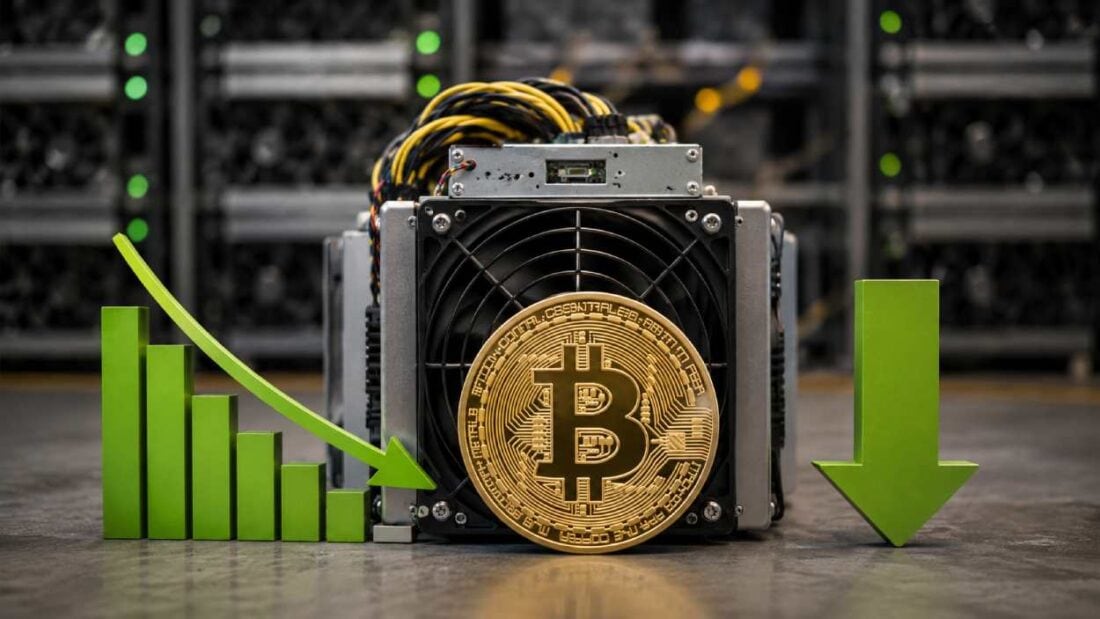
Hashprice captures this tug-of-war in real time. It fluctuates with every block and every price tick, and miners monitor it daily through profitability tracking tools. Through 2026, difficulty has trended both up and down rather than climbing in a straight line, reflecting the ongoing dance between new hardware deployments, older machines shutting down, and Bitcoin’s volatile market price.
Miners can’t control price or difficulty. The competitive edge comes entirely from controlling the cost basis: choosing efficient hardware, securing cheap power, and maintaining high uptime.
Mining pool fees and payout models
Solo mining with a single ASIC on a network producing 900 EH/s or more is statistically impractical. A miner running one current-gen machine could go years between finding a block. Mining pools solve this by combining hashrate from thousands of miners and splitting rewards proportionally based on each miner’s contributed work.
Pool fees typically range from 0.5% to 4% of mining revenue. The fee percentage matters, but the payout model matters just as much because it determines how income variance affects the miner.
PPS+ (Pay Per Share Plus) pays miners a fixed amount for each valid share submitted, regardless of whether the pool actually finds a block. The pool absorbs the variance risk. Miners get steady, predictable payouts, which makes budgeting easier. The trade-off is usually a slightly higher fee to compensate the pool for taking on that risk.
PPLNS (Pay Per Last N Shares) pays miners proportionally based on the shares they contributed during the window leading up to a found block. Income is less predictable, especially for miners who start and stop frequently, because payouts depend on when blocks are found relative to the miner’s active shares. Over time, PPLNS tends to reward consistent, always-on miners and can produce slightly higher average returns than PPS+ because the pool doesn’t need to price in variance risk.
For small miners, PPS+ generally makes more sense because the steady payout smooths cash flow. Larger or more experienced operators sometimes prefer PPLNS for its slightly better expected value over long periods.
Multi-coin mining apps add another option for GPU miners. These tools automatically mine whichever altcoin is most profitable at any given moment and convert the rewards to BTC. The convenience comes at a cost: fees typically range from roughly 1.5% to 6.5%, significantly higher than a standard pool.
Mining hardware options: ASICs, GPUs, and CPUs
A SHA-256 ASIC locks you into Bitcoin but delivers the best efficiency per watt, while a GPU costs less and can hop between altcoin algorithms whenever margins shift.
ASICs are purpose-built for a single algorithm. They’re the fastest and most efficient option for their target coin. Competitive mining on Bitcoin (SHA-256), Litecoin and Dogecoin (Scrypt), Zcash (Equihash), Dash, and Kaspa (kHeavyHash) requires them. The downside is inflexibility. A Scrypt ASIC can’t mine RandomX or SHA-256 coins. If your target coin tanks, the hardware becomes a paperweight with limited resale value. Current-gen BTC ASICs typically sell for anywhere between $4,500 and $10,000 apiece, with prices shifting alongside market conditions.
Where ASICs lock you into one algorithm, GPUs give you the freedom to mine across multiple algorithms, covering altcoins like Ethereum Classic, Ravencoin, Ergo, and Vertcoin. They can’t touch SHA-256 Bitcoin mining, not even close, but they let you switch algorithms whenever profitability shifts. A used RTX 3070 produces about 160 MH/s on Autolykos2 (Ergo’s algorithm) at 125 W and runs roughly $280 on the used market. GPUs also hold value outside of mining for gaming and professional workloads, which gives them a resale floor that ASICs lack.
CPUs have the lowest barrier to entry. They’re practical only for coins with CPU-favoring algorithms, primarily Monero’s RandomX. Daily dollar returns are modest compared with ASIC or GPU mining, but you don’t need specialized equipment or dedicated cooling. An AMD Ryzen 9 7950X produces about 31 KH/s on RandomX at 140 W and costs roughly $699. The AMD Threadripper 3990X pushes 54 KH/s at 280 W but runs about $3,995, putting it in a different category of commitment.
FPGAs are customizable chips that can be programmed for specific algorithms. They’re more efficient than GPUs but significantly harder to configure and maintain, which keeps them a less common choice outside of technically skilled operators.
Hardware longevity matters. The cheapest unit isn’t the best value if it fails after a few months. Fans wear out, hash boards develop bad chips, and power supplies degrade. Buying from reputable manufacturers and budgeting for maintenance extends a machine’s productive life.
Bitcoin mining in 2026: can individuals still compete?
Bitcoin mining is an industrial game. The operators setting the pace have negotiated power rates well below residential levels, run warehouses full of ASICs with on-site maintenance crews, and treat uptime like a factory metric. An individual miner on residential power almost always operates at a loss after electricity and hardware costs.
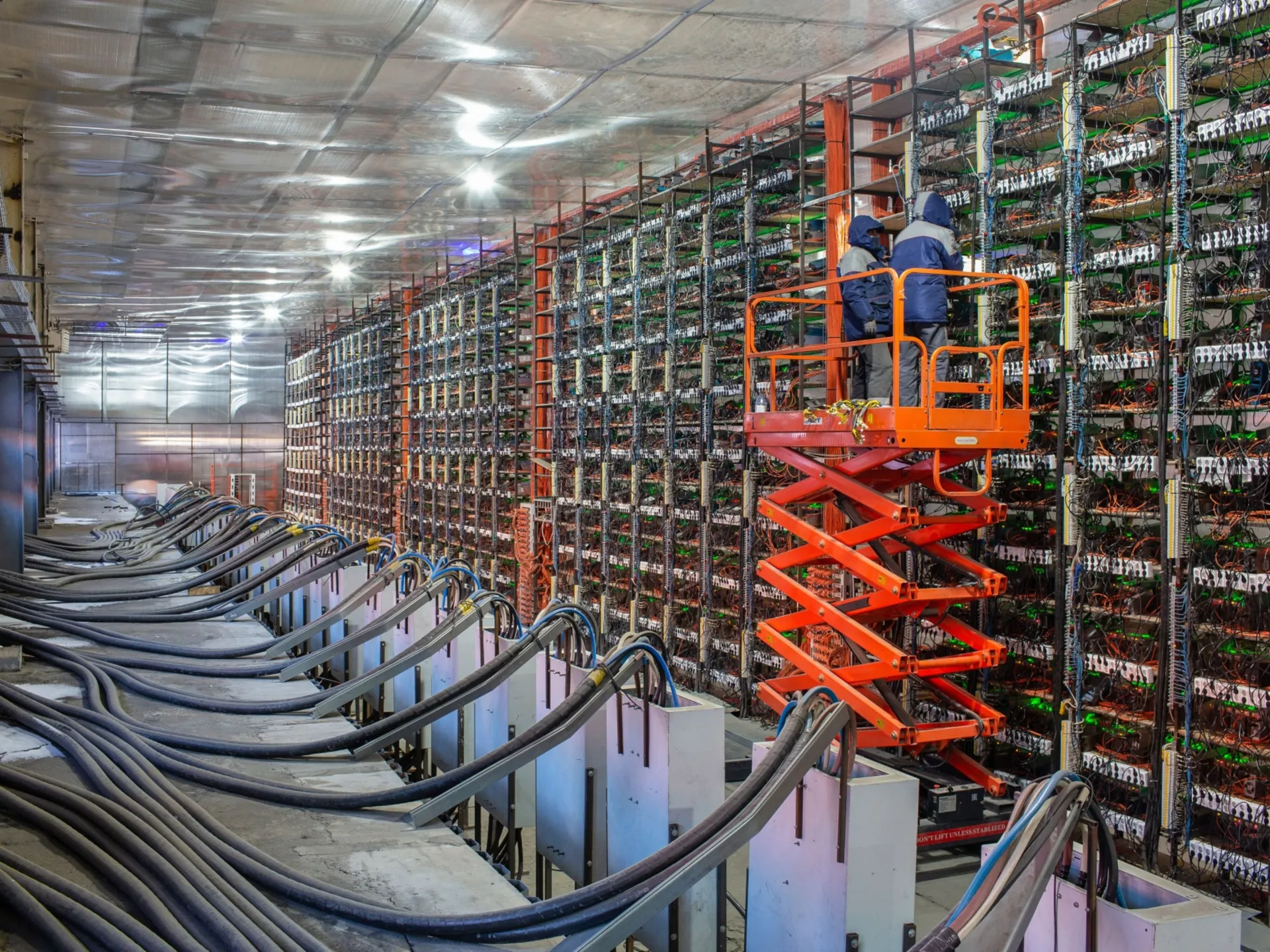
Joining a mining pool is non-negotiable for any individual BTC miner. Without pooling your hashrate with other miners, you could wait years between block finds on a single machine.
Beyond the economics, home mining comes with physical challenges most people don’t anticipate. A modern ASIC runs at approximately 75 to 80 dB, comparable to a vacuum cleaner running continuously. That noise alone makes living alongside the machine uncomfortable. Heat output is substantial too. A 3,000+ watt machine in a spare bedroom will raise the room temperature significantly, and in warmer months, the added cooling load on your home’s HVAC increases the effective electricity cost. Some setups require electrical-panel upgrades to safely handle the amperage draw, adding more upfront cost.
Hosted mining offers a middle path. You buy the ASIC, and a hosting facility houses it alongside thousands of other machines. You benefit from industrial power rates, typically around $0.07 to $0.08/kWh, plus professional uptime management and on-site repairs. Hosting fees cut into your margin, but the lower electricity cost and higher uptime usually more than compensate. At those rates, break-even on current-gen hardware generally falls in the 12-to-24-month range. You also keep ownership of the hardware itself, which has resale value, something cloud mining contracts don’t offer.
Most profitable altcoins to mine in 2026
Altcoins let miners compete with less powerful or less expensive hardware than Bitcoin demands. Network difficulties are lower, and the algorithms are more varied, opening doors for GPUs and CPUs that can’t touch SHA-256 mining. The trade-off is volatility. Altcoin prices swing harder, so a setup earning money right now can turn negative the moment difficulty spikes or the coin’s price drops. Each coin’s profitability depends on the same core variables: whether your hardware matches the algorithm, what you pay for electricity, and where network difficulty sits right now.
Miners who want to accumulate Bitcoin specifically can mine altcoins and sell them for BTC, sometimes coming out ahead of mining Bitcoin directly, depending on the altcoin’s margin.
Litecoin + Dogecoin (merged mining, Scrypt)
Litecoin and Dogecoin share the Scrypt algorithm, which means a single Scrypt ASIC can mine both coins simultaneously through Auxiliary Proof of Work at no extra power cost. This merged-mining arrangement changes the profitability picture significantly. Mining Litecoin alone at $0.10/kWh typically runs at a loss. The Dogecoin side adds enough revenue to make the pair worth considering.
The Antminer L9 17G delivers 17,000 MH/s at 3,450 W, with prices around $14,399. At $0.10/kWh, the DOGE-side daily profit comes to approximately $0.64. That’s thin, and it’s heavily dependent on DOGE’s price, which is notoriously volatile. LTC’s current block reward sits at 6.25 LTC, and the next Litecoin halving is expected around mid-2027, which will compress LTC-side revenue further. DOGE pays 10,000 DOGE per block and has no halving schedule, making the Dogecoin side increasingly important to the merged-mining equation.
Zcash (ZEC, Equihash)
A ZEC price rally in mid-2026 pushed Zcash mining economics from modest to strong. The Antminer Z15 Pro produces 840 KSol/s at 2,780 W and costs roughly $1,299, a relatively low hardware cost for the output compared with BTC ASICs. That lower entry point means faster break-even, at least at current ZEC prices.
The risk is that ZEC profitability is unusually sensitive to price swings. A pullback could erase current margins quickly. Zcash’s block reward stands at 1.25 ZEC, and the coin’s established privacy use case supports ongoing demand, but privacy coins face regulatory scrutiny in several jurisdictions, which adds a layer of uncertainty. If you’re entering ZEC mining, stress-testing your numbers at prices 20% to 40% below the current level is worth the five minutes it takes.
Kaspa (KAS, kHeavyHash)
Kaspa serves as a cautionary example. KAS is down roughly 85% from its 2024 peak as of mid-2026. Most older KAS-specific ASICs are mining at a loss at typical electricity rates. Only the newest, most efficient model, the Antminer KS7 (36 to 40 TH/s at 2,772 to 3,080 W), shows a thin positive margin.
What happened with Kaspa illustrates a common pattern: network hashrate grew faster than the coin’s price could support. As ASIC manufacturers shipped KAS-specific hardware, mining difficulty surged while the coin’s market price didn’t keep pace. Fast block times smooth out payout timing but don’t fix the underlying margin compression. Buying new ASICs for KAS without careful profitability modeling across multiple price scenarios is risky.
Ergo (ERG, Autolykos2) and Vertcoin (VTC, Verthash)
Ergo is one of the few coins where a mid-range GPU still produces meaningful hashrate. The Autolykos2 algorithm is GPU-friendly, and Ergo’s network difficulty stays low enough that a single RTX 3070 can contribute. The catch is that ERG’s low coin price keeps daily dollar output small per card. Ergo mining makes the most sense for people who already own GPUs for gaming or other work and want to put spare cycles to use rather than buying GPUs specifically for mining.
Vertcoin takes GPU-friendliness a step further. Its Verthash algorithm is intentionally ASIC-resistant, and the Vertcoin community has stated it would fork again to maintain GPU-only mining if ASICs ever appeared on the network. VTC requires just 2 GB or more of VRAM, making even older GPUs eligible. The downside: VTC’s market cap sits at roughly $3 million, making it among the smallest tracked mineable coins. That thin liquidity means selling large amounts of VTC without moving the price is difficult.
Both coins hover near break-even at $0.10/kWh for most mid-range GPUs. They’re best viewed as low-cost experiments for people who already own the hardware, not as the foundation of a mining business.
Monero (XMR), RandomX, CPU
Monero’s RandomX algorithm was deliberately designed to keep CPUs competitive against GPUs and ASICs. It’s the most credible CPU-mining option available, and it doesn’t require specialized hardware or ventilation beyond what a standard PC already has.
XMR’s block reward sits at 0.65 XMR through tail emission, meaning it doesn’t halve. That steady, predictable emission rate removes one variable that Bitcoin miners constantly worry about. An AMD Ryzen 9 7950X producing 31 KH/s at 140 W is a lower-cost entry point at roughly $699. Stepping up to AMD’s Threadripper 3990X gets you 54 KH/s at 280 W, netting roughly $0.88 per day at $0.10/kWh, but the chip carries a price tag around $3,995.
Absolute daily earnings are modest compared with ASIC-mined coins, but the barrier to entry is as low as it gets. Anyone with a reasonably modern CPU and a spare computer can start. XMRig, the standard mining software, is well-documented, though it’s sometimes flagged by antivirus software because the same tool is used in unauthorized cryptojacking. That flag is a false positive in the context of legitimate mining, but you may need to whitelist it.
How to calculate your mining profitability
Running the numbers before you buy hardware keeps you from learning expensive lessons after the fact. AXL Research Hub‘s mining guides walk through these calculations in detail. Here’s the process:
- Gather your inputs. You need your hardware’s hash rate, its power consumption in watts, your local electricity rate per kWh, the pool fee percentage, and the coin’s current difficulty and market price.
- Run the numbers through a live calculator. Tools like WhatToMine or CoinWarz pull real-time difficulty and hashprice data. Enter your specs and electricity rate, and they’ll spit out estimated daily revenue.
- Compare daily revenue against daily electricity cost. This is your gross margin. If revenue doesn’t cover electricity, stop here unless you’re deliberately mining at a loss for long-term accumulation.
- Subtract pool fees and any conversion fees. Pool fees range from 0.5% to 4%, and auto-conversion services for altcoin-to-BTC can add another 1.5% to 6.5%.
- Project your break-even timeline. Divide your total hardware cost by your daily net operating profit to see how many days until the machine pays for itself. If that number stretches past the hardware’s expected useful life of roughly two to three years for current-gen ASICs, the investment doesn’t work.
- Stress-test at lower prices. Run the same calculation at coin prices 20% and 40% below the current level. If the unit still earns at those prices, you have a margin of safety. If it flips negative at a 20% drop, you’re one bad week away from losing money.
- Budget for maintenance. Hash-board failures, fan replacements, and PSU wear add up. A rough estimate of 5% to 10% of annual revenue covers these costs for most operations.
- Account for taxes. In the U.S., mined coins are taxed as ordinary income at fair market value on the day received. This isn’t optional, and it hits harder than many new miners expect.
Net operating profit equals mining revenue minus electricity cost minus pool fees minus software fees minus other direct operating costs. Most online calculators don’t include hardware depreciation, cooling costs, or taxes. You have to add those manually to get the real picture.
Tax obligations for crypto miners in the U.S.
The IRS treats every coin you mine as ordinary income, valued at whatever the market price is on the day that coin hits your wallet. Every pool payout triggers a taxable event. If you mine 0.001 BTC on a Tuesday and Bitcoin is trading at a given price that day, you owe income tax on that dollar amount regardless of whether you sell the coins or hold them.
The IRS distinguishes between hobby mining and business mining, and how you’re classified has a major impact on your bottom line. Hobby miners generally can’t deduct hardware purchases, electricity costs, or maintenance expenses against their mining income. The coins are still taxable income, but the costs of producing them don’t offset that tax. This can make a thin pre-tax margin disappear entirely after the tax bill.
Business-classified mining operations get better treatment. Equipment, electricity, and maintenance qualify as deductible business expenses. Business miners may also be eligible for equipment depreciation, spreading the cost of an ASIC across its useful life. The difference between paying tax on gross mining revenue (hobby) versus net profit after expenses (business) can be the factor that makes or breaks profitability for small-scale miners.
Keeping detailed records of every payout, including the date, the amount of coin received, and the coin’s fair market value at the time of receipt, is necessary for accurate crypto tax reporting. Mining pools often provide payout logs, but those logs may not include fiat-equivalent values. Tracking this from day one is far easier than reconstructing it at tax time.
Cloud mining: red flags and realities
Cloud mining means renting hashrate from a provider without owning any hardware. The appeal is obvious: no setup, no noise, no heat, no maintenance. You sign a contract, pay a fee, and supposedly earn mining rewards.
Most cloud mining contracts underperform or lose money once fees are factored in. The provider needs to cover their own electricity, hardware costs, maintenance, and profit margin before you see a return. That layering of costs means you’re paying more per hash than you would running your own machine.
The industry has a long history of scams and Ponzi-style operations. Warning signs include guaranteed daily returns (no legitimate mining operation can guarantee returns when coin prices and difficulty fluctuate constantly), no verifiable proof that actual mining hardware exists, and referral-heavy payout structures where new deposits fund payouts to earlier investors.
Owning hardware, even through a hosted arrangement, preserves asset value and resale flexibility that a cloud contract doesn’t offer. If mining becomes unprofitable, you can sell the ASIC and recover some capital. A cloud contract that expires has zero residual value.
What happens when all 21 million Bitcoin are mined?
Bitcoin’s supply is capped at 21 million coins. The final fraction of a Bitcoin is expected to be mined around approximately 2140, though the exact timing depends on block production rates over the next century-plus.
After the last coin is mined, miners will earn revenue solely from transaction fees rather than block subsidies. Transaction fees already supplement the block reward today. Every Bitcoin transaction includes a fee paid by the sender, and miners collect all fees from the transactions they include in a block. As the block subsidy continues halving toward zero (it will halve roughly every four years until exhausted), transaction fees make up an increasing share of miner revenue.
The long-term question is whether transaction volume and fee levels will be high enough to sustain the security spending the network needs. Bitcoin’s design assumes they will. As the subsidy shrinks, either transaction volume rises, individual fees rise, or both, to compensate miners for the energy and hardware costs of securing the chain. If fees don’t reach a level that keeps enough miners profitable, hashrate drops, difficulty adjusts downward, and the remaining miners become more profitable until equilibrium is restored.
This isn’t a sudden cliff. The current block subsidy is 3.125 BTC. After the next halving around 2028, it drops to 1.5625 BTC. Each step is smaller in absolute terms, giving the fee market decades to develop. Litecoin faces a similar dynamic with its 84 million coin supply cap, though on a different timeline.
Frequently asked questions
How long does it take to mine one Bitcoin?
At mid-2026 difficulty, a lone machine faces wait times that are practically off the charts. Even the best hydro-cooled ASIC on the market would statistically need about 10 years of mining alone before landing a single block. A current-gen air-cooled unit would take roughly 21 years. Pool mining smooths payouts into frequent smaller amounts, but it doesn’t change the total expected output over time. You earn the same amount of BTC on average; it just arrives in smaller, more regular increments instead of one lump sum after years of waiting.
What is the easiest crypto to mine at home?
Monero via CPU mining. It runs on a standard computer with no dedicated ventilation or specialized hardware. The RandomX algorithm is designed to keep consumer CPUs competitive, and the XMRig mining software is well-documented. You won’t earn large daily amounts, but the barrier to getting started is as low as it gets in mining.
Will mining hardware become obsolete quickly?
Yes. ASICs lose competitiveness as difficulty rises and newer, more efficient models launch. Budget for about two to three years of productive use from current-gen hardware. After that, rising difficulty and better hardware from competitors typically push older machines below the profitability line. GPUs hold value longer because they have secondary uses, but their mining output also diminishes over time relative to newer cards.
Choosing the right path: mine, buy, or both
Mining is a bet on operational discipline. You need cheap power, efficient hardware, and high uptime. When those pieces line up, mining can acquire crypto below the spot cost of simply buying it on an exchange. That discount is the whole point.
Buying is a simpler bet on price. You don’t need to worry about electricity bills, maintenance schedules, or hardware depreciation. You get immediate exposure to the coin’s price movement with a lower capital threshold and none of the operational overhead.
The decision hinges on what you have available: capital, access to affordable electricity, technical skill, tolerance for noise and heat, and appetite for the operational risk that mining carries. Many people combine both strategies, mining for discounted accumulation when margins are healthy and buying directly for simplicity and liquidity when they want exposure without the hassle. Neither approach is universally better. The right answer depends on your specific situation.