

Blockchain is a distributed digital ledger that records transactions across a network of computers, giving every participant a synchronized copy of the same data. Whether you’re evaluating a cryptocurrency for the first time or trying to figure out why companies outside of finance care about distributed ledgers, the technology itself is the starting point.
What is blockchain?
A blockchain records data in blocks that are linked together in sequence, with each new block carrying a cryptographic reference to the one before it so the full history forms an unbroken chain. There’s no single central administrator. Instead, control is distributed among all the nodes (computers) on the network, and every node holds a full copy of the ledger.
Records on a blockchain are permanent, time-stamped, and tamper-resistant. Altering one block would require changing every block that comes after it across a majority of all copies on the network. That structure makes fraud and unauthorized changes extremely difficult to pull off without detection.
The concept traces back to a 2008 paper titled “Bitcoin: A Peer-to-Peer Electronic Cash System,” published under the pseudonym Satoshi Nakamoto. The first public blockchain launched in 2009 with the release of Bitcoin as a digital currency. Shortly after the first coins were mined, Hal Finney received the earliest known Bitcoin transaction, marking the first real transfer of value on a blockchain network.
Blockchain was first applied to digital currency, but the technology now reaches across finance, supply chain management, healthcare, and other fields. It’s worth drawing a clear line between the technology itself and the assets that ride on top of it. Blockchain is the infrastructure. Cryptocurrencies, tokens, and NFTs are applications built using that infrastructure, the same way websites are applications built on top of the internet.
How does blockchain work?
The process starts when someone initiates a transaction, like sending cryptocurrency to another person. That transaction is broadcast to a peer-to-peer network of nodes spread across the world.

Nodes validate the transaction using the blockchain’s consensus rules. These rules vary by network, but they all serve the same purpose: confirming that the sender has the right to make the transaction and that the details check out. Once validated, the transaction joins a group of other verified transactions, and they’re bundled into a new block.
That new block receives a cryptographic hash, a unique identifier generated from the block’s contents and the hash of the previous block. The block is then appended to the existing chain. Every node on the network updates its copy of the ledger to reflect the addition.
Once a block is recorded, the data inside it can’t be retroactively altered without gaining consensus from the majority of the network. This is what makes blockchain fundamentally different from a traditional database, where an administrator can edit or delete records.
How data is stored and secured on a blockchain
Each block contains three things: the transaction data itself, a timestamp, and the cryptographic hash of the previous block. That hash is what ties each block to the one before it, creating the chain.
A hash function takes an input of any length, whether it’s a single word or an entire novel, and outputs a fixed-length alphanumeric string. Think of it as a digital fingerprint. The same input always produces the same hash, but even the smallest change to the input produces a completely different output. If someone tampers with a transaction inside a block, the hash changes, breaking the link to every block that follows. The entire chain after that point becomes invalid, and other nodes on the network immediately spot the discrepancy.
Identity and authorization rely on public and private key pairs. Your public key works like an address: anyone can see it and send you something. Your private key works like a password: it proves you own that address and authorizes outgoing transactions. When you send a transaction, you sign it with your private key. The network verifies that signature using the corresponding public key to confirm that the transaction is legitimate and hasn’t been altered in transit.
Because thousands of nodes each hold a copy of the ledger, a hacker would need to alter every copy simultaneously to change the record, which is computationally impractical on large public networks. That distributed structure adds a significant layer of protection. However, blockchain is not immune to attack. In 2022, attackers exploited the Ronin Network by gaining control of a majority of its validator nodes and stole more than $600 million. The attack didn’t break the cryptography itself; it exploited the small number of validators securing that particular network.
Traditional centralized systems face their own vulnerabilities. Between 2015 and 2016, 140 million patient records were breached across healthcare systems, illustrating the kind of data-security gap that blockchain-based architectures aim to close by removing single points of failure.
Proof of work vs proof of stake
Both proof of work and proof of stake are consensus mechanisms, meaning they’re the methods a blockchain uses to get all nodes to agree on which transactions are valid. They reach the same goal through very different paths.
| Feature | Proof of work | Proof of stake |
|---|---|---|
| How validators are chosen | Miners compete to solve a complex mathematical puzzle; the first to solve it earns the right to add the block | Validators are selected based on the amount of cryptocurrency they lock up (stake) and how long they’ve held it |
| Reward | Block reward of newly mined coins plus transaction fees | Transaction fees; no new coins are created through mining |
| Energy use | High, because mining requires large amounts of computational power and electricity | Significantly lower, because the computational race is eliminated |
| Coin supply | New coins are minted with each block | All coins must be pre-mined, since no mining process generates new ones |
| Notable example | Bitcoin, which continues to operate on proof of work | Ethereum, which switched from proof of work to proof of stake in September 2022 in an upgrade known as the Merge |
Proof of work was the original consensus model, designed to make attacking the network prohibitively expensive by requiring real-world resources (hardware and electricity). Proof of stake achieves a similar economic deterrent by requiring validators to put their own money at risk: if they approve fraudulent transactions, they lose their stake.
Public, private, consortium, and hybrid blockchains
Not all blockchains operate the same way. The type of blockchain a project uses depends on who needs access, how much transparency is required, and how tightly the network needs to control participation.
| Type | Access | Governance | Best suited for |
|---|---|---|---|
| Public | Open to anyone; any person can join, read, or write transactions | Decentralized across all participants | Transparency and open participation (e.g., Bitcoin, Ethereum) |
| Private | Restricted to a known set of authorized entities | Controlled by a single organization | Internal processes requiring privacy and speed |
| Consortium | Restricted to a group of pre-approved organizations | Governed jointly by multiple organizations, not a single entity | Cross-company collaboration where shared control matters |
| Hybrid | Combines elements of public and private; selective data exposure | Defined by the implementing organization | Use cases where some data is public and some is confidential |
Public chains prioritize transparency and decentralization. Anyone can audit the ledger, and no single entity controls the rules. Private and consortium chains trade some of that openness for privacy, speed, and access control. These are permissioned networks, meaning they enforce rules about who can connect, transact, or create assets on the chain. A hospital network sharing patient data among approved providers, for example, doesn’t need or want a fully open ledger.
What’s the difference between blockchain and cryptocurrency?
Blockchain is the underlying technology, a distributed ledger infrastructure for recording data. Cryptocurrency is one application built on top of that infrastructure, functioning as a medium of exchange or a store of value. All cryptocurrencies rely on a blockchain, but a blockchain can exist and operate without any cryptocurrency attached to it.
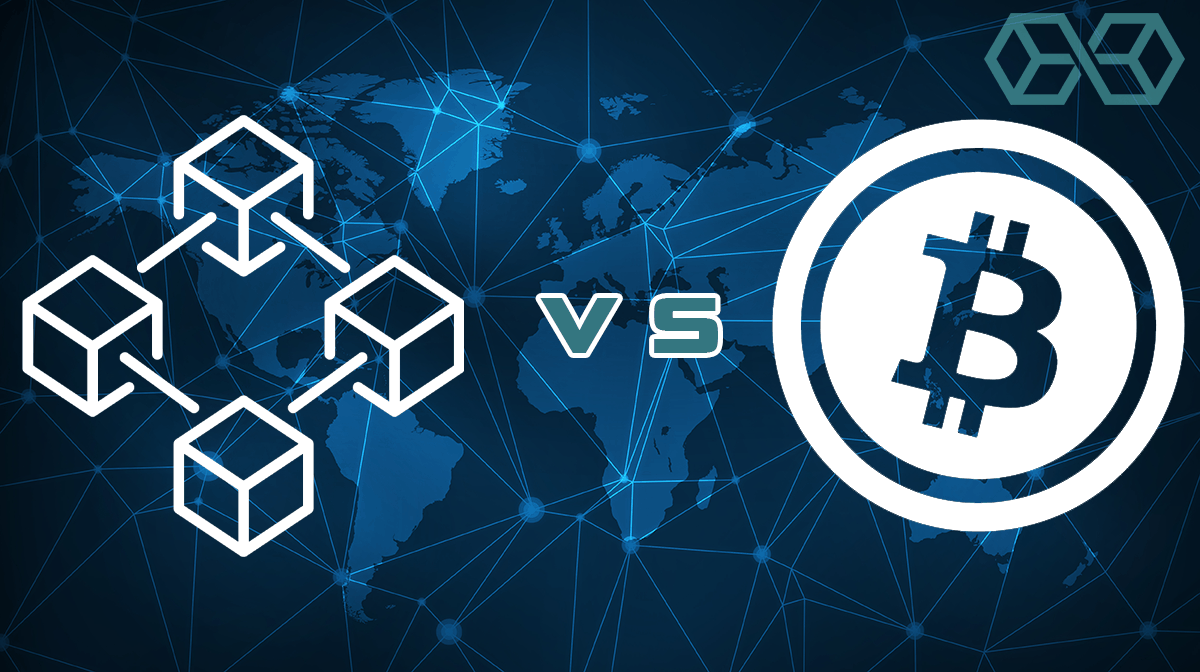
This distinction matters because many people treat the two as interchangeable. When Bitcoin launched, the blockchain powering it was the only widely known example. Since then, over 6,000 altcoins have been created, each running on blockchain and cryptocurrency infrastructure. But the technology’s reach now extends well beyond digital money, into supply chain tracking, identity verification, healthcare records, and more.
Decentralized finance (DeFi) sits at the intersection of the two concepts. Decentralized finance uses smart contracts on blockchains to replicate financial services, including lending, trading, and insurance, without traditional intermediaries like banks. The blockchain provides the record-keeping layer, and the cryptocurrency or token provides the economic layer. You can’t have one without the other in DeFi, but in plenty of enterprise blockchain applications, no cryptocurrency is involved at all.
Smart contracts and how they work
Smart contracts are self-executing programs stored on a blockchain, with the terms of the agreement written directly in code. When predefined conditions are met, the contract runs automatically, removing the need for a middleman to enforce or verify the agreement.
Ethereum as a platform popularized programmable smart contracts and enabled a broad range of decentralized applications (dApps) and token standards. Two of the most widely used standards are ERC-20, which governs fungible tokens (interchangeable units like most cryptocurrencies), and ERC-721, which governs non-fungible tokens (NFTs), where each token is unique.
Beyond tokens, businesses use smart contracts for supply-chain tracing, automated compliance checks, and transparent procurement. A manufacturer, for instance, can write a smart contract that releases payment to a supplier automatically once a shipment is confirmed at a specific checkpoint. The logic is on-chain, visible to both parties, and executes without either side needing to trust the other or rely on a third party to process the payment.
What is a blockchain explorer?
A blockchain explorer is a web-based tool that converts raw on-chain data into a searchable, human-readable interface. If the blockchain itself is the ledger, an explorer is the search engine for that ledger.
Explorers work by connecting to or running full nodes. They index new blocks as they’re produced and store the data in search-optimized databases. Users can look up individual transactions, check wallet balances, inspect smart contract code, and trace the flow of funds from one address to another.
Different blockchains often require different explorers because their underlying architectures vary. Bitcoin uses a UTXO (unspent transaction output) model, where each transaction references specific unspent outputs from previous transactions. Most other major chains use an account-based model, where balances are tracked per address, similar to a traditional bank account. An explorer built for one model won’t parse data from the other correctly.
Advanced explorers go further, offering features like entity labeling (tagging addresses associated with known decentralized exchanges or wallets), cross-chain tracking, alert systems for unusual activity, and behavior analysis. Common use cases include verifying that a payment was sent and confirmed, researching security incidents, and monitoring activity on DeFi protocols.
Blockchain protocols explained
A blockchain protocol is the set of rules governing how data is transmitted, validated, and stored on a given network. It defines the consensus mechanism, the block structure, the permission model, and the smart-contract capabilities available to developers and users.
Which protocol a network uses shapes everything about its behavior. It determines whether a blockchain is public or permissioned, general-purpose or built for a specific industry. Security is enforced through cryptographic techniques built into the protocol itself, which is what makes recorded data tamper-resistant.
Standardized protocols also enable interoperability, meaning different blockchain networks can communicate and share data with each other. Without shared standards, each blockchain is an island. Well-designed protocols balance transaction throughput and resource management so that the network can handle increasing activity without grinding to a halt or burning through excessive energy.
Real-world blockchain use cases
Blockchain’s value becomes clearest when you look at the specific problems it solves across industries. Some of these applications are already in production; others are still proving themselves.
- Supply-chain tracking. Companies record every step from raw material sourcing to final delivery on a shared ledger. Every participant in the chain, from the farmer to the retailer, can verify the origin and handling of a product. One example from trade finance: a letter-of-credit transaction processed on a blockchain took under four hours, compared to up to ten days with traditional paperwork.
- Drug supply-chain integrity. Counterfeit medications are a serious problem. Counterfeit drugs cost pharmaceutical companies an estimated $200 billion in losses annually. A blockchain-based chain of custody creates a verifiable record at each handoff, making it much harder for counterfeit products to enter the supply.
- Claims and billing. Automated ledger entries reduce intermediary costs and make fraudulent claims easier to detect. Medicare fraud caused more than $30 million in losses in the United States in 2016, and blockchain-based audit trails could make that kind of fraud significantly harder to carry out unnoticed.
- Financial services. Trade settlement, cross-border payments, and KYC (know your customer) verification all benefit from shared ledgers. KYC compliance can cost up to $500 million per year per bank, and a shared, verified identity record across institutions could reduce duplicate work.
- Audit trails and provenance. The sequential, permanent recording of transactions creates tamper-proof records for land titles, food safety certifications, and luxury goods authentication.
- NFTs. Non-fungible tokens are unique digital assets minted on smart-contract blockchains that verify ownership and authenticity. The Beeple NFT sold at Christie’s for $69.3 million in 2021, illustrating the market’s peak interest. By 2023, an analysis found 95% of NFTs worth practically nothing, a reminder that the underlying technology’s durability doesn’t guarantee the value of every asset built on it.
Blockchain in healthcare
Healthcare stands out as one of blockchain’s most frequently discussed use cases, and also one where adoption is moving cautiously.
The core promise is a unified electronic medical record that any authorized provider can access, regardless of which system originally stored the data. Right now, patient records are fragmented across hospitals, clinics, labs, and specialists, each using different software. A patient moving between providers often has to repeat tests or fill gaps in their history manually. A blockchain-based record would let each provider see the full picture.
The MedRec prototype was designed to give patients and providers one-stop access to complete medical histories across all facilities. Patients could also grant anonymous access to their records for research purposes, which could accelerate drug development by giving researchers larger, more complete datasets.
Connected medical devices, sometimes grouped under the Internet of Medical Things, generate enormous volumes of data. Blood-pressure monitors, insulin pumps, and wearable sensors all feed information into healthcare systems. Blockchain infrastructure could help secure that data and ensure its integrity. That said, adoption is incremental. Organizations are testing and vetting blockchain applications before committing to full deployment, and the gap between prototype and production remains wide.
Advantages and disadvantages of blockchain
Blockchain has real strengths, but it also carries trade-offs that are easy to overlook in the hype. Here’s how the advantages and disadvantages break down.
Advantages:
- Immutability. Once data is written to a blockchain, it can’t be changed. This creates a reliable audit trail for any transaction, from financial transfers to property records.
- Transparency. Every participant on a public blockchain can verify the ledger independently, reducing the need to trust a single authority to keep accurate records.
- Reduced fraud. Decentralized verification and cryptographic security make unauthorized alterations extremely difficult. No single actor can quietly rewrite the history of transactions.
- Disintermediation. Peer-to-peer transactions cut out middlemen, which can lower costs and speed up settlement times. A cross-border payment that takes days through correspondent banks can settle in minutes on a blockchain.
Disadvantages:
- Scalability. Many blockchain networks process transactions more slowly than centralized databases. Bitcoin, for example, handles far fewer transactions per second than a major payment processor.
- Energy consumption. Proof-of-work chains require significant electricity for mining. While proof of stake addresses this, not all major networks have made the switch.
- Regulatory uncertainty. Legal frameworks for smart contracts, tokens, and cross-border blockchain use remain unsettled in many jurisdictions. What’s legal in one country may be restricted in another.
- Complexity. Integrating blockchain with existing systems demands technical expertise and organizational change. It’s not a drop-in replacement for a traditional database.
- Irreversibility. Errors or unauthorized transactions recorded on-chain are extremely hard to reverse. If you send funds to the wrong address, there’s often no way to get them back.
- Few proven large-scale use cases. Despite billions in investment, practical and scalable deployments remain limited. Many projects are still in pilot phases.
How blockchain may evolve
Blockchain as a service (BaaS) is one of the more concrete trends shaping the near future. Cloud-based platforms let organizations build on distributed ledger technology without setting up and maintaining their own infrastructure, lowering the barrier to entry for companies that want to experiment.
Interoperability is another area seeing active development. Hardware standardization and scalable consensus algorithms could allow different blockchain networks, and even external systems, to share data with each other. Right now, most blockchains operate in isolation, which limits their usefulness for cross-industry applications.
Consumer and regulatory pressure for supply-chain transparency is also driving adoption. Shoppers increasingly want to know where their food, clothing, and electronics come from, and regulators in some sectors are starting to require traceable records.
At the same time, competing technologies, especially in payments and AI, may absorb funding and attention that once flowed to blockchain projects. Not every problem needs a distributed ledger, and some solutions that were pitched as blockchain use cases may end up being solved more efficiently by other tools.
The remaining hurdles are real: cybersecurity threats (as the Ronin Network attack demonstrated), governance ambiguity around smart contracts, and infrastructure scalability limits. Successful enterprise pilots are building confidence for broader deployment, but the path from pilot to production-scale adoption is gradual.
Frequently asked questions about blockchain
Can you withdraw money from a blockchain?
Blockchain itself is a ledger, not a bank. You can’t “withdraw” from a blockchain the way you’d withdraw from a checking account. What you can do is send cryptocurrency from a blockchain wallet to an exchange, convert it to a fiat currency like US dollars, and then withdraw money to your bank account. The blockchain records the transfer from your wallet to the exchange; the exchange handles the conversion.
Is blockchain a good or bad thing?
The technology is neutral. It offers transparency, security, and the ability to remove intermediaries from transactions, which can lower costs and speed things up. But it also comes with real drawbacks: energy consumption on proof-of-work networks, regulatory gaps that vary by jurisdiction, and the irreversibility of errors. Whether it’s “good” depends on how and where it’s applied.
What is the main purpose of a blockchain?
The main purpose is to provide a shared, tamper-resistant record of transactions without relying on a central authority. Every participant holds a copy of the ledger, and consensus rules ensure that all copies stay in sync. This setup makes it possible for people and organizations that don’t know or trust each other to transact directly.
Blockchain’s role in a decentralized future
Blockchain shifts data control from centralized institutions toward networked participants. That shift doesn’t mean replacing every existing system. The real value lies in applications that distribute data access, enable collaboration between parties that don’t share a trusted intermediary, and solve specific problems that centralized systems handle poorly.
Adoption is gradual. Organizations are moving from pilot programs to production as technical standards solidify and regulations catch up. Across the projects and platforms AXL Research Hub covers, the pattern is consistent: the teams that succeed are the ones solving a real problem, not just adding blockchain to a system that already works fine without it.
Understanding how blocks, consensus mechanisms, and cryptography fit together gives you a foundation for evaluating any blockchain project you come across, whether it’s a new cryptocurrency, a DeFi protocol, or an enterprise supply-chain platform. The technology isn’t magic, and it isn’t a fix for everything. But for the problems it’s suited to, nothing else works quite the same way.