
eToro vs Coinbase comes down to what you actually want from a trading platform. One bundles crypto with stocks, ETFs, and copy trading under a single login. The other gives you access to 250+ cryptocurrencies, a non-custodial wallet, and lower fees for active traders.
eToro vs Coinbase at a glance
| Category | eToro | Coinbase |
|---|---|---|
| Platform type | Multi-asset broker | Dedicated crypto exchange |
| Crypto assets | ~21 in the US (~70-80 globally) | 250+ |
| Stock and ETF access | Yes, commission-free in many regions | Limited; equity access in select jurisdictions only |
| Social/copy trading | CopyTrader for automated portfolio replication | None |
| Staking | Select assets in eligible regions | Available, varies by US state |
| Fee model | Flat 1% on crypto buys and sells | 0% to 0.60% maker-taker on Coinbase Advanced |
| Withdrawal fee | $5 flat | Varies by payment method; network fees on crypto |
| Inactivity fee | $10/month after 12 months dormant | None |
| Demo account | Yes, $100,000 in virtual funds | None |
| Mobile app | iOS and Android | iOS and Android |
| Regulation (US) | FinCEN-registered; FINRA member (equities) | FinCEN-registered; money transmitter licenses in most states |
| Stock listing | Nasdaq under ETOR (IPO May 2025, $52/share) | Nasdaq under COIN (since 2021) |
| Primary audience | Multi-asset investors, social traders | Crypto-focused investors and active traders |
Fee structures compared
eToro keeps pricing simple: a flat 1% fee on every crypto trade, built into the spread, regardless of your order size. You don’t need to think about volume tiers or payment method surcharges on the trading side. That predictability works well if you buy and hold, because you always know exactly what you’re paying.
Coinbase runs two pricing layers. The simple Buy/Sell interface combines a spread with a transaction fee that can actually exceed eToro’s 1% on smaller orders, especially when you pay by debit card. Coinbase Advanced uses a maker-taker model with fees ranging from 0% to 0.60%, dropping as your 30-day trading volume climbs. If you trade frequently and move any real size, Coinbase Advanced will cost you less per trade than eToro’s fixed percentage.
Two other eToro fees are worth knowing. Crypto-to-crypto conversions cost 0.10%, and transferring cryptocurrency off the platform carries a 0.50% fee. These add up if you regularly move coins around or swap between tokens.
Deposit, withdrawal, and hidden costs
Beyond trading fees, each platform has its own set of costs that catch people off guard:
- eToro withdrawal fee: A flat $5 every time you pull money out, no matter the amount.
- eToro inactivity fee: $10 per month kicks in after 12 consecutive months with no login or trade. Coinbase charges no inactivity fee at all, so a dormant account there won’t quietly drain your balance.
- eToro currency conversion: If you deposit in a currency other than USD, eToro charges a conversion fee on top of the exchange rate.
- Coinbase payment-method costs: Bank transfers (ACH) are typically free. Debit card and wire transfer deposits carry their own fees, which vary.
- Coinbase network fees: When you withdraw crypto to an external wallet, you pay the blockchain’s network fee. During busy periods on Ethereum, for example, that cost can spike.
Supported cryptocurrencies
Coinbase lists more than 250 cryptocurrencies on its main exchange, and its standalone Coinbase Wallet opens up thousands more across Ethereum, Solana, Base, and other chains. If you’re hunting for smaller-cap tokens or want early access to newer projects, Coinbase gives you far more to work with.
eToro offers roughly 70 to 80 coins on its global platform, but the US version is limited to around 21 due to state-by-state regulatory constraints. That narrower list still covers the major names (Bitcoin, Ethereum, and the largest altcoins by market cap), so it may be enough if your strategy centers on established assets. But if you want to branch out into mid-cap or niche tokens, eToro’s US selection will feel restrictive quickly.
Stock, ETF, and multi-asset access
With eToro, your crypto sits right next to stocks, ETFs, commodities, indices, and currency pairs, all managed under one login. Commission-free stock trading is available in many regions, which means you can build a diversified portfolio without juggling multiple brokerage logins. For investors who want their Bitcoin and their S&P 500 exposure in one place, that’s a genuine convenience.
Coinbase is primarily a crypto exchange. Some equity access has appeared in select jurisdictions recently, but for most US users, trading stocks on Coinbase isn’t an option right now. If you use Coinbase for crypto and also invest in equities, you’ll likely need a separate brokerage account for that side of your portfolio.
Social trading on eToro vs Coinbase
eToro built its reputation around social trading features that Coinbase simply doesn’t offer. CopyTrader lets you pick an investor whose track record you like and automatically replicate their trades in your own account. You set the amount, and your portfolio mirrors theirs going forward. For someone who wants exposure to crypto or stocks but doesn’t want to research every individual trade, CopyTrader removes a lot of the decision-making.

Smart Portfolios bundle thematic baskets of assets that you can fund with a single deposit, giving you a managed-feeling experience without a traditional advisor. eToro also runs a social feed where users share market commentary, trade ideas, and reactions, creating a community of more than 20 million users that works a bit like a finance-focused social network.
Coinbase has nothing comparable. The closest thing is Learn & Earn, which teaches crypto concepts through short lessons and pays small token rewards for completing them. It’s a useful onboarding tool, but it doesn’t give you a way to follow or replicate another investor’s strategy.
Staking, rewards, and yield features
Both platforms offer crypto staking, but availability depends heavily on where you live. eToro supports staking on select assets in eligible regions, though its crypto yield options are more limited overall. Coinbase also offers staking, but US availability varies by state because of ongoing regulatory restrictions. Before you count on earning yield from either platform, check whether staking is available for the specific asset you hold and in the state where you’re registered.
Custody, wallets, and on-chain access
Both eToro and Coinbase are custodial by default, meaning the platform holds your crypto on your behalf. The difference shows up when you want to move beyond that.
Coinbase lets you withdraw to external wallets for nearly all listed assets, and if you want full control, Coinbase Wallet puts your private keys in your hands so you can connect directly to DeFi protocols and NFT marketplaces across Ethereum, Solana, and Base. That combination means you can go from buying on the exchange to interacting on-chain without needing a third-party service. On the custodial side, roughly 98% of customer crypto is kept offline using cold wallet storage, which adds another layer of protection.
eToro is more oriented toward trading exposure than self-custody. The platform has expanded crypto withdrawals through eToro Money in some regions, but withdrawal support has historically been more limited than what Coinbase offers. If your plan includes staking through third-party protocols, interacting with DeFi apps, or moving coins to a hardware wallet, Coinbase gives you more flexibility to actually do that.
This distinction matters most for investors who see crypto as something to use, not just hold. On eToro, you’re primarily gaining price exposure. On Coinbase, you can take your assets off the exchange and participate in the broader on-chain economy whenever you’re ready.
Security measures
Both platforms use two-factor authentication, encryption, and cold storage for the majority of customer holdings. The specifics differ in ways that are worth understanding.
Coinbase stores roughly 98% of customer crypto offline, supports hardware security keys and biometric login, and carries crime insurance on its hot-wallet balances. It holds SOC 1 and SOC 2 certifications and maintains all customer assets in reserve at a 1:1 ratio.
eToro uses cold storage, two-factor authentication, and keeps customer funds separate from company funds. Cash balances at eToro USA are held at partner banks with FDIC insurance up to applicable limits. That FDIC coverage applies only to the cash portion of your account, not to any crypto holdings. The same is true on Coinbase: crypto is not FDIC-insured on either platform.
Regulation across jurisdictions
Both companies are Nasdaq-listed and file regular SEC reports, which means you can review their audited financials as a public shareholder or simply as a user who wants transparency.
Coinbase is registered with FinCEN and holds money transmitter licenses in most US states. In the UK, CB Payments Ltd is registered with the FCA under FRN 900635 for cryptoasset activities.
eToro is registered with FinCEN in the US, and eToro USA Securities Inc. is a FINRA member for equity trading. Internationally, eToro is regulated by the FCA in the UK (FRN 583263), CySEC in Cyprus, and ASIC in Australia.
For US investors, both platforms meet federal registration requirements. The practical difference is that eToro’s FINRA membership covers its stock trading side, while Coinbase’s state-by-state money transmitter licenses reflect its deeper footprint as a crypto exchange.
Which platform is more beginner-friendly
Both platforms were designed with new investors in mind, and both offer clean, streamlined mobile apps. The beginner-friendly edge depends on what kind of hand-holding you want.
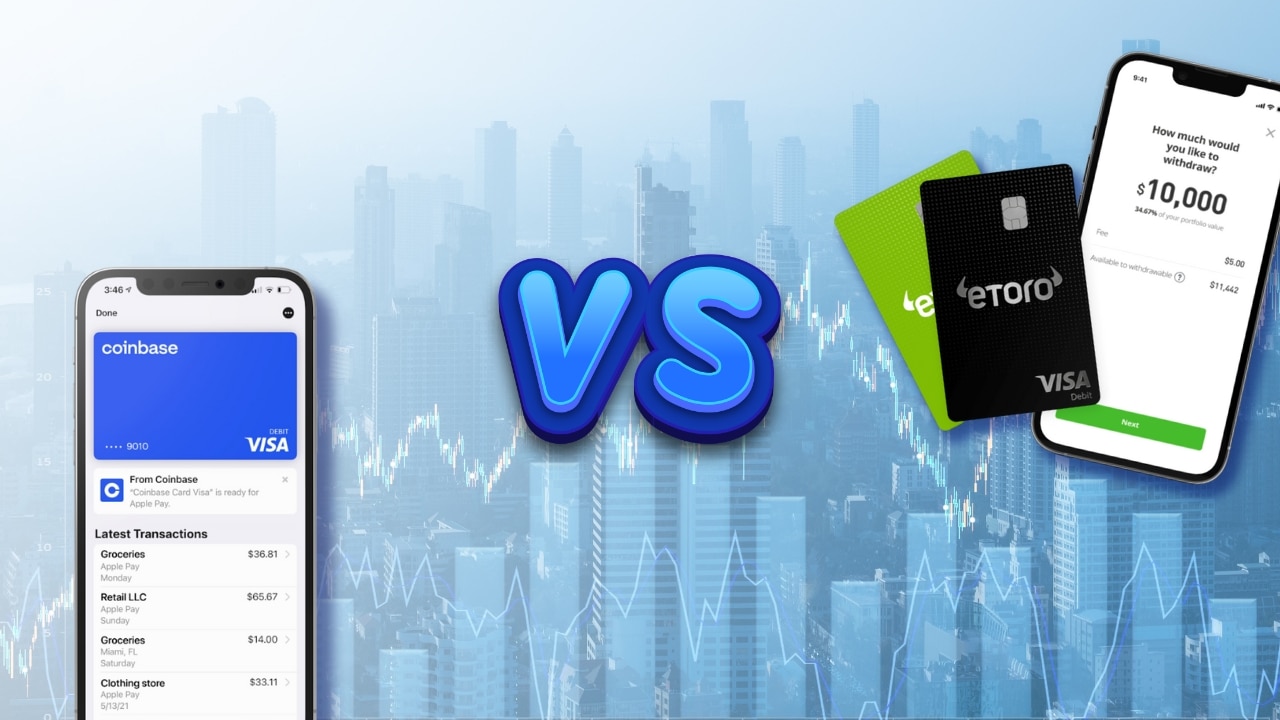
eToro gives you a $100,000 virtual demo account where you can practice trades with fake money before risking anything real. That’s a meaningful advantage if you’ve never placed a trade before and want to get comfortable with order types, position sizing, and how the interface works. Coinbase has no demo account, so your first trade is a real one.
eToro’s CopyTrader also lowers the barrier for beginners who’d rather follow someone experienced than pick every trade themselves. You find a trader whose approach matches your risk tolerance, allocate funds, and their moves are mirrored in your account automatically.
Coinbase takes a different approach with Learn & Earn, which walks you through crypto concepts in short modules and pays small token rewards for completing them. It’s effective at teaching the basics of individual tokens and blockchain ideas, but it doesn’t give you a risk-free environment to practice actual trading.
Geographic availability in the US
eToro became available in all 50 US states as of late 2024, though the US version carries a smaller crypto selection of around 21 coins compared to its international platform. Feature sets also vary by region, so some tools available to European users may not appear in your US account.
Coinbase is available across the US, but some states impose restrictions, particularly on staking. If earning yield on your holdings is part of your strategy, you’ll want to check whether your state allows it on Coinbase before you commit.
Internationally, Coinbase operates in 100+ countries, while eToro is available in 150+ countries. Both platforms adjust their feature sets based on local regulations, so the experience you read about from users in other countries may not match what you see in the US.
Tax reporting tools
Coinbase provides detailed transaction history exports that include staking reward data, which matters if you’re an active trader generating dozens or hundreds of taxable events per year. It also integrates directly with crypto tax software like Koinly and CoinTracker, so you can pull your data into a tax prep tool without manual formatting.
eToro allows CSV exports that are compatible with most tax tools, but it lacks the native integrations Coinbase offers. You’ll need to import the file yourself and may have to map some fields manually depending on which software you use.
Both platforms supply the documents you need for US tax filing. For straightforward portfolios, either one works fine. If you’re juggling frequent trades, staking rewards, and conversions across multiple tokens, Coinbase’s more detailed reporting and direct software integrations save you time.
Customer support
Both eToro and Coinbase offer 24/7 support through live chat and email. Both have also drawn criticism for slow response times, so neither platform has a clear reputation advantage here.
Coinbase offers a subscription called Coinbase One at $30 per month that includes priority customer service, among other perks. If fast responses matter to you and you trade enough to justify the monthly cost, that’s one way to skip the standard queue.
eToro provides help tickets and online support. Phone support availability has been a recurring complaint, and getting a human on the line isn’t always straightforward.
Counterparty risk when holding on an exchange
Any time you leave crypto on a custodial platform, you’re exposed to counterparty risk. If the company faces financial trouble, a security breach, or a regulatory freeze, your access to those assets could be delayed or, in a worst case, lost. Both eToro and Coinbase keep customer funds separate and follow regulatory requirements, but neither fully replaces the protection of holding your own keys in a personal wallet.
Investors with sizable positions often spread assets across multiple exchange accounts and one or more hardware wallets. That approach reduces your exposure to any single platform, so a problem at one doesn’t put your entire portfolio at risk.
Coinbase’s non-custodial wallet option offers a practical middle ground. You can buy on the exchange, then transfer crypto to Coinbase Wallet where you hold the private keys yourself, cutting your exchange-level exposure while staying within Coinbase’s own ecosystem. eToro’s more limited withdrawal support means you have fewer options for moving crypto into self-custody.
Frequently asked questions
Can you transfer crypto between eToro and Coinbase?
Coinbase allows you to send most listed coins to any external wallet address, which means you can transfer crypto directly to an eToro wallet as long as eToro accepts incoming deposits for that particular token. eToro’s withdrawal support is more limited but has expanded through eToro Money. Moving assets in the other direction (from eToro out to Coinbase) depends on whether eToro supports withdrawal for that specific token.
Is Coinbase cheaper than eToro?
It depends on which Coinbase interface you use. On Coinbase Advanced, the maker-taker fees (0% to 0.60%) are typically cheaper per trade than eToro’s flat 1%, especially at higher volumes. But Coinbase’s simple Buy/Sell interface can cost more than 1% on small orders, particularly when you pay by debit card. For buy-and-hold investors making infrequent trades, eToro’s flat rate is predictable. For active traders, Coinbase Advanced is usually the cheaper option.
Do I actually own my crypto on eToro?
eToro holds your assets in custody on your behalf. You can withdraw crypto to a personal wallet in supported regions, but withdrawal options are more restricted than on Coinbase. If full ownership and the ability to move your coins freely are priorities, Coinbase’s non-custodial wallet gives you direct control over your private keys.
Is there a better platform than Coinbase?
That depends on what you need. eToro is stronger if you want multi-asset investing (stocks, ETFs, and crypto in one account) and social trading through CopyTrader. Coinbase is stronger if you want deep crypto selection, on-chain access through a non-custodial wallet, and lower per-trade fees at volume. Neither is objectively better; the right pick depends on your priorities.
Can I use both platforms at the same time?
Yes, and many investors do. A common setup is using Coinbase for crypto depth, staking, and on-chain access, while using eToro for stock and ETF exposure and copy trading. There’s no rule against holding accounts on both, and splitting your activity across platforms can also reduce concentration risk.
Choosing between eToro and Coinbase based on your investing style
If you’re primarily a crypto investor who values broad token selection, DeFi access, and lower per-trade fees as your volume grows, Coinbase is the stronger fit. Its 250+ listed assets, non-custodial wallet, and tiered maker-taker pricing on Coinbase Advanced are built for people who live in the crypto world.
If you want crypto alongside stocks and ETFs in one account, or if CopyTrader appeals to you as a way to invest without managing every position yourself, eToro covers more ground from a single login. Its flat 1% fee is simple to budget around, and the demo account lets you test strategies before committing real money.
Infrequent traders who hold positions for weeks or months may find eToro’s pricing more straightforward. Active traders processing higher monthly volumes will save on Coinbase Advanced’s tiered schedule.
Using both platforms at the same time is a practical approach that plenty of investors take. Run your crypto trading and on-chain activity through Coinbase, and use eToro for diversified equity exposure, social trading, and commission-free stock trades. The AXL Research Hub exchange reviews and comparison guides go deeper into both platforms if you want more detail before opening an account.