

Uniswap is one of the largest decentralized exchanges (DEXs) by trading volume, allowing users to swap crypto tokens directly from their own wallets without handing custody of their funds to a centralized company. Its native token, UNI, has a separate job: it lets holders vote on how the protocol is developed and run.
What is Uniswap (UNI)?
Uniswap is an open-source decentralized exchange (DEX) protocol on the Ethereum blockchain that lets people swap tokens peer-to-peer, with no middleman. UNI is a separate token that holders use to govern the protocol. Since December 2025, part of Uniswap’s fees has gone toward buying UNI and burning it.
On a centralized crypto exchange, an order book matches buyers with sellers. Professional market makers keep prices tight. Uniswap drops both. Smart contracts hold pools of paired tokens, and regular users fund those pools. When you trade, you’re trading against the pool, not waiting for another person to take the other side.
Your coins never leave your control. Every swap runs from your own wallet, and your private keys stay with you the whole time. There’s no Uniswap account balance for anyone to freeze.
Anyone can create a market, too. Because you can set up a liquidity pool for any pair of ERC-20 tokens without paying a listing fee, brand-new tokens often show up on Uniswap first. It’s also why copycat and scam tokens show up there right next to the real ones.
Other apps build on top of Uniswap, which is why people in DeFi call it a “money lego.” Lending apps plug into it. Price data feeds read from its pools. Plenty of wallets and apps also run swaps through Uniswap in the background, so you may have used it without ever visiting the site.
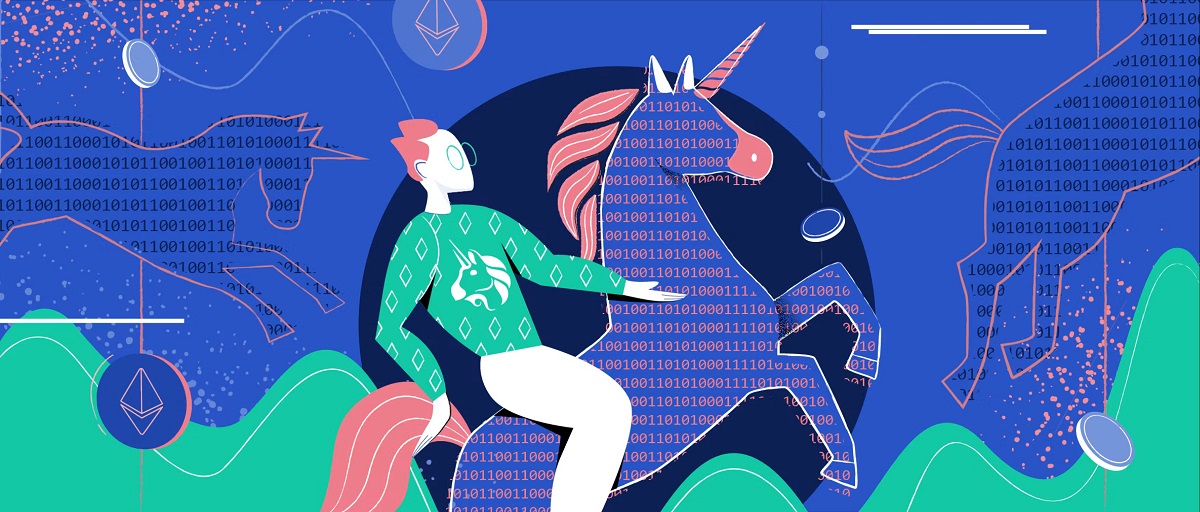
On Ethereum, you can trade Ether (ETH) along with ERC-20 tokens such as Chainlink (LINK), USD Coin (USDC), Tether (USDT), DAI, and Wrapped Bitcoin (WBTC). ERC-20 is Ethereum’s standard for fungible tokens, so any token built to it can get a pool. The unicorn in Uniswap’s logo stands for a transporter that carries you from one token to another.
Keep the two names apart in your head: Uniswap is the exchange you use, while UNI is a token you might hold. You don’t need any UNI to make a swap, because on Ethereum you pay the network fee in ETH and the swap fee comes out of the token you’re trading.
Origin of the Uniswap protocol
Uniswap started as an idea from Ethereum co-founder Vitalik Buterin. In a 2016 Reddit post, he sketched out on-chain exchanges where smart contracts would act as automated market makers. His goal was to shrink the wide spreads you get when you trade thinly traded assets.
Hayden Adams turned that idea into working code. He’d been a mechanical engineer at Siemens before he started studying smart contracts. He built Uniswap with a grant from the Ethereum Foundation, not with venture capital.
Uniswap v1 went live in November 2018 at Devcon, Ethereum’s main developer conference. Investor money came later. As Uniswap Labs grew into a company, the crypto hedge fund Paradigm backed it. By April 2023, all-time trading volume on Uniswap had passed $1.5 trillion.
Uniswap trading volume and adoption metrics
Uniswap handled $1.01 trillion in trading volume in 2025 and $326.7 billion in the first half of 2026. Over that same stretch, its share of all DEX volume grew from 27.6% to 39.7%.
| Metric | 2025 | First half of 2026 |
|---|---|---|
| Trading volume | $1.01 trillion | $326.7 billion |
| Share of all DEX volume | 27.6% | 39.7% |
| Total value locked | $3.96 billion (late 2025) | $4.11 billion (June 30, 2026) |
| Daily active fee-paying addresses | About 355,000 (late 2025) | 235,984 (June 30, 2026) |
The share number tells you more than the raw volume does. Crypto trading cooled off across 2025 and into 2026, so total volume fell. Uniswap took a bigger slice of a smaller pie and ended up with nearly two-fifths of everything traded on decentralized exchanges. Keep in mind that the 2026 figure covers only six months, so it won’t line up neatly against a full year.
Total value locked (TVL) is the money sitting in Uniswap’s pools, and it held up better than trading did. It reached $4.11 billion on June 30, 2026, up from $3.96 billion in late 2025. For you as a trader, TVL is the cushion against slippage. The deeper a pool is, the less a big order pushes the price against you.
Daily active fee-paying addresses went the other way. Uniswap had 235,984 of them on June 30, 2026. That’s down from roughly 355,000 in late 2025 and far below a peak near 1 million. One trader can run several wallets, so treat this as a gauge of on-chain activity rather than a head count.
On the busiest pairs, Uniswap’s liquidity can match or beat the big centralized exchanges. In May 2022, Uniswap v3’s ETH/stablecoin pools had roughly double the liquidity depth of the leading centralized exchanges. On January 23, 2023, the v3 ETH/USDC pools held about $177.1 million (roughly 108,630 ETH) across all 4 fee tiers.
How does Uniswap work?
Uniswap works by having you trade against a pool of two tokens held in a smart contract, not against another person. A formula sets the price from the ratio of the two tokens in the pool. Every trade changes that ratio, so the price moves with each swap.
Uniswap’s classic design runs on two kinds of smart contracts. The Factory contract creates new token pools. The Exchange contract holds a pool’s reserves and carries out the swaps.
This setup is called an automated market maker, or AMM. Nobody matches your order with a buyer or a seller. The contract already holds both assets, so it can quote you a price on the spot.
Constant product formula (x * y = k)
Uniswap prices trades with the equation x * y = k. Here x is the amount of token A in the pool, and y is the amount of token B. Multiply them and you get k, which the pool keeps constant through every trade.
So when you buy token A, you take some of it out of the pool. To keep k the same, you have to put in enough token B to make up the difference. The pool ends up with less A and more B, and A gets more expensive.
Here’s how that plays out in an ETH/USDC pool, with the swap fee left out to keep the math clean:
- The pool starts with 1,000 ETH (x) and 1,000,000 USDC (y).
- Multiply them and k = 1,000,000,000.
- The pool’s implied price is 1 ETH = 1,000 USDC.
- You buy 5 ETH, which leaves 995 ETH in the pool.
- To keep k at 1,000,000,000, the USDC side has to grow to 1,005,025.13, so you deposit 5,025.13 USDC.
You end up paying $1,005.03 per ETH, not the $1,000 the pool showed before you traded. That gap is slippage, and the Uniswap app shows it to you as price impact.
Slippage doesn’t grow in a straight line. A small order barely moves the ratio. An order that’s big compared to the pool shifts it sharply, and each extra ETH costs more than the one before. The same trade is cheaper in a deep pool than in a shallow one. If your price impact looks steep, a smaller order or a deeper pool usually saves you money.
Crypto arbitrage traders keep pool prices in line with the wider market. Say ETH in a Uniswap pool drifts below its price on centralized exchanges. Arbitrage traders buy the cheap ETH out of the pool until the gap closes. If the pool price drifts above the market, they sell ETH into the pool instead. Uniswap never looks up an outside price, because arbitrage does that job for it.
Liquidity pools
The tokens in every pool come from liquidity providers (LPs). These are regular users who deposit both tokens of a pair. Because the pool is always stocked, your trade goes through right away instead of waiting for someone to take the other side.
When you deposit, you get liquidity provider (LP) tokens back. Think of them as a receipt for your share of the pool. You can redeem them at any time for your portion of the underlying tokens, plus the fees you’ve earned.
Those fees come from traders. On Uniswap v1 and v2, every swap paid a 0.3% fee. That fee was split among LPs based on how much liquidity each one supplied.
Uniswap v3 added four fee tiers: 0.01%, 0.05%, 0.3%, and 1%. Stablecoin pairs like USDT/USDC usually sit in the lowest tiers because their prices barely move against each other. Exotic token pairs tend to use the 1% tier, which pays LPs more for the extra risk. Since December 2025, the protocol also keeps a portion of swap fees, so LPs no longer collect all of it.
The receipt itself changed between versions. In v2, LP tokens were standard ERC-20 tokens, and every share of a pool was interchangeable. You could post them as collateral on lending protocols like Aave or MakerDAO. In v3, each LP picks a custom price range, so no two positions are alike. That’s why v3 positions are NFTs. You get more control over where your money works, but you give up that easy, fungible receipt.
Impermanent loss
Impermanent loss is the gap between what your tokens are worth inside a pool and what they’d be worth if you’d simply held them in your wallet. It shows up when the price ratio between the two tokens drifts away from where it stood when you deposited.
Arbitrage is what causes it. When one token rises, arbitrage traders buy it out of the pool at the old, cheaper price and pay with the other token. Your share of the pool ends up holding less of the token that went up and more of the one that didn’t.
Here’s a simple ETH/USDT example. You deposit 1 ETH and 100 USDT when 1 ETH = 100 USDT. The pool then holds 10 ETH and 1,000 USDT, so k = 10,000, and you own 10% of it.
| Moment | Pool holds | Your 10% share | Value if you’d just held |
|---|---|---|---|
| At deposit (1 ETH = 100 USDT) | 10 ETH and 1,000 USDT | 1 ETH and 100 USDT, worth $200 | $200 |
| After ETH rises to 400 USDT | 5 ETH and 2,000 USDT | 0.5 ETH and 200 USDT, worth 400 USDT | 500 USDT |
Arbitrage moved the pool to 5 ETH and 2,000 USDT, which still multiplies out to 10,000. Your withdrawal is worth 400 USDT. The same coins sitting in your wallet would be worth 500 USDT.
The word “impermanent” is accurate, but only under certain conditions. If prices return to your entry ratio before you withdraw, the loss disappears. Trading fees can also make up for it if they add up to more than the gap. Withdraw while prices are still apart and before fees have caught up, and the loss becomes permanent.
Evolution from Uniswap v1 to v4
Each version fixed a specific problem in the one before it. For everyday traders, the biggest jumps were v2’s direct token pairs and v4’s lower gas costs. v3 mattered most to liquidity providers.
| Version | Launch | Pricing model | Fee tiers | Token weights | What it added |
|---|---|---|---|---|---|
| v1 | November 2018 | x * y = k across the full price range | 0.30% | Equal 50/50 | ETH-to-ERC-20 swaps, with ETH as the bridge for every token-to-token trade |
| v2 | May to August 2020 | x * y = k across the full price range | 0.30% | Equal 50/50 | Direct ERC-20-to-ERC-20 pools, on-chain price oracles, flash swaps |
| v3 | May 2021 | Concentrated liquidity in custom price ranges | 0.01%, 0.05%, 0.30%, 1% | Non-equal | LP positions as NFTs, TWAP oracles covering the past 9 days |
| v4 | January 2025, after Ethereum’s Dencun upgrade | Concentrated liquidity with customizable hooks | Dynamic | Non-equal | Singleton contract, cheaper native ETH handling, on-chain limit orders, custom oracles |
The ETH bridge was v1’s biggest limit. Swapping one ERC-20 token for another meant two trades under the hood: token to ETH, then ETH to the other token.
v2 fixed that with direct ERC-20 pairs. It also added on-chain price oracles that other apps could read. Then there were flash swaps. A flash swap lets you borrow ERC-20 tokens with no collateral, as long as you pay them back within the same transaction.
Before v3, your deposit was spread across every possible price from zero to infinity, so most of it sat idle, which made v3 the big shift for liquidity providers. With concentrated liquidity, you pick a price band, and your money works only inside that band. You earn more fees per dollar while the price stays in range. The trade-off is that you now have a position to manage. v3 also brought time-weighted average price (TWAP) oracles, which can serve price data from the past 9 days.
v4 rebuilt the plumbing. Instead of a separate contract for each pool, it keeps every pool inside one singleton contract. That cuts gas costs, including the cost of handling native ETH. Hooks are add-on smart contracts that a pool creator can attach to change how a pool behaves. They’re what make dynamic fees, on-chain limit orders, and custom oracles possible.
Supported blockchains
Uniswap’s contracts run on Ethereum and on a long list of EVM-compatible networks. The point was to get around Ethereum mainnet’s high gas fees and limited throughput. Supported networks include:
- Ethereum
- Arbitrum
- Polygon
- Optimism
- BNB Smart Chain (BSC)
- Avalanche (AVAX)
- Celo
- Base (deployed August 2023)
- Unichain (launched February 2025)
Each network has its own separate pools, and they don’t talk to each other. A pool on Arbitrum shares no liquidity with a pool on Ethereum. Before you swap, check that your wallet is on the network where your tokens actually sit. Expect prices and pool depth to differ from one chain to the next.
Unichain is Uniswap’s own Layer 2 network. It launched in February 2025 on the OP Stack, which places it in the Optimism Superchain next to Base and Ink. Uniswap built it for faster settlement and cheaper trades.
Adoption has been modest so far, at least next to the liquidity on Ethereum mainnet and the major Layer 2 rollups. On June 30, 2026, Unichain had $246.7 million in total value locked and 2,345 daily active addresses. Over the first half of 2026, it averaged 3,569 daily active addresses. The network generated $115,253 in fees across those six months.
What is the UNI token used for?
UNI gives holders a vote on how Uniswap runs, from protocol upgrades and new fee tiers to treasury grants. Since the December 2025 UNIfication upgrade, it’s also tied to protocol fees. Part of those fees now goes toward buying UNI on the open market and burning it.
Uniswap launched UNI in September 2020. The goal was to spread ownership of the protocol among its users and reward the people who’d shown up early. Every Ethereum address that had used Uniswap’s smart contracts before launch could claim 400 UNI in a retroactive airdrop.
Protocol governance
UNI holders can propose changes and vote on them on-chain. Votes cover protocol upgrades, new fee tiers, treasury grants, and the rules of governance itself.
Most holders don’t vote directly. They delegate their voting weight to active community delegates who vote for them. That keeps governance moving. In practice, though, it puts most decisions in the hands of big holders and popular delegates. If you hold a small amount of UNI, your real lever is picking a delegate whose positions you agree with.
The genesis supply was 1 billion UNI, handed out over a four-year vesting and issuance schedule.
| Group | Share of initial supply | Details |
|---|---|---|
| Community members | 60% | Retroactive user airdrops and liquidity mining on the ETH/USDT, ETH/USDC, ETH/DAI, and ETH/WBTC pools |
| Team and founders | 21.51% | 4-year vesting |
| Investors and community development/education | 17.8% | Investor allocation plus development and educational initiatives |
| Advisors | 0.69% | 4-year vesting |
The UNIfication fee burn
From 2020 through 2025, every cent of Uniswap’s swap fees went to liquidity providers. The protocol kept nothing. That changed in December 2025, when the UNIfication governance proposal switched on the protocol fee.
Now the protocol keeps a cut of swap fees. It uses that money to buy UNI on the open market and burn it, and burned tokens are gone for good. This links trading volume directly to UNI’s supply. More trading brings in more fees, and more fees mean more UNI gets bought and burned.
The proposal changed more than the fee switch. It burned 100 million UNI straight from the treasury. It folded the Uniswap Foundation teams into Uniswap Labs. It also removed the separate interface, wallet, and API fees that Uniswap Labs had been charging. If you trade through Uniswap’s own app, you no longer pay that extra layer on top of the swap fee.
The early numbers show real revenue, though not much of it yet. Uniswap users paid $258.5 million in fees in the first half of 2026. The protocol kept $23.65 million of that. Of that amount, $12.92 million came in the second quarter alone. Through most of 2025, the protocol’s share was $0.
The token price hasn’t followed revenue up. UNI fell 58.6% in 2025 and another 50.6% in the first half of 2026. Its circulating market cap stood at $1.73 billion at the end of June 2026. A fee-funded buyback doesn’t guarantee a rising price, and the first half of 2026 made that plain.
How to swap tokens on Uniswap
A Uniswap swap is usually over in a few minutes. Most costly mistakes happen before you ever confirm a trade: a fake website, the wrong network, or a copycat token. Take your time on the first three steps.
- Open the official Uniswap web app. Type the address yourself or use a saved bookmark. Search ads and lookalike sites are a common phishing trap. Before you trade, the Explore tab shows you live pool liquidity, token price charts, and recent transactions.
- Connect a self-custody wallet. MetaMask, Coinbase Wallet, Trust Wallet, and any WalletConnect-enabled wallet all work. You won’t register an account or go through KYC.
- Pick your tokens. Choose the token you’re selling and the one you’re buying. If the token isn’t well known, confirm its contract address so you don’t end up with a copy that shares the same name.
- Read the transaction preview. The pop-up shows the quoted exchange rate, the price impact, and the network gas fee in ETH. If the price impact looks high, try a smaller amount.
- Approve and sign in your wallet. Your wallet asks you to confirm and sign the transaction. The first time you sell a given token, you’ll usually approve it in a separate step before the swap itself.
- Check that it went through. For a swap on Ethereum, you can look up the transaction on the blockchain explorer Etherscan. The tokens you bought land directly in your wallet.
Providing liquidity starts from the Pool page instead. Click “+ New Position,” choose your pair, pick a fee tier, and set a price range. Your position shows up in your wallet as an NFT. The same preview, sign, and verify routine applies.
Strengths of the Uniswap protocol
In our view, self-custody is the strength that matters most, because you feel it when things go wrong. You hold your private keys the whole time. No exchange can freeze your assets. And there’s no company holding customer deposits that could collapse the way FTX did.
Uniswap is also open to any token. Anyone can create a market for a new ERC-20 token right away, with no gatekeeper and no listing fee. Nobody can block a token from trading, which is what people mean when they call it censorship resistant.
The code is public. Uniswap’s smart contracts are open source on GitHub, so anyone can check them. The core contracts have run continuously from November 2018 into 2026 without a single failure.
UNI has had a buy-and-burn mechanism since December 2025. Retained protocol fees buy UNI off the market and destroy it, which takes those tokens out of supply for good.
Risks of trading on Uniswap
Most of Uniswap’s risks come from the same freedom that makes it useful. Nobody screens the tokens, and nobody can undo your mistakes.
- No token vetting. Anyone can list a token, including scams, counterfeits, and worthless coins named after real projects. Check the contract address against the project’s official channels before you buy.
- Self-custody mistakes are permanent. Lose your seed phrase and nobody can recover your wallet. Send tokens to the wrong address and they’re gone, with no support desk to call.
- LPs carry impermanent loss. A sharp price move can leave you with less than you’d have by just holding. In v3, the price can also leave your range, so you’ll need to watch your position and adjust it.
- Ethereum gas can swallow small trades. When mainnet gets congested, gas fees can wipe out the point of a small swap. For massive institutional orders, centralized order books still give better execution.
Competition never lets up either. Rival decentralized exchanges like PancakeSwap, Curve, SushiSwap, and Raydium all chase the same traders and liquidity providers.
The legal picture is better than it was, but it isn’t settled. The US Securities and Exchange Commission (SEC) closed its investigation into Uniswap Labs in February 2025 without taking enforcement action. Regulators still haven’t said how they’ll treat protocol fee revenue. That question carries more weight now that Uniswap keeps a share of fees.
Frequently asked questions about Uniswap
Can I use Uniswap in the USA?
Yes. Uniswap is a permissionless smart contract protocol, and anyone with an Ethereum wallet can use it. You won’t register an account tied to your location. In February 2025, the SEC ended its investigation of Uniswap Labs and brought no enforcement action. How US rules will treat DeFi fee revenue is still an open question.
Can I withdraw money from Uniswap?
If you’re trading, there’s nothing to withdraw. You never deposit funds into a Uniswap account, because every swap settles straight from your wallet and back into it.
How do liquidity providers get their money out?
Liquidity providers redeem their LP tokens, which they can do at any time. The pool sends the underlying crypto and any trading fees they’ve earned back to their wallet.
Which trading pairs is UNI usually listed in?
On exchanges, UNI commonly trades as UNI/USDT, UNI/USDC, UNI/BTC, and UNI/EUR. You can also swap for UNI on Uniswap itself, just like any other ERC-20 token.
Evaluating Uniswap the exchange versus UNI the token
Using Uniswap and owning UNI are two separate decisions. Using Uniswap means getting a trade done from your own wallet. Holding UNI means betting on governance and the fee burn. You can do either one without the other.
As an exchange, Uniswap has a strong record. The automated market maker model has run since 2018. By mid-2026 it was capturing nearly two-fifths of all DEX volume, and it never took custody of anyone’s funds.
As a token, the numbers are smaller than the headlines suggest. The protocol kept $23.65 million in the first half of 2026, while UNI’s market cap sat at $1.73 billion. The fee burn gives UNI a link to real revenue that it lacked before December 2025. Next to the token’s valuation, though, that revenue is still small.