
On TRON, a decentralized, open-source blockchain, most transfers cost little or nothing, and the native coin is TRX. As of May 2025, it handled an average of 8.3 million transactions a day, but that speed comes with trade-offs you should know about before you buy.
What is TRON crypto?
TRON is a decentralized, open-source blockchain protocol that started out as a global infrastructure for digital entertainment and content sharing. The goal was to cut out the middlemen, so creators could distribute their work and get paid directly by the people who enjoy it. Today it runs fast smart contracts and decentralized apps (dApps), with TRX as its native coin.
That original pitch explains the unusual mix under the hood. TRON pairs peer-to-peer file sharing with a high-throughput smart contract engine. Developers use that engine to build dApps on top of the network.
Who’s in charge has changed too. The project began under the TRON Foundation, a non-profit based in Singapore. Governance has since moved to TRON DAO, a decentralized autonomous organization run by its community.
The network has grown fast. In March 2022, the public chain counted over 81 million users. By May 2025, TRON had passed 350 million user accounts.
Who founded TRON?
Justin Sun founded TRON. He’s a Chinese entrepreneur who was Ripple’s chief representative in Asia in 2013 and a protégé of Alibaba founder Jack Ma. Sun set up the non-profit TRON Foundation in Singapore in July 2017, two months before the project officially launched in September 2017.
Money came from a 2017 initial coin offering (ICO) that raised over $70 million. The timing was tight. The sale wrapped up shortly before China banned digital token sales.
TRX didn’t start on its own blockchain. It began as an ERC-20 token on Ethereum. In March 2018, the team released a blockchain explorer, a testnet, and a web wallet. The Odyssey 2.0 mainnet followed in May 2018. In June 2018, TRON migrated off Ethereum onto its own independent peer-to-peer mainnet, starting from what’s called the Genesis block.
The biggest early move was buying BitTorrent, the peer-to-peer file-sharing platform, in July 2018, a deal that fit TRON’s content-sharing story neatly. Just a month later, in August 2018, BitTorrent founder Bram Cohen left and went on to found Chia. By February 2019, a BitTorrent token sale was running on TRON.
Investors were paying attention. TRON’s market capitalization was roughly $1.6 billion in January 2019. On March 10, 2019, it stood at over $1.5 billion, which made it the 10th largest cryptocurrency.
TRX also picked up legal recognition in one country. The Commonwealth of Dominica made TRX an authorized digital currency and medium of exchange, effective October 7, 2022.
For US readers, the most practical milestone came in May 2025. A partnership with MoonPay let people in the United States buy TRX directly with US dollars.
The six-phase TRON development roadmap
TRON’s long-term plan runs in six named phases, and the later ones drift a long way from file sharing toward on-chain gaming. Read each phase as a stated goal. A phase name on a roadmap doesn’t prove the feature shipped the way it was described.
- Exodus (August 2017 to December 2018): built the core peer-to-peer setup for decentralized file storage and content distribution.
- Odyssey (January 2019 to June 2020): added token-based economic incentives, including tipping, so creators could earn from their audience.
- Great Voyage (July 2020 to July 2021): gave creators the tools to launch their own ICOs and issue personal branded tokens.
- Apollo (August 2021 to March 2023): set up a standard, decentralized way for individual content producers to issue tokens.
- Star Trek (April 2023 to September 2025): focused on building a decentralized gaming and prediction market platform on-chain.
- Eternity (September 2025 to September 2027): aims to scale and monetize decentralized gaming through community-led funding tools.
Don’t mix up the Odyssey phase with the Odyssey 2.0 mainnet software from May 2018. They share a name, but they’re different things. By the roadmap’s own dates, Eternity runs through September 2027.
How does TRON crypto work?
TRON splits its network into three layers, so data storage, consensus, and app logic don’t slow each other down. A small group of elected validators produces the blocks. Instead of paying a gas fee on every transaction, users spend account-based resources that often make transfers free.
TRON’s protocol messages follow Google Protobuf (Protocol Buffers), a format for packing structured data. Protobuf works across many programming languages. That means developers can connect to TRON from whatever language they already use.
The chain was built for volume, with each block able to hold up to 2 MB. TRON’s whitepaper set a baseline of 2,000 transactions per second (TPS), while throughput on the public chain can reach up to 10,000 TPS.
Three-layer blockchain architecture
TRON divides its work among a Core Layer, a Storage Layer, and an Application Layer. Each layer has its own job. A traffic spike in one area doesn’t have to jam the others.
The Core Layer is where transactions actually get processed. It runs smart contracts and manages accounts. It also holds the Delegated Proof-of-Stake consensus module and the wallet API that wallets use to talk to the chain.
The Storage Layer keeps block data and the network’s current state. It relies on a distributed storage protocol. That’s how TRON absorbs heavy traffic without the network getting congested.
The Application Layer is the part developers work with. It offers developer APIs, the hosted TRONGrid tools, and the TRON Studio IDE. With these, developers deploy custom wallets and dApps written in Solidity or Java. Solidity support matters because Ethereum developers already know it.
Delegated Proof-of-Stake consensus
TRON doesn’t use crypto mining. Its Delegated Proof-of-Stake (DPoS) system replaces energy-hungry Proof-of-Work with elections. Token holders vote, and the winners run the network.
To vote, you freeze TRX. Freezing locks your coins and gives you TRON Power, which is your voting weight. The more TRX you freeze, the more say you get. Wallets such as TronWallet and Klever.io let you cast those votes.
The top 27 vote-getters become Super Representatives (SRs). They rotate every six hours. While they’re on duty, they validate transactions, package them into blocks, and vote on proposals that change network parameters.
Candidates ranked 28th through 127th become Super Partners. That’s 100 runners-up who don’t produce blocks. They still earn rewards in proportion to their share of the vote.
A new block lands every three seconds. The SR who produces it earns 32 TRX. Confirmations weren’t always this quick. Before the TRON 4.0 upgrade brought in a two-layer consensus design, average confirmation time was 57 seconds.
The catch is concentration. With only 27 block producers, a small group decides what goes on-chain. That’s the main reason critics call TRON less decentralized than networks with much larger validator sets.
TRON Virtual Machine
The TRON Virtual Machine (TVM) is the engine that runs smart contracts on TRON. It’s Turing-complete, so it can run any program logic a developer writes. It was originally forked from the Ethereum Virtual Machine (EVM), and it stays fully compatible with Ethereum smart contracts.
Fees are where TRON really parts ways with Ethereum. There’s no global gas market. Each account gets its own resources instead, called bandwidth points and energy. This setup keeps standard transfers free. It also guards against Denial-of-Service (DoS) attacks, since anyone spamming the network drains their own account’s resources first.
Bandwidth pays for the raw data bytes in a transaction. Every account gets 5,000 free bandwidth points every 24 hours. Those points don’t carry over. If you skip a day, that day’s allowance is simply gone, so you can’t save up for a busy day later.
Energy comes into play when you touch a smart contract. Anything that runs on the TVM uses energy on top of bandwidth. Sending a TRC-20 token like USDT counts, because the token lives inside a contract.
When your resources run low, you’ve got two choices:
- Freeze TRX for at least three days to generate extra bandwidth or extra energy. Each freeze produces one resource type at a time, so you pick the one you need.
- Do nothing and let the network automatically burn TRX from your account to cover the cost.
This has a practical consequence if you hold stablecoins on TRON. Keep some TRX in the same wallet. Without it, a USDT transfer has no energy and nothing for the network to burn, so the transfer can’t go through. Freezing has its own cost, too. Your coins stay locked for at least three days, and you can’t sell them during that time if the price drops.
What is the TRX (Tronix) token?
TRX, short for Tronix, is the native utility coin of the TRON mainnet. It’s the network’s basic unit of account and the base medium of exchange for every TRC token. You use it to pay for network resources, to vote for validators, and at some merchants, to pay for things.
In day-to-day use, TRX does four jobs. It pays smart contract fees once your energy or bandwidth runs out. It tips content creators. When you freeze it, it becomes TRON Power for voting. And merchants such as SpendCard, Bitnovo, and Travala accept it as payment.
TRON issued 100 billion TRX at launch. The maximum supply on record is 100,850,743,812 TRX. Here’s how the launch supply was divided:
| Recipient | TRX allocated |
|---|---|
| ICO buyers | 40 billion |
| TRON Foundation | 34 billion |
| Private auction | 15.75 billion |
| Justin Sun’s company | 10 billion |
Put the foundation and Sun’s company together and they received more TRX than ICO buyers did. Large insider holdings matter to you as a buyer. When big holders sell, they can push the price down.
In 2022, about 71% of the maximum supply was in circulation. TRX ranked 22nd by crypto market capitalization that year.
You can’t mine TRX. TRON has no Proof-of-Work, so mining hardware has nothing to do here. New coins enter circulation through DPoS block rewards and incentives for providing storage. If anyone offers you a TRX mining rig or mining contract, treat it as a red flag.
TRON token standards
TRON supports three token standards: TRC-10, TRC-20, and TRC-721. A token’s standard decides how it works and what resources it uses when you move it.
TRC-10 is the native standard. It lets anyone create a basic token right on the TRON mainnet, with no need for the TRON Virtual Machine. Since no smart contract runs, a TRC-10 transfer doesn’t use energy.
TRC-20 is the smart contract standard, built to mirror Ethereum’s ERC-20. It covers fungible tokens, where every unit is interchangeable. The biggest tokens on TRON use it, including Tether (USDT), USD Coin (USDC), USDD, BitTorrent (BTT), and JUST (JST).
This is where people make costly mistakes. Many exchanges let you withdraw USDT over several networks. If you’re sending to a TRON address, pick the TRC-20 option. Choosing a different network, like ERC-20, can strand your funds where they’re hard or impossible to recover.
TRC-721 handles non-fungible tokens (NFTs), where each token is one of a kind. It’s the standard behind digital collectibles on TRON.
The TRON ecosystem and Sun Network
Sun Network is TRON’s expansion layer for apps that need extra room. It includes DAppChain, a set of sidechains that run on DPoS consensus. dApps on DAppChain use less energy while keeping high security.
TRONScan is the official block explorer, and it’s the tool you’ll likely use most. Paste in a wallet address and you’ll see its balance. You can also look up smart contracts, follow Super Representative votes, and read API maintenance updates. If a transfer looks stuck, check TRONScan first to see whether it actually went through.
TRON’s decentralized finance (DeFi) apps cover the basics. JustSwap and SunSwap are exchange protocols built on liquidity pools, so you trade against pooled funds instead of waiting for a matching buyer. PoloniDEX is a fee-free exchange. For borrowing and lending, there’s JustLend, and the Sun staking initiative rounds out the lineup.
Gaming apps lean on TRON’s ability to handle lots of activity at once. WINk, formerly TronBet, offers poker, dice, and slots. Players who stake TRX and LIVE can earn dividends. Tron Legend is an MMORPG whose game mechanics run on smart contracts. Gambling dApps carry the usual casino risk, plus the risk of a buggy contract.
How TRON compares to Ethereum
TRON gets its speed and low fees by limiting block production to 27 validators. Ethereum spreads validation much more widely.
| Feature | TRON | Ethereum |
|---|---|---|
| Consensus | Delegated Proof-of-Stake with 27 rotating Super Representatives | Proof-of-Stake (Proof-of-Work earlier), no 27-delegate cap |
| Base-layer throughput | 2,000 TPS whitepaper baseline, up to 10,000 TPS on the public chain | Lower than TRON |
| Fee model | 5,000 free daily bandwidth points plus frozen TRX for energy (near-zero fees) | Gas fees paid per transaction across the global network |
| Virtual machine | TRON Virtual Machine (TVM) | Ethereum Virtual Machine (EVM) |
| Smart contract languages | Solidity and Java | Solidity |
| Main token standard | TRC-20 (plus TRC-10 and TRC-721) | ERC-20 |
| Design priority | Speed and low fees | Broader validator decentralization |
The two chains share more than they differ in code. Academic researchers have described TRON as an Ethereum clone, pointing to the Solidity and EVM foundations the two share.
For developers, that shared base pays off. A Solidity contract written for Ethereum can move onto the TVM with minimal code changes.
For you as a user, it’s a question of priorities. TRON’s small validator set makes transfers fast and nearly free. Ethereum’s broader validator set costs more per transaction, but it doesn’t put block production in the hands of 27 operators.
Criticisms and legal challenges
TRON’s history includes plagiarism claims, a serious security bug, a stablecoin depeg, and an SEC lawsuit. None of these automatically rules the network out. You should still know them before you put money in.
Whitepaper and code-copying allegations
In January 2018, Protocol Labs CEO Juan Benet showed that TRON’s whitepaper contained uncredited text from IPFSbot and MineFilecoin. Justin Sun blamed translation errors made by volunteers.
Digital Asset Research (DAR) then looked at the code itself and found copied code. DAR also alleged violations of the GNU Lesser General Public License v3.0 (LGPL). The issue was that TRON hadn’t credited EthereumJ, a Java-based client. The TRON Foundation denied the claims.
Security and stability problems
In May 2019, a disclosure on HackerOne revealed a critical bug. A single computer sending a barrage of requests could exhaust the blockchain’s CPU and memory. That was enough to halt the network through a DDoS attack.
USDD, TRON’s algorithmic stablecoin, launched in April 2022. On June 13, 2022, during a broad crypto sell-off, it slipped off its dollar peg and fell to $0.91. An algorithmic stablecoin relies on code and market incentives to hold its price. When the whole market panics, those incentives can break down fast. If you hold stablecoins on TRON, check which kind you’re holding, because USDD isn’t built the same way as USDT or USDC.
The SEC case
In March 2023, the US Securities and Exchange Commission (SEC) sued Justin Sun and TRON, alleging unregistered securities sales of TRX and BTT. The SEC also alleged wash trading across accounts Sun controlled, which generated $31 million in proceeds. Wash trading means trading with yourself to fake market activity.
The SEC also charged eight celebrities over paid promotions they didn’t disclose. Among them were Akon, Ne-Yo, Austin Mahone, and Soulja Boy. Everyone except Soulja Boy and Mahone settled, paying over $400,000 without admitting or denying the findings.
The takeaway for a buyer is simple. TRX is a high-risk asset with real regulatory baggage, so size any purchase so that a sharp drop wouldn’t hurt you.
How to buy TRX
Buying TRX is quick on most major platforms. The step that matters most comes after the purchase, when you move your coins to a wallet you control.
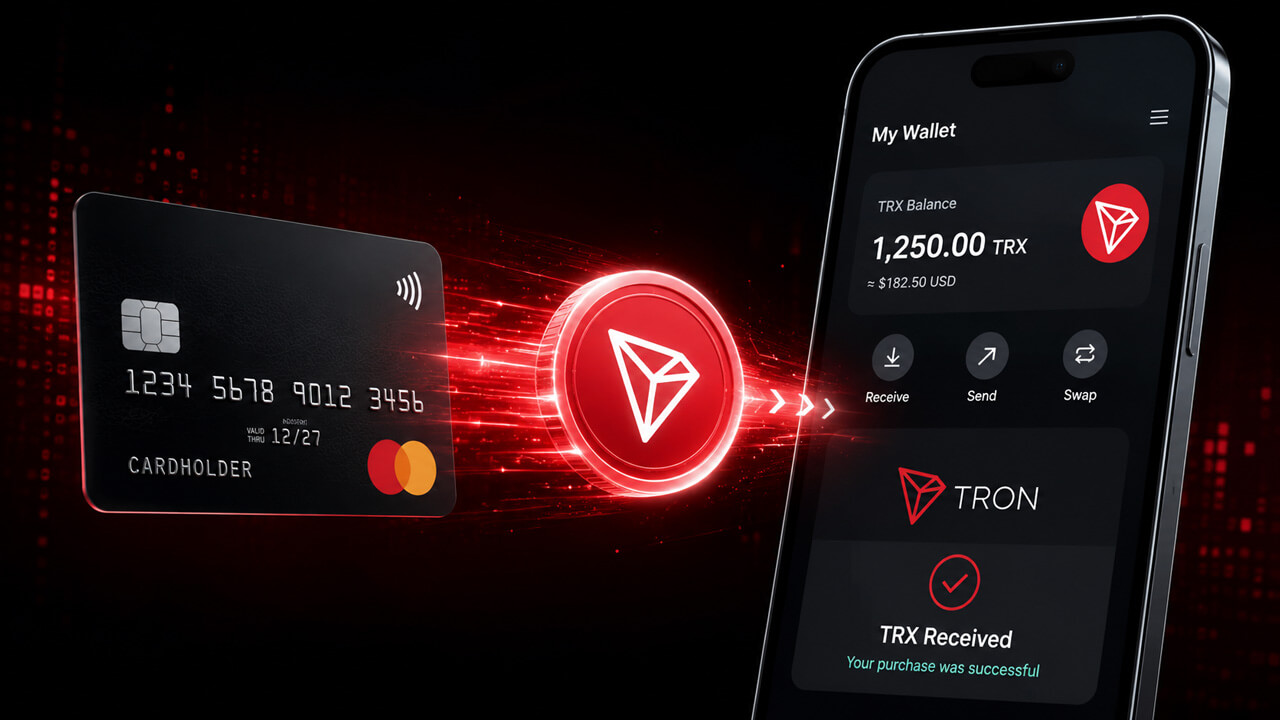
- Pick a platform that lists TRX. Binance, HTX (formerly Huobi), OKX, and Poloniex all offer TRX trading pairs. In the US, MoonPay lets you buy TRX directly with dollars, thanks to its May 2025 partnership with TRON. Not every crypto exchange platform serves every US state, so confirm yours is covered before you sign up.
- Create an account and verify your identity. Expect standard know-your-customer (KYC) checks. Most platforms ask for a government ID and basic personal details before you can trade.
- Fund your account. You can pay by bank transfer, debit or credit card, or a crypto deposit. Card purchases often cost more in fees than bank transfers, so compare before you pay.
- Place your buy order. Use the exchange’s TRX spot market, or the direct purchase page if the platform has one.
- Move your TRX to your own wallet. Options include TronWallet, Klever.io, the TRON Web Wallet, and hardware wallets. For larger amounts, a hardware wallet keeps your keys offline. When you withdraw, pick the TRON network so your coins land in the right place.
Once your TRX sits in TronWallet or Klever.io, you can freeze it for TRON Power and vote. If you plan to send TRC-20 tokens, leave a little TRX unfrozen or freeze some for energy, so your transfers have something to draw on.
Core takeaways on the TRON network
Our read is that TRON works best as a practical rail for moving TRC-20 stablecoins and using dApps at near-zero cost. If that’s your main need, it does the job well. Just keep some TRX around for energy and double-check the network every time you withdraw.
As an investment, TRX asks you to accept real trade-offs. Fast finality and low fees come from a 27-validator design that concentrates control. On top of that, the SEC case and the USDD depeg show how quickly regulators and markets can turn against the network.