
Robinhood folds crypto into an account that also holds stocks, ETFs, and options, while Coinbase stays crypto-only and lists 260-plus coins against Robinhood’s 15-plus. The choice usually turns on how many coins you want access to, what you pay in spreads versus a published fee schedule, and whether one login for everything matters more than depth.
Robinhood vs Coinbase: which platform wins for crypto in 2026?
Robinhood entered the market in 2013 with commission-free stock trading and eventually folded crypto into its multi-asset lineup, while Coinbase got its start a year earlier, in 2012, building a crypto-first exchange that now lists more coins than any other U.S. platform. The table below puts their core differences side by side.
| Category | Robinhood | Coinbase |
|---|---|---|
| Founded | 2013 | 2012 |
| Primary focus | Stocks, ETFs, options, and crypto | Crypto-only exchange |
| Supported cryptocurrencies | 15+ | 260+ |
| Fee model | No listed commission; cost embedded in spreads | 0% to 0.60% depending on volume and tier |
| Premium subscription | Robinhood Gold, $5/month (includes $1,000 margin allowance) | Coinbase One, $29.99/month |
| Passive income | Staking on ETH, SOL, ADA; USDG lending | Staking on multiple tokens; USDC interest; Learn-and-Earn |
| Self-custody wallet | Transfers supported through the main app | Dedicated Coinbase Wallet app with private-key control |
| Customer support | 24/7 in-app and phone | Help center and email; priority support for Coinbase One subscribers |
Robinhood suits investors who want stocks, ETFs, options, and crypto under one roof. If you’re focused exclusively on cryptocurrency and want access to staking, earn programs, and a self-custody wallet, Coinbase covers more ground, and our Coinbase withdrawal guide shows how easily funds move off the platform.
Fees and trading costs compared
Neither platform makes it easy to know your exact cost before you look at the confirmation screen, but the way each one charges you is fundamentally different.
Coinbase shows a visible fee on every transaction. On its standard tier, small orders carry fixed fees between $0.99 and $2.99, plus a quoted spread you can see before confirming. Coinbase Advanced drops the fixed fee in favor of a maker-taker model ranging from 0% to 0.60% based on your 30-day trading volume. That tiered structure rewards frequent or high-volume traders with progressively lower costs per trade.
Robinhood labels its crypto trades as commission-free, but the cost shows up in the bid-ask spread baked into the execution price. On high-liquidity coins like BTC, that spread tends to be narrow. On lesser-known tokens, it widens noticeably. The practical effect is that you pay more on small-cap altcoins than the “$0 commission” label suggests.
For a concrete example: an independent comparison from July 2026 found that a $100 ETH purchase on Robinhood delivered 0.005075 ETH, while the same $100 on Coinbase standard delivered 0.004980 ETH. That’s a 1.87% difference in the buyer’s favor on Robinhood for that particular trade. Small BTC buys tend to follow the same pattern, where Robinhood’s spread model often results in a lower effective cost than Coinbase’s standard fixed fees.
The picture flips for active traders working with diverse altcoins. Coinbase Advanced’s tiered pricing can undercut Robinhood’s wider spreads on lower-liquidity tokens, especially once your monthly volume pushes you into the lower fee brackets.
Robinhood also supplements its revenue through payment for order flow, a practice where it routes orders to market makers in exchange for compensation. This doesn’t cost you an explicit fee, but it can reduce price-improvement transparency, meaning you may not always get the best available market price.
The most reliable way to compare costs on any given trade is to check the final quoted price on the confirmation screen against a live market-reference price from an aggregator like CoinGecko or CoinMarketCap. Do this on both platforms before confirming, and you’ll see the true effective cost for that specific coin, trade size, and moment.
On margin rates, Robinhood charges 2.50% while Coinbase charges a fixed 8.00%. If you’re borrowing to trade, that gap matters.
Supported cryptocurrencies and asset classes
Coinbase lists over 260 tradable cryptocurrencies and stablecoins, covering everything from major tokens like BTC and ETH to a wide range of altcoins. If you’re looking to buy into newer projects or niche tokens, Coinbase is almost certainly the only option between the two that will have them listed.
Robinhood’s crypto selection is far more limited at 15+ coins. The lineup includes BTC, ETH, DOGE, SHIB, AVAX, LTC, UNI, ETC, LINK, XLM, and AAVE, among others. For most people buying mainstream crypto, that list covers the big names. But if you want to explore beyond the top tier, you’ll hit a wall quickly.
Where Robinhood pulls ahead is asset variety outside of crypto. It’s the only platform of the two that offers stocks, ETFs, options, and IPO access. Fractional share buying starts at $1, so you can spread a small portfolio across multiple asset classes without needing thousands of dollars. Coinbase remains crypto-only, with no stock or ETF trading available.
The decision here is straightforward. If you want exposure to a broad altcoin universe, you need Coinbase. If you want a single dashboard for stocks and crypto together, Robinhood is it.
Security and regulatory standing
Both platforms take security seriously, but they approach custody and regulation from different angles that reflect their origins.
Coinbase stores customer assets 1:1 in offline cold storage, meaning every dollar of crypto customers hold is backed by an equivalent amount in cold wallets. Two-step verification is standard, and the platform carries insurance on its digital assets. Coinbase holds an A+ rating from the Better Business Bureau. This 1:1 offline storage model gives Coinbase a clear edge in custodial transparency: you can verify that your funds are fully backed, not partially held in hot wallets exposed to network risk.
Robinhood uses a mix of online and offline storage, with cold storage holding the vast majority of customer coins. Two-step verification is also in place. Robinhood carries crime insurance underwritten by Lloyd’s syndicates, covering theft and cybersecurity breaches.
The regulatory picture splits along each platform’s roots. Robinhood is a FINRA member with SIPC protection up to $500,000 per account ($250,000 for cash claims) and holds memberships on NYSE, NASDAQ, and CBOE EDGX. Those protections apply to equities and cash held in brokerage accounts, not to crypto assets, but they reflect Robinhood’s deep ties to traditional financial regulation. Robinhood Crypto, LLC is separately licensed by the New York State Department of Financial Services and registered with FinCEN as a money services business.
Coinbase is registered as a Money Service Business with FinCEN and holds state licenses. Coinbase Global Inc. is publicly listed on NASDAQ, which means it files regular reports with the SEC. That said, SEC reporting obligations apply to the public company’s financials and disclosures, not directly to how the exchange operates day to day.
In short, Coinbase’s custodial model leans toward crypto-specific transparency, while Robinhood’s broader regulatory memberships provide traditional investor protections on the equities side. Neither set of protections fully covers every scenario, so understanding which safeguards apply to which assets on each platform matters before you deposit funds.
Do you actually own crypto on Robinhood?
Yes. Robinhood states that when you purchase crypto on its platform, you are the legal owner with rights to both appreciation and depreciation in value. That wasn’t always the practical reality, though.
When Robinhood first launched crypto trading, it operated on a custodial-only model. You could buy and sell crypto within the app, but you couldn’t withdraw it to an external wallet (today’s options are covered in our guide to how to withdraw money from Robinhood). Your coins existed as a balance on Robinhood’s books, and you had no way to move them to cold storage or a self-custody wallet. For many crypto holders, that gap between “owning” and “controlling” felt meaningful.
Robinhood later added wallet and transfer features, closing that gap. You can now send crypto to and receive crypto from external wallets, with no deposit or withdrawal fees charged by the platform. That said, hold periods and transfer limits may apply depending on your account status, the coin, and how recently you funded the purchase. Before planning a transfer, it’s worth checking the current rules inside the app, since these can change.
Coinbase takes a different approach by offering a dedicated self-custody wallet app where you control your own private keys. That means your coins live in a wallet only you can access, separate from Coinbase’s exchange infrastructure.
If you’re a long-term holder planning to move coins to a hardware wallet or cold storage, confirm that your chosen platform supports outbound transfers for the specific coin you hold, and understand any hold periods before you need the funds.
Crypto withdrawals and transfers: Robinhood vs Coinbase
How each platform handles moving crypto to your own wallet tells you a lot about where they came from, and it creates one of the biggest practical gaps between the two.
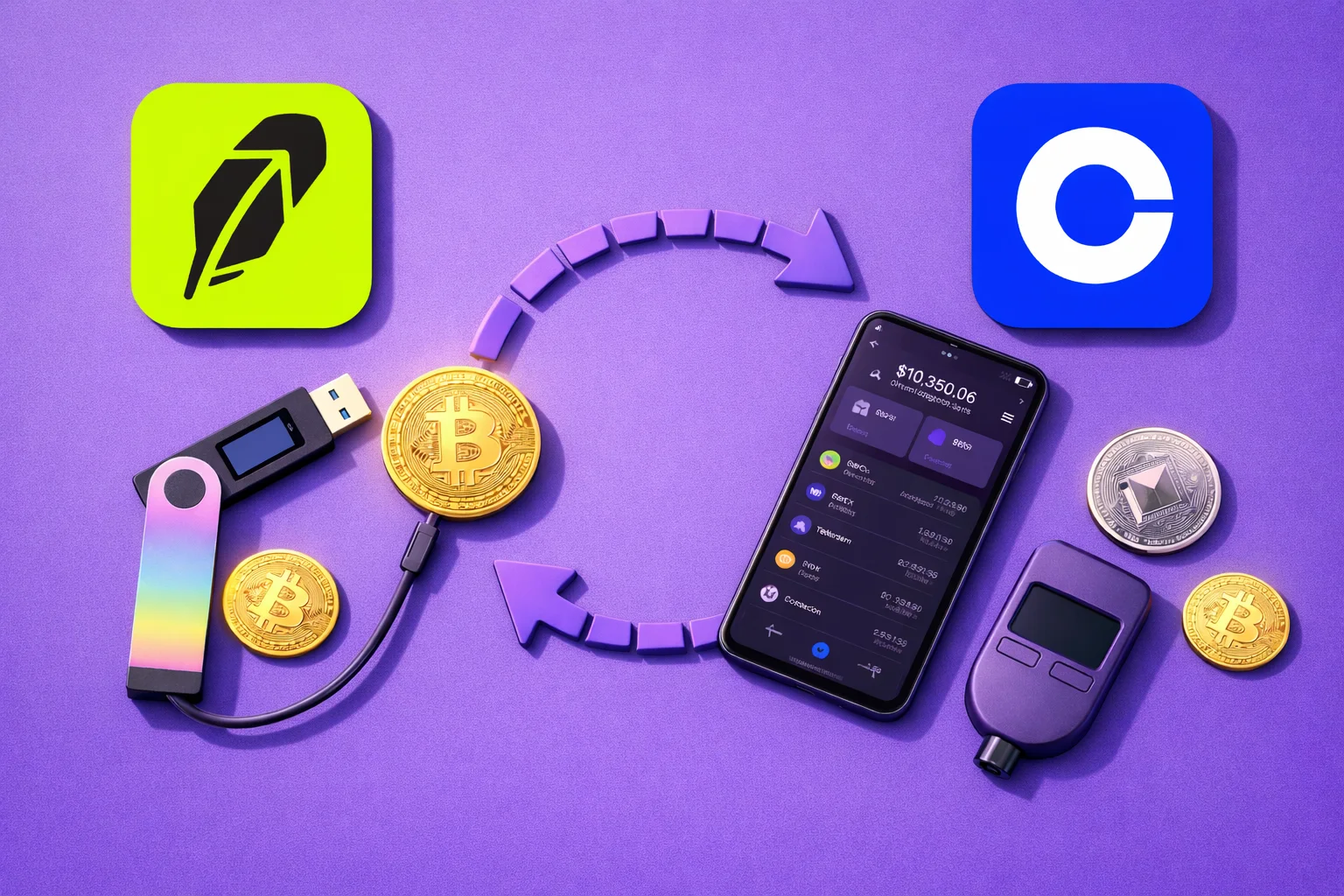
Coinbase supports outbound transfers to any external wallet address. If you want to move BTC to a Ledger or Trezor, you paste your hardware wallet’s address into Coinbase and send. For self-custody without a hardware device, the Coinbase Wallet app gives you full private-key control. The setup involves installing the wallet app, backing up a seed phrase offline (write it on paper, not in a screenshot), and then initiating a transfer from your exchange account to the wallet. Neither deposit nor withdrawal fees are charged on crypto transfers by Coinbase.
Robinhood’s transfer flow lives inside the main app. After Robinhood moved past its original custodial-only model, users gained the ability to send and receive crypto. The process is straightforward: you select the coin, enter the destination address, and confirm. No separate wallet app is needed. However, you should verify current transfer rules before assuming everything will go smoothly. Because these details shift depending on your account and the coin involved, check the current rules inside the app before planning any transfer. Robinhood also doesn’t charge deposit or withdrawal fees on crypto transfers.
Regardless of which platform you use, testing with a small withdrawal first is a smart habit. Send a minor amount to your external wallet, confirm it arrives, and note how long the process takes. Blockchain network congestion, platform-imposed delays, and coin-specific processing times can all extend what seems like it should be instant. Getting comfortable with the process on a small transaction saves you from sweating through a large one.
Staking, rewards, and passive income
Coinbase offers the broader set of earning options between the two. You can stake multiple tokens, earn interest on USDC holdings, and pick up small amounts of crypto through Learn-and-Earn modules, where you watch short educational videos and answer questions in exchange for token rewards. The variety of eligible tokens for staking and the number of different earning methods give Coinbase more options for passive income across your portfolio.
Robinhood supports staking on ETH, SOL, and ADA, with a minimum of $1 in crypto required to participate. It has also introduced limited Learn-and-Earn programs, though the selection is narrower than what Coinbase offers. Where Robinhood adds something distinct is its onchain lending feature, which lets you lend USDG through a self-custody wallet and accrue real-time earnings. The estimated APY on USDG lending sits at around 7%, though that figure fluctuates and isn’t guaranteed.
That last point applies across both platforms. Staking rewards and interest rates move with network conditions, token economics, and each platform’s own terms. Any quoted APY is an estimate, not a locked-in return. Before committing funds to staking or lending, check the current rates inside the app and understand that what you see today may not be what you earn next month.
At AXL Research Hub, we’ve found that the practical difference comes down to portfolio composition. If you hold a range of altcoins and want to put them to work, Coinbase gives you more tokens to stake and more ways to earn. If you’re focused on ETH, SOL, or ADA and want to add stablecoin lending, Robinhood covers those bases with a simpler interface.
Mobile app experience
Both platforms built proprietary mobile apps available on the App Store and Google Play, and both support streamlined sign-up flows that get you from download to first trade in minutes.
Robinhood’s app is designed to minimize steps. Buying crypto, setting up a recurring purchase, and switching between your stock and crypto holdings all happen with minimal tapping. The interface is clean to the point of being sparse, which works well for casual buyers who don’t want charting tools cluttering the screen. Robinhood also offers advanced trading tools for users who want them, including custom price alerts, advanced charts, and agentic trading through an MCP server connection.
Coinbase puts more information on screen by default. You’ll see visible fee breakdowns before confirming a trade, advanced charting options, and educational material woven into the app. For someone who wants to understand what they’re paying and why a coin is moving before they buy, that extra detail is useful. The trade-off is a busier interface that can feel overwhelming on a first visit.
Both apps support recurring buys starting at $1, so you can automate dollar-cost averaging on a daily, weekly, or monthly schedule without needing to open the app each time.
Neither platform supports third-party trading platforms like MetaTrader. All trading happens on proprietary software, so if you rely on external charting or execution tools, you won’t be able to connect them here.
Customer support
Neither platform has built a reputation for fast, helpful support, and that’s worth knowing before you run into a problem.
Robinhood provides 24/7 in-app and phone support, which sounds good on paper. In practice, users have reported multi-day response times and replies that don’t address the actual issue. Having round-the-clock availability doesn’t help much if the answers take days.
Coinbase offers support through its help center and email. Response delays have drawn similar criticism. If you subscribe to Coinbase One at $29.99 per month, you get priority support with faster response times, which effectively puts quality service behind a paywall.
Both companies have acknowledged these shortcomings and say they’re expanding support resources. For now, though, plan on self-service through help articles for most issues, and don’t assume either platform will resolve an urgent account problem quickly.
Platform trust record
Among U.S. crypto exchanges, Coinbase has built one of the strongest reputations for reliability. crypto platforms. It has operated continuously since 2012 with no reported exchange-level hacks, which is a notable track record in an industry where breaches have taken down major competitors. That said, Coinbase has faced legal challenges, including an SEC lawsuit over its staking-as-a-service offering. The outcome of that case and its implications for how Coinbase structures certain products are worth following if you use staking features.
Robinhood’s trust issues are different in nature. The 2021 restriction of GameStop and other meme-stock trading during a liquidity crunch raised real questions about whether the platform prioritizes its retail users’ interests. The incident didn’t involve crypto directly, but it shaped how many investors view the company’s decision-making under pressure. On top of that incident, Robinhood has faced persistent criticism for not showing users exactly how much the spread costs them and for routing orders through payment for order flow, which leaves traders without clear data on whether they’re getting the best execution price.
Despite those controversies, Robinhood serves over 25 million users globally and remains a familiar entry point for new investors who want a simple app to start with.
How much weight you put on reputation depends on your use case. Coinbase’s crypto-native track record appeals to dedicated crypto holders who want an exchange built from the ground up for digital assets. Robinhood’s massive user base reflects its strength in multi-asset simplicity, even if its crypto-specific credibility doesn’t run as deep.
Tax reporting on Robinhood and Coinbase
The IRS classifies cryptocurrency as property, which means every trade, sale, or disposal triggers a taxable event. You’re required to report the gain or loss on each transaction, even if you’re just swapping one token for another. This applies regardless of which platform you use.

Both Robinhood and Coinbase provide transaction-history exports and tax documents, but the format and availability of 1099 forms can change from year to year. Don’t assume this year’s process will match last year’s.
Coinbase offers CSV exports of your transaction history and integrates with several third-party crypto tax tools for cost-basis tracking. If you’re using software like Koinly or CoinTracker, Coinbase’s export format tends to plug in without much manual work. That integration can save real time if you’re trading frequently across dozens of tokens.
Robinhood provides downloadable transaction histories as well, and its tax documents cover both equity and crypto activity in a combined format. If you trade stocks and crypto on Robinhood, having everything in one document simplifies part of the process, but it also means you’ll need to separate crypto-specific activity if your tax software needs it broken out.
A few practical habits make tax season easier on either platform. Export your transaction records regularly, not just at year-end. Save them locally so you’re not relying on the platform to make old records available when you need them. And if you trade on both Robinhood and Coinbase, consolidate your exports so gains and losses are reconciled across accounts. Missing a trade on one platform while reporting everything on the other creates exactly the kind of discrepancy that triggers IRS notices.
HOOD vs COIN as stock investments
Both Robinhood (HOOD) and Coinbase (COIN) trade on NASDAQ and are classified as growth-oriented fintech stocks with above-average volatility. But their revenue profiles look very different, and that affects how each stock behaves during crypto market swings.
Coinbase’s revenue tracks closely with crypto market cycles. In Q1 2026, revenue came in at $1.4 billion, down 30.5% year over year during a crypto downturn. When crypto trading volume drops, Coinbase feels it directly because crypto is its entire business.
Robinhood is more diversified. Even as crypto revenue dropped 47% year over year in Q1 2026, options revenue grew 8% and equity revenue grew 46% over the same period. Overall, Robinhood’s Q1 2026 revenue grew 15% year over year despite crypto weakness. Its prediction-market segment generated $147 million in Q1 2026 revenue, up 320% year over year. That diversification means Robinhood’s stock price doesn’t swing as hard on crypto sentiment alone.
Coinbase has its own prediction market, which passed an annualized revenue run rate exceeding $100 million after two full months live.
Looking at longer-term growth, Robinhood’s three-year revenue CAGR stands at 48.3%, compared to Coinbase’s 31%. Both numbers reflect strong growth, but Robinhood’s higher rate comes partly from expanding into new revenue streams beyond its original stock-trading business.
The broader fintech market is projected to grow at a 15.3% CAGR through 2030, which provides a tailwind for both companies. But the investment thesis splits clearly: Robinhood is less dependent on crypto sentiment for total revenue, making it a comparatively less volatile equity holding. Coinbase has more upside if the crypto market rallies sharply, because a rising tide in crypto lifts nearly every part of its business at once.
Pros and cons of each platform
Robinhood
What works well:
- Commission-free crypto trades and a multi-asset platform covering stocks, ETFs, options, IPOs, and crypto in one account.
- A user-friendly mobile app that keeps casual buying simple, with fractional shares starting at $1.
- 24/7 customer support availability and a low margin rate of 2.50%.
Where it falls short:
- The crypto selection is narrow at 15+ coins, which rules out most altcoin exposure.
- Because costs are buried in the spread rather than displayed as a line-item fee, verifying your true trading cost takes extra effort, and the payment-for-order-flow model adds questions about whether execution favors the trader or the market maker.
- The fallout from restricting GameStop trades in 2021 still weighs on the platform’s credibility with some retail investors, and its crypto toolset hasn’t caught up to what dedicated exchanges offer.
Coinbase
What works well:
- Over 260 cryptocurrencies available, with an established crypto-specific platform operating since 2012.
- A visible fee structure that shows you what you’re paying before you confirm. A self-custody wallet option, staking and earn programs, and 1:1 offline asset storage.
- An A+ BBB rating and a track record with no reported exchange-level hacks.
Where it falls short:
- Higher fees on small standard purchases, with flat charges ranging from $0.99 to $2.99 on lower-dollar orders.
- No stock or ETF trading, so you’ll need a separate brokerage if you want equities.
- Customer support has been criticized for slow response times, and the platform has faced SEC legal action over its staking services.
Which platform fits your goals
The right choice depends on what you’re actually trying to do with your money. Here’s how each platform lines up with common goals.
If you’re a beginner buying small amounts of mainstream crypto, Robinhood’s simple app flow and lower effective cost on small BTC purchases make it an approachable starting point. You won’t feel lost in advanced charting tools you don’t need yet.
If you’re a crypto-focused investor wanting broad altcoin access and staking, Coinbase’s 260+ coin selection and earning options cover more ground. You can stake, earn interest on stablecoins, and explore tokens that Robinhood doesn’t list.
If you’re a long-term holder planning to self-custody in cold storage, Coinbase’s standalone wallet app and well-documented transfer process make it more straightforward to get your coins onto a hardware device you control. If you’re new to the process, learning how to create a crypto wallet before choosing a platform helps you understand what self-custody actually involves.
If you’re an active trader seeking lower per-trade fees on volume, Coinbase Advanced charges less per trade as your 30-day totals climb, so heavy activity directly reduces your costs.
If you’re an investor who wants stocks and crypto in one account, Robinhood is the only option between the two. Coinbase doesn’t offer equities, options, or ETFs.
If you’re a fee-conscious buyer regardless of platform loyalty, compare the live confirmation-screen prices on both apps before every trade. Effective cost depends on the coin, trade size, and market conditions at that moment, and the cheaper option can flip from one trade to the next.
Frequently asked questions
Can I cash out $100,000 from Coinbase?
Coinbase supports large withdrawals, but daily and per-transaction limits vary by your account verification level and payment method. Bank-wire withdrawals typically handle larger sums more smoothly than ACH transfers. Before initiating a large cashout, check your current limits in account settings. If your limit is lower than what you need, you may need to complete additional identity verification or split the withdrawal across multiple days.
Why do some investors avoid Robinhood?
The most common reasons are opaque spread-based pricing that makes it hard to verify your true trading cost, reliance on payment for order flow that creates potential conflicts of interest, the 2021 GameStop trading restriction that shook confidence in the platform’s commitment to retail investors, and a historically limited crypto feature set compared to dedicated exchanges like Coinbase. Each of these concerns carries different weight depending on how you plan to use the platform, but together they’ve built a skepticism among more experienced crypto traders.
Matching your crypto strategy to the right platform
The core trade-off between Robinhood and Coinbase is breadth of crypto features and self-custody on one side versus multi-asset convenience and simpler pricing on the other. Neither platform dominates every category. Fees tilt one direction, coin selection tilts another, and security model and passive-income tools each have their own winner.
Before committing funds to either platform, verify the live quoted prices, withdrawal rules, and staking terms inside each app. A general comparison like this one gives you the framework, but checking the numbers that apply to your specific trade size, coin, and account type turns that framework into an actual decision.
Both platforms continue adding features, adjusting fees, and expanding coin listings. What’s true today may shift in a few months. Revisiting the comparison periodically, especially when you’re about to make a large deposit or change your trading habits, keeps you on the platform that still fits your goals.