
What is an airdrop in crypto, and are those free tokens worth anything? An airdrop is a blockchain project sending free tokens to wallet addresses that met its conditions, often just for using its app before a cutoff date. A few drops have paid out thousands of dollars per wallet, but most airdropped tokens lose value in the months after launch.
What is an airdrop in crypto?
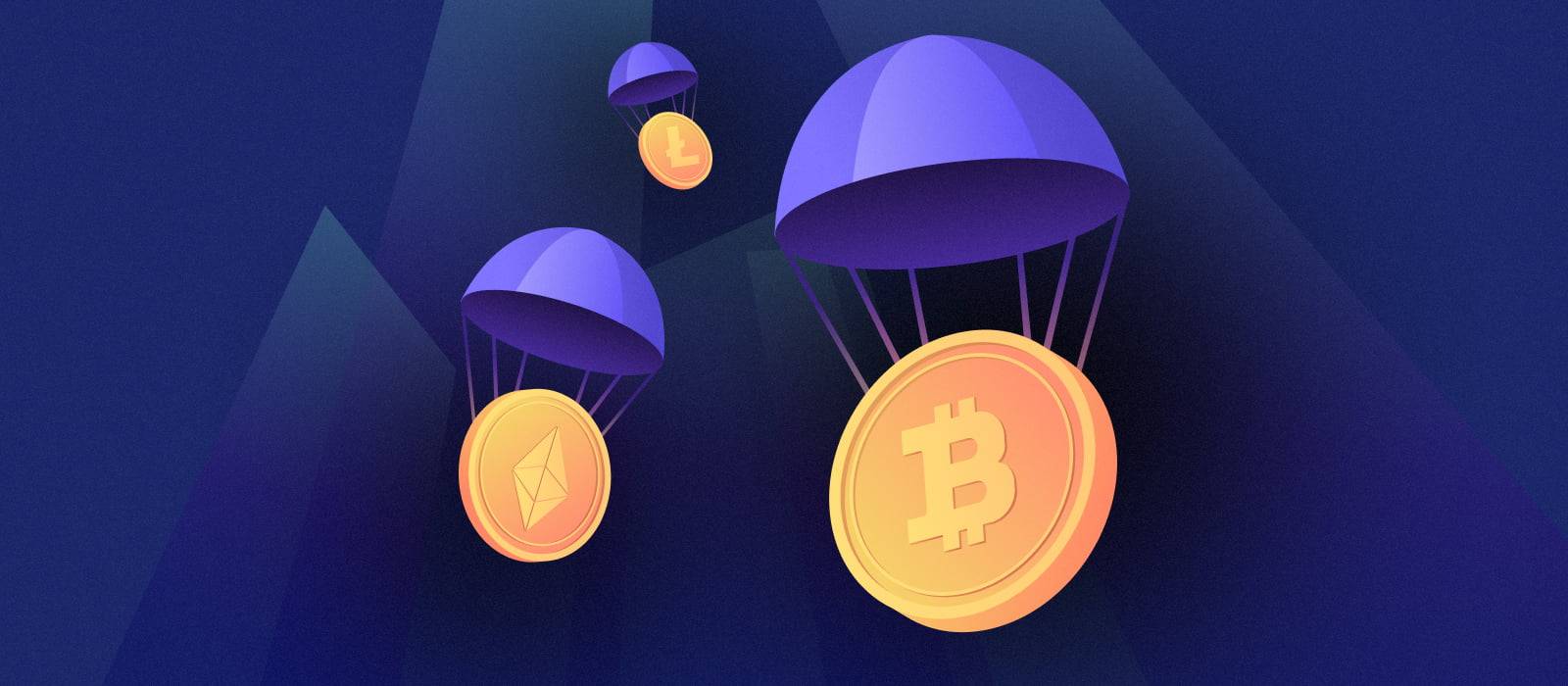
In a crypto airdrop, a blockchain project gives free tokens to wallet addresses that meet conditions the project sets. Qualifying usually comes down to something you did or held, such as holding a particular asset or testing an early version of the product.
Think of it like a discount coupon from a new store or a free sample at the supermarket. The project hands out tokens so that people hear about it, use it, and stick around as a community. That’s why the earliest users of a protocol are usually the ones who get tokens. Projects set aside a share of their total token supply just for these airdrop incentives.
Payouts range from small amounts to large sums. You often won’t know a drop is coming at all, because projects tend to stay quiet about whether and when they’ll release a token. That silence fuels speculation. Protocols without a token sometimes see unusual surges in activity from people hoping to qualify for a future drop.
Most airdropped tokens are issued on an existing chain, typically the one the project’s dApp already runs on, so they don’t come with a network of their own. The chain of issue decides where the tokens show up in your wallet. It also decides how you sell them, since your wallet and any exchange you use have to support that chain.
The first major airdrop happened in Iceland in 2014, when Auroracoin tried to create a national cryptocurrency by giving tokens to every citizen. The project didn’t last long. Its model did, and later airdrops followed the same template. Airdrops spread during the 2017-2018 ICO boom, as projects looked for alternatives to fundraising while regulatory restrictions grew. Between 2020 and 2023, crypto airdrops distributed more than $25 billion worth of tokens.
Airdrops vs. ICOs and IDOs
With an airdrop, you pay nothing beyond transaction fees. ICOs and IDOs ask you to invest money to buy tokens, and the rest of the differences follow from that.
| Airdrop | ICO (Initial Coin Offering) | IDO (Initial DEX Offering) | |
|---|---|---|---|
| Cost to you | Free (excluding transaction fees) | Investment required | Investment required |
| Who gets in | Wallets meeting predefined criteria | Open to everyone | Whitelist often required |
| Distribution | Immediate | Gradual | Gradual |
| Main objective | Adoption and engagement | Fundraising | Decentralized fundraising |
An ICO or IDO exists to raise money. Anyone can buy into a crypto ICO, but ICOs have typically courted larger investors such as venture capitalists. An airdrop exists to put the token in the hands of people who’ll actually use it. So the project picks recipients by its own criteria and sends the tokens all at once instead of releasing them over time.
Why crypto projects give away free tokens
Many airdrops pay back early users who adopted a product before it had a token at all. Those people took a chance on something unproven, and the tokens are a thank-you.
Spreading tokens widely also makes governance votes mean something. Many airdropped assets are governance tokens, which carry votes on technical parameters, protocol revenue allocation, partnerships, and network upgrades. Arbitrum’s ARB works this way, giving holders decision-making power over the protocol. If only the team and a handful of investors held the token, those votes would be a formality.
Airdrops are also a fast way to reach a critical mass of users: Uniswap had more than 250,000 active users within days of its September 2020 airdrop. The promise of free tokens gets people talking, too, which is why Twitter mentions of ENS spiked in the days after the project announced its 2021 airdrop.
Then there’s liquidity. Once recipients start trading on exchanges, volume goes up. More volume makes the token easier to buy, sell, and use in dApps. The rush of claims also stress-tests the project’s smart contracts and interface under real conditions, which is hard to simulate before launch.
Some projects add retention mechanisms such as gradual token vesting or staking bonuses, hoping to turn recipients into long-term users. They don’t always work. A lot of airdropped tokens land with short-term profit seekers who sell right away. That selling can destabilize the price. It also skews the team’s read on product-market fit, since a crowd that leaves right after claiming says little about real demand.
How a crypto airdrop works step by step
Most airdrops move through five stages, and the snapshot comes before the announcement. That order shapes everything you see from the outside.
- The team sets the rules. The project decides what the airdrop is for, how it’ll distribute tokens, and who qualifies.
- A snapshot captures the blockchain. A snapshot is a time-stamped record of the blockchain ledger at a fixed moment, showing wallet activity and balances. Because every transaction stays on-chain permanently, a project can reward past activity whenever it chooses. The snapshot is taken before the announcement, so anything you do after the news breaks won’t change the eligibility list. Many projects use a retroactive model and reveal their criteria only after the snapshot, because published criteria get gamed.
- The project announces the drop. News goes out through the project’s own website and verified social accounts, usually with a page where you can check your allocation. Allocations vary with how much each wallet used the project. A light user might get about 1,000 tokens while a heavy user of the same project gets 10,000 or more.
- Tokens go out in one of two ways.
- Pushed delivery. Smart contracts send tokens automatically to qualifying wallets, usually from the project’s treasury wallet. You don’t claim anything. The transaction details sit in a public block, so anyone can check that the distribution went out without favoritism.
- Claim delivery. The project opens an official claim page for a set date range. Eligible wallets connect and claim during that window. The only cost of a genuine claim is the network gas fee, which you pay in ETH on Ethereum.
- You decide what to do with the tokens. In most cases, claimed tokens are unlocked right away and tradeable on major exchanges. You can vote in governance, stake them for rewards, or sell them on the open market.
The snapshot timing gives you a simple test. Say someone offers you a way to qualify after an airdrop has already been announced, like a “last chance” sign-up or a deposit to “activate” eligibility. The list was most likely locked before the news came out, so that offer is a red flag.
The delivery model matters for safety too. With a pushed drop, you never need to visit a website or sign anything. Any link telling you to “claim” a pushed drop is fake. Claim drops are where fake claim pages thrive, because you really do have to connect your wallet somewhere. For those, the only safe page is the one linked from the project’s official site.
Types of crypto airdrops
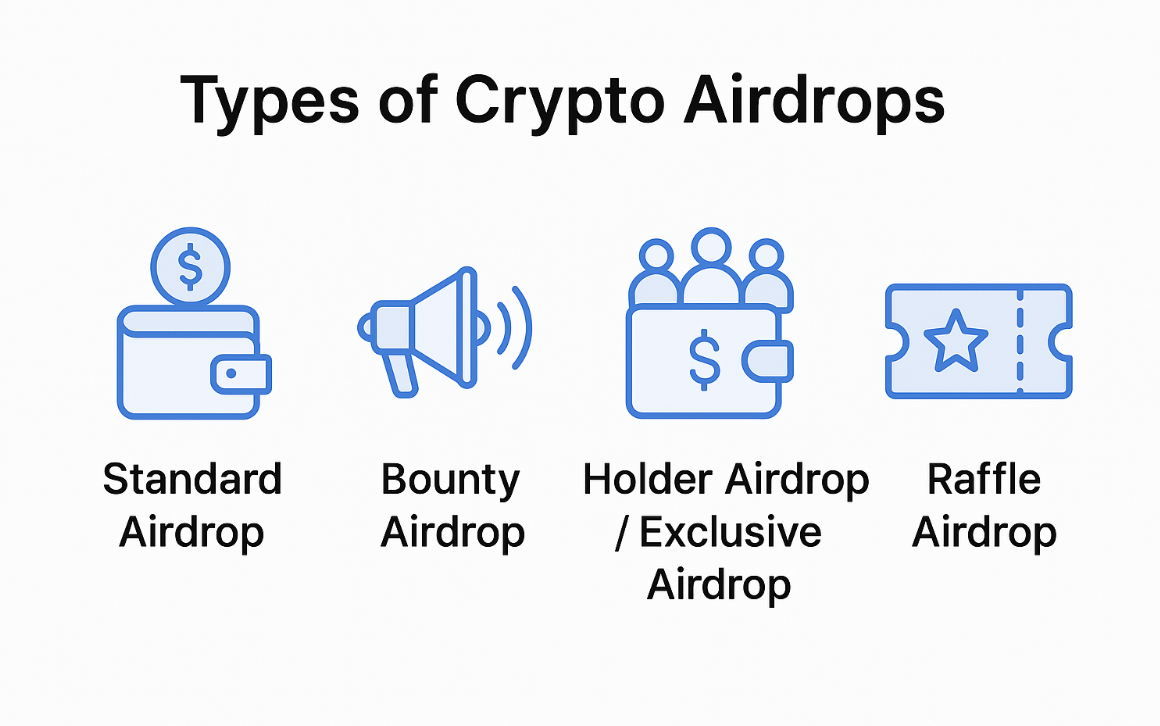
Some airdrops pay out for nothing more than a wallet address, while others want completed tasks, existing holdings, past protocol use, a lucky draw, or a chain split. The effort varies just as much. Holder and forked drops take close to zero work, while retroactive and bounty drops reward sustained activity.
Standard airdrop
A standard airdrop is open to anyone who signs up or completes a simple task and submits a valid wallet address. The project sets a fixed token pool and caps how much each participant can get. These drops are often first-come, first-served and time-sensitive, so showing up late can mean the pool is gone.
That easy entry is also the weak spot. One person can create many addresses and qualify each one, which is called a Sybil attack. Every fake address drains tokens meant for real participants.
Bounty airdrop
Bounty airdrops pay you for promoting the project. Typical tasks include resharing social posts, referring friends, signing up for a newsletter, joining Discord or Telegram, and writing reviews or making videos. Each task earns points, and your point total sets the size of your airdrop. A project might require 500 points to qualify, for example.
The team checks completed tasks before any tokens go out. A task you skipped or undid won’t count toward your total.
Holder airdrop
If your wallet held a specific cryptocurrency at the snapshot, a holder airdrop sends you new tokens automatically, in proportion to how much you held. The public ledger makes ownership easy to verify, so there’s nothing to apply for. Common conditions are a minimum balance or a minimum holding period. The new tokens arrive even if you have zero interest in the new project.
In 2018, Blockchain.com and the Stellar Development Foundation distributed 500 million XLM. Each user got 100 XLM, worth about $25 at the time. In 2020, Flare Network announced its Spark (FLR) token for XRP holders, and that token is now called Flare.
Exclusive airdrop
Exclusive airdrops go to select groups such as early adopters, loyal community members, influential users, and active contributors. Holding a token usually isn’t enough on its own. Projects may look at time spent on the platform, money spent on products, forum participation, or reputation.
Owning a particular NFT collection can also be the ticket. ApeCoin (APE) launched on March 17, 2022, with an airdrop to holders of Bored Ape NFTs and other NFTs in that ecosystem.
Retroactive airdrop
A retroactive airdrop pays the earliest and most active users of a protocol for what they’ve already done. Allocations usually come in tiers based on cumulative interactions, trading volume, and how long a wallet stayed active. Higher volume or a longer track record means a bigger reward. dYdX, for instance, distributed DYDX tokens to traders based on their historical trading volume.
Jito, a liquid staking MEV protocol on Solana, allocated 10% of its token supply to its airdrop. The tokens went to three groups: Jito-Solana Validators, Jito MEV Searchers, and JitoSol Stakers. Even the lowest allocation tier received 4,941 JTO.
A reward-based variant keeps paying out over time on DeFi platforms, handing tokens to people who provide liquidity, stake, or vote in governance. Those tokens often come with real influence. Aave, Compound, and SushiSwap all distributed governance tokens with voting rights on project decisions.
Raffle airdrop
Raffle airdrops work like a lottery. You earn entries by holding tokens, earning points, or sometimes just signing up to show interest. The project says in advance how many airdrops it’ll hand out. If demand outstrips the tokens on offer, winning wallets get picked at random, so an entry is a ticket and nothing more.
Forked airdrop
A fork happens when a blockchain splits into two parallel chains: the original keeps going while the new one heads in its own direction. Holders of the original coin automatically receive tokens on the new chain. When Bitcoin Cash forked off in 2017, holders got one BCH for every BTC they held, a 1:1 ratio.
Forks usually come from big moments in a chain’s life. A major technical upgrade can trigger one. So can a community split over the chain’s direction or a major governance change.
Biggest crypto airdrops so far
Every drop below rewarded things users had already done, sometimes years earlier, checked against an on-chain history nobody could change. Nobody qualified by rushing in after the announcement.
| Airdrop | Date | Recipients | Who qualified | Reported value |
|---|---|---|---|---|
| Uniswap (UNI) | September 16, 2020 | Roughly 220,000 to 250,000 addresses | Any address that had used Uniswap before the snapshot | At least 400 UNI each (about $1,200 at listing, over $17,000 at peak); about $6.4B total at peak |
| dYdX (DYDX) | September 8, 2021 | About 64,000 | dYdX traders, by historical trading volume | About $2B total at peak |
| Ethereum Name Service (ENS) | November 8, 2021 | About 137,000 | Registrants of .eth names | About $1.88B total at peak |
| ApeCoin (APE) | March 17, 2022 | Not disclosed | Holders of Bored Ape and other ecosystem NFTs | About $3.55B total at peak |
| Arbitrum (ARB) | March 23, 2023 | About 625,000 users | Arbitrum One and Nova users, scored on bridging and transactions | About 1.2B ARB distributed; token traded around $1.50 at launch |
Drops this size are rare, which is why people still talk about them. Look at the gap between value at receipt and value at peak, though. A Uniswap user’s 400 UNI was worth about $1,200 at listing and more than $17,000 at the peak. Token prices are that volatile, and the same swing can run the other way.
How to qualify for a crypto airdrop
The most common route is using blockchains and protocols the way a normal, active user would. Each project sets its own criteria, so no two airdrops qualify people the same way. The bar can be low. Uniswap required just one transaction on the protocol before September 2020.
Projects that score on-chain activity usually look at the funds you bridged, how many transactions you made, and their total value. Time matters as well, since projects tend to give bigger allocations to wallets that stayed active across months. Larger amounts typically earn more points or tokens, whether you bridged them, staked them, or supplied them as liquidity.
Arbitrum’s scoring shows how detailed this gets. It runs two networks: Arbitrum One, its main layer-2, and Arbitrum Nova, a faster chain catered to gaming. Wallets earned points for bridging into each network. More points came from transaction count, transaction value, and activity spread over several months. The number of criteria boxes a wallet checked set its token amount.
Some projects run points programs that publish how you earn points and how extra tasks boost them. Projects without one leave the criteria to guesswork. In that case, the best clue you have is what similar projects rewarded in the past.
Holding requirements are simpler. You need a minimum token balance at the snapshot, and sometimes you need to keep it for a set period.
On a testnet, you interact with a test version of the network without spending funds, so qualifying costs you time but no money. In 2024, Shardeum airdropped tokens to users who had tested its network by running smart contracts on its EVM-compatible blockchain. In the past, projects have also counted contributions to their open-source development as a criterion.
Any money you put into a young protocol to qualify is exposed. New protocols get hacked, and some teams pull the rug and disappear with users’ funds. Only move amounts you could stand to lose.
Where to find legitimate crypto airdrops
Start with the project itself, and treat every other source as a lead you still have to confirm there.
- Official website and verified X accounts. A project’s own site and its verified X (formerly Twitter) accounts are the primary source for real announcements. If a drop isn’t mentioned there, treat it as unconfirmed.
- DeFiLlama. Its dashboard lists projects that don’t have a token yet but likely will launch one, with each project’s valuation, TVL (total value locked), and category.
- Airdrops.io. You can sort listings by latest or hot and read project details along with possible eligibility requirements. A listing doesn’t guarantee a drop will happen.
- Airdrop calendars. Airdrop Alert, CoinGecko, and CoinMarketCap publish calendars of upcoming distributions. Use them for dates, then confirm each one on the project’s own channels.
- YouTube. Some channels cover potential drops and break down the criteria past airdrops used, which shows you how projects tend to score activity.
- Online communities. Reddit, Discord, Telegram, and X communities share airdrop research. Scammers post in the same places, so never click a claim link you found there.
- Crypto news sites and newsletters. Airdrop announcements get picked up here, which helps you catch drops you weren’t following.
Before you connect anything, vet the project itself. Look for a GitHub history, an identifiable team, a detailed whitepaper, a security audit, and a solid reputation in the community. A project missing most of those isn’t worth your wallet connection.
Choosing a wallet for airdrops
To receive airdropped tokens, you need a self-custodial wallet that supports the chain the token is issued on. Software wallets like Binance Wallet, Coinbase Wallet, MetaMask, and Rabby are common picks. Leaving crypto on an exchange is riskier, since exchanges are a common target for hackers.

Set up a separate crypto wallet just for airdrops. If you connect to a malicious site or approve a bad contract, the damage stays inside that wallet and your main holdings stay out of reach. For larger holdings, hardware wallets such as Ledger and Trezor store your private keys offline.
Keep some of the chain’s gas token in your airdrop wallet before you claim. An empty wallet can’t pay the claim fee, and you’ll be stuck until you fund it.
Some wallets add dApp blocklisting and suspicious-transaction alerts, which can warn you before you sign something harmful. AXL Research Hub publishes wallet reviews and comparisons that put the options side by side, which helps if you’re weighing those features.
Airdrop farming: trying to earn money from airdrops
Airdrop farming means interacting with protocols for the sole purpose of qualifying for possible drops, often before any airdrop has been announced. Farmers work testnets and young protocols across dozens of wallets. They’re hoping for a retroactive payout months or years later. Most farms pay nothing, and you only find out which ones paid after the fact.
The multi-wallet approach runs straight into Sybil filtering. Before distribution, projects look for clusters of addresses that move in lockstep and strip them from the list. Fifty wallets behaving like one person look exactly like what they are. The farmed cluster gets cut, while ordinary users keep their share. So spreading activity across many wallets is an unreliable way to multiply your rewards, and it can leave you with nothing from wallets you paid gas to run.
Farmers often stack other token sources on top, such as referral programs, staking, and yield farming. Most keep their farming to a small share of a portfolio they could afford to lose entirely.
What makes an airdrop worth chasing
None of these clues guarantees a drop or a payout. Together, they show whether a project has the money and the stated intent to reward its users.
- Funding and valuation. Larger raises and higher valuations point to a bigger token pool at launch.
- Dilution. More participants means a smaller share per recipient, so less-discussed drops tend to be less crowded.
- Tokenomics. Check the whitepaper for allocations to the “community” or “early adopters.” A named slice for them shows the team plans to put tokens in users’ hands.
- Decentralization language. Whitepaper wording about reaching “decentralization” or becoming “community-governed” is a common signal of a future drop, since spreading tokens is how a project hands control to users.
- Foundational ecosystem protocols. Some of the largest rewards have come from protocols other apps build on. Arbitrum’s drop to users of its own networks is one example.
Are airdropped tokens really free money?
Not entirely. A genuine claim costs only the network gas fee, so the claim itself is close to free. Qualifying and holding are another story: in a Keyrock analysis of 62 airdrops in 2024, about 88% of airdropped tokens lost value in the months after launch.
Every interaction you make while trying to qualify costs gas. Fees are lower on networks outside Ethereum, but they’re never zero. Nothing guarantees you’ll earn that money back. Time adds up too, between hunting for drops and finishing tasks.
Then there’s opportunity cost. If you lock liquidity in a smart contract to qualify and no drop arrives, that money sat there earning nothing. The claim fee can bite as well. During the ENS claim, some users paid significant gas fees for tokens whose value then swung sharply.
Prices fall for plain reasons. Many recipients sell at once, which pushes the price down fast. Tokens from failing projects, or tokens that never get listed on an exchange, can end up worthless. And with so many drops flooding the market, some new tokens never hold much value at all.
The upside is real, though. You get tokens with no upfront investment, and the price can rise. Going through a claim teaches you practical skills like managing a wallet, moving assets, and interacting with smart contracts. You also get in early on new projects, often with a governance vote.
Airdrop scams and how to stay safe
Fake airdrops cluster around genuine announcements, because that’s when searches for the project spike. The word “airdrop” is one of the most abused in crypto scams. Fakes show up far more often than real drops.
Common airdrop scams
The most damaging scam is a fake claim site that copies a real project’s page and asks for your seed phrase or a sweeping wallet approval. Typing your seed phrase into a website hands your wallet to the scammer. A sweeping approval does similar damage by letting a contract move tokens out of your wallet later.
- Lookalike accounts and domains. Scammers copy X accounts and websites with slightly altered usernames or addresses, counting on you to miss a single changed character.
- Hijacked official accounts. Sometimes a project’s real social media account gets taken over and posts malicious “airdrop” links. Check the project’s website before trusting even a verified post.
- Upfront-fee messages. Any message promising your tokens will be released after you pay is a scam.
- Direct-message offers. Treat any airdrop offer that arrives by DM as fake by default.
- Unsolicited tokens. Tokens that show up in your wallet unannounced can’t act on their own and stay harmless while you leave them alone. Trying to sell them or interact with them can trigger a malicious contract.
- Dusting attacks. Tiny token amounts get sent to your wallet so the sender can track its transaction history.
- Pump-and-dump schemes. The price gets inflated around a drop, then collapses after a sell-off, leaving late buyers holding devalued tokens.
- Malicious downloads. Some fake airdrops push software downloads that compromise your device’s security.
- Spam after sign-ups. Signing up for airdrops often brings a wave of spam emails, many carrying phishing offers.
Real drops draw scammers as well. When Stellar distributed 2 billion XLM to Keybase users, spammers used the event to target recipients. In 2022, millions of dollars in tokens were stolen after a security breach during a major airdrop.
How to spot a genuine airdrop claim
A genuine claim happens on the project’s official site and asks only for a wallet connection. The gas you pay goes to the network, never to a person. No legitimate project will ask for your private keys, seed phrases, or passwords, for any reason.
Get to the claim page by typing the project’s address yourself or using a bookmark you saved earlier, never a link someone shared. Before you connect a wallet, confirm the announcement on the project’s official channels. If tokens have already landed in your wallet, check that their smart contract address matches the one the project publishes. Fake tokens often copy a real token’s name, but they can’t copy its contract address.
Timing is another tell. Real claim windows last at least a few days, so a countdown pushing you to act right now is a warning sign. A payment box, a countdown clock, or a seed phrase field marks a page as fake. So does a promised reward that seems unusually large.
Are crypto airdrops taxable?
Yes, in the US. The IRS treats airdropped tokens as ordinary income at their fair market value when you receive them. That value becomes your cost basis. If you later sell above or below it, you have a capital gain or loss.
The Crypto Council for Innovation also classifies airdrops as ordinary income and treats them as taxable events. Since the income counts when the tokens arrive, you can owe tax even if you never sell. That holds even if the token loses value afterward.
For each airdrop, keep a record of the date you received it, the number of tokens, and their market value at that moment. You’ll need that value later to work out your gain or loss on a sale. Tax authorities use blockchain analytics to trace transactions. Unreported airdrop income can draw scrutiny, and penalties or fines are possible.
Outside the US, treatment varies by country. Some jurisdictions treat airdrops as income, while others treat them as gifts. A tax professional can tell you how the rules apply to your situation.
Crypto airdrop FAQs
What if claiming an airdrop costs high gas fees?
A claim is worth the token’s value minus the gas fee, so a small allocation can cost more to claim than it’s worth. Fees tend to drop when the network is less congested. Etherscan’s Gas Tracker shows gas prices so you can time your claim. Layer 2 networks carry lower fees to begin with.
How do I know if I received an airdrop?
Watch the project’s official social accounts, which post eligibility and claim news. Wallet-checker tools such as Earndrop, a free airdrop checker, show claimable airdrops when you paste in a wallet address. You’re sharing only a public address there, never your keys. Pushed drops simply appear in your wallet with no claim step.
Are airdrops considered securities?
The SEC (Securities and Exchange Commission) is reviewing whether airdrops count as securities. No final answer has come from that review yet, so keep an eye on SEC announcements if this affects you.
Airdrops as a reward for past use, not a paycheck
Our take: judge an airdrop the way you’d judge a loyalty reward. If you’d use the protocol anyway, any tokens that follow are a pleasant extra for activity already sitting on-chain before the snapshot. If you’re only there for the drop, you’re paying gas and time for a payout that may never come.
The odds also favor patience over chasing. Record payouts are rare, and most tokens slide after launch, so decide ahead of time whether you’ll sell on arrival or hold. Budget for airdrops like a hobby you enjoy, and keep your rent money somewhere else.