


Staking lets you put cryptocurrency to work on a blockchain network instead of leaving it sitting in a wallet. You lock or delegate coins to help the network verify transactions, and in return you earn rewards.
What is crypto staking?
Crypto staking is the act of locking or delegating cryptocurrency on a proof-of-stake (PoS) blockchain to help validate transactions and maintain network security, earning rewards in return. Those rewards come from newly minted tokens, transaction fees the network collects, or a mix of both.

Staking exists because of proof of stake, a consensus mechanism that replaced the energy-heavy mining process used in proof-of-work (PoW) networks like Bitcoin, a split that matters when choosing between Bitcoin and Ethereum. Instead of competing with raw computing power, PoS networks pick validators based on the coins they’ve committed. The concept first appeared in a 2012 paper by Sunny King and Scott Nadal, and Peercoin launched in 2013 as the first cryptocurrency to put the idea into practice.
The coins you stake act as collateral, so if a validator behaves dishonestly or makes serious errors, the network can confiscate part of that stake. Because cheating the network means losing money, validators have a direct financial reason to play by the rules. That built-in incentive keeps the chain reliable without needing a central authority.
Ethereum, the largest PoS network, ran on proof of work for years before completing its transition to proof of stake in September 2022 during an upgrade called The Merge, a turning point in how Ethereum works. That shift showed that even well-established blockchains can adopt staking as their security backbone.
How does crypto staking work?
The staking process follows a repeating cycle that secures the blockchain one block at a time:
- Pick a proof-of-stake cryptocurrency. Only coins running on PoS blockchains support staking (our cryptocurrency basics guide covers the difference). Bitcoin, for example, uses proof of work and can’t be staked.
- Lock or delegate your coins. You can do this through an exchange, a compatible wallet, or a staking pool. If you’re running your own validator on Ethereum, you’ll need at least 32 ETH to stake.
- The network selects a validator. Selection is typically random, but validators with a larger stake generally have better odds of being chosen to propose the next block.
- Other validators verify the block. Before it’s added to the chain, the proposed block gets cross-checked by other validators for accuracy.
- Rewards are distributed. The validator who proposed the block receives rewards, and when delegators backed that validator, they receive a proportional share.
- The cycle repeats. Each new block goes through the same selection, verification, and reward process, keeping the ledger continuously secured.
Validators vs delegators
A validator runs dedicated node software, stakes a large amount of crypto, and directly participates in proposing and verifying blocks. This role demands technical knowledge, reliable hardware, and consistent uptime. Validators earn the full block reward but carry the full responsibility for performance and conduct.
A delegator takes a different approach. Instead of running a node, you assign your coins to a validator you trust. You don’t need to meet the network’s full minimum stake or manage any hardware. On Polkadot, for instance, nominators (the network’s term for delegators) need at least 502 DOT to join a staking pool, a much lower bar than running a validator node yourself.
The trade-off is dependency. Your rewards are tied to your chosen validator’s behavior. If that validator has poor uptime or gets penalized, your returns shrink too. For most beginners, though, delegation removes the technical barrier while still earning a portion of staking rewards. The key decision becomes picking a reliable validator rather than building a technical setup.
Proof of stake vs proof of work
Both mechanisms accomplish the same goal: verifying transactions and securing a blockchain without a central intermediary. They get there in fundamentally different ways.
| Feature | Proof of stake (PoS) | Proof of work (PoW) |
|---|---|---|
| How validators/miners are selected | Validators lock coins as collateral; selection weighted by stake size | Miners compete to solve cryptographic puzzles using computing power |
| Energy usage | Low, no specialized hardware needed | High, requires continuous electricity and dedicated mining rigs |
| Source of security | Financial stake validators put at risk | Cost of computation |
| Hardware requirements | Standard server or computer for validators; none for delegators | Specialized mining hardware (ASICs, GPUs) |
| Notable networks | Ethereum, Solana, Cardano, Polkadot | Bitcoin |
The energy difference is the most dramatic distinction. When Ethereum switched from PoW to PoS, its energy consumption dropped by roughly 99.95%. That drop happened because PoS doesn’t need warehouses full of mining rigs running around the clock. Validators secure the network with capital rather than electricity.
PoW’s security model relies on making attacks expensive in hardware and energy costs. PoS achieves a similar result by making attacks expensive in locked capital: a validator trying to corrupt the chain risks losing the coins they’ve staked. Each model has its advocates, but the broader trend across newer blockchains has been toward proof of stake.
Ways to stake crypto
You can stake in several ways, and picking one comes down to your holdings, your technical comfort level, and how important it is to you to keep direct control of your keys.

Solo (validator) staking
Running your own validator node gives you the most control and the highest potential reward. You interact directly with the blockchain, propose blocks, and keep the full validator reward without splitting it with a third party.
The demands are real, though. On Ethereum, solo staking requires a minimum of 32 ETH just to activate a validator. Beyond the financial commitment, you’re responsible for maintaining uptime, applying software updates, and monitoring your node’s performance. Extended downtime or misconfigurations can cost you rewards or even trigger penalties. This path suits people with both the technical background and the capital to back it.
Delegated staking and staking as a service
Delegated staking lets you assign your coins to an existing validator. You keep ownership of the tokens, but you share the rewards because the validator does the operational work. It’s accessible for beginners since there’s no hardware to manage and no node software to maintain.
Staking-as-a-service platforms take this a step further by handling every aspect of node operation for a fee. You deposit your coins, the platform runs the validator, and you collect the block reward minus the platform’s cut. The convenience comes with trade-offs: you depend on the platform’s or validator’s performance, fee structure, supported assets, and unstaking policies. Before committing, it’s worth comparing fees across several options, since even small percentage differences compound over time.
Pooled staking
Staking pools let multiple users combine their funds through a smart contract to collectively meet a network’s minimum stake requirement. Rewards are split among participants based on each person’s contribution.
Pool size creates its own dynamic. Smaller pools get selected less often but pay out a larger share per person when they do. Very large pools get selected more frequently, but the reward gets divided among so many participants that individual payouts shrink. In both cases, you’re trusting the pool operator to manage fees transparently and run the node reliably.
Liquid staking
Traditional staking locks your coins for a set period, and you can’t use them until the unstaking cooldown finishes. Liquid staking solves that problem. When you deposit crypto into a liquid staking protocol, you receive a liquid staking token (LST) that represents your staked position. Your original coins continue earning staking rewards on the blockchain, while the LST can be traded, used as collateral in DeFi protocols, or sold on the open market.
This flexibility comes with its own risks, and they’re worth understanding before you jump in. Smart-contract vulnerabilities in the liquid staking protocol could put your funds at risk. The LST’s market price can drift away from the value of the underlying staked asset, especially during market stress. And because LSTs can be reused across multiple DeFi protocols, they can create layers of leverage that amplify losses if something goes wrong in any part of the chain. Liquid staking is a powerful tool, but it adds complexity that goes beyond basic staking.
Staking through an exchange
Centralized exchanges like Coinbase or Kraken offer the simplest staking experience. You hold a supported coin on the exchange, opt into staking, and the exchange handles everything: validator selection, custody, and reward distribution.
The barrier to entry is the lowest of any method, which makes it appealing for beginners. The downside is that exchanges typically offer lower reward rates than other methods because they take a cut for managing the process. More importantly, your coins sit in the exchange’s custody. That means you’re exposed to the exchange’s security practices, financial health, and policy decisions. Hacks, insolvency events, or sudden delistings can all affect your staked assets. If the exchange controls the keys, you’re trusting them with your crypto in a way that other staking methods don’t require.
Which cryptocurrencies can you stake?
Only coins that run on proof-of-stake blockchains support staking. The blockchain’s consensus mechanism determines eligibility, not the app or platform listing the coin. Before staking any token, verify that its underlying network actually uses PoS.
Some of the most widely staked PoS cryptocurrencies include:
- Ethereum (ETH) is the largest PoS network by market capitalization, with a massive validator set and broad support across wallets and platforms.
- Solana (SOL) is known for fast transaction throughput and has attracted a large staking community.
- Cardano (ADA) takes a research-driven development approach, with processing speed cited at 1,000 transactions per second.
- Polkadot (DOT) focuses on cross-chain interoperability and scalability, connecting multiple specialized blockchains.
- Cosmos (ATOM), Avalanche (AVAX), Tezos (XTZ), and Algorand (ALGO) are other widely staked PoS tokens, each with different reward structures, minimum requirements, and lock-up terms.
Each of these networks sets its own rules for staking. Minimum stake amounts, lock-up durations, and how rewards are distributed all vary from chain to chain, so check the specifics for any coin before you commit funds.
Staking rewards and how they are calculated
Staking rewards are typically expressed as an annual percentage yield (APY), but that number isn’t fixed. It shifts based on how many coins are staked across the network, the blockchain’s block issuance schedule, and how much transaction fee revenue the network generates.
Validators generally earn a larger share than delegators. When you delegate, you receive a portion of the validator’s rewards after their fee. That fee varies by validator, so two delegators staking the same coin on the same network can earn different rates depending on which validator they chose.
To give a rough sense of scale: at various points in time, Ethereum validator rewards have been noted at approximately 3.6%, Cardano delegator rewards around 4.6%, and Polkadot rewards around 14.88%. Rewards for many stakeable coins tend to fall somewhere around 5% to 10%, with some higher. These figures shift constantly, so treat them as a reference range, not a promise.
Two timing details catch beginners off guard. Many blockchains enforce a warm-up period after you stake, during which your coins are committed but not yet earning rewards. This delay can last anywhere from hours to several days depending on the network. On the other end, cooldown periods after you request unstaking can freeze your funds for days or even weeks. During that window, you can’t sell or transfer the coins. Both of these periods matter for planning, especially if you might need access to your funds on short notice.
Some platforms automatically reinvest earned rewards, compounding your staked balance over time. If your staking method supports this, it can meaningfully increase your effective yield compared to manually claiming and restaking.
Benefits of staking crypto
Staking offers several practical advantages for crypto holders who plan to keep their coins for the long term:
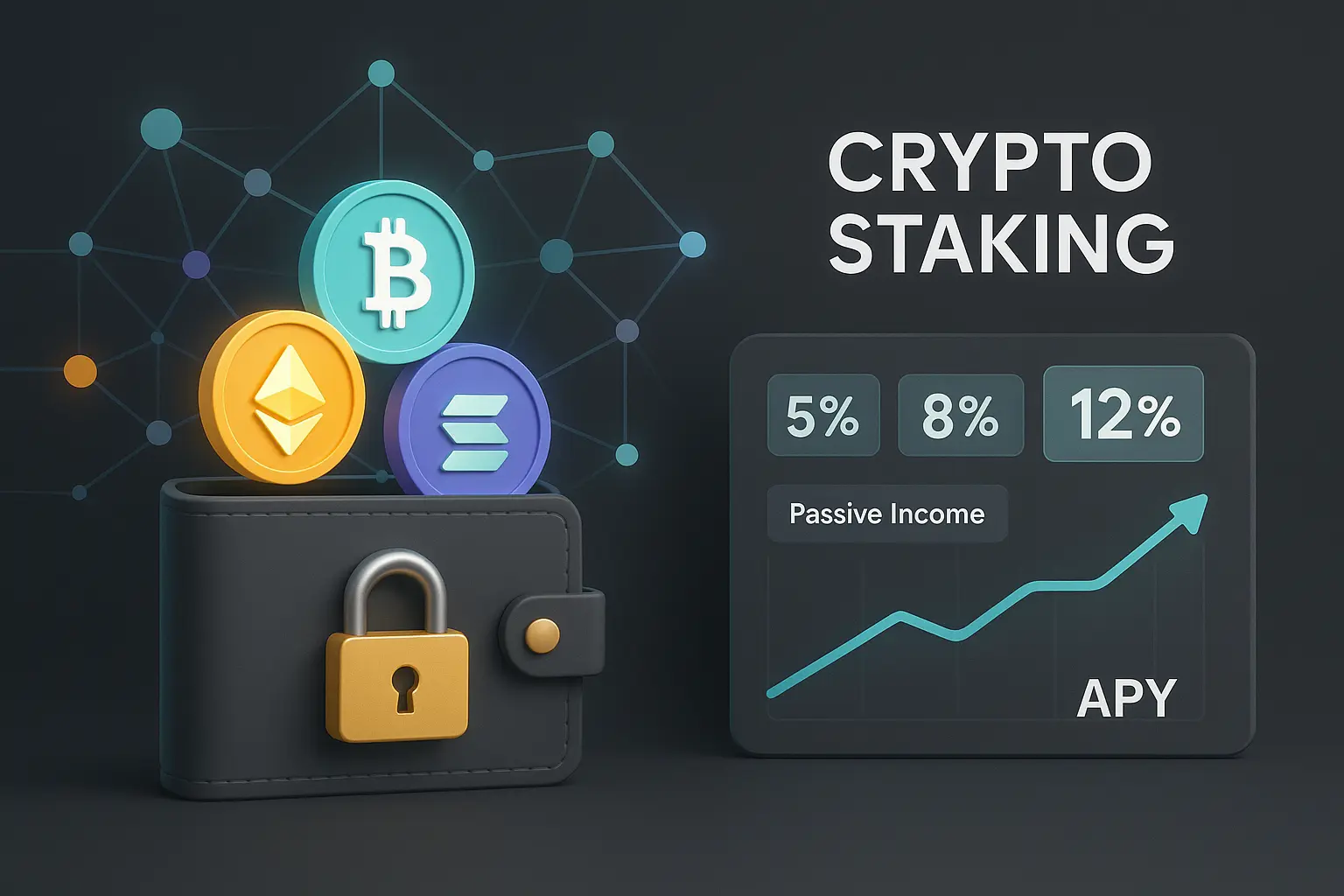
- Earn additional coins without active trading. Your holdings generate rewards passively once staking is set up, rather than sitting idle in a wallet.
- Contribute to blockchain security. By staking, you put capital to work validating transactions and maintaining the network. You’re not just earning rewards; you’re playing a functional role in keeping the chain honest.
- No mining hardware or high electricity costs. Unlike proof-of-work mining, staking doesn’t require specialized equipment or large power bills. A standard computer (for validators) or simply an exchange account (for delegators) is enough.
- Encourages holding over short-term selling. Lock-up periods and the steady flow of rewards create a reason to hold rather than trade. When enough participants stake, the circulating supply of a token decreases, which can support its market value over time.
- Governance participation. Some networks grant voting rights to stakers, giving you a say in protocol upgrades and policy decisions that shape the blockchain’s future.
Risks of staking crypto
Staking isn’t risk-free, and understanding the downsides matters just as much as knowing the benefits:
- Price volatility. The staked coin’s market value can fall by more than the rewards you earn. If a coin drops 40% while you’re earning 5% in staking rewards, you’ve lost money in dollar terms.
- Lock-up and unstaking periods. Your coins are frozen during these windows. If the market drops sharply, you can’t sell or move your funds until the cooldown ends.
- Validator risk. Poor uptime, technical errors, or dishonest behavior by your chosen validator can reduce or wipe out your rewards. As a delegator, you’re directly exposed to your validator’s performance.
- Slashing. PoS protocols can penalize misbehaving validators by confiscating a portion of their staked coins, and delegators who backed a slashed validator can lose part of their stake too.
- Platform risk. If you stake through an exchange or custodial platform, hacks, insolvency, or sudden policy changes can put your assets at risk.
- Reward dilution. High staking yields sometimes reflect rapid growth in a token’s total supply. The rewards look attractive in token terms, but if the supply is inflating quickly, each token’s share of the network’s value shrinks. Non-stakers get diluted the most, but even stakers can find their real returns are lower than the headline APY suggests.
- Concentration risk. When a large share of a network’s supply sits in staking contracts or is controlled by a small number of addresses, the network becomes vulnerable to coordinated selling or smart-contract failures. As of early 2025, roughly 30% of all Ether was deposited in Ethereum’s staking contract, and the next 60 largest Ether addresses held about 18% of total supply as of March 2025. That level of concentration means a bug in a major staking contract or a decision by large holders to exit could trigger significant price swings.
- Regulatory uncertainty. Staking rules differ across jurisdictions and can change. What’s allowed or taxed one way today might be treated differently tomorrow.
Can you lose money staking crypto?
Yes. Loss is possible through several paths, and staking rewards don’t automatically protect you from them.
The most common way to lose money is a decline in the staked coin’s price. Rewards are paid in the same token you staked, so you’re accumulating more units of an asset that may be falling in dollar value. If the price drops far enough, no amount of reward tokens makes up the difference.
Slashing penalties are another source of loss. If your validator gets slashed, you can lose a portion of your delegated coins outright. And if you stake through a platform that gets hacked or becomes insolvent, recovering your assets can be difficult or impossible.
Timing plays a role too. During warm-up and cooldown periods, your coins are locked. If the market turns while your funds are frozen, you can’t sell to limit your losses. Choosing a reliable validator, understanding the lock-up terms, and only staking coins you’re prepared to hold through volatility all reduce, but don’t eliminate, these risks.
What is slashing?
Slashing is a penalty mechanism built into PoS blockchains that punishes validators for malicious or negligent behavior. It’s what gives the “stake as collateral” model its teeth.
Common triggers include signing conflicting blocks (which could indicate an attempt to double-spend), extended downtime that disrupts the network’s ability to finalize blocks, and voting inconsistencies during the consensus process. When a validator is slashed, the protocol automatically confiscates a percentage of the crypto locked in their staking contract.
Delegators aren’t shielded from this. If you’ve delegated coins to a validator that gets slashed, you can lose a share of your delegated stake proportional to the penalty. This is why validator selection matters so much: you’re not just choosing who earns you rewards, you’re choosing who holds the risk of penalty over your coins. Slashing raises the financial cost of dishonesty high enough that it’s almost always cheaper to play by the rules, which is exactly how it protects the network’s integrity.
Staking vs lending and yield farming
These three activities all generate returns on crypto holdings, but they work in fundamentally different ways.
When you stake, your coins stay on the blockchain. They’re locked in a staking contract to help validate transactions, and they’re never transferred to another party’s control. The blockchain itself generates your rewards through new token issuance and fees.
Lending sends your crypto to a borrower through a platform. The borrower uses your coins, and you earn interest in return. Your tokens leave your control and sit with the borrower or the lending platform until the loan is repaid. The risk profile is different: you’re exposed to the borrower’s ability to repay and the platform’s solvency, not just the blockchain’s mechanics.
Yield farming is the most hands-on of the three. It involves actively moving assets across DeFi protocols to chase the highest available return. You might provide liquidity to a decentralized exchange, deposit into a lending pool, and then use the receipt tokens from that deposit in another protocol, all at the same time. The potential returns can exceed staking, but the complexity is much higher. You need to monitor positions constantly, understand how each protocol works, and accept risks like smart-contract exploits and impermanent loss (where the value of your deposited tokens shifts unfavorably compared to simply holding them).
Staking is comparatively passive once you’ve set it up. Yield farming resembles active portfolio management. If you want to earn on coins you’re already planning to hold without checking in daily, staking is the simpler choice. If you’re comfortable with DeFi mechanics and willing to invest the time, yield farming offers more flexibility and potentially higher returns at the cost of more risk and attention.
Crypto staking vs savings accounts
On the surface, staking and savings accounts both let you earn a return on money you’re not spending. The mechanics and protections behind them are entirely different.
A savings account is a bank product. The bank states an interest rate, your principal is denominated in U.S. dollars (or another fiat currency), and in the United States, deposits are insured by the FDIC up to the legal limit. Your balance doesn’t fluctuate with market conditions. The interest rate may change over time, but it’s typically disclosed in advance.
Staked crypto has none of those guardrails. Rewards are variable and protocol-driven. They can change without notice based on network participation levels and protocol updates. The value of your staked coins moves with the crypto market, so your principal in dollar terms can rise or fall dramatically. There’s no deposit insurance. If a validator gets slashed, a platform fails, or the token’s price crashes, there’s no safety net to make you whole.
This doesn’t mean staking is bad and savings accounts are good. They serve different purposes and carry different risk profiles. A savings account preserves capital with minimal risk. Staking puts capital to work with higher potential returns but exposes it to market and protocol risk. Understanding that distinction keeps you from treating staking rewards as guaranteed income the way you might treat bank interest.
Are staking rewards taxable?
The IRS classifies staking rewards as income, so you owe taxes on them the moment you receive them, a core part of our crypto tax guide. The taxable amount is the fair market value of the tokens at the time you receive them and gain control over them. This means every reward payout creates a taxable event, even if you don’t sell the tokens.
If you later sell, swap, or spend those reward tokens, that disposal may trigger a separate capital gains or loss event. The gain or loss is based on the difference between the token’s price when you received it (your cost basis) and its price when you disposed of it.
Keeping accurate records is a practical necessity. You need to track the date of each reward receipt and the fair market value at that moment. With staking rewards often arriving in small, frequent increments, this can add up to a lot of data points over the course of a year. Crypto tax software can help, but the record-keeping responsibility falls on you.
Tax treatment varies outside the United States. In the UK, for example, HMRC may tax staking rewards as income and apply Capital Gains Tax on later disposal, depending on the transaction structure. If you stake across multiple jurisdictions or hold citizenship in more than one country, the picture gets more complicated. This is an area where consulting a tax professional familiar with digital assets pays for itself.
Common beginner mistakes when staking
Most staking mistakes come from rushing in before understanding how the moving parts connect:

- Chasing the highest APY. A headline reward rate means nothing if the coin’s fundamentals are weak or the validator has a poor track record. High APY on an obscure token often reflects rapid supply inflation, meaning you’re earning more tokens that are each worth less over time.
- Ignoring lock-up and unstaking periods. Skipping the fine print on cooldown timelines before you stake can leave you unable to act for weeks if the market turns against you. Know exactly when you’ll be able to access your coins before you commit them.
- Overlooking validator selection. Not all validators are equal. Poor performance, frequent downtime, or even slashing events directly reduce your returns. Spending time researching a validator’s uptime history and fee structure is one of the most useful things a new staker can do.
- Forgetting about taxes. Every staking reward is a taxable event in the U.S., and selling those rewards later creates another one. Failing to track and report these can create problems at tax time.
- Not understanding the platform’s custody model. Staking through an exchange means the exchange holds your keys. Staking through a non-custodial wallet means you hold them. The difference matters if the platform has a security breach or changes its policies.
- Focusing on rewards while ignoring price risk. A 6% staking yield doesn’t help if the coin’s price drops 30%. The reward rate is only one part of the equation. The staked asset’s price trajectory and your willingness to hold through volatility are just as important.
Is staking crypto worth it?
Staking makes the most sense for coins you already plan to hold for the long term. If you’re going to keep ETH, SOL, or ADA in your wallet for months or years, staking turns those idle assets into something productive rather than letting them sit.
Whether it’s “worth it” depends on several factors specific to your situation. Your risk tolerance matters: can you handle your staked coins being locked during a market drop? Your time horizon matters: short-term holders who might need to sell quickly are a poor fit for assets with multi-week unstaking periods. And your willingness to do the homework matters: understanding the validator you’re backing, the network’s slashing rules, and the tax implications of each reward payout.
A high reward rate alone doesn’t make staking worthwhile. If the underlying token’s price is declining or the network carries elevated slashing risk or heavy concentration in a few addresses, the yield can easily be outweighed by losses. We’ve seen at AXL Research Hub that the stakers who do well over time are the ones who evaluate the full setup, including the blockchain’s mechanics, reward variability, validator reliability, and tax impact, before committing coins. That kind of careful decision-making is the difference between staking as a thoughtful strategy and staking as speculative chasing.
Frequently asked questions
What is the difference between staking and mining?
Staking locks coins on a proof-of-stake network to validate transactions, while mining uses specialized hardware and electricity on a proof-of-work network to solve cryptographic puzzles. Both accomplish the same core job, verifying transactions and securing the blockchain, and both earn rewards for participants. The difference is the resource they consume: staking requires capital (locked coins), and mining requires computing power and energy.
Staking as a building block for long-term crypto strategy
Staking ties passive reward generation to active participation in blockchain security. You’re not just earning yield; you’re playing a role in keeping the network you’ve invested in honest and functional. That dual purpose gives staking a logic that purely speculative crypto activity doesn’t have.
The PoS model continues to expand as more blockchains adopt it, which broadens the range of stakeable assets and the tools available to stakers. More wallets support one-click delegation, more liquid staking protocols offer flexibility, and more educational resources cover the details. The infrastructure is maturing.
But infrastructure alone doesn’t make staking a good decision for everyone. Understanding the full mechanics, from proof of stake and validator economics to lock-up trade-offs and tax treatment, turns staking from a buzzword into a deliberate part of a portfolio. If you take the time to learn what you’re committing to, staking can be a steady, productive layer in a long-term crypto strategy.