
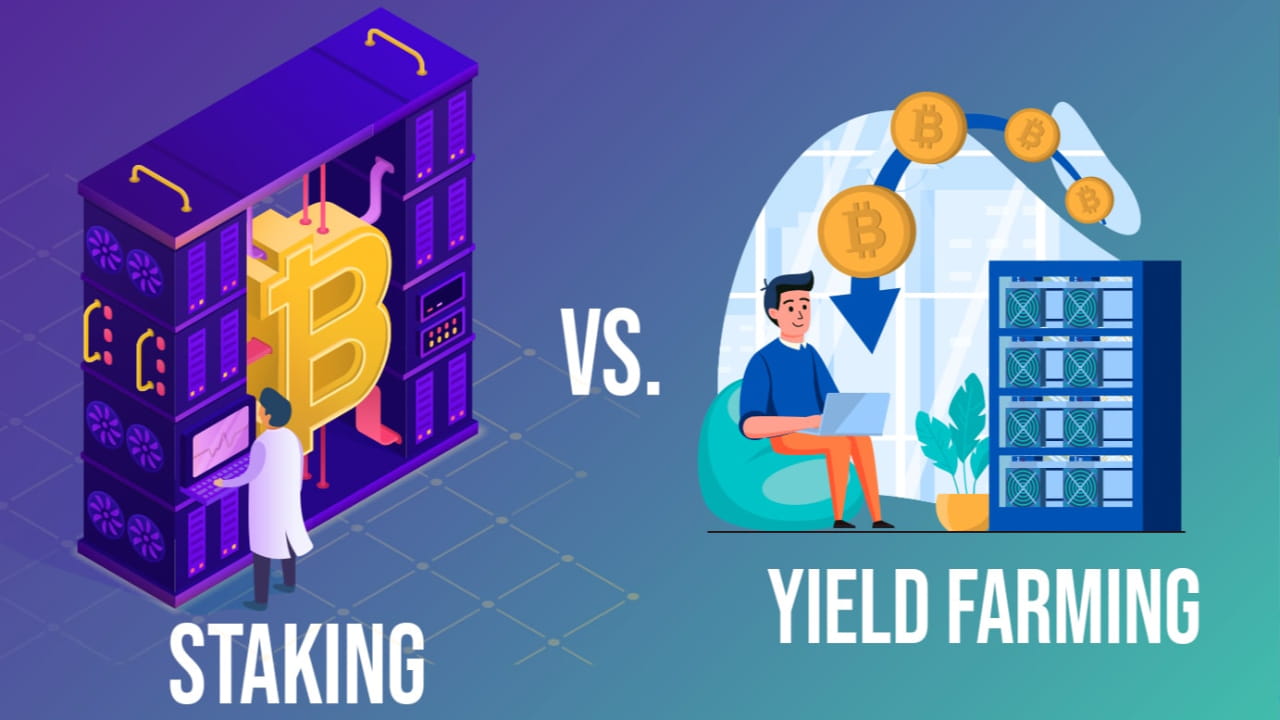
Staking and yield farming both put idle crypto to work, but they do it in fundamentally different ways and expose you to different levels of risk. Staked tokens back a network’s security and pay in the token you locked; farmed tokens supply trading liquidity and pay in fees plus whatever governance tokens the protocol is handing out. The riskier the venue, the higher the advertised yield.
What is the difference between staking and yield farming?
Staking locks your tokens in a proof-of-stake blockchain to help validate transactions and secure the network. In return, you earn rewards, usually paid in the same token you staked. Yield farming takes a different path: you deposit crypto assets into DeFi liquidity pools or lending protocols so other users can trade or borrow against them. As a liquidity provider, you earn a share of transaction fees and, in many cases, bonus governance tokens issued by the protocol itself.
Both methods generate passive income by temporarily committing capital, but the capital serves different purposes. Staked tokens back network security. Farmed tokens supply trading liquidity. That distinction shapes nearly every difference between the two, from reward stability to risk exposure.
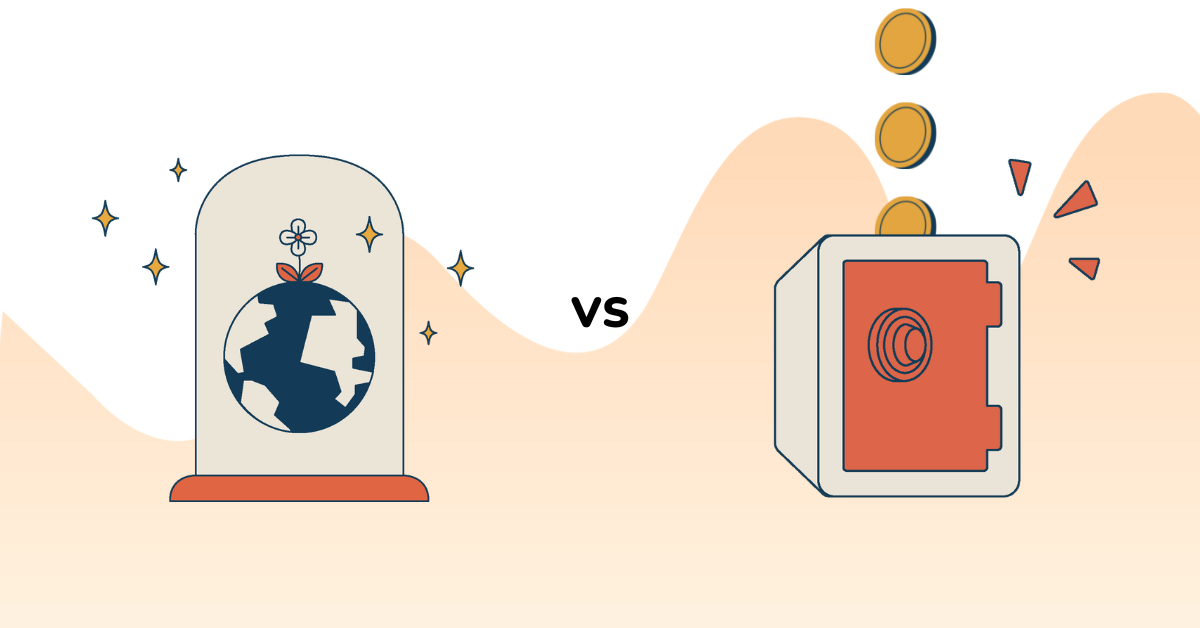
Free-market dynamics set yield levels in both cases. Newer or riskier networks and pools tend to pay higher percentages to attract capital, while mature, well-established options settle into narrower reward bands. Understanding where your capital goes, and why the yield exists, is the first step in choosing between these two strategies.
How staking works
Proof-of-stake consensus selects validators to build or confirm blocks based on the amount of tokens they have at stake. The more you stake, the higher your chance of being chosen and the more rewards you collect over time. Validators who act dishonestly or go offline face slashing, a penalty that removes part of their staked tokens. That built-in punishment is what keeps the network honest.
There are three common ways to stake. You can run a solo validator node, which gives you full control but requires technical setup and, on some networks like Ethereum, a significant minimum deposit. You can delegate through a centralized crypto exchange, which is the simplest option since the exchange handles validation on your behalf. Or you can use a liquid staking platform, which issues a tradable derivative token representing your staked position and accrued rewards. That derivative preserves your liquidity while your underlying tokens remain staked, a detail that matters more than most guides let on (we’ll come back to it).
Rewards are paid periodically, often every few days or weeks depending on the network. Typical staking APY falls in the range of 4% to 15% depending on the protocol. Staking activity spans multiple chains including Ethereum, BNB Chain, Solana, Cardano, and Tron, each with its own reward schedule and minimum requirements. Ethereum staking, for example, is available via solo validation, exchange delegation, or liquid staking, giving you flexibility regardless of your technical skill level.
How yield farming works
Yield farming starts when you deposit tokens into a DeFi protocol’s liquidity pool. Other users trade against or borrow from that pool, and the fees they pay get distributed to liquidity providers proportionally. On top of those trading fees, some protocols distribute their own governance token as an additional reward, which is often where the headline-grabbing APY numbers come from.
Rewards can accrue dynamically, sometimes hourly, based on pool activity and the protocol’s incentive schedule. Yield farming APY can range from roughly 10% to over 100% in high-incentive pools, though those triple-digit numbers rarely last. Protocols adjust incentives frequently, and early pools almost always pay the highest rates to bootstrap liquidity.
Because of those shifting rates, yield farmers often move capital between protocols chasing the highest available APY. That kind of active management separates farming from the more passive nature of staking. You’re not just depositing and waiting; you’re watching rates, comparing pools, and repositioning when the math changes.
Staking vs yield farming: head-to-head comparison
| Factor | Staking | Yield farming |
|---|---|---|
| Risk level | Lower to moderate; tied to validator reliability | Higher; impermanent loss, smart-contract bugs, protocol exploits |
| Return profile | Predictable, narrower band (roughly 4%-15% APY) | Potentially higher but volatile |
| Complexity | Minimal setup, especially through an exchange | Requires DeFi navigation, wallet management, and strategy adjustments |
| Lock-up periods | Often has fixed lock-up or cool-down windows | Typically allows withdrawal at any time, though delays or penalties may apply |
| Tokens needed | Only the single token being staked | Usually a pair of tokens for the liquidity pool |
| Transaction fees | Infrequent, lower fees for locking and unlocking | Frequent gas costs for adding liquidity, removing liquidity, claiming rewards, and swapping tokens |
| Reward token type | Same token you staked | May pay in a different protocol token |
| Market sensitivity | Rewards keep flowing regardless of market direction | Returns peak during high-volume bull markets, shrink in bear markets |
One detail worth calling out: yield farming gas fees on Ethereum add up across multiple transactions per position. Every time you add liquidity, remove it, claim rewards, or swap tokens, you’re paying gas. On congested networks, those costs can seriously cut into your net return, especially on smaller positions.
Risks of staking
For most stakers, the real danger is a token price decline during a crypto staking lock-up period, not a protocol exploit. If the token’s market value drops while your stake is locked, the fiat value of your holdings falls with it, and you can’t sell until the cool-down window ends. You’re earning more tokens the entire time, but those tokens are worth less than when you started.
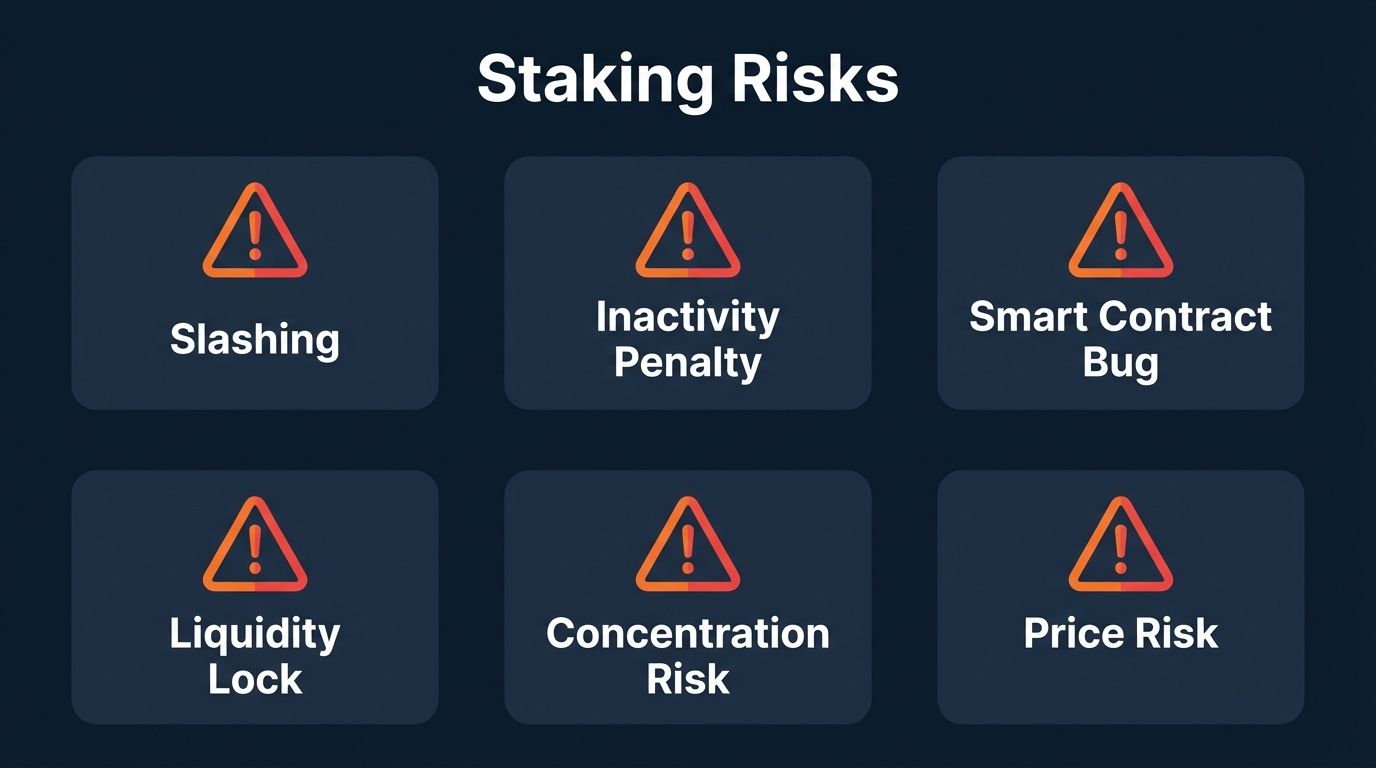
Slashing penalties are another concern. When a validator misbehaves or goes offline, the network can slash part of the staked balance. If you’re running your own node, that’s your responsibility. If you’ve delegated, your rewards (and sometimes your principal) depend on the validator you chose performing reliably.
Delegating through a centralized exchange introduces counterparty risk. The exchange controls the keys and custodies the funds. If the exchange mismanages assets or faces insolvency, your staked tokens are at risk regardless of how the underlying blockchain performs.
There’s also the opportunity cost. Capital locked in staking can’t be moved to higher-yield opportunities that appear while you wait. That said, staking’s overall risk profile remains lower than yield farming because you’re not exposed to impermanent loss or the full range of DeFi smart-contract exploits.
Risks of yield farming
Impermanent loss is the risk that defines yield farming. It happens when the prices of the two tokens in your liquidity pool diverge from the ratio at which you deposited them. The pool automatically rebalances, and if you withdraw at that point, you end up with fewer of the token that gained value and more of the one that lost. The result is a loss compared with simply holding both tokens in your wallet. The wider the price divergence, the bigger the impermanent loss.
Rug pulls add another layer of danger. Malicious project teams can drain a pool’s liquidity entirely, leaving depositors with worthless tokens or nothing at all. This risk is highest in unaudited protocols and newly launched pools offering suspiciously high APY.
Even in legitimate protocols, volatile reward tokens can lose value rapidly. A pool might advertise 80% APY, but if the governance token you’re earning drops 90% in price, your realized yield is far lower than the number suggested. You’re earning tokens, but those tokens may not hold their value.

High and frequent gas fees make the problem worse. Every interaction with the smart contract costs gas, and on congested networks those fees add up fast. For smaller positions, gas can eat a significant portion of your profits.
Finally, DeFi incentive structures change quickly. A protocol can reduce emissions or redirect rewards to a different pool overnight, dropping your APY without warning. Yield farming requires constant monitoring, and stepping away for a week can mean missing a shift that turns a profitable position into a losing one.
Liquid staking and stacking strategies
Liquid staking blurs the line between the two strategies because it lets you earn validator rewards and deploy capital in DeFi at the same time. When you stake through a liquid staking platform, you receive a derivative token that represents your staked position plus accrued rewards. That derivative is tradable and, more importantly, usable in DeFi.
This is where the stacking strategy comes in. You can take that derivative token and deposit it into a DeFi lending pool or liquidity pool, effectively layering staking yield on top of yield-farming yield. While your original tokens keep earning staking rewards on the base layer, the derivative token simultaneously picks up fees or incentives on the DeFi layer, giving you two income streams from a single capital outlay.
The trade-off is compounded risk. You’re simultaneously exposed to validator slashing on the staking side and smart-contract exploits on the DeFi side. If the liquid staking protocol suffers a bug, your derivative could lose its peg to the underlying asset, meaning it trades below the value of the staked tokens it’s supposed to represent. And if the DeFi protocol where you’ve deposited that derivative gets exploited, you lose access to your derivative entirely.
Before combining strategies, check two things. First, look at how stable the derivative token’s peg has been over time. A token that regularly trades at a discount to its underlying isn’t functioning as a reliable proxy. Second, confirm the audit status of both the staking protocol and the DeFi protocol. Stacking unaudited protocols multiplies your exposure to unknown vulnerabilities.
Bull-market and bear-market dynamics
Market conditions change the math for staking vs yield farming more than most people realize.
Yield farming returns spike during bull markets. Trading volumes surge, pool activity picks up, and protocol teams often increase token incentives to capture new liquidity. Higher fees and richer rewards together can push farming APY well above its baseline. If you’re already positioned in the right pools when a rally starts, the returns can be significant.
In bear markets, that picture reverses. Lower trading volume reduces fee income across DeFi. Volatile reward tokens drop in value alongside the broader market, which means even if you’re still earning the same number of tokens, they’re worth far less. Farming in a bear market can feel like running in place.
Staking rewards, by contrast, remain relatively stable through market cycles because they come from block-validation incentives, not trading activity. The network keeps producing blocks regardless of whether markets are up or down, and your reward rate stays roughly the same. Bear-market stakers still face unrealized losses from the token’s price decline, but they continue accumulating tokens at the protocol’s set rate. If the token recovers, those accumulated rewards become more valuable.
This means your choice between the two strategies partly depends on where you think the market cycle is headed and how long you plan to hold. Staking works better as a steady accumulation strategy during uncertain or declining markets. Yield farming has more upside during periods of high activity, but it can underperform staking when volumes dry up.
Staking pros and cons
Staking appeals to people who want passive income without a steep learning curve. Here’s what works in its favor and where it falls short.
Pros:
- Straightforward setup, especially through an exchange. You select a token, choose a validator or staking option, and confirm. No need to interact with DeFi protocols or manage multiple wallets.
- Predictable reward rate within a narrower APY band. You know roughly what to expect, which makes planning easier.
- Your staked tokens contribute to blockchain security and decentralization. You’re not just earning; you’re supporting the network you hold tokens in.
Cons:
- Lock-up periods restrict access to your capital. Depending on the network, you may wait days or weeks to withdraw.
- Returns are generally modest compared with high-incentive farming pools. If maximizing yield is your primary goal, staking alone won’t get you there.
- Slashing risk exists if your chosen validator underperforms or goes offline. Picking a reliable validator matters.
Yield farming pros and cons
Yield farming attracts users willing to trade simplicity for higher potential returns. The upsides are real, but so are the drawbacks.
Pros:
- Potential for significantly higher APY than staking, particularly in newer pools with aggressive incentive programs.
- Generally no mandatory lock-up. Liquidity can be withdrawn when you need it, giving you flexibility to exit or reposition.
- Ability to hop between protocols to chase the best rates. Active managers can capture yield across multiple platforms.
Cons:
- Smart-contract bugs or hacks can drain deposited funds entirely. Even audited protocols aren’t immune.
- High and recurring gas fees reduce net returns, especially on Ethereum during congested periods. Smaller positions can lose money to fees alone.
- Requires active monitoring, DeFi literacy, and wallet management. This isn’t a set-and-forget approach.
- Reward-token volatility can erase paper gains quickly. A high APY number means little if the token you’re earning crashes.
Which strategy should you choose?
Start with your risk tolerance. If you prefer simplicity and can accept modest, steady returns, staking is the more natural fit. You pick a token, lock it up, and collect rewards without needing to check in daily. Long-term holders who don’t plan to trade actively benefit the most from staking’s set-and-forget nature.
If you have a higher risk tolerance, solid DeFi fluency, and the willingness to actively manage positions, yield farming offers a path to higher returns. You’ll need to be comfortable with smart contracts, understand how gas fees affect your net yield, and stay on top of protocol changes that can shift APY overnight.
Liquidity needs should factor in, too. Staking often locks funds for a set period, which can be a problem if you need access to your capital quickly. Yield farming usually allows withdrawal at any time, but pulling out during a period of high impermanent loss can lock in a loss you might have recovered from by staying.
For many people, the strongest approach is combining both strategies rather than picking one over the other. Combining both strategies in a single portfolio diversifies your income sources and balances the risk-return spectrum. You might stake a core holding for steady accumulation while farming with a smaller allocation that you’re comfortable losing if a pool goes sideways. That split lets you capture some of farming’s upside without putting your entire position at risk.
Frequently asked questions
Can you lose crypto while staking?
Yes. Your staked tokens can lose fiat value if the token’s price drops during the lock-up period, and slashing penalties can reduce your token balance if your validator misbehaves or goes offline. Even so, staking carries less overall risk because impermanent loss and DeFi smart-contract exploits aren’t part of the equation.
Are returns guaranteed with either method?
No. Staking rewards are more predictable because they’re tied to block-validation schedules, but they aren’t guaranteed. Network changes, validator issues, or protocol updates can affect your rate. Yield farming returns fluctuate with market conditions, pool activity, and protocol incentive changes. Neither strategy promises a fixed return.
What is safer for long-term holding?
Staking is generally the safer option for long-term holders. Its mechanics are simpler, it has fewer attack surfaces, and there’s no impermanent-loss exposure. You’re earning the same token you deposited, on a protocol designed to reward you for securing the network. Yield farming can pay more, but it demands active management and carries more ways to lose capital.
Matching your passive-income strategy to your risk profile
Both staking and yield farming convert idle crypto into working capital, each along a different risk-return curve. Staking offers steadier, lower-maintenance income. Yield farming offers higher ceilings but demands more attention and tolerance for loss.
If you’re just getting started, staking on a well-established network is the simpler entry point. As your DeFi knowledge grows, you can explore farming with smaller positions and work your way into more complex strategies like liquid staking stacks.
Before committing capital to either strategy, check three things: the lock-up terms, the fee structure (especially gas costs relative to your position size), and the smart-contract audit history of the protocol you’re using. Unaudited protocols and unclear withdrawal terms are red flags regardless of how high the APY looks.
Regular portfolio reviews help, too. Market conditions shift, protocol incentives change, and your personal goals evolve. Adjusting your staking-to-farming ratio as those factors move keeps your passive-income strategy aligned with what you actually need from your portfolio.