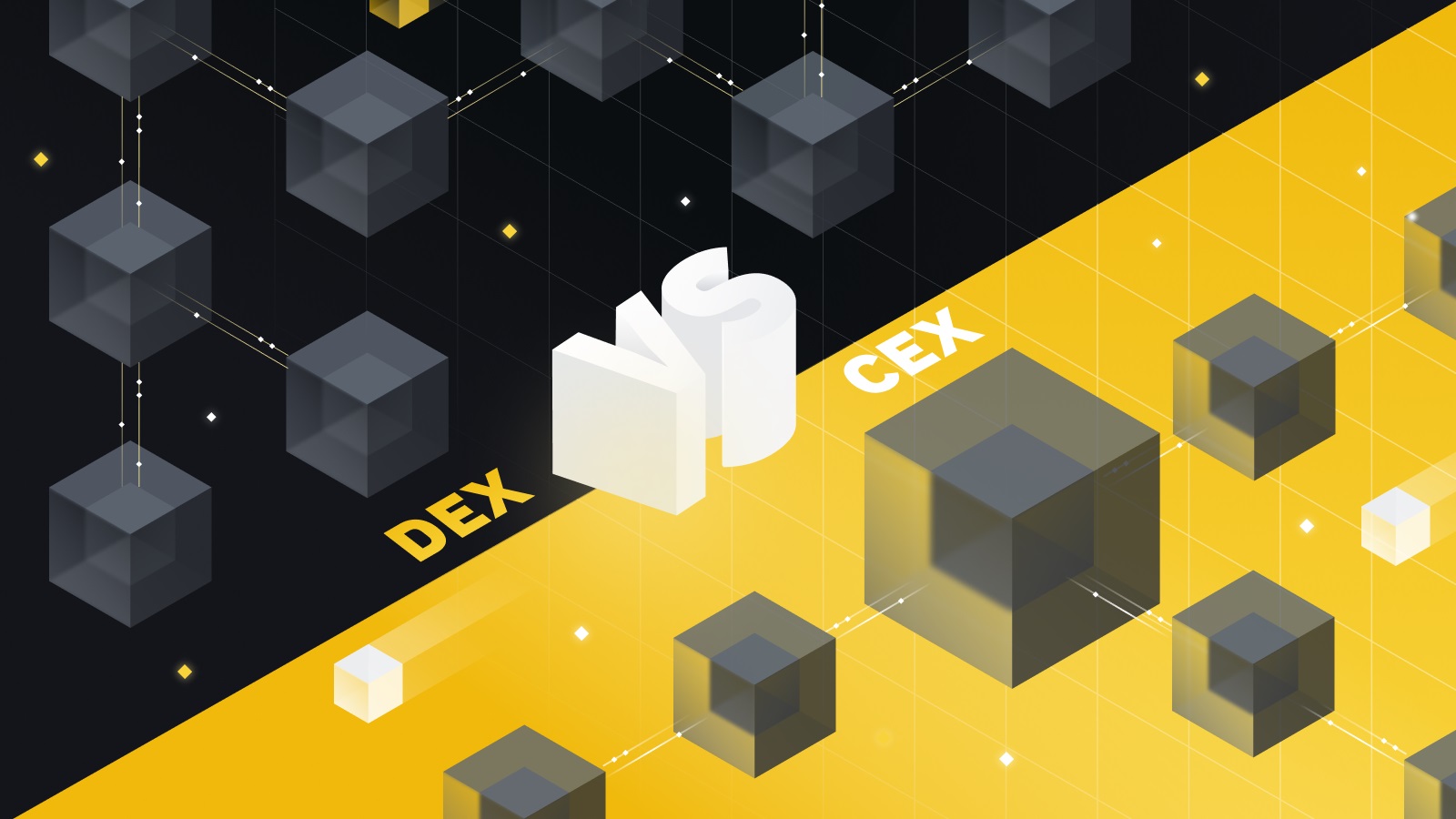

The CEX vs DEX decision hinges on a few practical questions: do you want the platform to custody your assets, or will you hold your own keys? Are you comfortable with on-chain execution, or do you need the speed of an off-chain matching engine? And how much risk management are you ready to handle without a support team behind you? Whether you’re buying your first bitcoin with a debit card or routing a large swap through multiple liquidity pools, the differences between these two exchange types shape every step of the process.
What are centralized and decentralized exchanges?
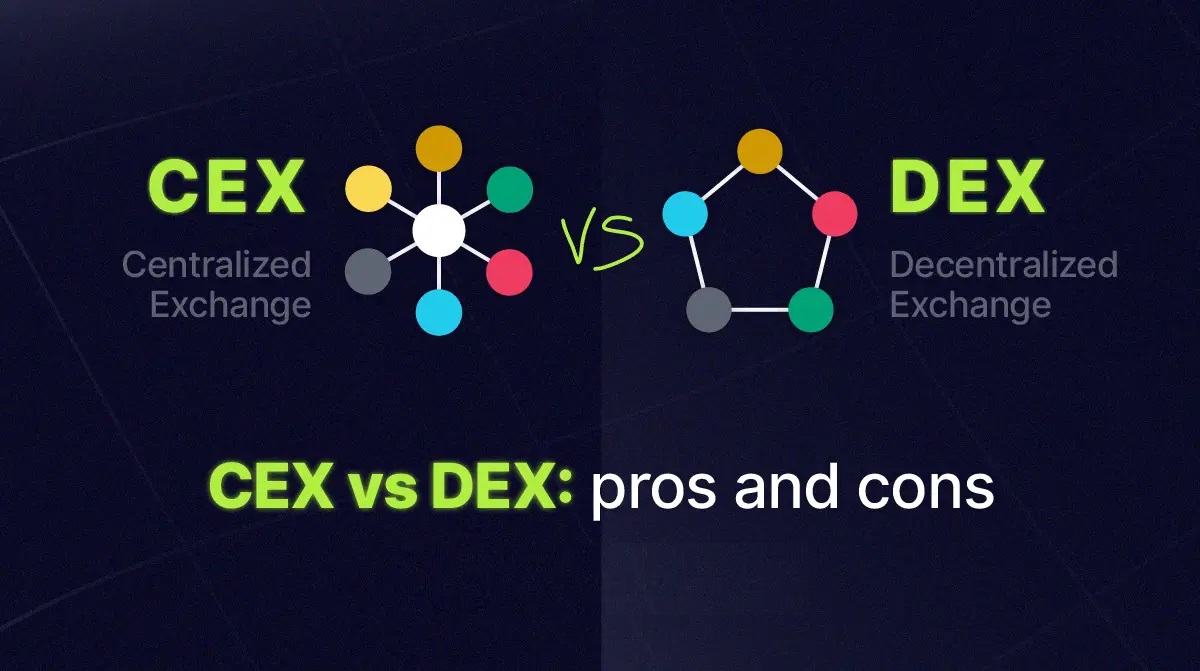
A centralized exchange (CEX) is a trading platform run by a single company that acts as the intermediary between buyers and sellers. The company holds user funds in its own wallets, matches orders through an internal order book, and handles deposits, withdrawals, and account management. If you’ve used a traditional stock brokerage, the experience feels similar: you create an account, deposit money, and trade through the platform’s interface.

A decentralized exchange (DEX) is a protocol built on smart contracts that lets users trade directly from self-custodial wallets without a central intermediary. There’s no company sitting between you and the other side of a trade. Instead, the exchange logic lives on a blockchain, and trades settle on-chain.
Both types let you buy, sell, and swap crypto, but they differ in custody, architecture, risk profile, and day-to-day workflow. CEXs grew out of the same model as traditional financial exchanges. DEXs emerged from blockchain-native development as an alternative that removes the need to trust a single operator with your assets. In practice, many crypto users rely on both: a CEX for converting dollars into crypto and a DEX for permissionless token swaps or access to newly launched projects.
How do CEXs and DEXs work?
CEXs and DEXs differ most in where and how trades get matched. CEXs use order books and matching engines running on private servers. DEXs replace that model with automated market makers and on-chain liquidity pools.
Order books and matching engines on a CEX
A CEX maintains an order book, a running record of every open buy and sell order at various price points. When you place a trade, the exchange’s matching engine pairs your bid with a seller’s ask (or vice versa) and executes the trade off-chain on the company’s private servers. Because none of this touches a blockchain until you withdraw, throughput is high. One major CEX matching engine sustains more than 1,400,000 orders per second, according to Chainlink.
Institutional market makers play a big role here. They supply continuous quotes on both sides of the order book, keeping spreads tight and liquidity deep on popular trading pairs. This is why large market orders on a major CEX often fill with minimal slippage.
Before you can trade, you deposit fiat or crypto into wallets the exchange controls. From that point on, your balances update internally. Buying ETH with USDT on a CEX doesn’t trigger an on-chain transaction for every fill. It’s just a database update on the exchange’s servers. On-chain settlement only happens when you withdraw to your own wallet.
Automated market makers and liquidity pools on a DEX
Early DEXs tried running fully on-chain order books, but every node on the network had to record each order. That was too slow and too expensive to compete with centralized alternatives. Automated market makers (AMMs) solved that scalability problem by replacing the order book entirely.
An AMM uses liquidity pools: smart contracts that hold reserves of two or more tokens. Instead of matching individual buyers with individual sellers, traders swap against the pool itself. Price is set algorithmically based on the ratio of tokens in the pool, commonly using the constant-product formula x × y = k. When you swap token A for token B, the pool’s balance of A increases and its balance of B decreases, shifting the price for the next trade.
Anyone can become a liquidity provider (LP) by depositing a pair of tokens into a pool. In return, LPs earn a share of the swap fees generated by that pool. This open model means liquidity isn’t controlled by a handful of market makers; it’s crowdsourced.
Not every DEX runs on an AMM, though. Some platforms use on-chain or hybrid order books, especially for derivatives trading and large-order execution where AMM slippage would be too costly. Execution speed on any DEX depends on the underlying blockchain’s capacity and current congestion. A swap on a busy Ethereum mainnet day takes longer and costs more in gas than one on a low-traffic layer-2 network.
CEX vs DEX: key differences at a glance
| Feature | CEX | DEX |
|---|---|---|
| Custody | Exchange holds user funds in custodial wallets | Users keep assets in self-custodial wallets throughout the trade |
| Access and identity | Account creation plus KYC/AML verification required | Only a compatible wallet connection needed |
| Transaction speed | Off-chain execution, near-instant settlement | On-chain confirmation required, speed varies with network load |
| Liquidity | Large aggregated order books with deep liquidity on major pairs | Depends on pool depth and network activity |
| Trading features | Spot, margin, futures, options, algorithmic APIs | Primarily token swaps; some platforms now support perpetuals and limit orders |
| Fees | Trading fees and withdrawal fees, sometimes with tiered discounts | Swap fees paid to LPs plus variable gas fees paid to the network |
| Transparency | Internal operations are opaque | Smart-contract code is publicly verifiable on-chain |
| Privacy | Collects personal data under regulatory requirements | Generally collects none, though on-chain activity is publicly traceable |
| Main risk | Counterparty failure, hacks, withdrawal freezes | Smart-contract bugs, fake tokens, user error |
Custody, security, and privacy compared
Who holds the assets, what threats each model faces, and how much personal data gets exposed are tightly connected. A custodial exchange that stores millions of users’ funds faces very different attack vectors than a non-custodial protocol where every user manages their own keys.
Custodial vs non-custodial models
On a CEX, the exchange holds your private keys. After you deposit funds, the platform controls them. You’re trusting the company’s internal security practices, its solvency, and its willingness to let you withdraw when you want to. If the platform fails, restricts withdrawals, or gets hacked, recovering those funds can be difficult or impossible.
On a DEX, you keep your private keys. Your wallet connects to the protocol’s interface, the smart contract executes the swap, and the tokens land back in your wallet. No third party ever takes custody. This removes the counterparty risk tied to trusting a company with your assets.
The trade-off is responsibility. Self-custody means you’re the only line of defense. Losing a seed phrase means permanent loss of access. Signing a malicious smart contract can drain your wallet. Connecting to a phishing site that mimics a legitimate DEX front-end can have the same result. There’s no support team to call and no “forgot password” flow. Every approval you sign is final.
Security risks on CEXs
Centralized pools of user funds create a single point of failure that’s attractive to hackers. A successful breach of one exchange can compromise millions of accounts at once.
But hacks aren’t the only threat. Exchange insolvency, hidden debt, or reckless internal lending can collapse a platform even without a technical exploit. High-profile exchange failures in 2022 showed that operational and counterparty risks can be just as devastating as a hack. Users who assumed their funds were safe discovered that the company had been mismanaging deposits behind the scenes, according to the Bitcoin Foundation.
Regulatory actions add another layer. Authorities can freeze accounts, restrict withdrawals, or force token delistings without advance notice. If you’re holding funds on a CEX when that happens, your options narrow fast.
Security risks on DEXs
Smart-contract vulnerabilities are the primary technical risk on a DEX. Bugs or logical flaws in pool code can be exploited to drain locked assets. Even audited contracts aren’t guaranteed to be safe, though audits do reduce the surface area for attacks.
Permissionless listing, one of a DEX’s strengths, also creates a wide-open door for scams. Anyone can create a token with a name and logo that duplicate a legitimate project. Some impostor tokens include concealed minting functions or code that prevents buyers from selling. If you swap into one of these tokens, your funds are gone.
Front-running and MEV (maximal extractable value) extraction are subtler but real. Validators or specialized bots can see your pending transaction in the mempool, place their own trade ahead of yours to move the price, and profit from the difference. This happens automatically and invisibly. On high-traffic networks, MEV extraction can cost traders meaningful amounts on every swap, especially larger ones. Some protocols and tools try to reduce this by routing transactions through private mempools or using batch auctions, but the problem hasn’t disappeared.
Wallet-level threats round out the picture. Approving unlimited token allowances gives a smart contract permission to move your tokens without further confirmation. If that contract turns out to be malicious, or if a legitimate contract gets compromised later, your approved tokens are at risk. There’s no customer support and no reversal mechanism once a transaction is signed and confirmed on-chain.
Privacy vs. regulatory trade-offs
CEXs collect government IDs, address proofs, financial records, and detailed trade logs under KYC/AML regulations. This compliance framework gives users a path to legal recourse and consumer protections, but it also means a central server holds sensitive personal data. Data breaches at exchanges expose not just funds but identities.
DEXs generally require no personal identification. Connecting a wallet is enough to start trading. No name, no ID upload, no address verification. That said, on-chain activity is publicly visible. Every swap you make is recorded on the blockchain, and analytics firms can link wallet addresses, trace cross-chain transfers, and identify behavioral patterns.
Regulatory pressure on DEXs is growing. Stricter checks on fiat gateways, stablecoin interfaces, and large outflows may eventually reach DEX front-ends. The privacy gap between CEXs and DEXs is narrower than it first appears, and it may continue to shrink as Britannica Money notes in its comparison of adoption-rate factors across exchange types.
Pros and cons of centralized exchanges
CEXs remain the default entry point for most people getting into crypto, and for good reason. But the convenience comes packaged with risks that are easy to overlook until something goes wrong.
Pros:
- High liquidity and deep order books reduce slippage on major trading pairs. When you place a market order for BTC or ETH on a large CEX, the price you see is close to the price you get.
- Fiat on-ramps and off-ramps let you convert dollars, euros, and other currencies directly. You can link a bank account or card and go from cash to crypto without an extra step.
- Polished interfaces resemble traditional brokerage platforms, making the experience familiar for first-time crypto buyers who’ve used a stock trading app before.
- Customer support and account-recovery options reduce the cost of mistakes. Sending funds to the wrong internal address or forgetting a password doesn’t have to mean permanent loss.
- A wide product suite sits under one roof: spot trading, futures, staking, earn programs, launchpads, and sometimes NFT marketplaces.
Cons:
- Mandatory KYC removes trading anonymity. Your identity is tied to every transaction on the platform, and that data lives on the exchange’s servers.
- Concentrated fund storage creates a high-value target for cyberattacks. One breach can compromise a massive pool of user assets.
- Fees may exceed DEX swap fees in some cases, and hidden costs can sit inside wider spreads that aren’t always obvious on the trading screen.
Pros and cons of decentralized exchanges
DEXs offer a fundamentally different relationship with your assets. You stay in control, but that control demands more from you at every step.
Pros:
- Self-custody means your funds stay in your wallet until the moment a trade executes. No deposit, no waiting for withdrawal processing, no trust required in a third party’s solvency.
- Permissionless access lets anyone with a compatible wallet trade without registration or ID submission. There’s no approval process and no geographic gatekeeping at the protocol level.
- Early access to newly launched or niche tokens that haven’t been listed on centralized platforms. Projects often launch liquidity pools on a DEX weeks or months before a CEX listing.
- Composability with the broader DeFi ecosystem means your same wallet and tokens work across lending protocols, yield farming, governance voting, and more.
Cons:
- A steeper learning curve is unavoidable. Managing wallets, understanding gas fees, setting slippage tolerance, verifying token contracts, and revoking approvals all fall on you.
- Limited or no fiat on-ramps. You typically need to acquire crypto somewhere else first, usually a CEX or a third-party on-ramp service, before you can trade on a DEX.
- Liquidity varies widely by pool and network. A large trade on a thin pool can cause significant price impact, meaning you end up paying much more (or receiving much less) than the quoted price.
- Exposure to scam tokens, rug pulls, and malicious smart contracts is constant. The same permissionless design that enables innovation also enables fraud.
Fees and yield opportunities
Fee structures on CEXs and DEXs look different on the surface, and the actual cost of trading on each depends on factors that aren’t always visible upfront.
CEX trading fees are typically fixed or tiered by 30-day volume. Trade more, pay less per trade. Some platforms discount fees further when you pay using the exchange’s native token. Withdrawal fees vary by exchange and by which network you use to move funds. Depositing via credit or debit card often carries an additional fee on top of the trading cost.
DEX swap fees work differently. The fee you pay on a swap goes directly to liquidity providers, not to a corporate treasury. On top of that, every DEX trade incurs a network gas fee paid to blockchain validators for processing the transaction. Gas cost fluctuates with network congestion. During busy periods on Ethereum mainnet, a single swap’s gas fee can dwarf the swap fee itself. On layer-2 networks, gas fees have dropped substantially, making small DEX trades practical in a way they weren’t when everything ran on layer 1.
On the yield side, CEXs offer crypto staking services and structured earn programs where the platform handles the technical work and returns a predictable yield. You deposit, the exchange manages the rest. DEX yield farming lets LPs earn additional governance tokens on top of the swap fees their pooled liquidity generates, and the combined returns can exceed what centralized earn programs offer.
But DEX yield comes with impermanent loss. When you provide liquidity to an AMM pool, the protocol constantly rebalances your position to maintain the price ratio. If the relative prices of your two deposited tokens diverge significantly, the value of your LP position can end up lower than if you’d simply held both tokens in your wallet. The wider the price divergence, the larger the loss. Swap fees you earned may or may not offset it, depending on trading volume in that pool. Impermanent loss isn’t a bug; it’s a structural feature of how constant-product AMMs work. Anyone considering LP positions needs to weigh expected fee income against the realistic range of price movement for that pair.
Hidden costs exist on both sides. CEX spreads can widen during volatile periods, quietly increasing your effective cost per trade. DEX slippage rises in thin pools, sometimes dramatically for larger orders. And if you’re moving assets across chains to reach a specific DEX, bridge fees add yet another layer to the total cost.
For context on overall market activity: in 2021, CEXs handled over $14 trillion in spot trading volume while DEXs topped roughly $85 billion in the same period. DEX share of spot trade volume peaked just above 24% in June 2025, up from about 1% five years earlier. The gap has narrowed considerably, but CEXs still process the bulk of crypto trading volume.
User flow: what you actually do on a CEX versus a DEX
The step-by-step experience of making a trade on each exchange type reveals where the complexity sits and who’s responsible for what.
Trading on a CEX:
- Create an account with your email and a password.
- Complete KYC verification by uploading a government ID and, in some cases, proof of address.
- Deposit fiat (bank transfer, card payment) or crypto from an external wallet.
- Go to the trading pair you want and place an order: market, limit, or another order type.
- The exchange’s matching engine pairs your order with a counterparty internally.
- Your account balance updates immediately. The trade is done.
The CEX abstracts away blockchain complexity. You see familiar account balances, instant updates, and a workflow that feels like any other financial app. If you make a mistake, customer support can often reverse it or help you recover.
Trading on a DEX:
- Install or open a self-custodial wallet (browser extension, mobile app, or hardware wallet).
- Fund the wallet with crypto. As mentioned earlier, that usually means buying some on a CEX or through a fiat on-ramp service first.
- Connect the wallet to the DEX’s web interface.
- Select the token pair you want to swap and enter the amount.
- Set your slippage tolerance, the maximum price movement you’ll accept during the transaction.
- Confirm the swap. Your wallet will ask you to approve token spending (if it’s your first time swapping that token) and then sign the transaction.
- Blockchain validators process the trade on-chain. Depending on the network, this takes a few seconds to a few minutes.
- Tokens arrive directly in your wallet.
The DEX flow requires you to choose the correct network, make sure you have that network’s native token for gas, verify the token contract address before swapping, and understand what you’re approving. Mistakes on a DEX, sending to the wrong address, swapping on the wrong chain, or signing a malicious approval, are usually permanent. There’s no support desk to undo the transaction.
DEX aggregators and cross-DEX routing
Trading on a single DEX means you’re limited to whatever liquidity that one protocol’s pools hold. For smaller swaps of popular tokens, that’s usually fine. For larger trades or less liquid pairs, the price impact on a single pool can be steep.
DEX aggregators solve this by splitting a single trade across multiple DEXs to find the best available price and minimize slippage. When you submit a swap through an aggregator, it scans liquidity pools on several protocols simultaneously, compares rates, and routes portions of your order to whichever pools have the deepest liquidity for each segment. A $50,000 swap might get split across three or four different pools on different protocols, with each portion filling where the price impact is lowest.
Platforms like 1inch, Matcha, and CowSwap serve as single interfaces to these multiple liquidity sources. You connect your wallet to the aggregator’s front-end, enter your swap, and the routing happens behind the scenes. You don’t need to manually check each DEX, compare prices, and execute separate transactions.
CowSwap takes an additional step by using batch auctions, grouping multiple users’ trades together and matching them before sending the remainder to on-chain liquidity. This approach also helps reduce MEV extraction, since trades aren’t sitting in a public mempool where bots can front-run them.
Aggregators narrow the usability gap with CEXs. Instead of needing to know which DEX has the best pool for a specific pair, you get a single interface that handles the comparison and routing. For anyone trading on DEXs regularly, especially with larger amounts, using an aggregator rather than going directly to a single protocol is a practical default.
Hybrid exchanges: blending CEX and DEX features
The sharp line between centralized and decentralized exchanges is getting blurrier. Hybrid models try to combine centralized order matching with decentralized settlement or self-custodial wallets, aiming for CEX-level speed and liquidity alongside DEX-level transparency and user control.
Some CEXs now offer non-custodial wallet integrations, letting users trade on the platform’s order book without depositing funds into the exchange’s custody. The order matching still happens on the exchange’s servers for speed, but settlement moves on-chain and funds stay in the user’s wallet until the trade executes.
From the other direction, some DEX front-ends are partnering with fiat on-ramp providers, letting users buy crypto with a bank card directly through the DEX interface. On-chain order-book DEXs are also gaining traction, particularly for derivatives and perpetual contracts, aiming for execution quality that approaches centralized venues while keeping trade settlement transparent and verifiable.
This convergence is accelerating. Institutions are exploring decentralized settlement for its transparency and auditability. The leading decentralized exchanges are integrating compliance layers to access regulated markets. The practical question for users is shifting from “CEX or DEX” toward “how much custody and transparency does this specific platform give me, regardless of what category it falls into?”
Which exchange type fits which user?
Different trading goals and comfort levels point toward different exchange types. Here’s how the match tends to break down.
- Beginners do best starting on a CEX. Simpler onboarding, fiat deposits, familiar interfaces, and customer support make the first experience less overwhelming. That said, keeping large balances on the exchange long-term still carries custodial risk, so learning to create a crypto wallet and move holdings there is a worthwhile next step.
- Active traders benefit from a CEX’s deep liquidity, fast execution, advanced order types, and minimal latency. For high-frequency strategies or large positions, centralized order books are hard to beat. Server outages and sudden withdrawal restrictions are the trade-offs to watch.
- DeFi-focused users gravitate toward DEXs for direct access to lending, yield farming, governance tokens, and early-stage project launches. Even experienced DeFi users risk losses from fake tokens and malicious contracts, so contract verification stays part of the routine.
- Long-term holders often buy on a CEX for convenience but store significant amounts in a personal cold wallet to reduce counterparty exposure. How assets are stored matters as much as what you buy.
- Privacy-focused users prefer DEXs because trading doesn’t require ID submission. On-chain traceability still exists, but no personal data sits on a central server waiting to be breached.
- Many users combine both. A CEX handles fiat conversion and derivatives trading. A DEX handles permissionless swaps and on-chain yield. The two aren’t mutually exclusive, and using each for what it does best is a common, practical approach.
Common mistakes when choosing a crypto exchange
Getting the CEX vs DEX decision right is one thing. Avoiding the mistakes that cost people money on either type is another.
- Picking an exchange based on low fees alone. A cheap trade doesn’t help if the platform has a poor security track record, no proof of reserves, or a history of freezing withdrawals during volatile markets. Reviewing the best exchanges for 2026 by security and trust scores should come before fee comparison.
- Ignoring liquidity depth. A displayed price means little if the order book or liquidity pool can’t absorb your trade size without heavy slippage. Check depth before placing larger orders, especially on DEXs with thinner pools.
- Treating an exchange as a storage vault. Exchanges are for trading and conversion, not long-term storage. Assets left on a CEX are exposed to the platform’s solvency risk. Assets left approved in DEX contracts are exposed to contract risk. Move holdings to a wallet you control once you’re done trading.
- Skipping wallet-security basics on a DEX. Failing to revoke token approvals after a swap, reusing seed phrases across wallets, or connecting to unverified front-ends are all preventable mistakes that lead to preventable losses.
- Assuming a DEX is automatically safer because it’s decentralized. Custody risk drops, yes, but smart-contract risk and user-error risk rise to fill the gap. Decentralized doesn’t mean risk-free.
- Not verifying token contract addresses before swapping. Impostor tokens on DEXs duplicate the names and logos of legitimate projects. Always confirm the contract address through an independent source like the project’s official site or a reputable token directory before approving a swap.
Frequently asked questions
Can I buy crypto with fiat on a DEX?
Most DEXs don’t accept fiat directly. You typically need to already hold crypto in a self-custodial wallet before you can trade. However, a growing number of DEX interfaces have integrated third-party on-ramp services (MoonPay, covered in our MoonPay on-ramp review, is one of the most common), so you can buy crypto with a card or bank transfer directly through the DEX without that extra step. The on-ramp handles the fiat-to-crypto conversion, and the purchased tokens land in your connected wallet.
Can beginners use a DEX?
Yes, but jumping in without preparation leads to costly mistakes. Before your first DEX trade, learn how to back up a wallet and store a seed phrase securely, how to select the right network, how to verify a token’s contract address, how to set slippage tolerance, and how gas fees work on the chain you’re using. Each of these is straightforward on its own, but skipping any one of them is where new users lose money.
Choosing the right exchange as crypto markets evolve
CEXs provide the fiat integration, deep liquidity, and familiar interfaces that bring new users into crypto and serve high-frequency trading. DEXs deliver transparency, self-custody, and the permissionless access that sits at the core of what blockchains were built for. Neither model is going away, and the two are converging. Institutions are exploring decentralized settlement. DEXs are adding compliance features and fiat integrations.
Choosing an exchange isn’t about loyalty to one model. It’s about matching your custody preference, technical comfort, and trading goals to the platform that fits. Understanding what a crypto exchange is and where your funds sit at every stage, from deposit through trade to withdrawal, is the most practical thing you can do before putting money on the line.