

Fomo, Pump.fun, and Axiom each solve a different piece of the Solana trading puzzle, and picking between them depends on where you enter the trade cycle and what question you’re asking first.
What Fomo, Pump.fun, and Axiom actually do
These three platforms sit at different points in the life of a Solana token, and understanding where each one plugs in saves you from treating them as interchangeable.
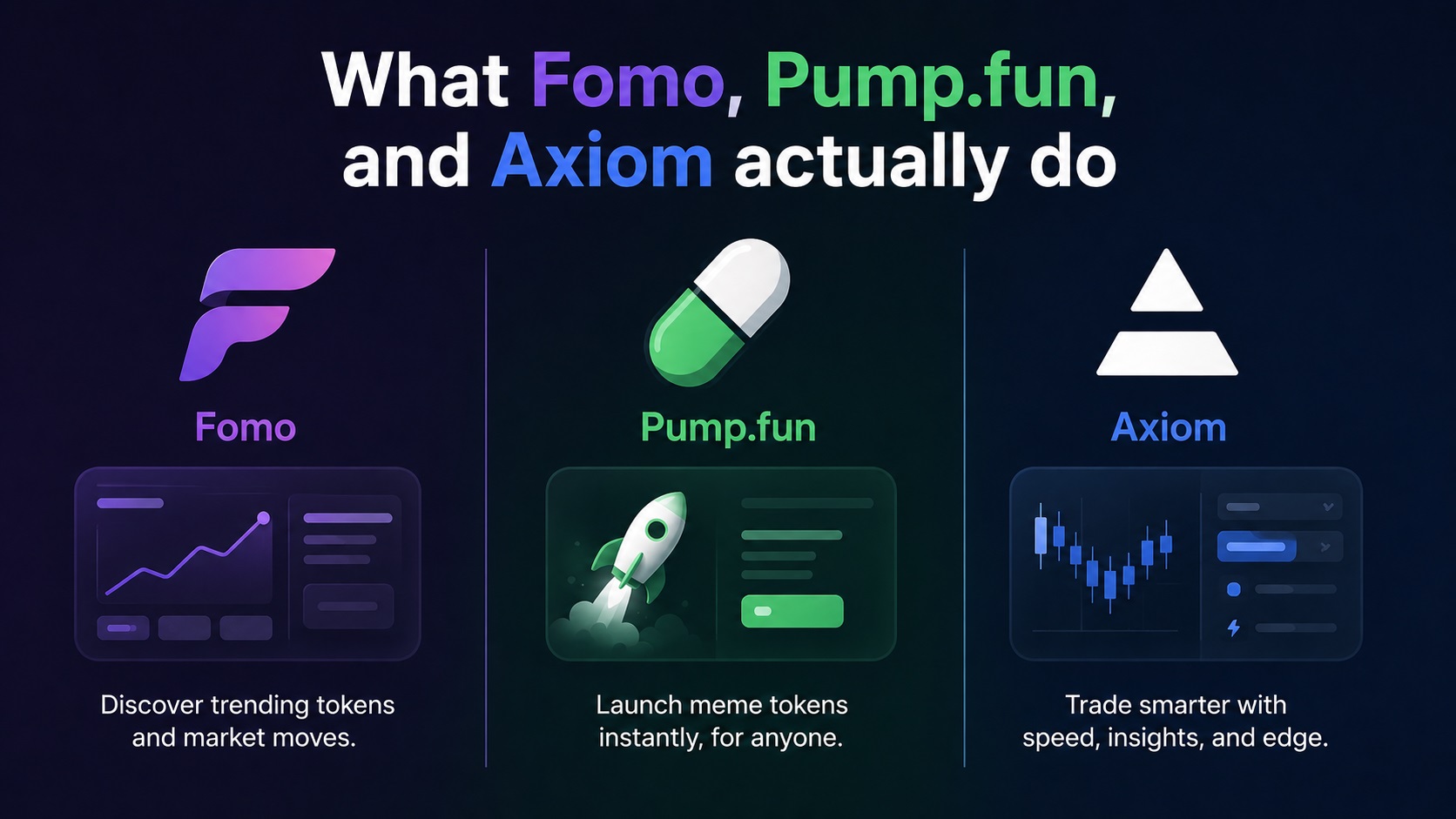
Pump.fun is a token launchpad. It lets anyone create a meme coin through a bonding-curve mechanism. Once a token hits a market cap of roughly $69,000, it graduates to PumpSwap, Pump.fun’s own AMM. Since launching in January 2024, more than 12 million tokens have been created through its infrastructure. By March 2026, Pump.fun became the first Solana app to cross $1 billion in cumulative revenue. Its starting point is asset origin: the token itself.
Fomo is a self-custodial social trading app. Its interface revolves around a real-time feed of trader activity, wallet following, leaderboards, and copy-trading workflows. Founded by three former dYdX engineers, Fomo launched in May 2025 and operates with a 17-person team. Its starting point is people: who’s trading what, how they’re performing, and whether you want to follow their moves.
Axiom is a web-based trading terminal. It focuses on token scanning, wallet tracking, and filtering by on-chain variables like holder concentration, developer holdings, sniper activity, liquidity, and volume. Axiom held the top trading-terminal position on Solana for more than a year before Fomo began closing the gap in mid-2026. Its starting point is data: which tokens pass your filters and why.
Affiliate link: we may earn a commission at no extra cost to you.
Think of it this way: Pump.fun creates supply. Fomo organizes demand through social discovery. Axiom organizes demand through data filters. All three are rooted in Solana, but their product philosophies are people-first, asset-origin-first, and data-first, respectively.
Side-by-side comparison of key features
The table below maps each platform’s core capabilities. Where a feature doesn’t exist on a platform, that gap usually reflects a deliberate product decision rather than an oversight.
| Feature | Fomo | Pump.fun | Axiom |
|---|---|---|---|
| Token creation | No | Yes, one-click launches via bonding curves | No |
| Social feed and leaderboard | Central to the UI: trader profiles, P&L, win rate, follow/alert mechanics | Added social trading features in August 2026 | Focuses on token and wallet data, not trader rankings |
| Copy trading | Copy-trading workflows built into the interface | No documented copy-trading layer | No documented copy-trading layer |
| Perpetual futures | Yes, via Hyperliquid integration (non-U.S. users) | No | No |
| Fiat onramp | Apple Pay, roughly 30 seconds from fiat to on-chain | Assumes a funded wallet | Assumes a funded wallet |
| Discovery approach | Trending tokens surfaced through trader activity | Tokens surfaced through launch activity, creator identity, and callouts | Filters like New Pairs, Trending, Pulse stages, watchlists, wallet tracking |
| Multi-chain support | Solana, Base, BNB Chain, Monad | Solana (multi-chain expansion signals exist) | Solana and additional chains via web terminal |
| Native token | No token yet | PUMP (roughly $1.1 billion market cap, 87% 30-day price increase) | No native token |
Fomo’s Apple Pay flow has onboarded more than 68,000 first-time crypto buyers, with that cohort alone generating roughly $25 million in volume. That’s a fundamentally different way to acquire users than what Axiom or Pump.fun uses, a contrast our FOMO vs Pump.fun breakdown explores in more depth. Both of those platforms assume you already have a funded wallet and at least a basic understanding of on-chain transactions.
Pump.fun’s August 2026 addition of social trading features signals that the boundaries between these products are blurring. Whether those features reach the depth of Fomo’s social layer or stay surface-level remains to be seen.
How fees compare across Fomo, Pump.fun, and Axiom
Comparing fees across these three platforms is harder than it looks because each platform charges for different things, at different stages, with different structures. The table below shows the headline rates, but a direct comparison requires quoting the same contract at the same size and time on each platform.
| Fee component | Fomo | Pump.fun | Axiom |
|---|---|---|---|
| Spot trading fee | Varies by transaction size, type, token, and routing; shown before confirmation. One reference describes a $1 flat fee per trade | 1.25% on bonding-curve trades. PumpSwap dynamic tiers decline from 1.25% down to 0.30%, split among creator, protocol, and LP | Wood-tier net fee of 0.95% after 0.05% cashback; higher tiers reduce the net fee further |
| Perpetual fee | 0.05% Fomo platform fee plus third-party protocol, liquidity, gas, slippage, and funding costs | N/A | N/A |
| Fee-free options | Not documented | Described as fee-free for certain trading activity, reducing friction for high-frequency traders | Not documented |
| Network and priority costs | Added separately | Added separately | Added separately (Solana network, priority, and bribe costs) |
Fomo’s reported gross margin of roughly 96.7% (per DeFiLlama protocol data) is unusually high and reflects the gap between what users pay and what the platform retains after routing costs.
Axiom’s tiered cashback system means your effective fee drops as you move up tiers, but the specifics of each tier beyond Wood aren’t fully documented in a single public breakdown. If you’re trading at high volume on Axiom, checking your current tier and the cashback rate matters more than the headline 0.95% number.
Pump.fun’s fee structure splits across two distinct surfaces. On bonding-curve trades (before graduation), you’re paying 1.25%. After graduation on PumpSwap, the dynamic tiers can bring that down to 0.30%, with fees divided among the token creator, the protocol, and liquidity providers.
The full cost on any of these platforms goes beyond the platform fee. Spread, price impact, network or priority costs, bribe fees, funding or conversion costs, and realistic exit quotes all factor in. Two platforms showing the same headline rate can deliver very different all-in costs depending on route, token liquidity, and order size.
Trading volume and market-share trends
Volume data in this category shifts frequently, so treat any snapshot as exactly that.
Axiom reached $101 million in single-day trading volume in April 2025 and held between 30% and 72% of Solana meme-trading activity at its peak. By June 2026, Axiom’s share settled to 44.6% of daily trading-terminal volume at roughly $51.5 million per day, while Fomo sat at 17.2% at roughly $19.8 million per day.
Fomo logged six consecutive weeks of all-time-high trading volume heading into August 2026, with Solana accounting for more than half of its total trader flow. The platform’s daily protocol revenue rose to between $437,000 and $474,000 in the three days ending August 5, up from roughly $224,000 per day the prior week. Fomo’s cumulative volume on Solana passed $2.5 billion, and total users crossed 625,000.
But here’s the part that complicates a simple “Fomo is catching Axiom” narrative: Axiom’s own daily active on-chain traders grew 48% in four weeks from early July to early August 2026, climbing from roughly 32,000 to over 47,000. Axiom expanded even while Fomo closed the gap. This isn’t a zero-sum game where one platform’s gain is automatically another’s loss. The overall pie of Solana trading activity has been growing.
Pump.fun’s cumulative trading volume exceeds $150 billion, but its daily volume as a trading frontend is lower than both Fomo and Axiom. That’s because much of the trading on Pump.fun-launched tokens routes through other frontends. A trade on a Pump.fun-originated token executed through Axiom counts under Axiom’s volume, not Pump.fun’s. Pump.fun’s lifetime unique wallets exceed 22 million, reflecting its reach as a launchpad rather than as a trading terminal.
Revenue models and financial scale
Pump.fun’s revenue comes from multiple streams: bonding-curve trading fees, graduation fees, PumpSwap LP and protocol fees, Mayhem-mode fees, and Terminal trading fees. Cumulative revenue exceeds $1.07 billion per DeFiLlama. Annualized revenue has been reported at roughly $325 million to $455 million depending on the period measured. Monthly revenue peaked at roughly $138 million during peak meme-coin mania, fell to a weekly low of roughly $1.72 million in July, then recovered to roughly $9.23 million per week by August. Half of Pump.fun’s protocol revenue goes toward programmatic PUMP token buybacks, tying buy pressure directly to platform activity.

Fomo operates on trading-fee revenue with no token-related income yet. Cumulative revenue sits at roughly $25.55 million per DeFiLlama. The annualized revenue run rate reached roughly $72 million at peak. Weekly revenue grew from roughly $150,000 per week in late 2025 to $1.39 million per week by July 2026. At the $72 million run rate with a 17-person team, Fomo’s revenue per employee lands at roughly $4.2 million. The company raised $94 million total, including a $75 million Series B at a $550 million valuation in June 2026.
Axiom’s revenue model relies on trading fees with tiered cashback, but no comparable cumulative-revenue or annualized-revenue figure has been publicly detailed in the same way. That gap makes it hard to place Axiom on the same financial scale as the other two.
The revenue cycles differ in a meaningful way. Pump.fun’s revenue swings hard with meme-coin launch volume: when new token creation spikes, the platform prints revenue, but when it doesn’t, the drop is steep, as the fall from $138 million in a peak month to $1.72 million in a low week shows. Fomo’s revenue, by contrast, tracks ongoing social-trading activity, which doesn’t depend on new launches the same way.
Discovery and token-finding tools
Each platform surfaces tokens through a fundamentally different lens, and the lens shapes what you see first and what you might miss.
Fomo’s discovery is built around a social feed. You follow wallets, see real-time buy and sell activity, and inspect leaderboard profiles showing P&L, win rate, and trade history across multiple timeframes. The signal you’re reading is human behavior: who bought, when, how much, and how they’ve performed over time. That’s powerful when you’re trying to learn from experienced traders, but it also means you’re inheriting their biases and timing.
Where Fomo’s lens is social behavior, Pump.fun’s discovery starts at the token’s birth. You see newly created coins, creator identity, callout activity, and positions forming around each launch. The signal is origin: where did this token come from, who made it, and what’s happening in the first minutes and hours of its life. For traders who want to catch tokens early, Pump.fun’s surface offers the closest view to the moment of creation.
Axiom’s discovery works through data filters, and this is where the platform’s depth is often underappreciated. Pulse breaks token discovery into stages: new-pair, bonding-curve, and migrated-token phases, each with filters for holder concentration, developer holdings, sniper activity, insider bundles, liquidity, volume, market cap, transaction count, and pro-trader participation. Explore surfaces new-pair and trending tokens with adjustable timeframes and watchlists. On top of that, wallet tracking and tweet monitoring add layers of signal that let you cross-reference on-chain movement with off-chain chatter.
The same token can appear on all three surfaces for different reasons: trending on Fomo’s feed because a high-profile trader bought it, called out on Pump.fun because the creator is promoting it, and passing an Axiom scanner filter because its holder distribution meets your criteria. But each signal type measures something different. Agreement across surfaces doesn’t count as independent confirmation. The same promotional push can ripple through every platform without any of them providing a genuinely separate data point.
How each platform handles execution and orders
Axiom’s terminal-style interface connects discovery directly to execution. Its swap screen exposes route details, expected amount, minimum received, slippage tolerance, and price impact. For traders coming from a data-driven scanning workflow, that transparency matters because you’re making a decision based on numbers, and you want to see the numbers hold through execution. Axiom historically competed on execution speed, snipe reliability, and MEV protection, attributes that defined the trading-terminal category through 2024 and early 2025.
Fomo pairs its social feed with in-app trading so you can move from seeing a trader’s buy to executing your own trade without switching platforms. Gasless swaps and unified balances across chains reduce friction, making the path from discovery to execution shorter. Copy-trading execution controls, including allocation rules, latency, stop conditions, exit triggers, and failure handling, need in-app verification before you rely on them. These mechanics aren’t fully detailed in public documentation.
Pump.fun keeps the order close to the launch surface. You can buy tokens during the bonding-curve phase or after graduation on PumpSwap. The execution is simple by design, because the primary action is buying a newly launched token, not running a complex multi-leg order.
Regardless of platform, the confirmation screen is where the real control quality lives. Before confirming any trade, verify: input amount, expected output, route, minimum received, slippage tolerance, price impact, platform charge, network cost, required approvals, and what happens if the transaction fails. If the confirmation screen doesn’t show you these details clearly, slow down.
Risk controls across all three platforms
Each platform carries a primary behavioral risk that’s tied to how it presents information.
Fomo’s risk comes from feed urgency. Leaderboard rankings and real-time buy notifications can push fast action before you’ve reviewed enough of a trader’s performance sample. A profile showing strong recent returns may be riding a single streak or trading with a risk profile you wouldn’t tolerate. To reduce this risk, keep your follow list narrow, delay action after discovery to review capital size, drawdown history, and entry context behind each profile. Treat displayed P&L as a record of the past, not a forecast.
Because roughly 98.5% of tokens launched on Pump.fun fail to complete the bonding curve, the platform’s primary risk centers on launch timing and contract uncertainty. That baseline failure rate means reducing exposure requires checking contract identity and authorities, reviewing creator history and holder patterns, verifying pool age, and sizing positions as if the entire amount could go to zero.
Axiom’s risk is subtler. A dense scanner displaying many data fields can create false confidence. Seeing those on-chain variables arranged in clean columns can feel like certainty when it’s really just organized data that still needs interpretation. To reduce this risk, define your filter criteria explicitly before scanning, understand what each field actually measures, and log the tokens you reject so you can evaluate your filter quality over time. Axiom’s own Explore documentation warns that high volume may include wash trading.
Shared risks cut across all three: wallet-signing transactions you don’t fully understand, unexpected fee or slippage outcomes, low liquidity making exits expensive or impossible, and custody exposure from connected wallets. Separating experimental funds from long-term holdings limits the damage from any single mistake.
Cross-platform echo risk deserves its own attention. The same promotional activity can show up as a trending profile on Fomo, a callout on Pump.fun, and a volume spike on Axiom’s scanner. Without checking the contract address, originating wallet, and timestamp, you might interpret three signals where only one source exists. Deduplicating by contract, wallet, timestamp, and original source reduces false-confirmation bias.
Multi-chain support and expansion paths
Multi-chain coverage affects how dependent you are on a single network’s trading cycles. Here’s where each platform stands:
- Fomo supports Solana, Base, BNB Chain, and Monad from a single interface. That breadth means if meme-coin activity fragments away from Solana, Fomo can follow it without requiring users to switch tools. This multi-chain architecture reduces exposure to any single chain’s activity cycle.
- Axiom supports Solana and additional chains through its web terminal, with documentation referencing multi-chain swap and wallet features. Axiom’s historical strength in Solana was an asset during peak Solana meme-trading activity, but it raises a structural question if volume disperses to other chains long-term.
- Pump.fun remains Solana-focused. Discovered subdomains for Ethereum and other networks suggest planned multi-chain expansion, but nothing is live yet. Pump.fun’s Terminal product (formerly Padre, acquired April 2025) handles trading of existing assets on Solana and could serve as a foundation for cross-chain rollout.
For traders who already operate across multiple chains, Fomo’s architecture offers the most consolidated view. For traders committed to Solana-first workflows, Axiom’s deep Solana integration is a strength, not a weakness. Pump.fun’s Solana focus makes sense for a launchpad because that’s where the meme-coin creation activity lives.
Which platform fits which trader
The right pick depends on the specific question you’re trying to answer first.
If you want to create a meme coin with a one-click launch, bonding-curve pricing, and automatic DEX graduation, Pump.fun is the only option among these three. It’s a launchpad, and neither Fomo nor Axiom offers token creation.
If you want to discover tokens through other traders’ real-time activity, follow wallets, see public P&L and win rates, and build a copy-trading workflow, Fomo is purpose-built for that. Its entire interface organizes around trader profiles rather than raw data or token launches.
If you’re a data-driven trader who wants to filter new pairs by holder distribution, sniper activity, developer holdings, and liquidity thresholds, then execute from a terminal with visible route and impact details, Axiom gives you that control surface. For a deeper look at its capabilities, see our Axiom review.
If you’re a first-time crypto buyer with no wallet, Fomo’s Apple Pay onramp gets you from fiat to on-chain in roughly 30 seconds. Neither Pump.fun nor Axiom provides that starting point.
If you want perpetual futures alongside spot trading and you’re outside the U.S., Fomo’s Hyperliquid integration is the only path among these three.
If you want exposure through a native token tied to platform activity, Pump.fun’s PUMP token is the only option. Half of protocol revenue funds programmatic buybacks.
If you operate across multiple chains and want one interface, Fomo covers Solana, Base, BNB Chain, and Monad.
If you want to catch tokens as close to the creation moment as possible, with full visibility into the creator, first callers, holder patterns, and pool formation, Pump.fun’s launch surface is the closest view available.
And if you want to combine surfaces, the three work in sequence: launch on Pump.fun, scan with Axiom, trade socially on Fomo.
Affiliate link: we may earn a commission at no extra cost to you.
How Fomo overtook Axiom in daily Solana trading volume
Fomo’s volume gain accelerated through mid-2026. A 57% increase over six days in June preceded the crossover. By early August 2026, Fomo passed a major competitor in daily trading-terminal revenue to take second position, then briefly overtook Axiom in daily fees on August 6. Weekly revenue crossed the $2 million mark.
The shift reflects something deeper than one platform getting lucky with a meme-coin cycle. The competitive axis in Solana trading terminals moved from speed-first (execution speed, snipe reliability, MEV protection) toward distribution-first (social feed, mobile onboarding, multi-chain reach). Axiom defined the speed-first era. Fomo is defining what comes next.
Fomo’s mobile-first design, Apple Pay integration, and social-feed format reach users who would otherwise use centralized exchanges. That’s a different way to acquire users than optimizing latency for existing on-chain traders. You’re pulling in people who weren’t part of the Solana DeFi ecosystem before, rather than competing for the same pool of terminal users.
Pump.fun responded quickly. On August 7, 2026, it rolled out social trading features, which immediately drove new all-time highs in daily active users on Pump.fun’s app. That speed of response shows how seriously launchpads take the distribution threat from social trading interfaces.
Volume rankings on any given day don’t establish permanent leadership. Positions shift with market conditions, meme-coin cycles, and feature launches. The day-to-day leaderboard matters less than the structural trend: platforms that can acquire new users through social and mobile channels are growing faster than platforms that compete purely on execution speed for existing DeFi users.
The broader Solana trading-platform landscape
Fomo, Pump.fun, and Axiom don’t operate in isolation. The Solana trading-frontend market includes web terminals, Telegram bots, and mobile apps, all competing for order flow.
A live benchmarking tracker attributes on-chain swap events to the originating frontend using referral tags, program IDs, and memo fields. That attribution system makes volume mutually exclusive: a trade on a Pump.fun-launched token routed through Axiom counts under Axiom, not Pump.fun. This distinction is important because Pump.fun’s launchpad volume (bonding-curve swaps) and its trading-platform volume (swaps attributed to its frontend) are different measurements. Combining them inflates Pump.fun’s apparent share of the trading-terminal market.
Telegram-native bots serve a distinct trader segment with significant bot-driven flow. A wallet app also routes wallet-initiated swaps and collects its own platform fee. The spread between the highest-volume and lowest-volume tracked platforms hit 46.5x on one snapshot, underscoring how concentrated volume is at the top. A handful of platforms capture the vast majority of order flow, and everything below the top tier handles comparatively thin volume.
At AXL Research Hub, we track these shifts because they affect which platforms have the liquidity depth to support the trades you actually want to make. A platform ranking fifth or sixth on the daily leaderboard may still execute well for your specific tokens, but understanding where volume concentrates helps you set realistic expectations about fill quality and price impact.
Using all three platforms together
A multi-source workflow reduces your dependence on any single platform’s display or signal type. Instead of picking one and ignoring the others, you can use each platform for what it does best.
One practical sequence: discover a trader profile on Fomo and note which tokens they’re buying. Then locate the original token and creator context on Pump.fun, checking creator history, holder patterns, and launch timing. Finally, inspect the token’s on-chain data in Axiom, applying Pulse’s filtering stages to review how holders are distributed, what the developer retains, whether snipers are present, and how deep the liquidity sits.
But cross-checking doesn’t mean treating agreement as independent proof. If the same promotional push is behind a token, it’ll surface as a popular name in Fomo’s feed, a callout on Pump.fun, and a volume spike on Axiom. All three surfaces are reflecting the same source, not confirming each other.
Record one canonical entry per trade keyed to chain and contract address. Include the source where you found it, the timestamp, visible price, liquidity at time of discovery, any claims being made about it, the wallets involved, and the current status. When two platforms disagree on a data point, investigate definitions and timing rather than averaging the difference. The discrepancy may reveal stale data on one side or a different calculation method.
Deduplication by contract address, wallet, and timestamp prevents repeated signals from looking like separate confirmation. This is the single most important habit for anyone working across multiple trading surfaces.
Beginner considerations across all three platforms
Fomo’s consumer-social framing may feel like the easiest starting point. Scrolling a feed of trader profiles is more familiar than parsing a holder-distribution table. But ease of navigation isn’t the same as ease of risk. Beginners can read a profile faster than they can read a scanner, and that speed can lead to over-trusting the profile. A leaderboard rank and a strong win rate feel like endorsements when they’re really just historical records.
Pump.fun and Axiom expose users to launch-stage decisions that require understanding of contract identity, token authorities, pool depth, price impact, and wallet clusters. These aren’t concepts you can skip. A beginner buying a token during the bonding-curve phase on Pump.fun without understanding these mechanics is taking on more risk than they realize.
On any of the three platforms, starting with paper observation, watching activity without committing capital, builds familiarity without cost. Follow a few traders on Fomo and track whether their displayed performance matches what would’ve happened if you’d copied them. Watch token launches on Pump.fun and see how many survive the bonding curve. Run Axiom’s filters and track the tokens that pass to see how they perform over the following days.
Before trading on any platform, you’ll need a self-custody wallet; our guide on crypto wallet setup walks through the process. Pump.fun and Axiom are better approached after you can articulate those launch-stage concepts, from contract verification to liquidity mechanics to wallet-cluster analysis, in your own words. Historical P&L displayed on any platform reflects past conditions, not a guarantee of future results.
Choosing by workflow, not by hype
The clearest way to pick among these three is to match your first question to the platform that answers it. If your first question is “who is trading this?”, start with Fomo. If it’s “where did this token come from?”, start with Pump.fun. If it’s “which tokens pass my filters?”, start with Axiom.
All three products are moving fast. Pump.fun added social features. Fomo keeps setting volume records. Axiom’s user base continues expanding. Any ranking based on today’s numbers is a snapshot, not a verdict.
Understanding what DeFi is and how decentralized protocols operate gives you the foundation to evaluate all three platforms on their own terms. The platforms are tools. The process is yours.