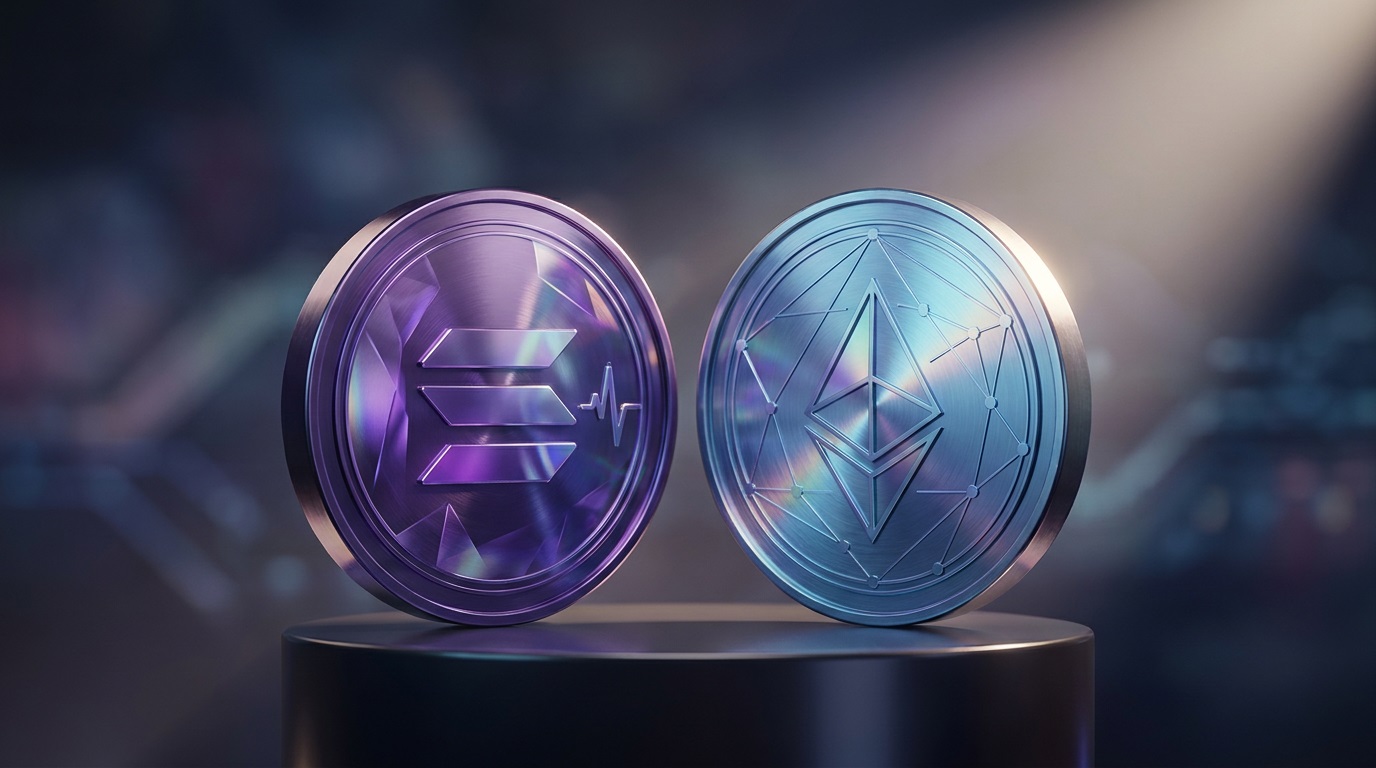

Fees, staking mechanics, tokenized real-world assets, validator economics, and upcoming protocol upgrades all factor into which network fits a given use case or portfolio. The two chains have stopped competing for the same job anyway. Ethereum has settled in as a settlement layer where large capital wants maximum security, while Solana handles the high-frequency, low-fee end of the market.
What sets Solana and Ethereum apart
Ethereum launched in 2015 as the first platform purpose-built for smart contracts and decentralized applications. Co-founded by Vitalik Buterin, it established the template every programmable blockchain has followed since. Solana arrived five years later in 2020, designed from the ground up by Anatoly Yakovenko for high throughput and minimal transaction costs.
Both networks now run on proof of stake, but they get there differently. Ethereum completed its transition from proof of work with the Merge in September 2022. Solana pairs proof of stake with proof of history, a cryptographic clock that timestamps transactions before validators process them. That pre-ordering lets the network handle transactions in parallel rather than sequencing them one by one.
Rather than competing for the same users, the two chains increasingly serve complementary roles. Ethereum has settled into its position as a settlement and custody layer where large capital pools need maximum security and deep liquidity, while Solana operates as a high-throughput execution layer that attracts retail traders, consumer apps, and high-frequency activity. Those different strengths and weaknesses shape every comparison that follows.
Transaction speed and throughput
Solana’s base layer processes roughly 600 to 700 transactions per second (TPS) under typical conditions, with a theoretical ceiling of 65,000 TPS. Real-world throughput can range from 1,100 to 6,200 TPS depending on network load. All of that happens on a single chain with a 0.4-second block time, no Layer 2 required.
Ethereum’s mainnet handles 15 to 30 TPS at a 12-second block time. That sounds like a different league, but raw L1 numbers don’t tell the full story. Ethereum scales through Layer 2 rollups, separate execution environments that process transactions off-chain and settle compressed data back to mainnet. Combined L2 throughput already exceeds 5,000 TPS, and it keeps growing as new rollups launch. The trade-off is complexity: users bridge assets between networks, and liquidity fragments across those rollups.
Finality, the point where a transaction can’t be reversed, also differs sharply. Solana currently reaches finality in roughly 6 to 13 seconds. The upcoming Alpenglow consensus upgrade targets 100 to 150 milliseconds, which would put Solana’s finality on par with traditional payment networks. Ethereum L1 finality takes about 12 minutes. L2s settle faster for the user, but final settlement still depends on data posting back to mainnet.
The Firedancer validator client, which launched in late 2025, gave Solana a second independent software implementation. Before Firedancer, a bug in the single client could take down the entire network. Running two separate codebases means a flaw in one client doesn’t automatically crash the other, improving both performance and resilience.
Transaction fees
Solana’s average transaction costs around $0.00025, a fraction of a cent that stays below one cent even when the network is busy. That’s possible because Solana isolates local fee markets: congestion in one program or application doesn’t push fees up for everyone else on the network.
Ethereum mainnet fees range from roughly $0.50 to $3 for a simple transfer. Complex DeFi operations, like multi-step swaps or contract interactions during congestion, can climb to $15 to $30. The culprit is Ethereum’s global fee market, where a spike in demand from any source raises gas prices across the board for every user. Gas fees have fallen to levels last seen in Q2 2020 as scaling improvements take hold, but the global-market structure still means periodic cost surges.
Layer 2 networks narrow the gap. After the Pectra upgrade, L2 transaction fees dropped to roughly $0.10 to $0.50 per transaction. That’s a dramatic improvement over mainnet, though still 100 to 1,000 times more than a Solana mainnet transaction.
The practical impact of near-zero fees shows up in how people actually use Solana. Micropayments become viable when sending a dollar doesn’t cost a dollar. High-frequency traders can enter and exit positions hundreds of times a day without fees eating their margins. Gaming apps can record every in-game action on-chain. On Ethereum mainnet, those patterns would be cost-prohibitive, which is exactly why L2s exist, but they add bridging steps and split liquidity in ways Solana’s single-chain architecture avoids.
Side-by-side comparison chart
| Metric | Ethereum | Solana |
|---|---|---|
| Mainnet TPS | 15–30 | 600–700 (theoretical max 65,000) |
| Transaction fees | $0.50–$3 (L1); $0.10–$0.50 (L2) | ~$0.00025 |
| Finality time | ~12 minutes (L1) | ~6–13 seconds |
| Consensus mechanism | Proof of stake | Proof of stake + proof of history |
| DeFi TVL | ~$55–58 billion | ~$8–9 billion |
| Active developers | ~31,800 | ~17,700 |
| Validator count | Over 1 million | ~800 to a few thousand |
| Network uptime record | No unplanned downtime on mainnet | 99.9%+ since mid-2024; outages occurred 2021–2023 |
| Scaling approach | Modular (L2 rollups) | Monolithic (single-layer) |
| Architecture type | Modular | Monolithic |
| Programming languages | Solidity, Vyper, Yul+, Fe | Rust, TypeScript, C, C++ |
| Staking yield range | ~2.5–3.5% APY | ~6.25–8% APY |
| Primary use cases | Institutional DeFi, tokenized assets, settlement | High-frequency trading, consumer apps, micropayments |
Figures for TVL, developer count, and staking yields fluctuate and represent approximate snapshots.
Blockchain architecture: modular vs monolithic
Ethereum follows a modular design. The base layer handles security and settlement while Layer 2 solutions take on execution and cost reduction. That separation lets Ethereum upgrade individual components, like increasing blob throughput or adding new rollup types, without overhauling the entire chain. L2 diversity spans optimistic rollups and zero-knowledge rollups, each optimized for different workloads.

Solana takes the monolithic approach. Everything, execution, consensus, data availability, runs on one chain. For users and developers, that means no bridging, no picking which L2 to deploy on, and no fragmented liquidity across a dozen rollup networks. A developer building on Solana writes one deployment and reaches every user on the network.
The trade-off cuts both ways. Modular architecture gives Ethereum flexibility: if one rollup technology proves superior, the ecosystem can shift without affecting the base layer. Monolithic architecture concentrates risk on a single software stack. A protocol-level bug affects the entire network (though Firedancer’s addition of a second client mitigates that specific scenario). On the other hand, Solana’s unified state means composability is native. One DeFi protocol can call another in the same transaction without cross-chain messaging or bridges, which matters for complex financial operations that depend on atomic execution.
Ecosystem maturity, DeFi, and developer activity
Ethereum’s DeFi TVL sits at roughly $55 to $58 billion, which works out to about 52 to 68% of the global DeFi market depending on the measurement period. The chain hosts over 4,000 dApps and holds the majority of on-chain stablecoin supply, anchored by the ERC-20 token standard, still the most widely adopted fungible-token standard in crypto. That combination of deep liquidity and broad tooling is why blue-chip DeFi protocols and institutional-grade products call Ethereum home.
Solana’s DeFi TVL is around $8 to $9 billion with roughly 500 active dApps, a smaller ecosystem by capitalization but one that punches above its weight in activity. Solana surpassed Ethereum in weekly DEX volume during 2024 and has maintained that lead through 2026, fueled by high-frequency trading, memecoins, and consumer apps. Memecoin trading accounts for roughly 63% of all DEX activity on Solana. Since its 2020 launch, the network has processed over 496 billion total transactions and more than $2.58 trillion in DEX trading volume.
Key Solana DeFi lending and borrowing protocols include Jupiter for DEX aggregation, Raydium for AMM liquidity, and Kamino for lending. These protocols benefit from Solana’s near-zero fees, which let traders execute strategies that would be uneconomical on higher-fee chains.
Stablecoins tell another part of the story. Circle issues USDC natively on Solana, supporting stablecoin-based treasury operations. Solana’s stablecoin market cap reached an all-time high of $15 billion in January 2026, a 200% increase from 2025, and later climbed to $15.7 billion.
Developer activity skews toward Ethereum, with roughly 31,800 active developers compared to Solana’s approximately 17,700. Solana’s developer community has grown nearly tenfold since 2020, reaching around 6,000 contributors by the end of 2025 per one source. That growth rate matters because developer count tends to predict where new applications and capital flow next.
Tokenized real-world assets
Real-world asset (RWA) tokenization is one of the fastest-moving fronts in the Solana vs Ethereum comparison. Solana added $378.2 million in tokenized U.S. Treasuries in one recent 30-day period, exceeding Ethereum’s $272.2 million over the same span. That pace pushed Solana’s broader RWA ecosystem to an all-time high of $3.90 billion in total value across 339,421 holders.
Tokenized equities are where Solana’s lead is most visible: the chain holds a 64 to 65% share of roughly $111 million in that category. Tokenized credit funds on Solana saw the largest year-to-date growth, adding $468.2 million to reach $664.3 million total.
Major financial institutions have taken notice. BlackRock, Franklin Templeton, J.P. Morgan, and State Street have all deployed tokenized products on Solana. The appeal is straightforward: near-zero transaction costs and fast finality make it practical to settle, transfer, and fractionalize assets at a scale that would be expensive on Ethereum mainnet.
Ethereum remains the default blockchain for Wall Street integration, though. Multiple banks have piloted deposit tokens and stablecoin payment protocols on Ethereum, and institutional money market funds have launched as tokenized assets on the network. Ethereum’s longer track record, deeper auditing infrastructure, and regulatory familiarity give it an edge when compliance teams evaluate which chain to build on.
The gap between the two chains in regulated product availability has narrowed but hasn’t closed. Solana’s growth rate in RWA tokenization is steeper, while Ethereum’s total base and institutional trust remain larger.
Security, network stability, and decentralization
Ethereum mainnet has never experienced unplanned downtime. Its validator set of over one million participants distributes stake broadly enough that a 51% attack would require an economically prohibitive amount of capital. Smart-contract vulnerabilities remain the primary security risk on Ethereum, but those sit at the application layer, not the protocol. A bug in one DeFi contract doesn’t compromise the chain itself.

Solana’s uptime history is rockier. The network experienced multiple full or partial outages between 2021 and 2023. Those events represented availability risk, not loss-of-funds risk: no user funds were lost during any period of downtime. Since mid-2024, Solana has maintained 99.9%+ uptime, and running two independent validator codebases means a bug in one client no longer threatens to halt the entire chain. The August 2022 Slope wallet incident, which affected approximately 9,000 wallets, was an application-layer exploit tied to a specific wallet’s key storage, not a breach of the Solana protocol.
Decentralization is where the architectural difference bites hardest. Ethereum validators run on consumer-grade hardware, lowering the barrier to participation and broadening the validator set. Anyone with 32 ETH and a decent computer can run a validator. Solana’s validators need specialized, high-performance hardware, which concentrates the validator set. The network has pruned its validator count roughly threefold in recent years to remove underperforming nodes. Solana’s Nakamoto coefficient, the minimum number of validators that would need to collude to halt the network, sits around 20 to 22. By comparison, Ethereum’s far larger validator set makes that same attack vector orders of magnitude harder to execute.
What does this mean practically? If you’re building an application where maximum censorship resistance and uptime guarantees are non-negotiable, Ethereum’s track record is stronger. If you need speed and low cost and can tolerate some residual centralization risk, Solana’s improvements since 2023 are meaningful but the validator economics still favor larger operators.
Tokenomics and supply mechanics
Ethereum and Solana handle token supply in fundamentally different ways, and those mechanics affect everything from staking returns to long-term value.
Ethereum caps annual issuance at 18 million ETH per year. The EIP-1559 mechanism, introduced in 2021, burns a portion of every transaction’s base fee. When the burn rate exceeds new issuance, ETH’s net supply shrinks, creating deflationary pressure during periods of high network activity. Over 30% of ETH supply is currently staked, locking a significant portion of circulating tokens.
Solana’s inflation schedule started at 8% annually and decreases by 15% each year, targeting a long-term floor of 1.5%. Right now, supply grows at roughly 4.5% per year. Solana’s fee-burn mechanism destroys a portion of each transaction fee, with validators keeping the remainder. The SIMD-0096 proposal aims to push SOL toward deflation by burning priority fees against new issuance during periods of high activity, a structure inspired by Ethereum’s EIP-1559 but adapted for Solana’s fee architecture.
How each chain manages supply directly shapes the investment profile of each token. Ethereum can be net-deflationary when usage is high, which means holding ETH during active periods carries a built-in scarcity tailwind. Solana’s ongoing inflation means non-stakers see their share of the network diluted each year, which is one reason staking participation on Solana runs high and staking yields are more generous.
For context, Bitcoin’s hard cap of 21 million coins represents a third model entirely: fixed supply with no inflation once all coins are mined. Each approach embeds a different assumption about how to balance network security incentives against holder dilution.
Staking yields: how SOL and ETH rewards compare
Solana staking yields run roughly 6.25 to 8% APY, while Ethereum staking yields sit around 2.5 to 3.5% APY. The gap is real, but the reasons behind it matter as much as the headline numbers.
Solana’s higher yield is mostly issuance-driven. The network pays validators and delegators from newly minted SOL, which means that generous APY comes partly at the cost of diluting the total supply. If you’re staking, you’re keeping pace with inflation and earning a real return on top. If you’re holding SOL without staking, that 4.5% annual supply growth erodes your purchasing power.
Ethereum’s lower yield reflects a different balance. With over 30% of ETH staked and the EIP-1559 burn offsetting a portion of issuance, Ethereum’s staking rewards aim to secure the network without significantly inflating the supply. The result is a lower nominal APY but less dilution for non-stakers.
Running a validator on each chain comes with different requirements. Ethereum validators need 32 ETH and consumer-grade hardware. Solana validators need a variable amount of SOL but specialized, high-performance servers that cost significantly more to operate. Both chains support liquid staking protocols that let you earn rewards while keeping your tokens usable in DeFi.
Solana’s simpler delegation model, where you can stake to a validator without running your own node, and its higher nominal yield tend to attract holders focused on passive income. Ethereum’s model appeals to participants who prioritize lower inflation risk and the security of a more decentralized validator set. Neither yield is guaranteed; both fluctuate with network conditions, participation rates, and protocol changes.
Upcoming protocol upgrades
Both chains have aggressive upgrade schedules that will reshape this comparison over the next year.
On the Ethereum side, the Pectra upgrade (May 2025) introduced EIP-7702 and doubled blob throughput, directly reducing L2 transaction costs. Fusaka followed in December 2025 with PeerDAS, increasing theoretical blob capacity by 8x and further compressing the cost of posting rollup data to mainnet. The next major milestone is the Glamsterdam upgrade, targeting H1 2026. Glamsterdam aims to bring parallel execution to Ethereum, push gas limits beyond 100 million, and enshrine proposer-builder separation (ePBS via EIP-7732). Parallel execution would let Ethereum process multiple transactions simultaneously rather than sequentially, a feature Solana has had since launch. Vitalik Buterin’s stated 2026 priority centers on reversing decentralization “backsliding” and strengthening self-sovereignty across the network.
Solana’s biggest recent upgrade was the Firedancer validator client in December 2025, which eliminated single-client risk and set the stage for further performance gains. The Token Extensions upgrade expanded what developers can do with Solana-based tokens, adding programmable features like transfer hooks and confidential transfers. Once Alpenglow ships, Solana’s consensus finality could drop to 100 to 150 milliseconds, fast enough to rival the settlement times of traditional card payment networks.
These upgrades matter because they target each chain’s known weaknesses. Ethereum is working to close its speed and cost gap with Solana through parallel execution and cheaper L2s. Solana is working to close its resilience and decentralization gap with Ethereum through client diversity and consensus improvements.
Investment profile: risk, volatility, and institutional adoption
Ethereum’s circulating market cap sits at roughly $294.72 billion, about 5x larger than Solana’s approximately $56.21 billion. That size difference drives much of the investment comparison.
SOL is meaningfully more volatile than ETH. Over a recent three-month window, SOL’s realized volatility ran around 80%, nearly twice bitcoin’s and about one-third higher than ETH’s. The one-year rolling correlation between SOL and ETH is approximately +0.7, which means they tend to move in the same direction but SOL swings wider. Both tokens correlate positively with the Nasdaq-100 at around +0.4, so neither offers a true hedge against tech-stock drawdowns.
Institutional access has expanded on both sides. U.S. spot Ethereum ETFs were approved in 2024 and have drawn over $11.23 billion in net inflows since launch. Solana gained spot ETF approval in October 2025, though ETF holdings still represent only about 2.5% of SOL’s market cap, compared to bitcoin’s roughly 9%. That lower share suggests room for inflows to grow, but it also means the institutional base is thinner.
ETH exchange reserves have dropped near a 10-year low, pointing to reduced selling pressure and long-term holder conviction. Large holders have been accumulating since mid-2025. Ethereum’s broader developer base, deepest DeFi liquidity, and widest range of institutional products create what amounts to a higher floor: the network’s utility provides a baseline level of demand regardless of market sentiment.
Solana’s smaller market cap gives it more room for percentage gains in a bull market but also more downside risk in a selloff. Meme-token activity, which accounts for a large share of Solana’s DEX volume, adds a layer of speculative volatility that doesn’t exist at the same scale on Ethereum.
Neither asset suits every investor. The choice depends on your risk tolerance, time horizon, and what role you want crypto to play in your portfolio.
Use cases: which chain fits which need
The gap between Ethereum and Solana goes well beyond raw performance numbers. They attract different kinds of projects and users based on what each chain does best.
Ethereum strengths:
- Complex smart contracts that require mature auditing tools and battle-tested security. The depth of Ethereum’s auditing ecosystem means contracts handling large sums get reviewed by firms with years of Solidity-specific experience.
- Institutional-grade DeFi with deep liquidity. Ethereum’s lending, borrowing, and derivatives protocols concentrate enough locked capital that large positions can move in and out with minimal slippage.
- Tokenized asset issuance for regulated products. Banks and asset managers building compliant offerings default to Ethereum because of its regulatory familiarity and existing legal frameworks.
- Applications where maximum security and decentralization are the priority. Ethereum’s unbroken uptime record and million-plus validator set make it the conservative choice.
Solana strengths:
- High-frequency trading and DEX activity. Sub-second block times and negligible fees let traders execute strategies that depend on speed and volume.
- Micropayments and real-time settlement. Sending a fraction of a cent costs a fraction of a cent, which opens up use cases like pay-per-article, tipping, and machine-to-machine payments.
- Consumer-scale apps like gaming and social platforms. Games that record player actions on-chain and social apps that mint posts as tokens need throughput and low cost, not deep liquidity pools.
- NFT minting at high volume and low cost. Solana’s fast finality suits large-scale drops where thousands of items need to mint in minutes.
- Stablecoin-based treasury operations. A major financial services company is launching a USD stablecoin on Solana, underscoring the chain’s fit for payment rails.
Ethereum hosts historically significant NFT collections with higher-value transactions, while Solana’s economics favor retail-scale trading and high-volume minting. In practice, many active DeFi participants and institutions use both chains, allocating based on operational needs rather than picking one exclusively.
Developer tools and programming languages
Ethereum’s primary smart-contract language is Solidity, with additional support for Vyper, Yul+, and Fe. Solidity benefits from the largest existing developer base in crypto, extensive audited smart-contract libraries, and a mature set of tools, from development frameworks to testing suites. Events like ETHGlobal hackathons keep bringing new developers into the fold.
Solana primarily uses Rust and TypeScript, with support for C and C++. Rust’s memory safety and performance characteristics align well with Solana’s emphasis on throughput, though the learning curve is steeper than Solidity for developers coming from web development backgrounds. Solana’s SDKs reduce low-level programming overhead, letting developers focus on application logic rather than memory management.
Both chains have formalized governance processes for protocol changes. Ethereum follows Ethereum Improvement Proposals (EIPs), while Solana uses Solana Improvement Documents (SIMDs). The Solana Foundation runs ecosystem programs, hackathons, and initiatives like mtnDAO to accelerate developer growth.
For developers choosing between the two, the decision often comes down to what you’re building. If your app needs composability with existing DeFi protocols and access to the largest pool of smart-contract auditors, Ethereum’s tooling is more mature. If you’re building a performance-sensitive application where transaction cost and speed are the primary constraints, Solana’s Rust-based stack and single-chain architecture remove several layers of complexity.
Can Solana overtake Ethereum?
Solana already leads Ethereum on several metrics. In August 2026, Solana recorded roughly 2.7 million 24-hour active addresses compared to Ethereum’s approximately 565,000. Daily transaction counts tell a similar story: about 177.7 million on Solana versus 1.86 million on Ethereum. Solana has maintained its weekly DEX volume lead since 2024 and costs a fraction of a cent per transaction.
Ethereum leads on TVL, developer count, institutional adoption depth, and regulated product availability. Those aren’t small advantages. TVL reflects trust and capital commitment. Developer count predicts where the next wave of applications gets built. Institutional adoption means banks, asset managers, and compliance frameworks already know how to work with Ethereum.
Both chains are actively improving in ways that target their weaknesses. Ethereum’s L2 ecosystem continues to narrow the fee and speed gap, and the Glamsterdam upgrade’s parallel execution could bring mainnet closer to Solana’s throughput model. Solana’s Firedancer and Alpenglow upgrades push performance and resilience further, addressing the reliability concerns that kept institutions cautious.
Neither chain is likely to displace the other. The coexistence model looks a lot like how traditional financial infrastructure works: different rails serve different segments. Ethereum anchors high-value settlement and institutional products. Solana handles high-frequency, consumer-facing activity. AXL Research Hub sees this pattern holding, and the data from the first half of 2026 supports it.
Frequently asked questions
Is Solana faster than Ethereum?
Yes. Solana’s mainnet processes 600 to 700+ real-world TPS compared to Ethereum’s 15 to 30 TPS on L1. Ethereum’s combined L2 throughput adds thousands more TPS, but those transactions route through separate networks and require bridging, while Solana handles everything on a single chain.
Why are Solana fees so much lower?
Solana’s architecture isolates local fee markets, so heavy activity in one part of the network doesn’t push fees up elsewhere. Ethereum uses a global fee market on mainnet where demand surges raise gas prices for every user. Even at L2 prices, a single Ethereum transaction still runs between 100x and 1,000x what you’d pay on Solana’s mainnet.
Is Ethereum more secure than Solana?
Ethereum has a stronger uptime record, with no unplanned mainnet downtime, and over one million validators securing the network. Solana experienced outages between 2021 and 2023 but has maintained 99.9%+ uptime since mid-2024. Having two separate validator codebases means a flaw in one implementation no longer puts the whole network at risk of going down.
How do staking yields compare?
Staking on Solana currently pays in the range of 6.25 to 8% APY, compared to Ethereum’s 2.5 to 3.5% APY. Solana’s higher number is partially offset by higher token inflation at around 4.5% per year, which dilutes non-stakers. Ethereum’s lower yield comes with less inflationary pressure. Both rates fluctuate with network conditions.
Is Solana a better investment than Ethereum?
That depends on your risk tolerance and goals. Solana’s smaller market cap (roughly $56 billion vs. Ethereum’s $295 billion) allows larger percentage moves in both directions. Ethereum’s deeper ecosystem and institutional base provide a higher floor. Meme-token activity adds extra volatility to Solana’s price.
Are Solana and Ethereum competitors or complementary?
Increasingly complementary. Ethereum anchors high-value DeFi and institutional products, while Solana serves high-frequency trading and consumer-facing applications. Many institutions and active DeFi users operate on both chains, choosing based on what each transaction or product requires.
Choosing between SOL and ETH for your portfolio
The decision comes down to what you prioritize. If maximum security, ecosystem depth, and the broadest institutional infrastructure matter most, Ethereum is the stronger pick. Its unbroken uptime, million-plus validator set, and dominant share of DeFi TVL provide a level of stability that Solana hasn’t matched yet.
If speed, low transaction costs, and higher staking yields are your priorities, Solana delivers those at the base layer without the hassle of bridging between multiple L2 networks. Its growth in tokenized real-world assets, DEX volume, and active addresses shows a chain gaining ground in areas that matter for long-term adoption.
Holding both gives you exposure to different blockchain infrastructure roles: Ethereum as a settlement layer, Solana as an execution layer. That’s not a hedge in the traditional sense, since the two tokens correlate at around +0.7, but it does spread your exposure across different user bases, revenue models, and growth trajectories.
Both networks face challenges ahead. Ethereum must balance its decentralization goals with growing institutional demand for faster, cheaper access. Solana must sustain its uptime improvements and broaden its validator set to address lingering centralization concerns. As tokenization of real-world assets accelerates, both chains stand to benefit, but through different product categories and user segments. Your allocation between them should reflect which of those futures you find more compelling, and how much volatility you’re comfortable with along the way.