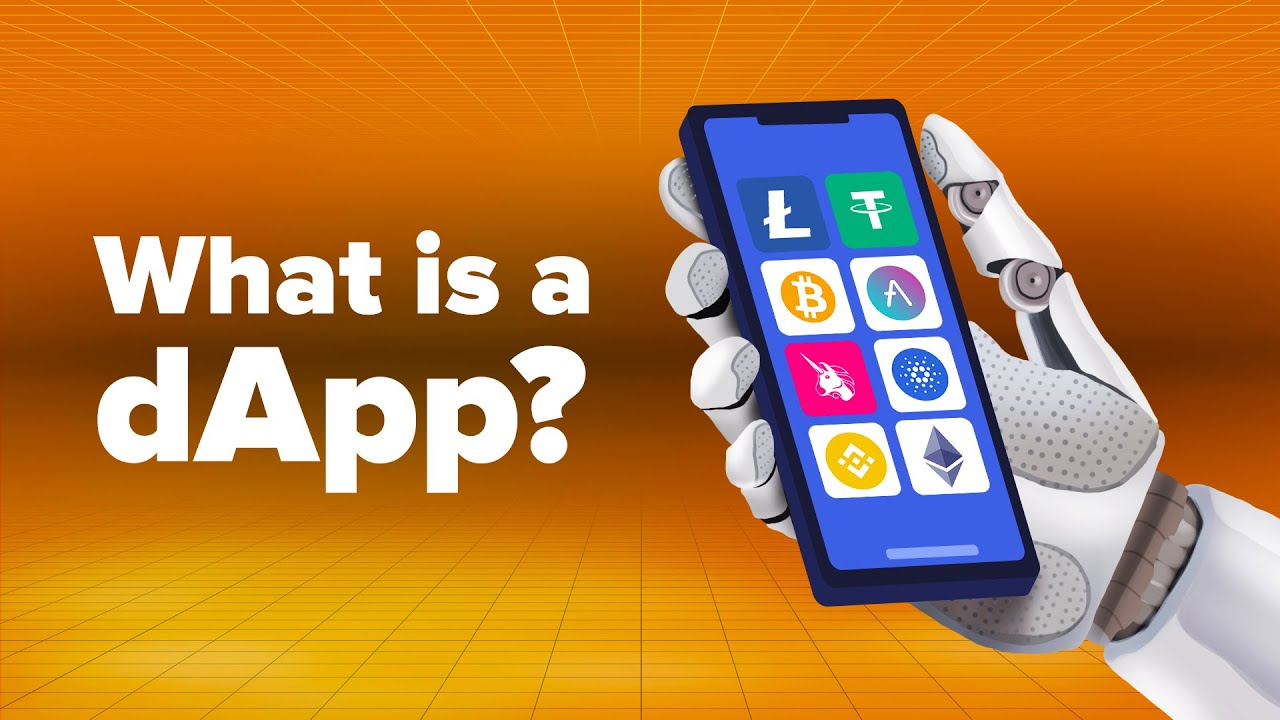

A dApp, short for decentralized application, is an app whose backend runs on a blockchain instead of a company’s servers. It can look like any website, but its rules live in smart contracts that no single company can rewrite or switch off. That changes how you sign in, who holds your data, and what can go wrong.
What is a dApp?
In technical terms, a dApp (decentralized application) keeps its backend code on a decentralized peer-to-peer network, usually a blockchain, rather than on servers a company owns. Its logic lives in blockchain smart contracts, and a frontend user interface sends calls to those contracts. Because the code runs on the network, no single company can rewrite it, ban users, or shut the service off.
That last point is the practical heart of it. In a regular app, staff decide who gets an account, what the fees are, and when features change. In a dApp, the code enforces the rules, so the app keeps running with little human intervention. If the contract says a swap happens at a certain rate or a loan unlocks once collateral arrives, that’s what happens, with no support agent approving it.
You’ll see the name written several ways: DApp, dApp, Dapp, and dapp. They all mean the same thing.
Ethereum is the best-known platform for building dApps. Developers build on it much the way app makers build for iOS, except the “operating system” is a public blockchain. Ethereum smart contracts are open and readable, a bit like public APIs, so one dApp can plug straight into a contract someone else wrote. A wallet app can tap into an exchange contract, and a lending app can read prices from another project’s contract, without asking anyone’s permission.
By infrastructure, dApps fall into two groups:
- dApps on their own blockchain: the project runs its own chain, and the app is built into it.
- dApps on another network’s chain: the project deploys smart contracts to an existing blockchain such as Ethereum and relies on that network for security and record-keeping.
On the surface, a dApp often looks like an ordinary website or app, and its frontend is commonly written in HTML, CSS, and JavaScript, the same languages behind most of the web. The difference sits in where the logic runs: on a blockchain that thousands of computers keep in sync, not on one company’s machine.
dApps vs. traditional apps
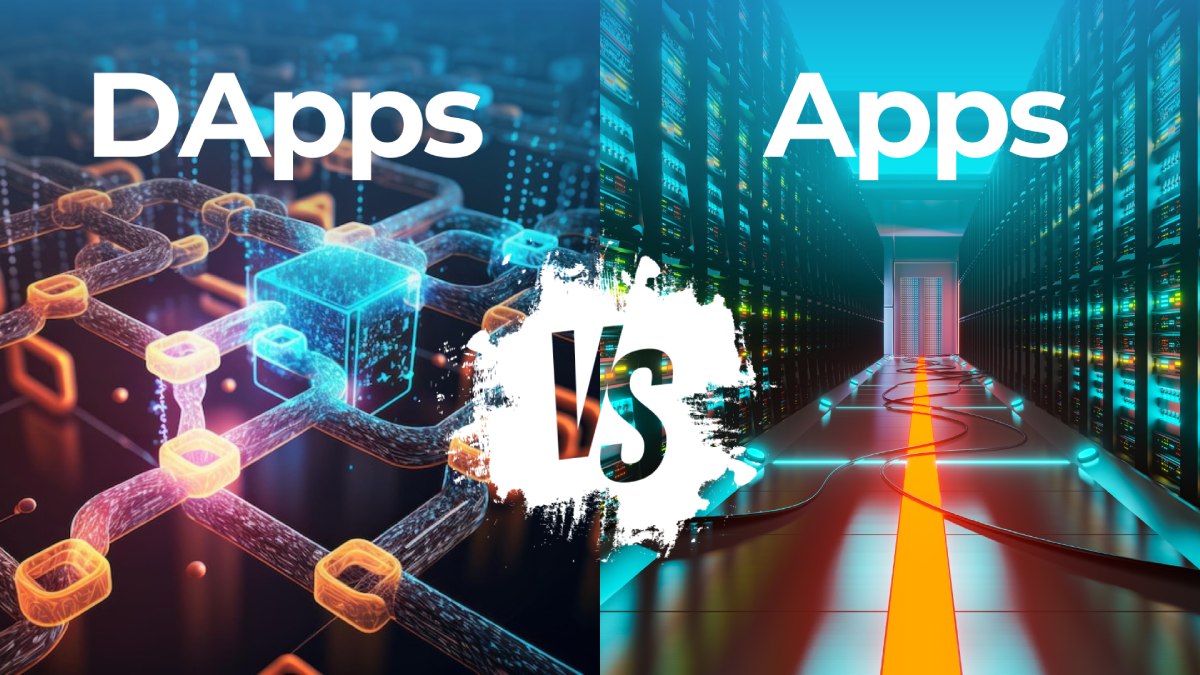
The biggest split is ownership: a traditional app runs on servers one company owns, while a dApp runs on a public network that many independent participants maintain. Almost every other difference follows from that.
| Traditional app | dApp | |
|---|---|---|
| Backend hosting | Centralized company servers | Public network maintained by many independent participants |
| Who controls it | One company (e.g., Alphabet, Meta, Snap Inc.) | Smart contract logic, and often governance-token holders |
| Signing in | Account with email, phone number, or bank details | Connect a crypto wallet; no account to create |
| Trust model | You trust the company with your personal data | Cryptography and publicly verifiable code |
| Personal data | Collected and sometimes monetized | No real-world identity required |
| Blocking users | Company can freeze accounts without warning | No single party can block a user |
| Updates | Company can patch code at any time | Code is difficult to modify after deployment |
| Regional access | Sometimes restricted to select countries | Open to anyone with an internet connection |
With a traditional app, the company can freeze your account without warning, change the rules overnight, or shut the whole service down. A dApp’s behavior is fixed by its contract code, so those decisions aren’t sitting with one team.
The update row cuts both ways, though. Code that’s hard to change protects you from sudden policy shifts, but it also means a bug in a deployed contract can’t simply be patched the way a company fixes its own app. That trade-off comes up again in the safety section.
How do dApps work?
A dApp works in three layers: a blockchain backend that stores data and records every action, smart contracts that hold the app’s logic, and a frontend interface you click through. Your wallet signs each action, the contract runs it, and the blockchain records the result for anyone to check.
Compare that with the usual Web2 client-server model, where one company’s server holds both the data and the logic. Your phone asks the server for something, the server decides, and you see the answer. Nobody outside the company can see how that decision was made.
A thought experiment makes the difference concrete. Picture a dApp version of Uber or Lyft. Drivers and passengers get matched automatically once both agree on a fare. Every ride goes into a public record anyone can audit. Payment moves peer-to-peer in crypto, and because the code is open source, the community can keep improving it after launch.
That payment piece matters. Cryptocurrency acts as the native payment layer for dApps, so value moves inside the app without a bank or card processor sitting in the middle and taking a cut.
The blockchain backend
A blockchain is a distributed ledger copied across thousands of nodes, rather than one central database that an admin can edit. Anyone with an internet connection can run a node, and some dApp users run their own so they don’t have to rely on anyone else’s copy of the data.
Most dApps don’t run a separate consensus system. They rely on the consensus mechanism of the chain they’re built on, which is how the network’s nodes agree on which transactions are valid. The two main approaches are:
- Proof-of-work (PoW): miners spend computing power to validate blocks.
- Proof-of-stake (PoS): validators stake assets to take part in validation, putting their own funds on the line.
Once data is verified, it’s appended to the chain and never rewritten. That immutability, combined with copies on many machines, means there’s no single point of failure. The network also gets harder to compromise as it grows, because an attacker would need to overpower more and more independent participants.
Activity on a blockchain is tied to cryptographically generated public-key addresses, not names. That gives you a degree of anonymity, though not total privacy, since every address’s history is public.
Blockchains also track much more than payments. Networks such as Cardano, Solana, and Polkadot store all kinds of data that dApps use.
What role do smart contracts play in a dApp?
Smart contracts are the dApp’s backend logic: code that lives on the blockchain and runs exactly as programmed. When you click a button in a dApp, you’re calling a function in one of these contracts, and the contract carries it out with no intermediary needed.
The classic comparison is a vending machine. Put in enough money, make a selection, and the item drops. No cashier checks your order. A smart contract works the same way: if the conditions are met, the result follows.
In practice, that looks like this:
- A decentralized exchange contract defines how token swaps happen, and each swap you make calls one of its functions.
- A lending contract manages loan terms between lender and borrower without anyone reviewing the application by hand.
- In a rideshare dApp, the contract dispatches a car only after confirming the passenger has enough funds, and a ride request for six people gets matched to a vehicle with enough seats.
Most dApps are simpler than they look under the hood. A 2021 study published in Software: Practice and Experience found that over 75% of DApps are supported by a single smart contract. More complex dApps split their logic across several contracts that call each other.
Serious teams spend a lot of time on careful design and thorough testing before launch, because a contract’s code stays fixed once it’s deployed and mistakes that reach the blockchain tend to stay there.
The frontend interface
The frontend is the part you actually see, and developers can write it in any language that can call the backend contracts. It can be hosted on a regular web server or on decentralized storage such as IPFS. Hosting on IPFS adds censorship resistance, because there’s no single server someone can take down to make the site disappear.
The sign-in step looks different too. Instead of a username and password, you connect a Web3 wallet such as MetaMask. The wallet holds your cryptographic private keys, and those keys sign transactions and prove you control your funds without sending any identity data to a server. The dApp sees your wallet address and your signature, nothing more.
How oracles bring real-world data to dApps
Blockchains can’t fetch outside data on their own. The reason is determinism: every node has to replay every transaction and reach exactly the same result. If a contract asked an external API for a price, that API might answer differently a few seconds later, nodes would disagree, and consensus would break. This limit is known as the “oracle problem.”
That limit causes real trouble for many apps, since a DeFi lending protocol can’t know an asset’s market price without outside input, and it needs that price to decide whether a loan is still safely backed. A prediction market such as Augur needs live real-world results to settle bets.
Oracles fill the gap. An oracle is an automated service that feeds external data into smart contracts without depending on a single third party. Oracle networks such as Chainlink and Band Protocol supply this data to dApps. With oracles in place, contracts can react to real-world events, which opens up a much wider range of uses than on-chain data alone allows.
Core traits of a dApp
A handful of technical traits separate a dApp from a website that just happens to accept crypto. If a project lacks most of these, it’s decentralized in name only.
- Open source by convention: anyone can inspect, copy, modify, and build on the code. Some dApps are fully or partially closed source, so check rather than assume.
- Deterministic: a given function produces the same result no matter what environment runs it.
- Turing complete: the code can perform any computation, given the required resources.
- Isolated: on Ethereum, contracts execute inside the Ethereum Virtual Machine (EVM), so a buggy contract doesn’t disrupt the rest of the network.
- Publicly recorded: every in-app action lands on a public, cryptographically protected record, which means anyone can audit the app’s full history.
Popular types of dApps with real examples
In principle, almost any type of app that exists today could be rebuilt as a peer-to-peer dApp. The main reason to do it is to remove a centralized middleman that takes a cut or charges hidden fees.
Take an Airbnb-style room-hosting service. Hosts could pool funds to build a dApp that connects them directly with guests. With no platform taking a commission on every booking, hosts keep more of what they earn, and the rules for listings and payments sit in code everyone can read.
Decentralized finance (DeFi) dApps
DeFi is the largest dApp category. These apps handle lending, borrowing, trading, token swaps, insurance, and earning interest without banks or brokers. Well-known examples include Uniswap, Aave, and Curve.
On Uniswap, a decentralized exchange on Ethereum, you can trade crypto with anyone in the world, and no intermediary holds your funds during the trade.
Aave is a lending and liquidity protocol. You can deposit crypto to earn interest or take out a loan against your holdings. The interest rates aren’t set by a committee; smart contracts adjust them based on supply and demand.
The loan mechanics show why DeFi works without credit checks. The borrower deposits collateral to an address the contract controls. If the borrower defaults, the contract repays the lender automatically from that collateral. Since the lender is protected by code, the borrower doesn’t need a credit rating or a stack of paperwork. That matters for unbanked people in developing countries, who may have a phone and internet access but no relationship with a bank.
Blockchain games (GameFi)
Blockchain games give players ownership of in-game items as NFTs, and gameplay rewards can carry real-world economic value. If you own a sword or a character, it sits in your wallet, not on a game company’s server.
CryptoKitties, built by the Vancouver-based blockchain company Axiom Zen, was the first known dApp built for leisure. Players adopt, raise, breed, and trade virtual cats. By December 2017, people had spent over $1M on them.
Axie Infinity has players battle, breed, and trade digital pets called Axies to earn rewards. Gods Unchained is a blockchain trading card game that draws on Magic: The Gathering and Hearthstone, with cards you actually own and can sell.
NFT marketplaces
OpenSea lets people buy, sell, create, and trade NFTs peer-to-peer, from art and collectibles to domain names. Origin is a decentralized online marketplace that covers both physical goods and digital assets.
Social media dApps
Social dApps challenge big tech’s control over user data. Lens Protocol lets you own your social graph, so your followers and content come with you when you switch apps instead of being locked inside one platform.
Steemit takes a different angle: it pays crypto rewards for posting articles, images, and comments, and also pays users for finding and upvoting popular content.
Other dApp use cases
Livepeer is a decentralized video streaming platform. Insurance is another fit for smart contracts: a life insurance payout could be released right after a death certificate is submitted and verified, instead of after weeks of waiting on a claims department.
Who controls a dApp?
No single owner controls most dApps. On many of them, control is spread among holders of governance tokens, who vote on protocol upgrades and the project’s strategic direction. The rules those votes produce are then carried out by smart contracts, not by a company’s management.
Voting weight usually rises with the number of governance tokens you hold. In practice, that means someone with a large stack of tokens has far more say than a casual user with a handful. The idea is a user-owned economy that shifts power from the platform to its users, but how evenly that power is spread depends on who holds the tokens.
Decentralized governance doesn’t mean nobody touches the code. On some dApps, authorized developers still update the code periodically to keep it secure and compatible with other platforms. If you’re putting money into a dApp, it’s worth finding out who holds those update rights and how they’re checked by token-holder votes.
Researchers have started testing how decentralized these setups really are. A 2022 study titled “Are decentralized finance really decentralized?” used social network analysis to map Aave’s transaction and control networks on Ethereum. The question it asks is the right one for you as a user too: decentralization is a spectrum, and a project’s marketing doesn’t tell you where it sits on it.
Benefits of using dApps
The strongest benefits come from the same place: no single company stands between you and the code.
- Zero downtime: once a contract is deployed, the network keeps serving it, and denial-of-service attacks aimed at one dApp don’t work the way they do against a single server.
- Censorship resistance: a dApp stays reachable as long as the underlying blockchain keeps running, so no one can quietly pull it offline.
- Privacy: you don’t need to reveal your real-world identity to deploy or use a dApp.
- Data integrity: on-chain data is immutable, so transactions that are already public can’t be forged or altered.
- Verifiable behavior: contract code is open to analysis and runs predictably. With online banking, by contrast, you have to trust the bank not to misuse your data, tamper with records, or get hacked.
- Self-custody: your assets sit in a non-custodial wallet you control, so no custodian can mismanage your funds.
Are dApps safe?
Even with blockchain records that are hard to tamper with, some dApps are still unsafe to use. Most of the risk sits in three places: the contract code, how you handle your keys, and centralized add-ons bolted onto the app. Safety varies dApp by dApp, depending on code quality and how decentralized the setup truly is.
Smart contract bugs
Because deployed code is immutable, a bug stays in place instead of getting fixed with a quick update, as it would in a normal app. Attackers look for these vulnerabilities and exploit them to drain funds, and the public, open nature of contracts means they can study the code as closely as anyone else.
The main line of defense is high-quality code audits and well-tested contracts. Before you deposit money, look for published audits and a track record of the contract holding funds without incident. Even then, maintenance stays hard: updating a dApp or its stored data is difficult even after a security flaw turns up in an old version, so old contracts can carry known weaknesses for a long time.
Lost wallet keys
Your private keys and seed phrase are the only proof that you own your funds. Lose the seed phrase and you lose the funds. There’s no password reset link and no customer support desk that can restore access.
Setting up a wallet securely is a real hurdle for non-technical users, and it’s where many beginners slip up. Write the seed phrase down offline, store it somewhere safe, and never type it into a website. Some wallet apps also include security scanners that flag high-risk dApps and warn you about threats before you sign anything.
Hidden centralization
Some user-friendly services on Ethereum look like dApps but cut corners behind the scenes. They may store your keys on their own servers, serve the frontend from one central server, or run the business logic off-chain and only write results to the blockchain afterward.
When that happens, many or all of the blockchain’s advantages disappear, and you’re back to the risks of a traditional app, where the company might freeze access, lose data, or get hacked. One quick check: if a service never asked you to save a seed phrase, someone else is probably holding your keys.
Drawbacks of dApps
A dApp’s performance is tied to the blockchain’s latency, throughput, and sequential performance, which are all slower than a single company server. And every dApp depends on an internet connection; there’s no offline mode for a blockchain.
Gas fees and network congestion
On a blockchain, every node runs and stores every transaction. That redundancy is what makes the system tamper-resistant, but it creates heavy performance overhead and makes scaling hard. Consensus adds time too: even under proof-of-stake, the network has to agree on each transaction before it’s final.
The numbers show the gap. Ethereum’s base layer handles about 10-15 transactions per second, according to ethereum.org. Visa can process about 10,000 transactions per second, while Bitcoin’s capacity was 7 transactions per second in 2013. Average block times are 10 minutes on Bitcoin and 12 seconds on Ethereum.
When transactions arrive faster than the base layer can process them, the pool of unconfirmed transactions grows quickly. A single resource-heavy dApp can back up the whole network. CryptoKitties did exactly that in 2017, congesting Ethereum during its popularity spike, and NFT dApp traffic has driven Ethereum fee spikes since.
From your side, gas is the fee you pay validators to run the smart contract behind your action. Higher demand pushes fees up, because users effectively compete for limited space in each block. Complex contracts cost more since they need more computation, and when gas costs run too high, complex contracts on Ethereum can fail to deploy at all, which lowers throughput and lengthens waits for everyone. Small transactions take the hardest hit: when the fee is roughly the same regardless of amount, moving a small sum can mean losing a large share of it to fees.
Slow mainstream adoption
Real usage data paints a more modest picture than the hype. A 2021 study of 995 DApps on Ethereum found that fewer than one fifth of them attracted almost all users, about 5% accounted for 80% of transactions, and 80% had fewer than 1,000 users. In other words, usage is concentrated in a handful of dApps, and most have very few users.
Later research shows mixed trends rather than steady growth. A 2023 utilization study in Frontiers in Blockchain analyzed 197 DApps and found that the share of positive trend segments had declined by March 2023, with DeFi carrying a disproportionate share of the negative trends.
Games have struggled with retention as well. The Wall Street Journal reported in 2019 that early game dApps such as CryptoKitties were failing to keep users. The barriers are familiar: usability problems, difficulty telling how a dApp differs from a regular app, and transaction costs.
There’s a useful signal for picking dApps here. A 2026 study in Research Policy linked open-source development activity and community interaction to later user engagement and transaction volume. A project with active code updates and a lively community is more likely to stick around than one that went quiet after launch.
How to use a dApp
Using a dApp is less complicated than it sounds, and the steps are the same no matter which wallet you choose. The part that deserves the most care is the seed phrase, because there’s no way to recover it later.
- Set up a Web3 wallet. Install a browser wallet such as the MetaMask wallet or a mobile wallet with a built-in dApp browser. Our wallet reviews at AXL Research Hub compare options side by side if you’re not sure which fits you.
- Record your seed phrase. The wallet shows it once during setup. Write it down and store it offline; it’s your only recovery route if you lose your device.
- Fund your wallet. Buy crypto on a cryptocurrency exchange platform, earn it through crypto mining, or withdraw it from a cryptocurrency ATM, then send it to your wallet address. Keep enough balance to cover gas, not just the amount you plan to use.
- Open the dApp. Visit the dApp’s website, or open it through your wallet’s dApp browser, either from a curated list or by entering the URL directly. Double-check the address, since fake copies of popular dApps exist.
- Connect your wallet. Click the connect button and approve the request in your wallet. There’s no account, email, or password involved.
- Review and sign transactions. When you swap, lend, or buy something, your wallet shows what you’re approving. Read it, then sign. You’ll pay the network fee when you confirm.
If a signature request asks for permission you didn’t expect, such as unlimited access to a token, reject it and look into the dApp before trying again.
dApp FAQs
Is Bitcoin a dApp?
Yes. Bitcoin, the first cryptocurrency, counts as an example of a decentralized application. It runs on a peer-to-peer network with no company in charge. Its rules are enforced by code rather than staff.
Do dApps cost money to use?
Most dApps are free to use, with no subscription or commission. What you do pay is gas: a fee that goes to blockchain validators for running the smart contracts behind your actions.
What exactly is gas?
Gas is the fee paid to blockchain validators for deploying and executing dApp smart contracts. More complex actions require more computation, so they cost more gas, and fees rise when the network is busy.
What are some of the biggest dApps?
Uniswap is the largest decentralized exchange on Ethereum, and OpenSea is the largest NFT trading platform. Aave and Curve are other widely used DeFi dApps.
What dApps could look like next
Layer-2 networks such as Arbitrum and Optimism process transactions off the main chain and settle them on it. That cuts costs and wait times while still leaning on the main chain for security, which goes straight at the gas and congestion problems above.
Newer blockchains such as Solana were built to exceed card-network transaction rates from the start. Cross-chain connections are also letting dApps move data and value between blockchains, so an app doesn’t have to live entirely on one network.
The bigger shift may come from traditional finance. Major institutions including Swift, Euroclear, and ANZ are exploring ways to bring real-world assets onchain, a move that could turn dApps from a crypto niche into part of standard financial infrastructure.