
What is Litecoin, and how is it different from the Bitcoin it was copied from? Litecoin (LTC) is a peer-to-peer cryptocurrency built from a modified copy of Bitcoin’s code. It’s tuned for fast, cheap everyday payments, which is why people call it silver to Bitcoin’s gold.
What is Litecoin?
Litecoin is a decentralized, open-source cryptocurrency that people send directly to each other, with no central authority issuing, controlling, or backing it. Its code started as an altered version of Bitcoin’s, and it was designed mainly for payments, especially small everyday ones, rather than as a long-term store of value.
Litecoin is the name of the network and the project. LTC is its native coin, and it’s the ticker you’ll see on exchanges. Nobody owns Litecoin. Anyone can join the network, and its users and miners are the ones who keep it running.
In crypto terms, Litecoin is an altcoin, which just means any cryptocurrency other than Bitcoin. It was the third cryptocurrency ever created, after Bitcoin and Namecoin. It’s also widely regarded as the first successful altcoin and the oldest major one.
You’ll often hear Litecoin called a fork of Bitcoin, but that label only fits loosely. Its creator took Bitcoin’s code, changed it, and started a brand-new blockchain with its own genesis block, the very first block on a chain. That’s different from a typical hard or soft fork, where one existing chain splits in two and both sides keep every transaction recorded before the split. Litecoin never shared that history with Bitcoin: its ledger started from scratch, so nobody received LTC for holding bitcoin. When people say “fork,” then, they’re talking about the code, not the chain.
That early start has paid off. Litecoin’s long history has given it an established economy and a larger user base than most altcoins have. The project’s official site is litecoin.org.
Who created Litecoin?
Charlie Lee, a former Google software engineer, created Litecoin and released it in October 2011. He’s a computer scientist and a graduate of the Massachusetts Institute of Technology. He also runs the Litecoin Foundation, the non-profit that promotes and develops Litecoin, as its managing director.
Lee was born in Ivory Coast and grew up in New Jersey. In crypto circles he goes by “Satoshi Lite,” a nod to Satoshi Nakamoto, the pseudonymous creator of Bitcoin.
The Litecoin Foundation’s team is small. A handful of paid developers do the core work, and advisors, contributors, ambassadors, and volunteers back them up. The foundation doesn’t own the network any more than Lee does; it funds development and promotion the way a non-profit supports any open-source project. Its website is litecoin-foundation.org.
Why was Litecoin created?
Lee built Litecoin to fix the spots where Bitcoin struggled as everyday money: slow confirmations, rising fees, and mining concentrated among people who could afford costly hardware. His biggest worry was that last one, because it pointed toward Bitcoin becoming too centrally controlled. So he set out to build a coin that was faster and could scale, without giving up decentralization.
Merchants felt Bitcoin’s slowness the most. Online stores and shops often waited for 6 Bitcoin transaction confirmations before treating a payment as final, and that took about an hour. An hour’s wait is fine when you’re selling a car. At a checkout counter, it’s useless. Litecoin’s early focus on merchants and e-commerce grew out of that problem.
Lee didn’t pitch Litecoin as a Bitcoin killer. In his plan, Bitcoin would handle large, infrequent transfers and long-term holding, while Litecoin covered the smaller payments people make day to day. That division is why his original software release message described Litecoin as silver to Bitcoin’s gold, a line early marketing kept using.
Litecoin vs. Bitcoin: why it’s called digital silver
Litecoin and Bitcoin share the same foundation: proof-of-work mining, a hard supply cap, halvings about every four years, and mining difficulty that climbs as more miners join. They part ways on the mining algorithm and on nearly every number that sets the network’s pace.
| Feature | Litecoin | Bitcoin |
|---|---|---|
| Ticker | LTC | BTC |
| Consensus mechanism | Proof of work | Proof of work |
| Mining algorithm | Scrypt | SHA-256 |
| Average block time | 2.5 minutes | About 10 minutes |
| Maximum supply | 84,000,000 LTC | 21,000,000 BTC |
| Halving interval | Every 840,000 blocks | Every 210,000 blocks |
| Halving frequency | About every 4 years | About every 4 years |
| Difficulty adjustment | Every 3 days, 12 hours | Less frequent |
| Transactions per second | About 60 | About 8 |
| Market capitalization | Much smaller | Much larger |
| Primary role | Fast, low-cost payments | Store of value |
The algorithm split has a practical effect. Scrypt and SHA-256 need different mining hardware, so a Bitcoin miner can’t just point the same machines at Litecoin.
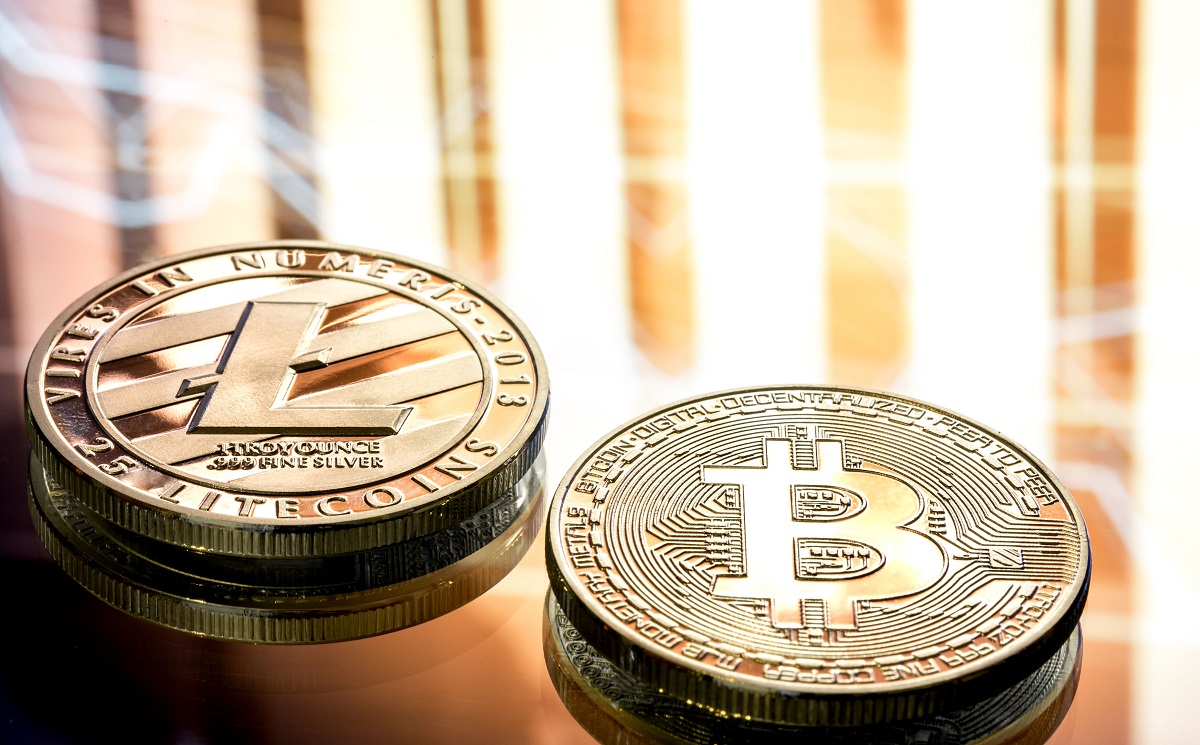
Litecoin blocks arrive about four times as fast as Bitcoin’s, so your payment gets confirmed sooner. The supply cap is four times larger too. More coins in existence means a lower price per coin.
The halving schedule looks different on paper but lands in the same place. Both networks trigger a halving by block count, not by calendar date. Litecoin waits four times as many blocks, and its blocks come four times as fast, so both coins halve about every four years. Litecoin also resets its mining difficulty far more often, every three and a half days.
Throughput is where the payment focus shows. Litecoin’s network handles about 60 transactions per second, compared with about 8 for Bitcoin and about 20 for Ethereum.
The gold and silver roles follow from all this. Bitcoin is seen as the better store of value, while Litecoin is positioned for quick, low-cost spending. The comparison goes back to bimetallic money, when gold and silver circulated side by side. Gold worked like large bills. Silver worked like coins, the money you used to make change and pay for cheap things.
How does Litecoin work?
Litecoin works almost exactly like Bitcoin, since it runs on a Bitcoin-derived codebase. Miners bundle transactions into blocks, cryptography protects who owns each coin, and every transfer is recorded on a public blockchain. If you already know how Bitcoin works, most of Litecoin will look familiar.
The code keeps tracking Bitcoin, too. When Bitcoin developers ship an upgrade, a patch, or an optimization, Litecoin’s developers usually port it over quickly. Development is open source, so anyone can read the code and review changes before they go live.
How Litecoin mining works
Litecoin miners compete to solve complex math problems, and the first one to succeed adds the next block and earns newly minted LTC. That’s proof of work. Block rewards are the only way new LTC enters circulation, so mining is also how the supply grows.
Litecoin uses Scrypt (pronounced “ess-crypt”), a memory-intensive algorithm that leans on RAM rather than raw processing power. The goal was to blunt ASICs, short for application-specific integrated circuits. These are machines built to do one kind of mining calculation and nothing else, and on Bitcoin they ended up concentrating mining among well-funded operators.
Here’s the honest version: that resistance didn’t hold. Manufacturers built Scrypt-specific ASIC miners, and large-scale operations came to dominate Litecoin mining. So you’ll read that Litecoin was designed to keep mining open to regular people, and you’ll also read that it’s run by ASIC farms. Both are true. The first describes the original intent, and the second describes what happened.
Hobbyist equipment can still technically mine LTC. Even so, a lone miner with a single ASIC is unlikely to ever win a block reward. The practical setup is several ASIC miners connected to a mining pool, which combines members’ computing power and shares the rewards among them.
How Litecoin transactions work
Every LTC transaction between addresses goes onto Litecoin’s blockchain, a decentralized public ledger that’s close to impossible to alter. When you send LTC, the transaction is broadcast to the network instantly. It isn’t final, though, until miners confirm it in a block.
With a block about every 2.5 minutes, a Litecoin payment counts as settled sooner than a Bitcoin one. That shorter wait is what draws merchants, and it matters most when you’re paying in person and the cashier is waiting with you.
Network fees on Litecoin are typically a small fraction of Bitcoin’s. Bitcoin’s fees climb when the network gets busy, and that’s exactly when a small payment stops making sense.
Litecoin addresses are pseudonymous. You receive payments at an address that isn’t tied to your name, although the payments themselves are visible on the public ledger. Litecoin addresses start with L, M or 3, or ltc1. Some Bitcoin addresses also start with 3, so confirm the receiving wallet is a Litecoin wallet before you hit send.
Litecoin supply cap and halving
Litecoin’s software sets a hard limit of 84,000,000 LTC, and no coin beyond that cap can ever be created. Every 840,000 blocks, the block reward gets cut in half. Those halvings will keep coming until all LTC has been mined.
The cap and the halvings work together to control inflation. You know the maximum supply in advance, and you know new coins will arrive at a predictable rate that only shrinks over time.
Most of the total supply is already mined. About 10 million LTC were left to mine as of January 2024, and each halving releases the remainder more slowly. The most recent halving happened on August 2, 2023, and the next one is scheduled for 2027.
SegWit and MimbleWimble: Litecoin’s big upgrades
Litecoin’s developers have used the network as a testing ground for experimental features that Bitcoin later adopted. The market has generally read those experiments as part of Litecoin’s role next to Bitcoin, not as an attempt to compete with it.
Segregated Witness (SegWit) upgrade
Litecoin adopted Segregated Witness, or SegWit, in 2017. Before that, each transaction stored everything together: the sender, the receiver, the amount, and the signatures, which are called witnesses. As more people used the network, that structure slowed processing and raised costs.
The old setup also left room for transaction malleability. Someone could make small changes to a transaction’s data after it was created but before it was confirmed. The payment would still be delivered, but its record no longer matched the original.
Picture a package shipment. You mail a box with a tracking number, and someone quietly alters that number along the way. The box still arrives, but you can’t prove it did. A dishonest recipient can claim it never showed up and get you to pay a second time.
SegWit fixed this by separating the signature data from the transaction data, which closed the gap for tampering. The change also cut the amount of data in each transaction. More transactions fit in each block, so capacity went up without slowing the network or raising costs.
Lightning Network on Litecoin
The Lightning Network is a layered design that processes payments on top of the base blockchain, so small payments don’t each need to wait for a block. Later in 2017, the first Lightning Network transaction was completed on Litecoin. SegWit made that possible, because Lightning relies on transactions that can’t be quietly altered before they confirm.
MimbleWimble privacy upgrade
Litecoin added the MimbleWimble upgrade in 2022. MimbleWimble encrypts transaction amounts, so the network can validate a transaction without seeing how much moved. Only the sender and the receiver know the amount.
The upgrade also uses a technique called cut-through, which trims old transaction history. The network can still verify that funds exist without revealing where they came from or where they’re going. Because only the most recent transaction data gets stored, the blockchain stays smaller, and that helps Litecoin scale as volume grows.
That privacy has a cost. Know Your Customer (KYC) and Anti-Money Laundering (AML) rules require regulated crypto firms to trace transactions back to wallet holders, and hidden amounts work against that. After South Korea’s financial regulators banned privacy coins, several major South Korean exchanges delisted Litecoin. Other countries could crack down the same way, and that would make LTC harder to buy or sell wherever it happens.
Key moments in Litecoin’s history
A lot of what shapes LTC today happened in a single year, 2017, when Lee came back to the project full time and the price hit its peak. The years before that explain why the comeback mattered.
- October 7, 2011: Litecoin launches, about two years after Bitcoin, at a price of about $4.30.
- Early years: Many of the first adopters are former Bitcoin GPU miners who’d profited from mining with graphics cards.
- 2013: Lee joins Coinbase as Director of Engineering and largely sets Litecoin development aside to focus on helping people own and hold bitcoin.
- Mid-2010s: Merchant interest in crypto fades, and Litecoin shifts its energy to aggressively developing new features.
- 2017: Lee leaves Coinbase to work on Litecoin full time. The same year, Litecoin adopts SegWit and hosts the first Lightning Network transaction.
- December 2017: Lee announces he’s sold most of his LTC. He wanted to avoid conflicts of interest as Litecoin’s developer, a public commentator on it, and head of its foundation.
- December 2017: LTC reaches its all-time high of $347, alongside the broader crypto market’s peak.
- 2022: The MimbleWimble privacy upgrade goes live.
- August 2, 2023: The most recent halving cuts the block reward in half.
- 2027: The next halving is scheduled.
What gives Litecoin its value?
LTC’s value rests on a supply capped at 84,000,000 coins, issuance that gets cut about every four years, and demand from people who buy it. Traders tend to buy around halvings, when new supply shrinks. Many also expect LTC to keep pace when Bitcoin’s price rises.

LTC is listed on most major exchanges, which makes it one of the more liquid crypto markets in the world. For you, that means buying or selling is usually quick, and a normal-sized order won’t move the price much.
You’ll see Litecoin’s size measured by crypto market capitalization. That’s the current market price multiplied by the number of coins in circulation, and Litecoin’s market cap is much smaller than Bitcoin’s.
A larger supply, combined with Bitcoin’s wider acceptance as money and as a store of value, keeps LTC’s per-coin price well below Bitcoin’s.
The silver comparison breaks down a bit on price. From 323 BC to around 1900, gold was worth about 12 to 15 times as much as silver. LTC’s best showing against Bitcoin came in late 2013, when one LTC was worth 0.048 BTC. Even at that peak, Litecoin was cheaper relative to Bitcoin than silver typically was relative to gold.
Expect the price to move almost constantly. LTC largely tracks the broader crypto market, so when the whole market swings, LTC usually swings with it.
What is Litecoin used for?
People mainly use Litecoin to pay for goods and services, since it was designed first as a payment method. Its low network fees also make it practical for quickly sending money to family or friends. The other big use is trading LTC on crypto exchanges.
Much of that trading is speculation. Traders position themselves around halvings, and some pile in when Bitcoin rallies on the bet that LTC will follow.
You can’t stake LTC on its own blockchain. Staking belongs to proof-of-stake networks, and Litecoin’s proof-of-work design rules it out. If you want yield on LTC, you’ll have to use third-party platforms or DeFi protocols. That means trusting someone else’s platform or code with your coins, so weigh that risk before chasing the return.
Is Litecoin reliable?
Litecoin’s network has run since October 2011, secured by proof-of-work miners who earn LTC for confirming transactions. That makes it one of the longest-running crypto networks, and its market has held up despite years of criticism. Whether LTC is a reliable investment is a separate question, because a working network doesn’t mean a stable price.
Proof of work is what protects the ledger. To rewrite Litecoin’s history, an attacker would need to outpace the honest miners, and that gets more expensive as more mining power joins.
Litecoin advantages
Litecoin’s practical pluses mostly come down to its bigger supply, and they matter most to people buying in small amounts.
- Lower price per coin: LTC costs far less per coin than BTC, which makes it easier to buy.
- Larger issuance: With a cap of 84,000,000 coins, there’s room for more people to hold whole coins.
- Less mining competition: Litecoin mining is less crowded than Bitcoin mining, even as its difficulty keeps rising.
Keep the first two in perspective. You can buy a fraction of a bitcoin just as easily, so a low price per coin doesn’t make LTC a bargain by itself. And less competition than Bitcoin still means competing with pools full of ASIC miners.
Litecoin drawbacks and criticisms
Critics argue that Litecoin doesn’t offer a clear reason to exist beyond what Bitcoin offers. It runs on Bitcoin-derived code, and Bitcoin’s upgrades get ported over, so skeptics ask why anyone needs both. Supporters answer with speed and fees, but the question hasn’t gone away.
Other complaints are more concrete:
- Electricity use: Proof-of-work mining takes a lot of electricity, the same criticism aimed at Bitcoin.
- Speed limits: At about 60 transactions per second, Litecoin beats Bitcoin but still falls short of what replacing fiat money would demand.
- Regulatory exposure: MimbleWimble’s privacy features clash with KYC and AML rules, and the South Korean delistings show how that can cut off access.
- Smaller market: Bitcoin’s market cap dwarfs Litecoin’s, and LTC’s price swings hard with the rest of crypto.
None of these stop the network from working. They do decide whether LTC fits what you want from it, so weigh them against the size of the position you’re thinking about.
How to buy Litecoin
Most people buy LTC on a crypto exchange, and since Litecoin trades on most major exchanges worldwide, you’ll have plenty of choices. Binance and Coinbase both list it. Binance’s main platform doesn’t serve US customers, so check which version operates where you live.
- Pick an exchange that lists LTC. Make sure it’s available in your state and supports the funding method you plan to use.
- Create an account. Use a strong, unique password for it.
- Verify your identity. Regulated platforms require this under KYC rules, so have a photo ID ready.
- Fund your account. A bank transfer or debit card works on most platforms, and so does crypto you already hold. Some also accept credit cards, Apple Pay, and Google Pay.
- Place your order. Enter the amount of LTC you want and complete the purchase.
- Move your LTC to a wallet. A hot wallet stays online for convenient spending, while a cold wallet keeps your coins offline.
Crypto ATMs offer another route if you’d rather skip an online account. They look like bank machines and sell LTC on the spot, though they tend to charge more than online exchanges. If you’re still choosing a platform, AXL Research Hub‘s crypto exchange reviews and wallet comparisons put the options for buying and storing LTC side by side.
Where to store Litecoin: wallet options
Start with the download section on litecoin.org, which lists open-source Litecoin wallets that have been vetted. Be careful with obscure or untested wallet apps from app stores or random websites. Some have turned out to carry malware that steals coins.
Litecoin Core is the full desktop wallet, available for Windows, Mac, and Linux. It runs a full node, so your computer helps support the network. The trade-off is a long initial sync and a lot of disk space for the full blockchain. Its pruning option cuts that down by storing only part of the chain.
Loaf Wallet is a light mobile wallet for Android and iOS (the app has since been renamed Litewallet). Instead of storing the blockchain, it queries trusted full nodes, so it uses few of your phone’s resources.
Electrum Litecoin is a light desktop wallet forked from Bitcoin’s Electrum. You get desktop control without downloading the full blockchain.
For larger holdings, a hardware wallet is the stronger choice. It generates and keeps your private keys on a separate USB device, out of reach of online hackers. Leaving a large LTC balance on an exchange account carries more risk. So does a software wallet without a strong password and a backup of your private keys.
Whatever wallet you choose, write down its seed phrase and keep it somewhere safe offline. If your device is lost or damaged, the seed phrase lets you recover the wallet. Anyone who finds it can take your coins, so never store it in a photo or a cloud note.
How to turn Litecoin into cash
To cash out, sell your LTC for dollars on an exchange or crypto platform that supports sales. Type in how much LTC you’re selling and choose where the funds should go. Then withdraw the dollars to your bank account.
LTC to USD is one of the common pairs, and LTC is quoted in almost every other currency too, so you won’t struggle to find a place to convert it. In the US, selling crypto for more than you paid is generally a taxable gain, so keep a record of what you paid for your LTC.
More questions about Litecoin
What will Litecoin be worth in 2030?
No one can give you a dependable forecast. How investors, traders, governments, and the public will treat LTC by then is unknowable. New cryptocurrencies also appear every day to compete for the same money, so treat any 2030 price target you see as a guess.
Which companies accept Litecoin?
Most merchants that take LTC do it through crypto payment processors. The processor accepts bitcoin, LTC, and other cryptocurrencies on the merchant’s behalf, so the store doesn’t need its own crypto setup to get paid.
Is there an official list of stores that take Litecoin?
No. Acceptance has spread across many retailers worldwide, helped along by Litecoin’s low network fees, but no single official merchant list exists. Your best bet is to check the crypto options at checkout or ask whether the store’s payment processor supports LTC.
Litecoin’s place next to Bitcoin
If you want a coin to hold for years, Bitcoin is the one most of the market treats as a store of value. If you want to move value quickly and cheaply, LTC’s faster blocks and low fees make it the more practical of the two. That’s the job Lee designed it for, and its Scrypt mining and bigger supply cap all serve that payments role.
Before you put money in, weigh what comes with it. Its privacy features have already cost it exchange listings in one country. Its market is a fraction of Bitcoin’s size, and its price can swing hard in either direction, so size your position for that.