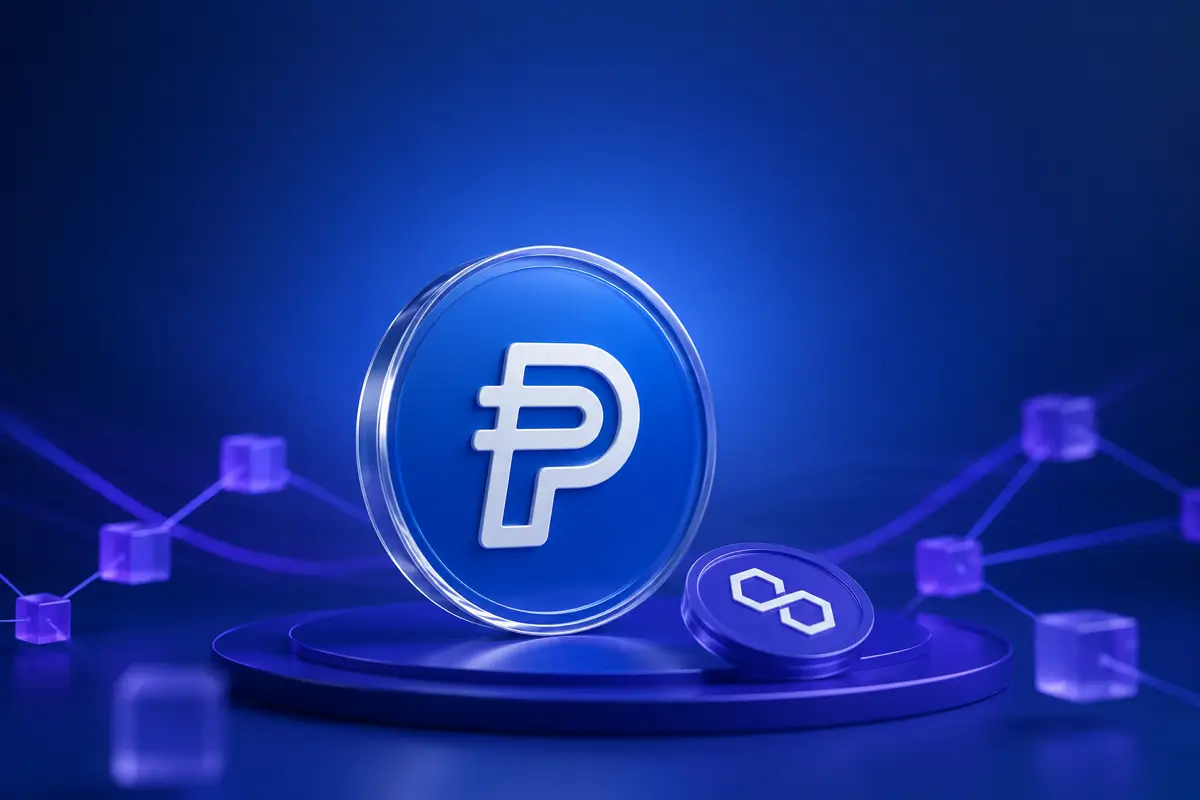

What is PayPal USD? It’s PayPal’s US dollar stablecoin, a crypto token you can buy and sell in the PayPal and Venmo apps for exactly $1.00 apiece. The token itself comes from Paxos Trust Company, not PayPal, and Paxos holds the reserves that back every PYUSD in circulation.
What is PayPal USD (PYUSD)?
PayPal USD (PYUSD) is a stablecoin pegged to the US dollar, and you can redeem it 1:1 for US dollars. PayPal puts its name on it and sells it in its apps, but Paxos Trust Company issues the token and holds it in custody.
Inside PayPal, 1 PYUSD equals 1 USD. You can buy it, hold it, and send it from the PayPal app, and Venmo supports it too.

Under the hood, PYUSD started as an ERC-20 token on Ethereum. ERC-20 is the standard token format on that network. Most Ethereum wallets and apps already know how to read it, so PYUSD could plug into them from the start.
PayPal pitches PYUSD as a bridge between regular money and blockchain payments. For you as a consumer, that means a dollar you can put on a crypto network without buying something whose price jumps around. Merchants can take it as payment, and developers can build it into their apps.
What is a stablecoin?
A stablecoin is a cryptocurrency designed to hold a steady value against a reference asset, usually the US dollar. Most other cryptocurrencies swing in price, so buying and selling them carries a real risk of big losses. A dollar stablecoin tries to stay at a dollar while still moving the way crypto moves.
Because stablecoins live on public blockchains, developers can write them into apps like any other token. That’s why you’ll hear them called programmable money. An app can send a stablecoin payment on its own when something in its code says to.
That puts stablecoins between two worlds: the traditional economy and web3, the world of blockchain-based apps. The case for them is money that moves fast and efficiently, plus broader access to the financial system.
Most stablecoin volume sits inside web3 itself. PYUSD was built to work in that ecosystem from day one, and launching it as an Ethereum token is what made that possible.
When did PayPal launch PYUSD?
PayPal launched PYUSD on August 7, 2023, announcing it from San Jose, California, according to the PayPal Newsroom. Eligible US PayPal customers got it first, and access rolled out gradually over the following weeks instead of reaching every account on day one.
Venmo wasn’t part of the launch. PayPal said Venmo support was coming soon, and PYUSD has since been added to the Venmo app.
Dan Schulman, PayPal’s president and CEO at the time, framed the launch around fully backed, regulated stablecoins. His case was that dollar tokens with real reserves and a regulator behind them could change how payments work in web3 and other digitally native settings.
How PYUSD stays at $1 with the US dollar
Every PYUSD is backed 100% by reserves held in US dollar deposits, short-term US Treasuries, or similar cash equivalents. Paxos holds those reserve assets, and it also handles custody of PYUSD itself.
The reserve is one half of the peg. The other half is the price. Inside PayPal, you buy PYUSD at $1.00 and sell it at $1.00, every time. That fixed two-way rate is what actually ties the token to the dollar for you.
In plain terms, 1:1 redemption means you can swap whatever PYUSD you hold back for the same number of US dollars at face value. You don’t need to find a buyer or time the market, because PayPal’s sell rate doesn’t move.
That fixed rate belongs to PayPal and Venmo. Once PYUSD sits on an outside exchange, its price there comes from trading between buyers and sellers, so it can drift slightly above or below $1.00. The reserves and the redemption promise are designed to keep it close to a dollar.
The 1:1 rate also covers only PYUSD and US dollars. Swaps into other currencies or other crypto carry a spread.
Is PayPal USD safe?
Paxos, the company that issues PayPal USD, publishes a report on PYUSD’s dollar reserves every month. New York’s financial regulator oversees Paxos. Still, PYUSD is a crypto product: it isn’t a bank deposit or legal tender, so it doesn’t carry the protections of money in a bank.
The safety picture has three parts. Full dollar backing is the base layer. Public reporting and state regulation are the checks that let you confirm the backing is really there. The legal limits on what PYUSD is tell you which protections you don’t get.
Monthly reserve reports and attestations
After each month ends, Paxos publishes its own report on what the PYUSD reserve holds, broken down by asset type. The first monthly Reserve Report came out in September 2023.
A company reporting on itself only goes so far, so there’s a second check. Each month, an independent third-party accounting firm issues a separate attestation of the reserve’s value. The firm does that work under standards set by the American Institute of Certified Public Accountants (AICPA), the group that writes the rules CPA firms follow for this kind of engagement. An attestation confirms the reserve’s value at a point in time, which is narrower than a full audit of the company.
Both reports sit on the Paxos PayPal USD Transparency page, and anyone can open them. To check for yourself, compare the reserve value in the latest attestation with the number of PYUSD tokens outstanding on the same date. The reserves should cover every token.
Regulation and licensing behind PYUSD
Paxos Trust Company is a fully licensed limited purpose trust company overseen by the New York State Department of Financial Services (NYDFS). Since Paxos issues PYUSD and holds the reserves, the way NYDFS oversees Paxos is the main regulatory check on the token itself.
PayPal holds its own New York licenses for its crypto business. NYDFS granted PayPal a BitLicense in June 2022, after PayPal had first operated under a conditional BitLicense. NYDFS also chartered PayPal Digital, Inc. as a limited purpose trust company for virtual currency business.
If you want to verify PayPal Digital yourself, its NMLS ID is 2610315 and its address is 117 Barrow St, New York, NY 10014. You can search that ID in NMLS, the national licensing database for money transmitters and other financial firms.
PayPal doesn’t handle every crypto function in-house. Paxos or another licensed provider performs custody, trading, and transfers for the crypto in your PayPal account.
What PYUSD is not: deposits, legal tender, and state rules
PYUSD isn’t legal tender. Legal tender is money the government recognizes for paying debts, like dollar bills and coins. PYUSD doesn’t have that status, so you can spend it only where a merchant or platform agrees to take it, such as at PayPal checkout.
Your PYUSD balance isn’t a deposit, either. Because the PayPal Cryptocurrencies Hub where it sits isn’t a deposit account and PayPal itself isn’t a bank, the protections that come with a bank deposit don’t extend to PYUSD. Instead, what stands behind your tokens is the reserve, Paxos’s regulation, and PayPal’s terms.
State rules add one more gap. PayPal’s disclosures say buying, selling, transferring, and holding crypto isn’t regulated in many states, and they name California as one of them. In a state like that, your state regulator may have no specific role over your crypto activity. Crypto rules are shifting state by state, so check what your own state’s financial regulator covers.
What can you use PayPal USD for?
You can use PayPal USD to send money to people, pay at checkout where PayPal is accepted, and hold a dollar value inside a crypto wallet. Businesses on PayPal can also accept it as payment, including for cross-border sales.
When PayPal launched PYUSD, it named specific jobs for it. In-app payments in virtual worlds were one. Transfers to friends and family, remittances, and other international payments were on the list as well, along with direct payouts to developers and creators.
Sending money with PYUSD
You can send PYUSD person to person to friends and family, whether they’re on PayPal or not. Sending works worldwide and around the clock, 24/7, so you aren’t waiting on bank hours or a weekend.
When both of you are on PayPal, the money lands in seconds. Some bank transfers take several days to arrive.
A friend who isn’t on PayPal can still get PYUSD at their own crypto wallet address. That send goes over a public blockchain, so it carries a network fee.
PayPal’s plan is to let people buy, send, and get paid in PYUSD across about 70 markets, with more added over time. That rollout happens in stages. Before you send to someone abroad, make sure PYUSD is available where they live.
Paying at checkout with PYUSD
At PayPal checkout, PYUSD shows up as a funding source you can pick, the same way you’d pick a card or your balance. PayPal calls this Checkout with Crypto.
Behind the scenes, Checkout with Crypto converts your PYUSD to regular dollars when you pay. Because the merchant receives fiat and handles no crypto at all, PYUSD works at millions of US merchants that accept PayPal, including stores that have never set up anything for stablecoins.
Business payments with PYUSD
Businesses on PayPal can accept PYUSD for payments, including cross-border transactions. A US merchant doesn’t need a separate crypto setup to do it. If PayPal checkout is already on the site, PYUSD comes with it.
PayPal also aims PYUSD at developers and large brands. For them, the draw is programmable dollar payments they can build straight into their own apps and platforms.
How to buy PYUSD on PayPal
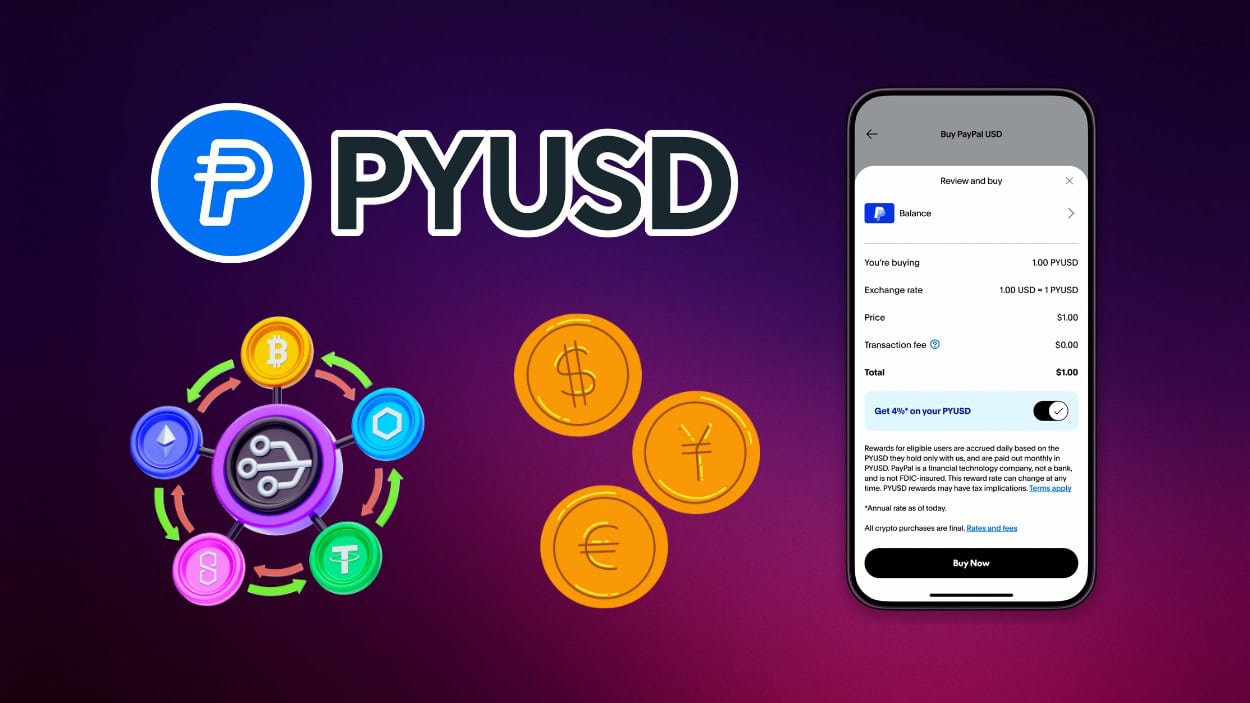
Buying PYUSD with dollars already in your PayPal balance trades 1:1 and costs nothing. The first purchase takes a few setup steps, mostly to confirm who you are.
- Sign in to PayPal or create an account. Crypto requires a PayPal Balance account, so open one if you don’t have it yet.
- Complete identity verification. PayPal asks you to verify your identity before you can use its crypto features.
- Opt in to crypto services. You can do this in the PayPal app or on the PayPal website.
- Buy PYUSD in your PayPal wallet. Paying from your USD balance gets you PYUSD at 1:1 with zero fees. In eligible regions, you can also pay with a linked bank account or debit card.
- Pick what to do with it. You can send it, spend it at checkout, or hold it. If you hold it, opt in to rewards so the balance can earn.
If you don’t see PYUSD after opting in to crypto, check whether it’s offered in your country.
Where PYUSD is available
PYUSD started out with eligible US PayPal customers only. PayPal has since been expanding it to eligible markets across the Americas, Europe, Asia-Pacific, and Africa. Eligibility is set country by country, so a region on that list doesn’t mean every country in it qualifies.
Whether you can buy, sell, hold, or earn rewards on PYUSD all comes down to your market. The PayPal app shows what’s open to you once you finish identity verification, and that’s the quickest way to get a firm answer.
PayPal USD fees
Buying, selling, and holding PYUSD on PayPal and Venmo costs $0. Sending it to eligible PayPal or Venmo users is free too. That includes global sends on PayPal.
A fee shows up when PYUSD leaves PayPal and Venmo for an outside wallet address. That transfer moves on a public blockchain, and the blockchain charges a network fee to process it. The amount depends on which blockchain you use and how busy it is when you send.
Before any crypto transaction, checkout included, PayPal shows you the exchange rate and any fees. Look at that screen before you confirm, especially on swaps into other crypto, where a spread is built into the rate.
The real dividing line is whether your PYUSD stays inside PayPal and Venmo or leaves them.
| What you do | Cost |
|---|---|
| Buy PYUSD with USD on PayPal or Venmo | $0 |
| Sell PYUSD for USD on PayPal or Venmo | $0 |
| Hold PYUSD on PayPal or Venmo | $0 |
| Send to an eligible PayPal or Venmo user, including global sends on PayPal | No fee |
| Send to an outside wallet address | Blockchain network fee |
| Convert to another crypto or a non-USD currency | Spread built into the exchange rate |
Can you convert PYUSD to US dollars?
Yes. On PayPal and Venmo, 1 PYUSD sells for 1 USD, and PayPal charges no fee to sell. Whatever amount of PYUSD you sell, you get the same number of US dollars back. That fixed rate is what separates PYUSD from other crypto, whose sale price moves with the market.
Converting to other currencies works differently. If you’re in an eligible market and convert PYUSD to a currency other than the US dollar, the exchange rate includes a spread. You won’t get an exact 1:1 trade.
You can also swap PYUSD for any cryptocurrency PayPal supports, and back again. On those trades, the exchange rate includes a spread that PayPal earns on each purchase and sale. A spread is a markup baked into the price rather than a separate line item. If you want to know what you’re paying, compare PayPal’s quoted rate with the coin’s market price elsewhere.
How PYUSD rewards work
PayPal pays rewards on PYUSD you hold in the PayPal app at a variable annual rate of 4%, according to PayPal’s PYUSD page. Variable means PayPal can change that rate, so treat 4% as a number that can move, not a promise.
Rewards are calculated on your average daily PYUSD balance, not on what you hold on any one day. A big deposit the day before payout barely moves the reward, and a short dip mid-month won’t erase what you’ve built up. Payouts come monthly in PYUSD, not dollars, so your reward shows up as more tokens in your balance.
To qualify, you need to have signed up for crypto, opted in to rewards, and hold at least 1 PYUSD. Below 1 PYUSD, nothing accrues. You can track pending rewards in the Crypto hub before each payout.
You can opt out anytime, and new rewards stop accruing right away. Rewards you’d already earned still arrive on the next scheduled payment date. The same goes if you withdraw your full balance: you’re paid what you earned up to that point on the next payment date, even with nothing left in the account.
Some details depend on where you hold PYUSD and where you live. Rewards may be available on PYUSD held in Venmo too. PayPal is also bringing them to more countries over time.
PayPal structures the rewards as a loyalty program. It says the program isn’t meant to be a securities offering.
Using PayPal USD on Venmo
In the Venmo app, you can buy and sell PYUSD directly at 1 PYUSD for 1 USD.
You can also move PYUSD between Venmo and PayPal, which links the two apps. That’s handy if your PYUSD sits in Venmo and you’d like to spend it through PayPal checkout.
Venmo’s Crypto tab includes educational material on how crypto works. If PYUSD is your first crypto, it’s a reasonable place to read up before you buy.
Sending PYUSD to external wallets and blockchains
You can send PYUSD out of PayPal to Venmo, to compatible crypto wallets, to exchanges, and onto several blockchains. PayPal built it as an open system, so the token isn’t stuck inside PayPal’s own apps.
Ethereum is PYUSD’s original network, where it runs as an ERC-20 token. A large base of wallets and web3 apps can already receive it there. PayPal lists PYUSD on Ethereum, Solana, Arbitrum, and Stellar. On networks like Ethereum and Solana, you can send it to almost anyone, almost anywhere.
Because exchanges support PYUSD, you can move it between PayPal and trading platforms. Crypto exchanges in the PYUSD ecosystem include Coinbase, Kraken, OKX, Bybit, and Bitget.
Before you send anything out, check the receiving side. A wallet can only receive PYUSD if it supports PYUSD on the network you choose. Send on one chain to a wallet that only handles PYUSD on another, and you may not be able to get the tokens back, since blockchain transfers generally can’t be reversed. A small test send to a new address is a sensible first move. If you’re still choosing a wallet, AXL Research Hub‘s crypto wallet reviews cover the options.
PYUSD at a glance: a redeemable digital dollar inside PayPal and Venmo
If you want a dollar you can send onto Ethereum or Solana and cash back out at $1.00 in PayPal or Venmo, PYUSD does that job. Paxos issues it under NYDFS oversight and keeps it fully reserved. The monthly reserve reports let you check that backing yourself. Holding it can also earn variable rewards, paid monthly in PYUSD.
As a crypto product that is neither a deposit nor legal tender, PYUSD doesn’t work like a bank account, so cash that needs bank-account protections belongs in a bank.