
Robinhood has grown well past its roots as a bare-bones stock-trading app. It now covers stocks, ETFs, options, crypto, futures, and even prediction markets, all without account minimums and with $0 commissions on core trades. But a low price tag doesn’t automatically mean a good fit.
What is Robinhood and who is it for?
Robinhood is an online brokerage built around the idea of making investing accessible to everyone. Users can trade stocks, ETFs, equity and index options, crypto, futures, and prediction markets from a single app or the newer desktop workstation. There’s no account minimum for brokerage, Gold, or IRA accounts, and fractional shares let you start buying with as little as $1.
The audience has broadened over the years, stretching well beyond first-time investors. Beginners still flock to Robinhood for its clean mobile interface and fast sign-up, while active traders stick around because the zero-commission structure keeps their costs low. IRA savers, meanwhile, are drawn by a contribution match that’s rare outside employer-sponsored plans. Even crypto buyers have a reason to stay: with 40-plus coins available inside the same brokerage account, there’s no need to juggle a separate exchange.
The platform has matured, too. What started as a mobile-first starter app now includes a full desktop workstation (Robinhood Legend), an expanding set of asset classes, and access to over 650 foreign companies through American Depositary Receipts. It’s no longer just a place to buy your first share of stock.
Robinhood’s pros and cons
Robinhood’s strengths cluster around cost and convenience, while its weaknesses show up when you need depth, whether that’s research, asset variety, or customer support.
Pros
- Commission-free trades on stocks, ETFs, and equity options keep costs at $0 for the trades most users place every day. Very few brokerages match this across all three categories without tacking on per-contract fees for options.
- Cryptocurrency trading covers 40-plus coins directly inside your brokerage account. Trades routed through a market maker carry no commission, which removes a cost that crypto exchanges typically charge.
- The IRA contribution match gives you 1% on a standard account or 3% with Gold. Getting any match on an IRA that isn’t tied to an employer is unusual, and the Gold-tier 3% rivals what some 401(k) plans offer.
- 24/5 stock trading through limit orders placed between 8 p.m. Sunday and 8 p.m. Friday ET opens a wide window for reacting to after-hours news.
- The mobile app remains one of the fastest to set up. Charting is intuitive, order execution feels quick, and the interface stays uncluttered even as Robinhood keeps adding features.
Cons
- No mutual funds and no individual bonds. If you want fixed-income exposure, you’re limited to bond ETFs. That narrows your options compared to full-service brokerages.
- Third-party research is locked behind the Gold paywall. Even then, you only get Morningstar reports and Nasdaq Level II data, which is thin compared to the research libraries at competitors like Fidelity or Schwab.
- Customer service has improved (24/7 chat and weekday phone support from 7 a.m. to 9 p.m. ET now exist), but complaints about slow responses and limited access to live agents remain common.
- Robinhood’s payment-for-order-flow model creates a potential conflict of interest. As of October 2025, Robinhood’s reported order execution quality sat at 96.25%, below the industry-reviewed average of 97.51%. On any single trade the difference is tiny, but it can add up for high-volume traders.
- The $100 outgoing ACAT transfer fee is steep. If you decide to move your portfolio to another broker, that cost stings more than at many peers.
Fees and costs breakdown
Robinhood’s fee structure is straightforward for core trades but has a few line items worth knowing about before you fund an account.
| Fee category | Cost |
|---|---|
| Stock and ETF trades | $0 |
| Equity options | $0 per contract |
| Index options | $0.50 per contract ($0.35 for Gold members) |
| Crypto trades (market-maker routed) | $0 |
| Smart exchange routing (crypto) | 0.03% to 0.85%, based on 30-day volume |
| Crypto debit-card purchase | Up to 1.5% |
| Gold subscription | $5/month or $50/year |
| Instant withdrawal | 1.75% of amount ($1 minimum, $150 maximum) |
| Annual or inactivity fee | $0 |
| Outgoing ACAT transfer | $100 |
A few of these deserve extra context. The smart exchange routing fee is volume-tiered: traders with higher 30-day crypto volume pay less per trade, starting as low as 0.03%. If you’re only making occasional crypto buys through the default market-maker route, you won’t see this fee at all.
Pulling money out immediately costs 1.75% of the withdrawal, capped at $150, a fee that catches some users off guard. If you can wait for a standard transfer, you avoid this entirely.
The IRA match also comes with a clawback rule. If you withdraw IRA funds within five years, Robinhood reclaims the proportional match it contributed, something to weigh before you follow our Robinhood withdrawal guide. That five-year clock starts from each match deposit, so keep it in mind before treating the IRA as a short-term parking spot.
Robinhood Gold: free tier versus Gold membership
Gold costs $5 per month (or $50 per year), and whether it’s worth paying depends on how much uninvested cash you hold, whether you want margin access, and how much you value research tools.
| Feature | Free tier | Gold membership |
|---|---|---|
| Interest on uninvested cash | 0.01% | 3.35%* |
| IRA contribution match | 1% | 3% |
| Index options fee | $0.50/contract | $0.35/contract |
| Margin access | Not available | Available ($2,000 minimum balance) |
| Margin rates | N/A | 3.95% to 5%* |
| Morningstar reports & Nasdaq Level II | Not included | Included |
| Robinhood Strategies management fee | Standard fee applies | $0 on balances over $100K |
| Round-up rewards (debit card) | Not available | Available |
- Rates subject to change.
The cash interest rate alone can justify the subscription. If you keep $2,000 or more in uninvested cash, the interest difference between 0.01% and 3.35% easily exceeds the $50 annual cost of Gold. Below that threshold, the math gets tighter.
Gold’s margin rates sit among the lower end of the brokerage industry, though they fluctuate. You need at least $2,000 in your account to access margin at all. For active options traders, the $0.15 per-contract discount on index options also chips away at the subscription cost over time.
Robinhood Strategies, the platform’s managed-portfolio service, waives its management fee on every dollar above $100,000 for Gold members. If you’re considering hands-off portfolio management and have a sizable balance, that’s a meaningful perk.
The round-up rewards program works through the Robinhood debit card. Each purchase rounds up to the nearest dollar, and the spare change gets funneled into a stock or ETF of your choice. It’s a small feature, but it automates micro-investing without any extra effort on your part.
For someone who holds little cash, doesn’t trade on margin, and doesn’t need Morningstar research, Gold probably isn’t worth it. For anyone who checks even two of those boxes, the $5 monthly fee pays for itself quickly.
Available investments and trading platforms
Robinhood covers stocks, ETFs, equity and index options, fractional shares, ADRs, futures, prediction markets, and OTC stocks. IPO access is also available through the platform. The notable absences are mutual funds and individual bonds, so anyone building a fixed-income portfolio will have to rely entirely on bond ETFs.
Futures trading launched in 2024 with a limited selection of contracts. The lineup has been growing, but it’s still smaller than what dedicated futures brokers offer. If futures are your primary focus, you’ll likely want a platform with deeper contract variety and more specialized tools.
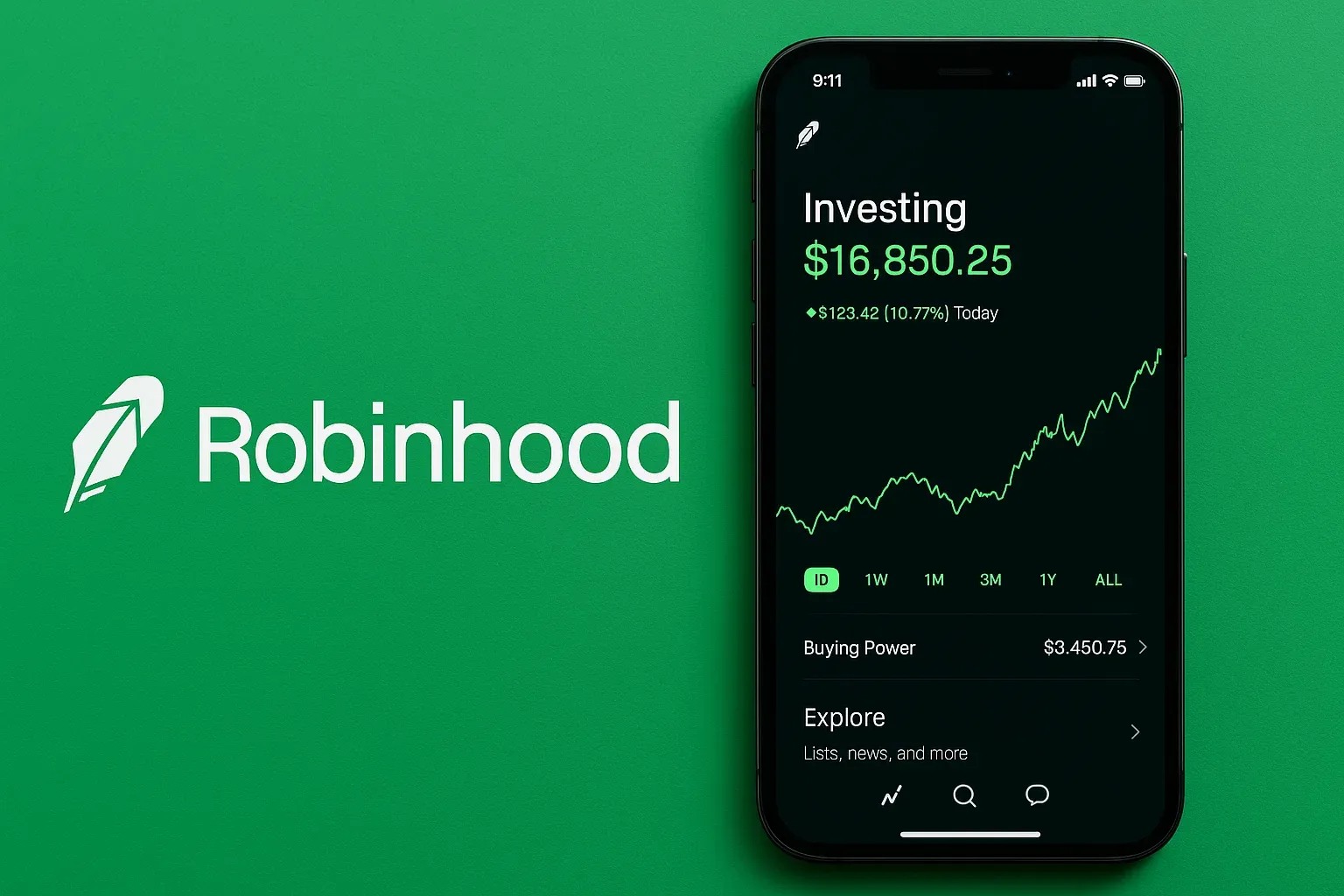
The mobile app handles most of what casual and moderately active traders need: customizable alerts, a news feed, advanced charting, and live earnings-call audio for select companies. It’s fast, and the interface stays relatively simple despite the platform’s expanding feature set.
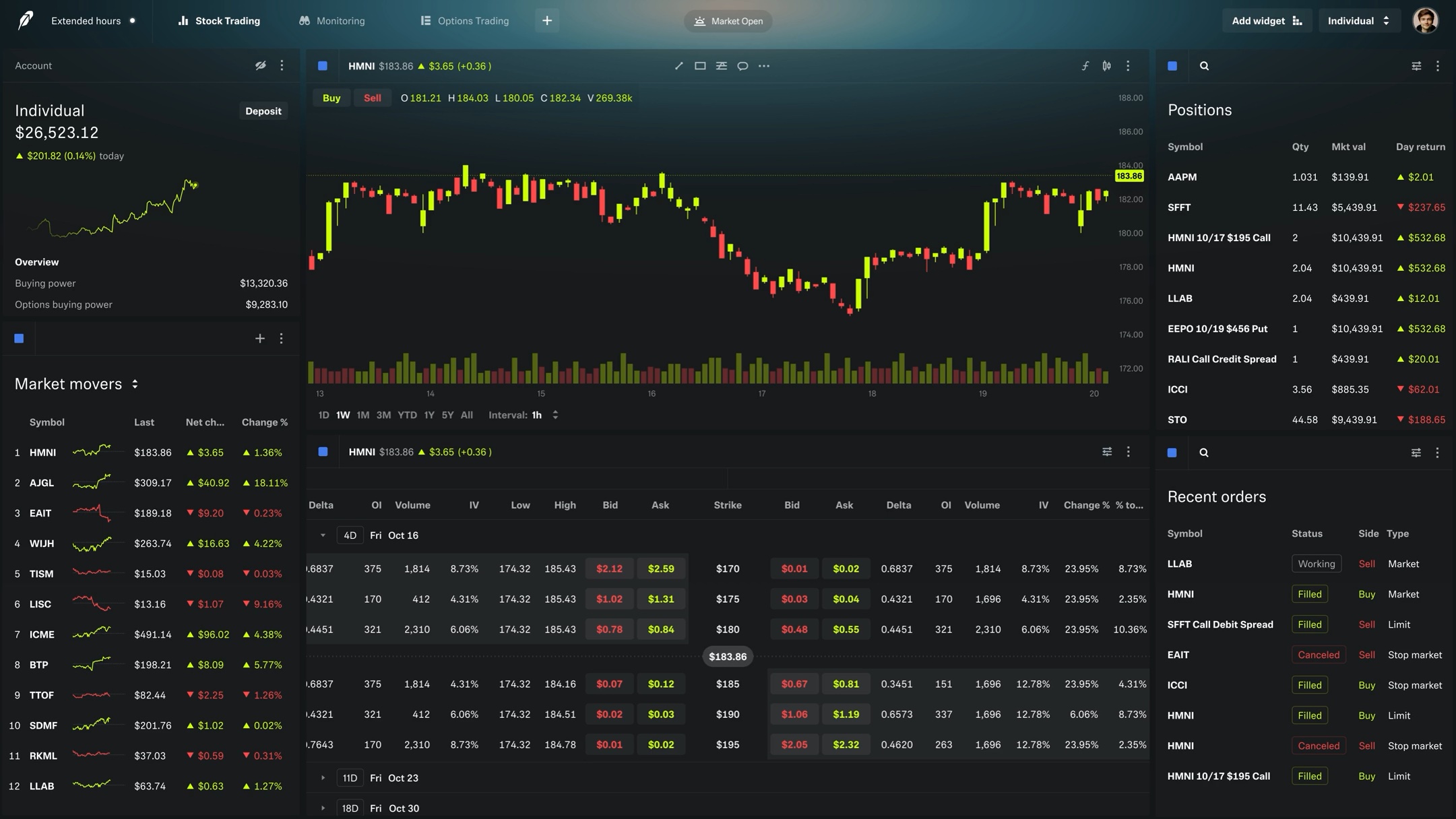
For more serious traders, Robinhood Legend is the desktop workstation that also launched in 2024. It adds advanced charting with drawing tools, customizable screen layouts, and custom time intervals. If you’re used to thinkorswim or another full-featured desktop platform, Legend feels lighter, but it covers the core needs of active and day traders without overwhelming beginners who want to graduate from the mobile app.
The 24/5 trading window is worth highlighting. You can place limit orders between 8 p.m. Sunday and 8 p.m. Friday ET, which stretches well past standard market hours. That’s useful for reacting to overnight news or earnings releases that drop after the close.
Robinhood crypto: trading, staking, and limitations
Robinhood lists more than 40 cryptocurrencies inside the standard taxable brokerage account, including BTC, ETH, XRP, SOL, DOGE, and SHIB. The $1 minimum per trade lowers the barrier enough to let you test the waters without committing a large amount.
At AXL Research Hub, we look at Robinhood’s crypto offering through a crypto-native lens, and from that angle, a few limitations stand out. The coin selection is larger than what most traditional brokerages provide but noticeably smaller than what you’d find on a dedicated exchange like Coinbase or Kraken (both near the top of our crypto exchange rankings). If you’re looking for newer altcoins or niche tokens, Robinhood probably won’t have them.
Crypto-to-crypto trading pairs aren’t supported. Every trade routes through USD, so swapping ETH for SOL means selling ETH to dollars first, then buying SOL. On a pure-play exchange you’d do that in a single trade, often at a lower spread.
You can send and receive crypto through Robinhood, which gives you actual wallet functionality rather than just exposure to price movements. However, this capability is restricted in certain states. Crypto staking is available too, but it faces the same state-level restrictions. Before you count on either feature, check whether your state allows it.
One important gap: crypto isn’t available inside Robinhood IRAs. If you want to hold Bitcoin or Ethereum in a tax-advantaged retirement account, you’ll need to look at a provider that supports crypto IRAs specifically.
For someone who already trades stocks on Robinhood and wants to add a few major coins without opening a separate account, the crypto offering is convenient and cost-effective. For someone whose primary activity is crypto trading, a dedicated exchange will give you more coins, more trading pairs, and deeper liquidity.
Robinhood IRA and retirement accounts
Robinhood offers both traditional and Roth IRAs with no account minimum. The standout feature is the contribution match: 1% on standard accounts, 3% for Gold subscribers. Getting a match on an IRA without an employer is genuinely unusual. The 3% Gold match rivals what some employer 401(k) plans offer, though employer matches often come with their own vesting schedules and restrictions.
The catch is the five-year clawback rule. If you withdraw funds from your IRA before five years have passed since the match was deposited, Robinhood takes back the proportional match amount. This isn’t a penalty you pay; it’s a reversal of the match itself. The clock runs from each individual match deposit, not from when you opened the account. So if you received a match in January 2026 and another in January 2027, each one has its own five-year window.
This makes the IRA match most valuable for long-term savers who don’t plan to touch the money. If there’s any chance you’ll need to pull funds within five years, the match is less of a sure thing than it first appears.
Margin trading isn’t permitted inside IRAs, which is standard across the industry. The bigger limitation for some users is that crypto trading isn’t available in Robinhood IRAs. If part of your retirement strategy involves holding crypto in a tax-advantaged wrapper, Robinhood can’t handle that piece.
Account sign-up, funding, and instant deposits
Opening a Robinhood account happens entirely in the app. The process is fast: approved customers typically get notified in under an hour. Instant bank verification works with many major banks, which skips the micro-deposit step that other brokerages sometimes require.
Once you’re approved, Robinhood’s instant deposit feature makes up to $1,000 available for trading right away on standard accounts, even while the full bank transfer settles over several business days. Larger deposits take four to five business days to process and clear.
The instant deposit system works because Robinhood essentially advances you the funds before your bank completes the transfer. That’s convenient, but it carries a risk. If your bank reverses the transfer for any reason (insufficient funds, a mismatch in account details), your Robinhood account can be restricted, and positions may be force-sold to cover the shortfall. Some users have reported account lockouts lasting up to 99 days after a failed bank transfer, which can freeze your money and your ability to trade.
Linking a bank account can also trip people up. If the name on your bank account doesn’t match your Robinhood account exactly, the link may fail and trigger restrictions. It’s a small detail, but it causes real headaches when it happens.
The ease of sign-up has drawn criticism, too. Because the process is so quick and barrier-free, some inexperienced investors start trading options or volatile assets before they fully understand the risks. That’s not unique to Robinhood, but the streamlined onboarding makes it especially easy to jump in fast.
Is Robinhood safe? Regulatory track record explained
Robinhood is a SIPC member, which means securities and cash in your brokerage account are protected up to $500,000, including $250,000 for cash. The Robinhood Protection Guarantee covers unauthorized activity and commits to data security measures like multi-factor authentication. The company also promises 24/7 support availability as part of that guarantee.
On the regulatory side, though, the track record is rough. Understanding the history matters because it shapes how much you trust the platform with your money.
FINRA levied a $70 million penalty against Robinhood, the largest financial penalty FINRA had ever imposed at that time. The fine covered providing false or misleading information to millions of customers and system outages during the March 2020 market volatility. FINRA also found that algorithmic bots had approved thousands of customers for options trading who didn’t actually qualify.
Separately, FINRA ordered $3.75 million in restitution for violations related to anti-money-laundering controls, supervisory failures, and disclosure shortcomings.
The SEC charged Robinhood with misleading customers about order execution quality. The agency found that inferior execution across all customers cost them $34.1 million in aggregate. Robinhood settled for $65 million. The SEC also imposed $45 million in combined penalties for more than ten additional securities-law violations.
The January 2021 meme-stock episode added to the scrutiny. Robinhood restricted trading in GameStop and other volatile stocks during the frenzy, drawing heavy criticism from users and lawmakers. Massachusetts accused Robinhood of aggressively marketing to inexperienced investors and using gamification to manipulate customer behavior.
Since then, Robinhood has increased its capital holdings, expanded its compliance procedures, and added support staff. The payment-for-order-flow model, discussed in more detail below, remains an ongoing regulatory concern.
None of this means your money isn’t protected under SIPC, and the security infrastructure (multi-factor authentication, unauthorized activity coverage) is in line with industry standards. But the enforcement history is heavier than what you’ll find at most established brokerages.
Customer support quality from real user feedback
Robinhood now offers 24/7 chat support along with phone assistance on weekdays starting at 7 a.m. to 9 p.m. ET. That’s a significant expansion from the earlier model, which was limited to email and left many users waiting days for a response.
The iOS App Store rating has sat around 4.3 out of 5 based on roughly 4.8 million ratings. That’s a strong score in absolute terms, though it falls below the 4.5-star mark on both iOS and Android. The volume of reviews gives a useful signal about what users actually experience day to day.
Positive themes come up consistently: the clean interface, easy onboarding, commission-free trades, and having real-time data visible on one screen. Users who are new to investing especially appreciate that the app doesn’t overwhelm them with complexity right away.
The negative themes are just as consistent. Customer service response times still frustrate users, particularly when issues fall outside the help center’s preloaded FAQ articles. The automated systems that lock accounts during bank-transfer disputes are a common complaint. Users describe being stuck in a loop of automated responses with no clear path to a live agent who can actually resolve the issue.
Some users also flag interface quirks in the options-trading flow and report difficulty when bank account names don’t match their Robinhood profile exactly. These aren’t deal-breakers for most people, but they surface frequently enough to be worth mentioning.
Educational content, including articles and webinar events, is accessible within the app. It’s serviceable for beginners, though it doesn’t come close to the learning libraries at brokerages like Fidelity or TD Ameritrade.
How payment for order flow affects execution quality
Payment for order flow (PFOF) is how Robinhood earns a significant portion of its revenue. When you place a trade, Robinhood routes your order to a market-making firm. That firm pays Robinhood for the right to fill your order. In return, the market maker profits from the spread between the bid and ask price.
The concern regulators have raised is straightforward: if the broker earns more by sending orders to the highest-paying market maker rather than the one offering the best price, your order might not get the best available execution. The SEC flagged exactly this conflict when it charged Robinhood and found that inferior execution cost customers $34.1 million in aggregate.
Order execution quality measures the percentage of orders filled at or better than the National Best Bid and Offer (NBBO). As of October 2025, Robinhood reported execution quality at 96.25%, compared to an industry-reviewed average of 97.51%. That 1.26 percentage-point gap means a small share of orders fill at slightly worse prices than they would at brokers with higher execution quality.
For a single trade, the difference in price is often fractions of a penny per share. You won’t notice it on a casual buy of a few shares. But for active traders placing dozens or hundreds of trades per month, those fractions compound. The SEC’s finding of $34.1 million in aggregate customer losses illustrates how small per-trade differences scale across millions of orders.
If best execution is a priority for you, particularly if you trade frequently or in large sizes, it’s worth considering brokers that don’t accept PFOF. Fidelity, for example, routes orders differently and consistently reports higher execution quality numbers.
Newer features: Prediction markets, futures, and agentic trading
Robinhood has been expanding beyond traditional brokerage territory, and three recent additions stand out.
Prediction markets let you buy event contracts on political, economic, sports, pop-culture, and tech outcomes. To access them, you’ll need to complete a set of disclosures and questionnaires. Both prediction markets and futures trading launched in 2024, signaling that Robinhood is actively chasing a more sophisticated user base alongside its beginner-friendly core.
Futures trading is live but still limited in contract selection. The lineup has been growing since launch, though it doesn’t yet rival what dedicated futures platforms offer. If you’re already on Robinhood and want occasional futures exposure, it’s convenient. If futures are central to your strategy, you’ll probably want a more specialized broker.
Agentic trading is the most unusual addition. It lets you give an AI agent a dedicated Robinhood account to trade in. You can monitor the agent’s activity and performance inside the app. Alongside this, Robinhood launched an agentic credit card, a virtual card built specifically for AI agents. It offers 3% cash back and lets you set spending controls.
These features are clearly aimed at tech-forward users and signal that Robinhood sees its future beyond the buy-your-first-stock crowd. Whether agentic trading becomes a mainstream feature or stays a niche experiment remains to be seen, but we at AXL Research Hub find it worth watching as the intersection of AI and brokerage services evolves.
Frequently asked questions
Is Robinhood trustworthy?
Robinhood is a SIPC member whose Protection Guarantee addresses unauthorized account activity, and the platform uses multi-factor authentication to secure logins. That said, the company has faced multiple regulatory penalties, including a $70 million FINRA fine and a $65 million SEC settlement. Whether you consider the platform trustworthy depends on how you weigh the low costs and security infrastructure against that enforcement history.
What are the main downsides of Robinhood?
The biggest gaps are the lack of mutual funds and individual bonds, third-party research that’s limited to Morningstar and Level II data behind the Gold paywall, order execution quality that trails the broker industry average because of payment for order flow, and customer support that still draws complaints about automation and slow escalation to live agents. The $100 outgoing ACAT transfer fee also makes leaving the platform more expensive than at many competitors.
Can you make money on Robinhood?
Robinhood’s low fees mean more of your returns stay in your pocket, but the platform itself doesn’t determine whether your investments go up or down. Your results depend on what you buy, when you buy it, and broader market conditions. A Gold subscription’s 3% IRA match ($5/month or $50/year for the subscription) gives you a small guaranteed return on contributions, but that’s a feature of the account type, not a trading edge.
Who benefits most and who should look elsewhere
Robinhood works best for mobile-first investors and beginners who want a clean, simple app with zero commissions. If you’re opening your first brokerage account and don’t need hand-holding from a financial advisor, the low barrier to entry and intuitive design make it easy to get started.
IRA savers who don’t have access to an employer match get a tangible benefit from the contribution match, especially at the 3% Gold tier. If you’re disciplined enough to leave the money in for at least five years (avoiding the clawback), the match adds real value.
If you primarily hold major coins like BTC, ETH, or SOL and prefer keeping them alongside your stock portfolio, the consolidated setup saves you the hassle of managing a separate exchange. For users new to the space, understanding how cryptocurrency works can help you evaluate whether Robinhood’s coin selection meets your needs.
Robinhood is a weaker fit if your strategy depends on mutual funds, individual bonds, in-depth fundamental research, or responsive human support. Investors with complex portfolios or large balances may get more from brokerages that offer comprehensive research libraries, financial planning tools, and dedicated advisory services. If best execution matters to you, especially as a frequent trader, brokers that don’t rely on payment for order flow may serve you better.