

Every blockchain is built around the same basic idea: a shared ledger that no single party controls. What changes from one network to another is how access, speed, security, and privacy are managed.
What is blockchain technology?
Blockchain is a form of distributed ledger technology (DLT) that records and verifies transactions across a network of computers without relying on a central authority. Instead of a single database sitting on one server, every participating node holds its own copy of the ledger. Data is stored in blocks that are cryptographically linked to one another, so any alteration to a past block changes its hash and becomes immediately detectable by other nodes on the network.
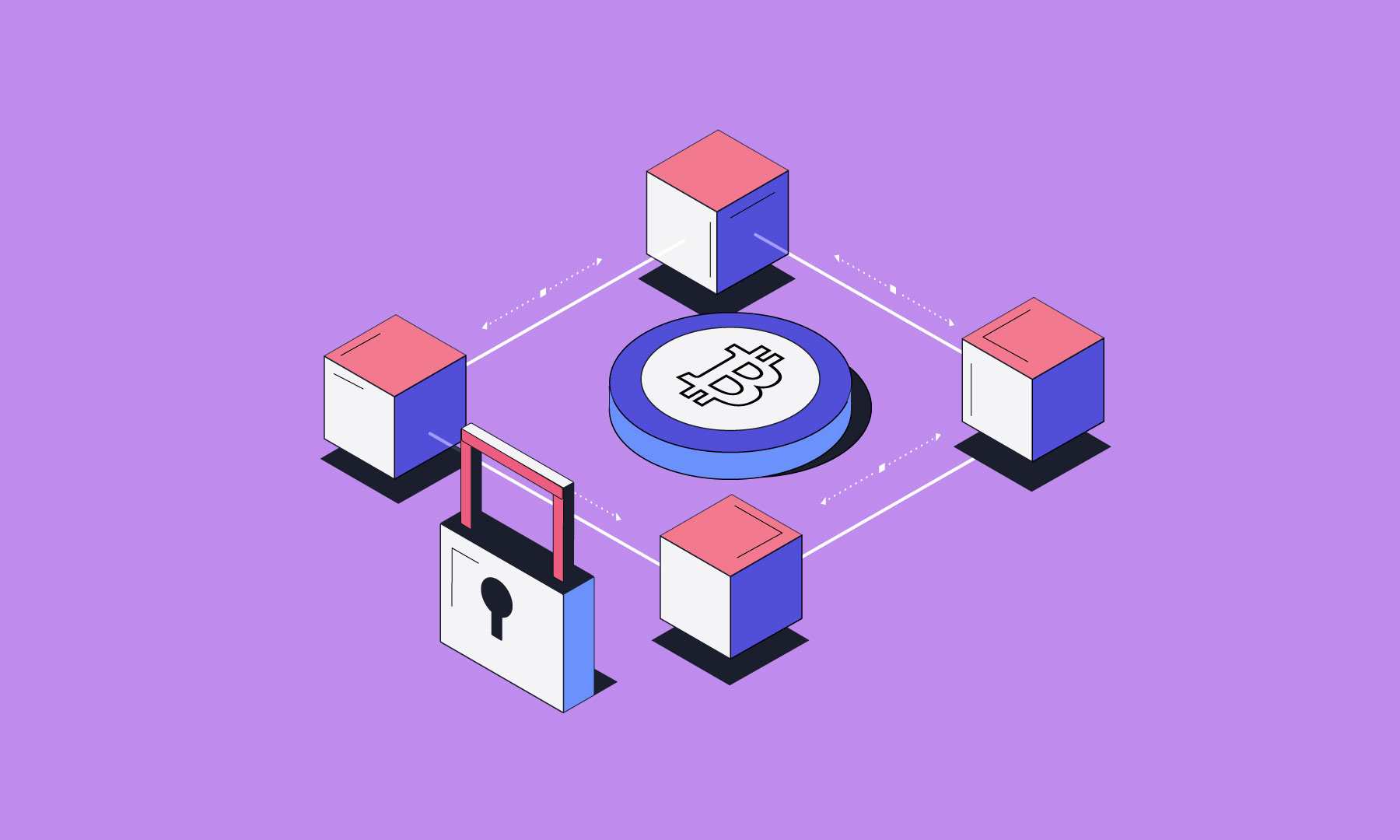
Four core properties show up in every blockchain regardless of type: decentralization, a distributed ledger, immutability, and a consensus mechanism. Decentralization means no single party owns the final say over the data. The distributed ledger ensures every node can independently verify the chain’s history. Immutability comes from the cryptographic linking, once a block is accepted, rewriting it without detection is practically impossible. And consensus mechanisms are the rules the network follows to agree that a transaction is valid before adding it to the chain.
The two most common consensus methods are proof of work (PoW) and proof of stake (PoS). In PoW, nodes compete to solve a computational puzzle, and the winner earns the right to add the next block. PoS selects validators based on how much of the network’s native token they’ve staked as collateral. Both approaches solve the same problem, getting strangers to agree on the state of a shared ledger, but they differ sharply in energy use and hardware requirements.
Some blockchains also support smart contracts, self-executing programs stored on the chain that carry out the terms of an agreement automatically when predefined conditions are met. Smart contracts remove the need for intermediaries in tasks like releasing payment on delivery or distributing royalties, which is why they’ve become central to decentralized finance and tokenized assets.
Permissioned vs. permissionless blockchains
Before jumping into the four types, it helps to understand the access layer that sits above all of them. Every blockchain falls somewhere on a spectrum between permissioned and permissionless, and that distinction shapes who can join, who validates transactions, and how governance works.
A permissionless blockchain lets anyone participate. There’s no application process, no identity check, and no administrator deciding who gets in. You download the software, connect to the network, and start reading data or submitting transactions. Public blockchains are the most common permissionless networks, but “permissionless” and “public” aren’t perfectly synonymous. The term permissionless describes the access model; “public” also implies that all data on the chain is visible to everyone.
A permissioned blockchain restricts network access to vetted, authorized participants. An administrator or governing body controls who can join, what roles they hold, and what data they can see. It’s important not to treat “permissioned” as a direct synonym for “private.” Permissioned networks can take the form of a private blockchain run by one organization, a consortium blockchain governed by several organizations, or even a hybrid blockchain where some layers are open and others are gated. The label depends on how a specific blockchain is designed and set up, not on a rigid category.
This access-layer distinction matters because it determines the trust model. On a permissionless network, trust comes from the protocol itself, thousands of anonymous nodes following the same consensus rules. On a permissioned network, trust comes partly from the vetting process, you already know (or at least someone has verified) who the other participants are. That difference ripples through every tradeoff discussed in the sections below: speed, privacy, energy use, and governance complexity.
Four types of blockchain
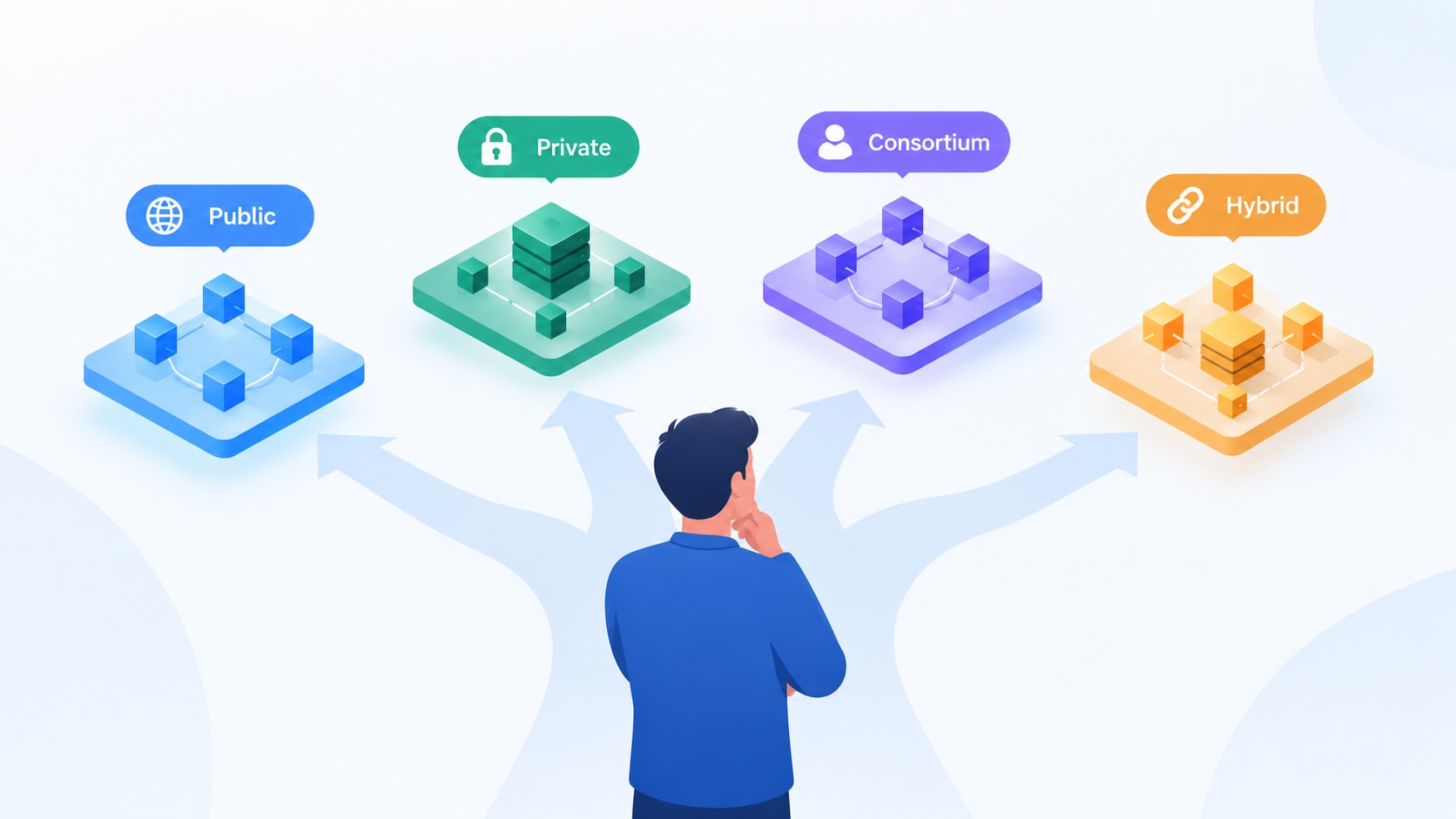
Blockchains generally fall into four categories: public, private, hybrid, and consortium. Each type strikes a different balance among decentralization, privacy, speed, scalability, and governance. The dividing lines come down to three questions: who can participate, who controls the network, and how transparent the data is.

Public blockchain
A public blockchain is open and permissionless. Anyone with an internet connection can join the network, read transaction data, and participate in the validation process. There’s no single owner; the chain runs on a peer-to-peer network where every node holds a full copy of the ledger.
Consensus algorithms like PoW or PoS verify transactions and secure the network against fraud. Because the source code is typically open source, anyone can audit transaction logic, find bugs, or propose protocol changes. Bitcoin and Ethereum are the most widely recognized public blockchains.
Transparency is the defining feature: every transaction ever recorded is publicly visible and auditable. Participants are identified by public keys rather than personal information, though, so what you get is pseudonymity, not full anonymity. If your public key gets linked to your real identity through an exchange or on-chain analysis, your entire transaction history becomes traceable.
A public blockchain doesn’t depend on any founding organization to keep running. As long as enough nodes stay online and follow the protocol, the network persists. That resilience is one reason public chains are popular for assets and records that need to outlive any single company.
The tradeoffs are real, though. Transaction speed tends to be slow because every node must validate each transaction, which limits throughput. Scalability is constrained for the same reason: the ledger requires real-time updates reflecting all past and present transactions, and that workload grows over time. PoW-based public blockchains consume a lot of energy because miners run powerful hardware around the clock. And while decentralization makes attacks difficult, a 51% attack is theoretically possible if a majority of nodes collude to rewrite the chain. Full transparency also means public blockchains aren’t suited for sensitive business transactions where data confidentiality matters.
Public blockchain use cases
Public blockchains show up wherever openness and verifiability are more valuable than speed or privacy.
- Mining and exchanging cryptocurrencies. Bitcoin and Ethereum both run on public chains, and every transfer of their native tokens is validated by the open network.
- Fixed records with auditable chains of custody. Electronic notarization and property ownership records benefit from a ledger that you can verify but no one can quietly alter.
- Non-fungible tokens (NFTs). Digital asset records tied to art, music, or collectibles rely on a public chain’s transparency to prove provenance and ownership.
- Crowdfunding and donations. Open-source projects and fundraising campaigns use public blockchains so contributors can see exactly where funds go.
- Transparency-driven organizations. Nonprofits and similar groups built on public trust can use a public ledger to demonstrate how donations are allocated.
Private blockchain
A private blockchain restricts access to authorized participants within a closed network, typically run by a single organization. It still uses peer-to-peer connections and cryptographic verification, but on a much smaller scale than a public chain. The controlling entity sets permission levels, security rules, and data accessibility.
Because fewer nodes participate in validation, transactions process faster. Scalability is also more flexible: the organization can adjust the network’s size to fit its needs rather than waiting for organic growth. And because the data stays inside a closed environment, privacy is significantly higher, which makes private blockchains attractive for confidential business operations. Hyperledger Fabric and Corda are two widely used private blockchain platforms.
The downsides mirror the benefits. Source code is often proprietary and closed, which means independent external audits aren’t possible unless the controlling organization allows them. Critics argue that a blockchain run by a single authority contradicts the core philosophy of decentralization. If that authority decides a transaction is invalid, there’s no broader network to overrule the decision. Fewer nodes also mean the chain is more vulnerable if some go offline or act maliciously, because there’s less redundancy to absorb failures. Unlike public blockchains, private chains offer no participant anonymity; the organization knows exactly who’s on the network.
Private blockchain use cases
Private blockchains fit situations where an organization needs cryptographic security and an auditable ledger but can’t expose data to the public.
- Internal operations. Logistics tracking, accounting, and payroll records benefit from tamper-resistant logs without requiring external visibility.
- Healthcare data exchange. Collaborating providers can share confidential patient information across institutions while keeping it off a public ledger.
- Supply chain management. Secure, real-time tracking of goods movement within a company’s own network reduces fraud and reconciliation errors.
- Asset ownership and corporate voting. Internal records of who owns what, or how board votes were cast, stay verifiable without becoming public.
- Financial record-keeping. Organizations that need cryptographic proof of transactions but operate under strict confidentiality requirements keep everything within a private chain.
Hybrid blockchain
A hybrid blockchain combines elements of public and private blockchains in a single network. Organizations control which data stays private and which becomes publicly accessible. Permission-based and permissionless components coexist within the same architecture, and users interact with the system through smart contracts that enforce access rules.
Transactions and records aren’t public by default, but they can be verified when needed. Even the primary entity that owns a hybrid blockchain can’t alter transactions once they’re recorded, which preserves the immutability guarantee that private chains on their own sometimes struggle to defend. The XDC Network is one example of a hybrid blockchain platform that supports both public and private transaction capabilities.
Because part of the network operates in a closed environment, 51% attacks are harder to pull off than on a fully public chain. Transaction costs tend to be lower, too, since only selected nodes handle verification rather than the entire network. The architecture is customizable, letting an organization balance integrity, security, and transparency based on the specific use case.
Complexity is the main cost. Managing both public and private components adds governance and operational overhead. The controlling organization decides what information to share and what to keep private, which means the chain lacks the full transparency of a public network. That closed side can also reduce incentives for outside participation, because external users can’t see or verify everything the way they can on a public chain. Upgrading a hybrid network is harder, too, because changes to one component can ripple into the other.
Hybrid blockchain use cases
Hybrid blockchains suit industries that need to show some data to the public while keeping other data locked down.
- Financial services. Banks and fintech companies can make certain records publicly auditable, like proof of reserves, while protecting customer account details.
- Healthcare. Patient records stay private, but anonymized or aggregated data can be shared on the public side for public health tracking and research.
- Real estate. Listings and ownership transfers can be displayed publicly, while contracts, inspections, and financing details run through the private layer.
- Retail. Processes that span both internal inventory systems and customer-facing order tracking benefit from a chain that handles both data flows.
- Regulated industries. Any sector that faces compliance requirements around selective data-sharing, think energy or insurance, can use a hybrid model to produce auditable records without overexposing sensitive information.
Consortium blockchain
A consortium blockchain, sometimes called a federated blockchain, is controlled jointly by a group of organizations rather than a single entity. Each member organization typically holds equal governance rights, and designated validator nodes initiate, receive, and validate transactions on behalf of the group.
This shared-control model eliminates the single-entity risk that comes with a private blockchain. If one member acts against the group’s interests, the remaining members can outvote or isolate that participant. At the same time, because all participants are known and vetted, a consortium chain is more efficient than a public blockchain. Transaction fees stay consistently low regardless of how many users the consortium serves, and the cost and risk of running the network are spread across members. Corda by R3 and Tendermint are two well-known consortium blockchain technologies.
The challenge is coordination. Reaching consensus across multiple organizations with different goals and strategies involves compromise, and that process can be slow. Differences in priorities, think one bank focused on speed and another focused on regulatory caution, can lead to conflicts or stalled upgrades. Protocol changes require approval from all members, which reduces the network’s agility compared to a private chain where one entity calls the shots. Security also carries a specific risk: because the validator set is small and known, a breach at one member node can threaten the entire network.
Consortium blockchain use cases
Consortium blockchains work best when several organizations need a shared ledger but none of them wants to hand control to a single party.
- Banking and payments. Multiple banks can form a consortium to validate interbank transactions, reducing settlement times and reconciliation disputes without relying on a single clearinghouse.
- Supply chain traceability. Food and pharmaceutical companies use consortium chains to track products from manufacturer to retailer, with each participant verifying its own leg of the journey.
- Research collaboration. Universities and research institutions share datasets across organizational boundaries while maintaining joint governance over access and usage.
- Logistics and cross-organizational data sharing. Shipping companies, port authorities, and customs agencies can write to and read from the same ledger, cutting paperwork and delays at handoff points.
Comparison of all four blockchain types
| Feature | Public | Private | Hybrid | Consortium |
|---|---|---|---|---|
| Access control | Open to everyone | Restricted to authorized users | Combination of public and private | Limited to a group of organizations |
| Governance | Decentralized | Centralized (single entity) | Semi-decentralized | Shared among members |
| Transparency | High (all data visible) | Low | Moderate and selective | Variable |
| Scalability | Limited | High | Moderate | High potential |
| Security model | High through decentralization; susceptible to 51% attacks | Lower due to centralization | Moderate; 51% attacks harder | Variable; depends on member integrity |
| Transaction speed | Slower due to broad consensus | Faster with fewer nodes | Faster than public, slower than private | Variable |
| Energy consumption | Highest (especially PoW) | Lower | Lower (smaller validator set) | Lower (smaller validator set) |
Energy consumption deserves a closer look because it’s often discussed only in the context of public PoW chains. Public blockchains that use proof of work consume the most energy by a wide margin, since miners worldwide run specialized hardware continuously. Public chains that have moved to proof of stake, like Ethereum after its transition, cut energy use dramatically but still run larger validator sets than any private or consortium chain. Private, hybrid, and consortium blockchains all use smaller groups of known validators, which keeps energy consumption comparatively low. If environmental impact matters to your project, the type of blockchain you choose, and the consensus mechanism it uses, will be a major factor.
How to choose the right blockchain type
Picking a blockchain type starts with your data’s relationship to the public. If full transparency strengthens your product, like an open-source token or a public registry, a public blockchain is the natural fit. If confidentiality is non-negotiable, a private chain keeps everything behind closed doors. Most real-world projects land somewhere in between, which is where hybrid and consortium models earn their place.
After settling the public-vs.-private question, look at how the blockchain will work with your existing infrastructure. A private chain that plugs into your current databases and identity systems is a simpler lift than bolting a public chain onto legacy software. Hybrid blockchains can bridge both worlds, but the dual architecture adds integration work upfront.
Scalability expectations matter early in the decision. If your user base or transaction volume could grow quickly, a private or consortium chain gives you more room to adjust node counts and throughput. Public blockchains scale more slowly because every node processes every transaction, and relief often comes from layer-2 solutions built on top of the base chain rather than from the base chain itself.
If you operate in healthcare, finance, or energy, data-protection standards can narrow your options fast, potentially ruling out a fully public chain where all records are visible. A consortium or hybrid model lets you keep sensitive data gated while still providing the auditability regulators expect.
Governance structure is another filter. If your organization wants full control, a private blockchain is the simplest path. If you need buy-in from multiple independent parties, a consortium distributes that control, though it also distributes the decision-making friction. Hybrid chains let a single entity control governance while selectively opening parts of the network.
Finally, weigh decentralization against speed. The more decentralized a network is, the harder it is to tamper with, but the slower it tends to run. If your project plans to issue tokenized or digital assets that need to trade on open markets, a public or hybrid chain with a public-facing layer gives those assets broader reach. If the assets stay internal, a private or consortium chain avoids the overhead.
Walking through these filters in order, data exposure first, then integration, scalability, regulation, governance, and speed, keeps your evaluation structured and prevents you from defaulting to whichever blockchain type you’ve heard the most about.
Matching blockchain architecture to real-world goals
Each blockchain type addresses a different balance of openness, control, speed, and trust. Public blockchains suit transparency-first applications where anyone should be able to verify the data: open currencies, public registries, community-governed protocols. Private blockchains suit confidentiality-first applications where one organization needs a tamper-resistant ledger without exposing anything externally: internal record-keeping, proprietary supply chains, sensitive healthcare data.
Hybrid and consortium models fill the space between those poles. A hybrid chain works when an organization needs to show selected data publicly while keeping the rest private, common in real estate, regulated finance, and retail logistics. A consortium chain works when several independent organizations need a shared source of truth but no single party should own it, which is why banking groups, research alliances, and multi-company supply chains gravitate toward federated governance.
No single type is the right answer for every situation. The choice comes down to which tradeoffs your project can accept across security, scalability, and decentralization, and which ones it can’t. Getting that balance right early saves you from re-architecting later, when switching blockchain types means migrating data, renegotiating governance, and retraining everyone who touches the system.