
Solana has survived a 97% crash, lost one of its biggest backers to bankruptcy, and rebuilt into a network processing tens of millions of transactions a day at sub-cent fees. That resilience doesn’t automatically make SOL a good buy.
Is Solana a good investment in 2026?
Solana is a layer-1 blockchain designed from scratch for high throughput and extremely low transaction costs. It processes thousands of transactions per second, compared to roughly 15 to 30 on Ethereum’s base layer, and fees consistently stay below $0.01. That combination positions it as a direct alternative to higher-fee smart-contract networks for developers building consumer-facing apps, DeFi protocols, and payment tools.
SOL, the network’s native token, isn’t just a speculative asset. It’s required to pay transaction fees, to stake and help secure the network, and to participate in governance votes. That means demand for SOL ties directly to how much the network gets used, not only to market sentiment.
The investment question comes down to whether three trends can sustain themselves: growing on-chain activity, broadening institutional access through spot ETFs, and upcoming network upgrades that address reliability and speed. If those trends hold, SOL’s utility-driven demand has room to grow. If they stall, the token’s high-beta nature means it’ll fall harder than most of the market.
SOL has ranked in the top 10 cryptocurrencies by market cap as of mid-2026, but ranking alone doesn’t tell you much. It amplifies broader market moves in both directions, outperforming during bull cycles and dropping more steeply in downturns. Whether it fits your portfolio depends on your tolerance for that volatility, the strength of competing platforms, and how much regulatory clarity arrives over the next few years.
What is Solana and how does it work?
Solana is a standalone layer-1 blockchain, meaning it doesn’t sit on top of another chain the way layer-2 networks do. Anatoly Yakovenko and Raj Gokal founded the project in 2020, building it around a core idea: order events before consensus so validators spend less time talking to each other.
That ordering mechanism is called Proof of History. It’s a cryptographic timestamp that sequences transactions before the network’s Proof of Stake validators confirm them. By reducing the back-and-forth communication validators normally need, Solana achieves block times under 0.5 seconds and keeps fees negligible. The base fee is 5,000 lamports per signature, and since 1 SOL equals 1 billion lamports, that works out to a fraction of a cent per transaction.
Fees on Solana split two ways. Half of every base fee gets burned, permanently removing those tokens from circulation. The other half goes to the validator that produced the block. Priority fees, which users can attach to get their transactions processed faster during congestion, go entirely to validators. Validators therefore earn more by processing transactions efficiently, while the burn steadily reduces the outstanding token supply.
Sub-second finality and sub-cent costs open the door to use cases that break down on higher-fee chains. DeFi trades that would cost several dollars on Ethereum cost almost nothing on Solana. Gaming apps can process microtransactions without the fee eating the payment. Mobile wallets and point-of-sale integrations become viable when the cost per transaction is essentially invisible to the user.
There’s a trade-off, though. Running a Solana validator requires high-end hardware: powerful multi-core processors, large amounts of RAM, and fast SSD storage. That hardware cost means fewer people can afford to run validators compared to networks with lower requirements. The result is a smaller validator set, which raises legitimate questions about how decentralized the network truly is. It’s a design choice baked into Solana’s architecture: prioritize speed and throughput, and accept that the barrier to running infrastructure will be higher.
Solana on-chain metrics and ecosystem data
On-chain activity is the closest thing to a fundamentals check for a blockchain. It measures real demand for block space, which translates directly into demand for SOL, independently of whatever speculative narrative is driving the token’s price on exchanges. The two can diverge sharply: a network can get busier while its token price drops, or vice versa.
The metrics worth tracking fall into a few categories. Daily transactions and active addresses tell you how many people and bots are actually using the chain. DeFi total value locked (TVL) shows how much capital is parked in lending, trading, and yield protocols. DEX volume reveals trading activity happening on-chain rather than on centralized exchanges. Stablecoin supply measures how much dollar-denominated liquidity has moved onto Solana for trading, lending, and settlement. Chain fees and app revenue indicate whether that activity is generating real economic value.
As of a May 2026 snapshot, Solana’s numbers reflect a busy network. DeFi TVL sat at approximately $5.28 billion, while stablecoin market cap on the chain reached roughly $14.82 billion. In a single 24-hour period, the network processed about 78.3 million transactions across approximately 1.92 million active addresses, with DEX volume hitting around $1.06 billion (about $7.9 billion over a seven-day window). For additional context, Solana DEXes cleared more than $3.4 billion in February 2026 alone.
Stablecoin inflows deserve special attention. When USDC or USDT moves onto Solana, it’s typically headed for trading desks, lending protocols, or payment settlement. That’s fundamentally different from speculative token inflows because stablecoins don’t appreciate in value. Their presence signals genuine economic activity.
The longer trend adds context. DeFi TVL grew from approximately $4.8 billion at the end of March 2024 to near $6.6 billion roughly two years later. That growth happened through a full market cycle, suggesting it wasn’t purely driven by one speculative wave.
You don’t have to take anyone’s word for these numbers. Solscan provides transaction-level data. DeFiLlama tracks TVL and DeFi activity across chains. Dune Analytics offers customizable dashboards for DEX volume and protocol-specific metrics. Solana Beach shows validator performance and network health. Token Unlocks tracks vesting schedules for SOL and other tokens. All of them are free.
When network usage is growing but the token price is falling, it usually means the market is either pricing in risks that haven’t materialized yet or discounting future growth more heavily than the on-chain data would suggest. That gap between usage and price is where informed investors look for opportunities, and where they also find traps if the risks turn out to be real.
Active-address decline and what it signals
Daily active wallet addresses on Solana peaked near 8.79 million on October 22, 2024. By early June 2026, that number had dropped to approximately 1.48 million, an 83% decline from the peak.
That drop tracks closely with the fading of memecoin-driven transaction surges. During late 2024, memecoin launches flooded Solana with bot activity and short-lived wallet addresses that existed solely to trade newly minted tokens. Many of those wallets were created, used once or twice, and abandoned. When the memecoin frenzy cooled, those addresses disappeared from the daily count.
The question this raises is whether Solana’s usage growth was structural, reflecting real adoption of DeFi, payments, and consumer apps, or whether a large share of it was speculative froth that reversed once the hype passed. The answer is probably both, and the ratio matters. If the remaining 1.48 million daily active wallets represent genuine, recurring users, that’s still a substantial base. If even that figure includes significant bot activity, the organic user count is lower than it appears.
For investors tracking on-chain data, the takeaway is straightforward: raw address counts need context. A spike in active addresses during a memecoin wave tells you something different than steady growth in addresses interacting with lending protocols or payment apps. Distinguishing between the two requires looking at what those addresses are actually doing, not just how many of them exist.
Solana price history and past cycle behavior
SOL entered 2021 trading under $2. By November of that year, it had rocketed to an all-time high near $260, propelled by the “Ethereum killer” narrative, a burst of ecosystem launches, and the enormous liquidity that central bank stimulus policies had pumped into every risk asset class. That’s a gain of more than 13,000% in under a year.
The collapse was equally dramatic. The 2022 bear market, triggered by the Terra/LUNA implosion and deepened by the FTX bankruptcy, crushed SOL to roughly $8, a peak-to-trough drawdown of approximately 97%. FTX and its affiliated trading firm, Alameda Research, held significant SOL positions, and the forced liquidations of those holdings intensified selling pressure on a token that was already in freefall. For a stretch, SOL’s survival as a relevant project was a genuine open question.
The recovery cycle that followed was different from the initial run-up in one important way: it came with receipts. DEX volume grew. Stablecoin inflows increased. Fee revenue climbed. SOL pushed back above $200 and re-entered the top five by market cap during the 2024 bull cycle, and the on-chain data supported the move rather than just narrative.
That recovery didn’t hold, though. From its January 2025 peak, SOL dropped roughly 70 to 74% by mid-2026. Once again, the broader crypto market turned risk-off, and SOL amplified the move downward.
The pattern across three cycles is consistent: SOL acts as a high-beta asset. When risk appetite is strong and capital flows into crypto, SOL tends to outperform. When sentiment reverses, it falls harder than most. That characteristic isn’t a flaw or a feature. It’s a structural trait that anyone holding SOL needs to plan around, not be surprised by.
The bull case for Solana
If blockchain technology reaches mass adoption, the winning networks will be the ones where users don’t notice they’re using a blockchain. That means fast transactions, invisible fees, and apps that feel as responsive as anything running on a traditional server. Solana’s architecture is built for exactly that outcome.
Consumer-facing applications are where this matters most. Mobile trading apps, in-app wallets, payment checkout flows, and blockchain-based games all need sub-second response times and fees low enough that processing a $3 coffee payment doesn’t cost $2 in gas. Solana’s sub-0.5-second block times and sub-cent fees make these applications practical in ways that high-fee layer-1 environments can’t match without routing transactions through additional layers.
The DeFi ecosystem has matured well past its early identity as a hub for NFTs and memecoins. Jupiter, a trading aggregator built on Solana, became one of the highest-volume decentralized exchanges across all chains. Liquid staking protocols, lending markets, leveraged trading products, and even on-chain order books have developed into functioning financial infrastructure. Solana Pay has been gaining adoption as a low-fee alternative for payment processing, bringing blockchain settlement closer to point-of-sale use cases.
Stablecoin supply growth on the chain reinforces this picture. With approximately $14.82 billion in stablecoins sitting on Solana as of the May 2026 snapshot, there’s a meaningful pool of dollar-denominated liquidity being used for trading, lending, and settlement. That capital is there to do work, not to speculate on price appreciation.
SOL ETFs open institutional access
The first spot SOL ETFs went live in the U.S. in October 2025, placing Solana alongside Bitcoin and Ethereum as the only crypto assets with regulated spot ETF products available to American investors. That’s a significant shift in accessibility.
Before ETFs, buying SOL meant setting up a crypto exchange account, managing wallet custody, and working through an asset class that most financial advisors couldn’t touch on behalf of clients. ETFs remove those barriers. Institutions, retirement accounts, and brokerage-account holders can now get SOL exposure through the same channels they use to buy stocks or bond funds.
The SEC’s approval of generic listing standards for commodity-based trust shares in September 2025 streamlined the process for eligible spot commodity ETPs, including certain digital-asset products. Early SOL ETF inflows reached approximately $900 million, a meaningful start. One spot SOL ETF listed a 0.20% management fee with a fee waiver (0%) for the first three months on the first $1 billion in assets. That fund’s page showed a net staking reward rate of 6.01% as of late May 2026, meaning the ETF was passing along yield from staking the underlying SOL.
Institutional capital typically carries longer holding horizons and compliance-driven due diligence. Over time, a growing share of SOL held in institutional vehicles could reduce the speculative volatility that has defined the token’s history.
But ETFs aren’t a one-way valve. Flows can reverse. AUM shrinks when the underlying asset’s price drops. And staked ETF products introduce additional operational and regulatory layers, including questions around how staking rewards are taxed and whether the ETF provider’s staking arrangement introduces counterparty risk. Approval opened a door. Whether sustained capital walks through it depends on performance, macro conditions, and how comfortable institutional allocators become with a high-beta crypto asset.
Developer momentum behind upcoming upgrades
Developer count is one of the most forward-looking metrics in crypto because the projects being built today drive user demand two to three years from now. According to the Electric Capital Developer Report 2025, Solana ranked 4th among top chains by monthly active developers, with over 890 developers actively building on the network. Those builders tend to focus on consumer-facing applications rather than purely financial infrastructure, which aligns with Solana’s design thesis of high throughput and low fees.
Two upgrades stand out on the technical roadmap. Firedancer is a second independent validator client, built by Jump Crypto’s engineering team, separate from the original Solana Labs client. Today, most Solana validators run the same software. If a critical bug hits that client, it can take down the entire network, which is exactly what happened during past outages. A second independent client means that even if one implementation has a bug, validators running the other client can keep the network alive. The reduction in systemic risk is real, but it depends on Firedancer being widely adopted and battle-tested in production, which takes time.
Alpenglow is a new consensus design targeting median finality around 150 milliseconds, and potentially as fast as 100 ms under favorable conditions. That’s a dramatic improvement over the roughly 12.8-second finality under TowerBFT, Solana’s current consensus mechanism. Faster finality would make Solana even more competitive for real-time applications like payments and gaming.
Both upgrades are still in development. Alpenglow has not been confirmed live in production. Roadmap items in any software project are subject to version changes and timeline shifts. If you’re factoring these upgrades into an investment decision, verify their production status through official Solana releases and validator adoption data rather than relying on roadmap promises.
Risks of investing in Solana
SOL’s high-beta behavior means it can lose 40 to 70% or more during market stress, even when on-chain activity holds relatively steady. The 97% drawdown during the 2021-2022 bear market is the extreme case, but the 70 to 74% decline from the January 2025 peak shows that large drawdowns aren’t a one-time event. They’re a recurring feature of holding this asset.
Network reliability is a separate concern. Solana has experienced outages lasting as long as 17 hours historically. The most recent major incident was a 5-hour outage in February 2024. Since then, the Solana Status page showed 100% uptime for March, April, and May 2026, but that’s a point-in-time snapshot, not a guarantee. Even when the network doesn’t go fully offline, congestion during sudden demand spikes can make it unusable for practical purposes. A popular memecoin launch in March 2025 caused congestion severe enough that many users couldn’t get transactions through.
Decentralization is a structural concern tied to Solana’s design choices. The network has thousands of validators, which sounds like a lot until you compare it to Ethereum’s more than one million. The hardware cost to run a Solana validator, requiring high-performance CPUs, substantial RAM, and fast storage, limits who can participate. That smaller validator set means the network is more susceptible to coordinated failures or geographic concentration risks.
A large share of the initial SOL supply was allocated to the founding team, early investors, and the Solana Foundation. While vesting has progressed and much of that supply has entered circulation, remaining unlock schedules can create periodic sell pressure. Tracking these schedules through tools like Token Unlocks helps you anticipate when large batches of tokens might hit the market.
Regulatory uncertainty cuts across multiple dimensions. How staking rewards get classified for tax purposes, whether exchanges face restrictions on listing SOL, how ETF custody rules evolve, and whether new legislation changes the treatment of proof-of-stake tokens are all open questions. Different jurisdictions are moving at different speeds, and the answers could shift the economics of holding SOL in ways that are hard to predict.
Tokenomics and inflation impact on holders
Unlike Bitcoin, which has a hard cap at 21 million coins, SOL has no maximum supply. New tokens are created continuously through inflation, making the mechanics of that inflation schedule directly relevant to anyone holding SOL over a multi-year horizon.
Solana’s inflation follows a fixed declining trajectory. It started at 8% annually and decreases by 15% each year. So the rate drops from 8% to 6.8%, then to 5.78%, and so on, eventually settling at a long-term floor of 1.5%. At the time of research, the reported inflation rate sat between 4.18% and 5.1%, placing the network in the mid-stages of that decline curve.
What this means practically depends on whether you stake. Stakers earn newly minted SOL as rewards, which largely offsets the dilution that inflation causes. If the inflation rate is 5% and your staking yield is close to that, your share of the total network stays roughly constant. Non-stakers, on the other hand, see their percentage ownership of the network shrink with every new token minted. It’s a slow but persistent drag on purchasing power.
The staking ratio has historically stayed above 60%, meaning the majority of circulating SOL is locked in staking and not actively available for sale. That functions as a supply-side counterweight to inflation: a large portion of the supply isn’t sitting on exchanges waiting to be sold.
Solana’s fee-burn mechanism adds another layer. Because half of every base fee is destroyed, network activity chips away at the outstanding supply, partially counteracting new issuance. Whether the burn rate is high enough to meaningfully counteract inflation is an ongoing debate. During periods of heavy network usage, the burn increases. During quieter stretches, it barely dents the new supply being created.
Circulating supply is already close to total supply, which narrows the gap compared to many other crypto projects. That’s actually a positive for current holders because it means there’s less future dilution coming from tokens that haven’t entered circulation yet. The biggest dilution risk has already played out.
For practical purposes: if you’re holding SOL and not staking it, you’re losing ground to inflation every year. Native staking on Solana involves delegating your tokens to a validator. Your SOL stays in your wallet, but it’s locked for the current epoch (roughly two days), and unstaking takes an additional cooldown period. Liquid staking tokens, like those offered by Marinade or Jito, give you a tradable receipt that represents your staked position. You can use that receipt in DeFi while still earning staking rewards. The trade-off is that liquid staking adds smart-contract risk: if the protocol has a bug or gets exploited, your staked position is at risk. During stressed markets, liquid staking tokens can also trade below their expected value, a depeg that forces you to choose between selling at a loss or waiting for the peg to recover.
Competition from other smart-contract platforms
Ethereum remains the deepest DeFi ecosystem by TVL, stablecoin liquidity, developer base, and institutional adoption. That depth creates a network effect that’s genuinely hard to displace. More liquidity attracts more traders, which attracts more builders, which attracts more liquidity.
The competitive pressure on Solana isn’t just coming from Ethereum’s base layer, though. Ethereum’s layer-2 networks, like Arbitrum, Optimism, and Base, reduce transaction costs dramatically while inheriting Ethereum’s security model and liquidity pools. When an Ethereum L2 can process transactions at speeds and costs that rival Solana’s, Solana’s primary advantage narrows. A developer choosing where to build has to weigh Solana’s raw speed against the deeper liquidity and larger user base they’d access on Ethereum or its L2s.
Other high-throughput layer-1 chains are also competing for the same pool of consumer-app developers and users that Solana targets. Some of these rival chains achieve speed through even greater centralization than Solana, running fewer validators on more powerful hardware. That creates a spectrum: more performance typically comes at the cost of more centralization, and different projects land at different points on that trade-off.
Solana doesn’t need to lose existing users for competition to hurt SOL as an investment. If growth slows while SOL’s market cap still prices in aggressive adoption, the valuation becomes stretched relative to actual usage. That’s a risk that doesn’t show up in on-chain metrics. It shows up in the gap between what the market expects and what the network delivers.
Solana vs. Ethereum as an investment
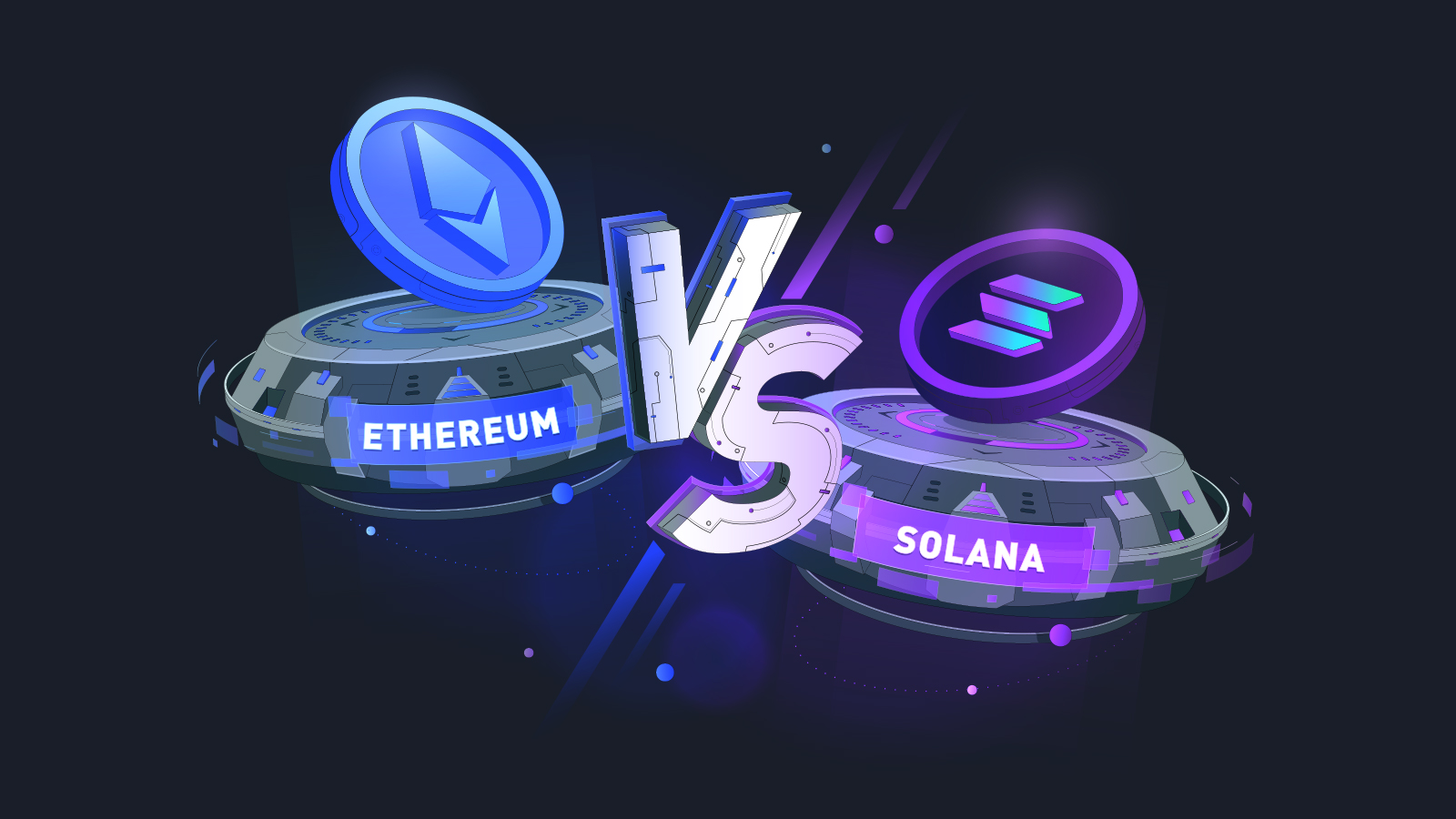
Both Solana and Ethereum are smart-contract platforms that let third-party developers build decentralized applications. Both use Proof of Stake consensus. Both have unlimited token supplies paired with fee-burn mechanisms. The differences lie in how they prioritize speed, cost, decentralization, and ecosystem depth.
| Feature | Solana | Ethereum |
|---|---|---|
| Transaction speed | Thousands of TPS | 15-30 TPS on base layer (L2s can rival Solana) |
| Transaction fees | Consistently below $0.01 | Generally above $0.10 |
| Block finality | Sub-second | Slower on base layer |
| Validator count | Thousands | Over 1 million |
| DeFi ecosystem | Growing, strong DEX volume | Larger TVL, deeper institutional roots |
| Developer base | 4th largest, 890+ active devs | Largest across all chains |
| Stability record | Past outages up to 17 hours | Stronger uptime track record |
| Popular use cases | Memecoins, consumer apps, payments | DeFi, institutional applications |
| Spot ETF availability | October 2025 launch | Available earlier |
| Volatility profile | High-beta, larger swings | Lower volatility relative to SOL |
Neither chain is objectively superior as an investment. Ethereum offers deeper decentralization, a longer stability track record, and the largest developer and liquidity ecosystem in crypto, the core of the argument over whether Ethereum is worth buying. Solana offers higher throughput, lower fees, and more room for growth, paired with higher volatility. SOL works more as a high-beta complement to an existing crypto allocation than as a replacement for ETH. Which one fits better depends on your thesis about where blockchain adoption is heading, how much volatility you can stomach, and your investment time horizon.
Can Solana reach $1,000?
A $1,000 SOL price would require a market cap many times its current level. Getting there would demand massive growth across the ecosystem: dramatically higher DeFi TVL, sustained and growing ETF inflows, expanding stablecoin and payment adoption, and a favorable macro environment where risk assets broadly appreciate.
In a strong bull scenario, targets closer to $500 become more plausible. That path would likely need several things to go right at once: ETF flows accelerating, Firedancer and Alpenglow improving confidence in network reliability, stablecoin and payment usage expanding beyond the current base, and DeFi TVL rising materially from current levels.
Bear-case scenarios are just as worth considering. If liquidity leaves altcoins in favor of Bitcoin or traditional assets, if ETF flows reverse, or if developer attention migrates to competing chains, SOL could stay well below its prior highs for an extended period. Historical recovery from deep drawdowns has taken 12 to 24 months in past cycles, but past performance doesn’t set a floor or a timeline for future recoveries.
The $1,000 figure makes for a compelling headline, but it shouldn’t drive portfolio sizing. The range of outcomes for any multi-year crypto forecast is genuinely wide, and building a position around a specific price target exposes you to the full downside if that target never arrives.
Who should and should not buy SOL
SOL makes sense for some investor profiles and is a poor fit for others. Where you land depends on your existing portfolio, your risk tolerance, and your willingness to actively manage the position.
SOL may fit if you are:
- A long-term crypto investor who already holds Bitcoin and Ethereum. SOL adds high-growth smart-contract exposure to a portfolio that already has a foundation in the two largest, most established crypto assets. It’s a satellite holding, not a core one.
- An active trader drawn to SOL’s liquidity and volatility. High daily volume and wide price swings create trading opportunities, but only if you use strict risk controls, defined position sizes, and predetermined exit points. Volatility without discipline is just loss acceleration.
- A staker or yield seeker willing to accept the trade-offs. Staking rewards help offset inflation, but they don’t remove price risk. If SOL drops 50% while you’re earning a 6% staking yield, you’re still deeply in the red. Liquid staking tokens add smart-contract risk and the possibility of depegging during market stress.
SOL is likely a poor fit if you:
- Need capital preservation. An asset that has historically drawn down 70 to 97% from peak to trough is incompatible with capital you can’t afford to lose.
- Can’t tolerate 40-70% drawdowns without panic selling. If a 50% drop would cause you to sell at the bottom, the position is too large or the asset is wrong for you.
- Already have heavy altcoin exposure. Adding SOL to a portfolio that’s already concentrated in smaller-cap crypto assets compounds your risk rather than diversifying it.
- Lack basic self-custody knowledge. Understanding how wallets, private keys, and transaction signing work is a prerequisite, not an optional extra. Strong technology does not guarantee strong investor returns, and losing access to your keys means losing your investment entirely.
- Are a beginner who hasn’t studied volatility and position sizing. SOL can be part of a beginner’s portfolio, but only after understanding what drawdowns look like in practice and sizing the position so a total loss wouldn’t be devastating.
How to evaluate SOL before buying
Buying SOL without a framework is gambling. These steps won’t eliminate risk, but they’ll help you make a decision you can defend to yourself six months later, regardless of which direction the price moves.
- Define your time horizon first. A minimum of five years gives you a reasonable chance of weathering at least one full drawdown-and-recovery cycle, based on SOL’s historical pattern. Shorter horizons expose you to the risk of buying before a multi-year decline.
- Size the position so a total loss is painful but survivable. SOL belongs as a small allocation within a broader portfolio. If losing the entire investment would change your financial situation in a material way, the position is too big.
- Decide on custody before you buy. Exchange custody is convenient but means you don’t control the private keys. Software wallets (like Phantom or Solflare) offer moderate security with more control. Hardware wallets provide the strongest long-term protection for holdings you don’t plan to trade frequently. If you’re new to self-custody, our guide on crypto wallet setup walks through the process. Make this decision before purchasing, not after.
- Set exit strategies for both directions. Determine upside profit-taking levels and a downside plan before entering. That might be a stop-loss at a specific percentage below your entry, or it might be a commitment to hold through a full cycle. Either approach works as long as it’s decided in advance and written down.
- Monitor on-chain health regularly. TVL trends, stablecoin supply changes, DEX volume, developer count, validator uptime, and ETF flow data all give you a clearer picture of whether the investment thesis is playing out. Checking quarterly is a reasonable cadence for long-term holders.
- Treat your plan as a safeguard. During a sharp drawdown, the impulse to sell everything or double down can override rational analysis. A pre-decided plan removes emotion from the decision at the moment when emotion is most dangerous.
Red flags that would weaken the SOL investment thesis
No single metric breaking trend automatically means you should sell. But several of these appearing together should prompt a serious review of your position size and timeline.
- A major outage or repeated performance failures. Solana’s 100% uptime over recent months is encouraging, but the network’s outage history means reliability is something it has to keep proving. Another multi-hour outage, or a pattern of shorter failures, would undermine the narrative that the network is production-ready for mainstream use.
- Sustained decline in DeFi TVL or stablecoin liquidity leaving the chain. TVL can fluctuate with token prices, but a persistent outflow of capital from Solana’s DeFi protocols, especially stablecoins, signals that users and capital are moving to competing chains.
- Falling developer activity. If the monthly active developer count drops significantly from its current level, the pipeline of future consumer apps dries up. Fewer apps being built today means fewer reasons to use Solana two to three years from now.
- ETF outflows or weak institutional demand. The bull case partly rests on institutional capital entering through ETFs. If flows reverse or AUM shrinks faster than the underlying asset’s price decline would explain, institutional conviction is weakening.
- Worsening validator concentration. If the number of validators drops or the share controlled by a small group grows, decentralization concerns become harder to dismiss. Watch for changes in the Nakamoto coefficient and geographic distribution of validators.
- App revenue declining while market cap stays elevated. This is valuation risk in its purest form. If the network is generating less economic activity but the market is still pricing SOL as though aggressive growth is coming, the gap between expectation and reality can close painfully.
- Meaningful market-share loss to Ethereum L2s or competing L1 chains. If Solana’s share of DEX volume, developer attention, or new app launches shrinks relative to competitors, the growth assumptions embedded in SOL’s price become harder to justify.
Frequently asked questions
Is Solana a good long-term investment?
The long-term case rests on the trends outlined above: real network usage, a growing developer base, and expanding institutional access through spot ETFs. It’s not a safe investment, though. Holding SOL profitably over the long term requires a multi-year horizon (five years minimum to weather historical drawdown cycles), proper position sizing, and genuine tolerance for drawdowns that have historically reached 70 to 97%. The thesis is real, but so are the risks.
Is it worth buying SOL after a 70%+ plunge?
A large price decline doesn’t automatically create a buying opportunity. Whether SOL recovers depends on whether on-chain metrics like TVL, stablecoin supply, and developer count stabilize or keep declining, and whether broader macro conditions shift back toward risk-on. Past recoveries from deep drawdowns have taken 12 to 24 months, but past cycles don’t guarantee future ones. Check the fundamentals before assuming a low price means a bargain.
What drives SOL’s price?
Three forces interact: network usage (transaction volume, DeFi activity, stablecoin settlement), macro liquidity conditions (interest rates, risk appetite, capital flows into crypto broadly), and market sentiment (narratives, ETF flows, social momentum). Over short periods, sentiment dominates. Over longer periods, organic demand from transaction fees and staking becomes the more reliable driver.
How does Solana’s inflation affect long-term holders?
SOL’s inflation rate started at 8% annually and declines by 15% each year toward a 1.5% floor. Stakers earn rewards that largely offset this dilution, keeping their share of the network roughly constant. Non-stakers lose purchasing power over time as new tokens enter circulation. The fee-burn mechanism partially counteracts new issuance, but whether it’s enough to make SOL net-deflationary depends on how heavily the network gets used.
Where can investors track Solana’s on-chain metrics?
Several free dashboards cover the key data. Solscan provides transaction-level details. DeFiLlama provides TVL breakdowns and DeFi activity across chains. Dune Analytics lets you build custom dashboards covering DEX volume and protocol-specific metrics. Solana Beach displays validator performance and network health. Token Unlocks shows upcoming vesting dates and amounts for SOL allocations. Together, these tools let you verify any claim about Solana’s network health independently.
Weighing the data before committing capital
SOL presents a credible investment thesis, but credible and safe aren’t the same thing. The network works as designed. The ecosystem has grown through a full bear market. Regulated spot ETFs now give institutions a path into SOL that did not exist a year ago. On-chain metrics show real usage, not just speculation.
At the same time, this is an asset that fell 97% from peak, lost a major backer in FTX, and rebuilt from near-irrelevance. That recovery speaks to the network’s resilience, but it also shows just how severe the downside risk can be. The 70 to 74% decline from the January 2025 peak is a reminder that deep drawdowns aren’t ancient history.
Matching the investment to the investor matters more than any price prediction. Before committing capital, it’s worth considering the broader question of crypto as an investment for your situation at all. Your time horizon, your ability to sit through a 50%+ decline without selling, the size of the position relative to your total portfolio, and whether you’ve set up proper custody all outweigh any forecast about where SOL trades next year. AXL Research Hub’s view is straightforward: the data supports a case for SOL as a small, monitored allocation within a diversified portfolio, but only for investors who’ve done the work to understand what they’re holding and why.
Ongoing monitoring is what turns a buy decision into an investment process. Track the on-chain metrics, watch how rival chains are evolving, and pay attention to regulatory developments. If the fundamentals hold, the thesis holds. If the red flags start stacking up, adjust accordingly. The goal isn’t to predict the future. It’s to make a decision you can manage through whatever the future brings.